


What Are No-Go Zones?
No-go zones in European cities are urban areas with large numbers of immigrants, high levels of unemployment and poverty, chronic welfare dependence, elevated rates of crime, severe social deprivation, and where state authority has broken down. They are ethnic enclaves with high concentrations of Muslims who have become self-segregated from their host country.
No-go zones often are areas of temporal hopelessness and thus breeding grounds for transcendent ideologies, especially radical Islam. Many no-go zones are directly or indirectly controlled by Islamists and Muslim proselytizers who actively seek out young, disaffected youth with the aim of drawing them into networks of Islamic radicalism. As their numbers increase, they impose Islamic norms of dress or behavior in public spaces. Over time, the result is double-segregation: immigrants separate themselves from native Europeans, and natives stay clear of no-go zones to avoid social interaction with these types of immigrants.
In some European countries (Belgium, Germany, and the United Kingdom, among others) no-go zones are primarily located within inner cities, whereas in France they are found mostly in large-scale housing complexes on the outer fringes of the suburban periphery.
The borders of these areas are often informal and unacknowledged, and yet their frontiers are generally known and understood. Not all no-go zones in Europe are entirely off-limits to non-Muslim outsiders, particularly during daylight, but many are lawless and menacing for native Europeans, including police, firefighters, and other state representatives. Jews, women, or people who are openly homosexual are subject to physical danger in these areas at any time of the day. Some media groups trying to “debunk the myth” of no-go zones film these parts with large production crews during the day, but presumably most journalists would not venture into these areas alone at night.
A Taboo Topic
The debate over no-go zones in European cities has been raging for nearly half a century. It is acrimonious and highly politicized. Governmental authorities routinely deny that such areas exist, but confidential police reports, testimonies from security personnel, empirical research, and anecdotal evidence all confirm that parts of major European cities have become pockets of lawlessness where Islamists and criminal migrants have effectively usurped control of the streets from state authorities. Proponents of multiculturalism and mass migration regularly brand those who attempt to raise awareness about these areas as bigots, xenophobes, and “Islamophobes.”
In Britain, for instance, the then-Bishop of Rochester, Michael Nazir-Ali, warned about no-go zones, areas across the country that are dangerous for non-Muslims to enter. “There has been a worldwide resurgence of the ideology of Islamic extremism,” he wrote in The Sunday Telegraph.¹ One of the results of this, he argued, was “to turn already separate communities into ‘no-go’ areas where adherence to this ideology has become a mark of acceptability.”² Nazir-Ali, who was born in Pakistan, affirmed that attempts had been made to “impose an ‘Islamic’ character on certain areas” by, for example, amplifying the Muslim call to prayer.³ Nazir-Ali’s remarks provoked outrage and denial; critics accused him of “talking nonsense,” and “scaremongering”⁴ In a subsequent interview with The Telegraph, Nazir-Ali said that a “spiritual and moral vacuum” in Britain was being filled by radical Islam.⁵ He received death threats and was forced to accept police protection for himself and his family.⁶
This widespread tactic of equating use of the term “no-go zone” with racism, sensationalism, and rightwing populism has for many years effectively shut down serious discussion of this problem, one that is directly associated with the spread of Islam in Europe. Governments are notoriously reluctant to counter Islamic communalism because of the fear of being accused of stigmatizing Muslims.
Parallel Islamic Societies Are Real
From time to time, however, outbreaks of urban violence have cast light on the reality that millions of Muslims live in parallel Islamic societies that exist within their European host countries but operate separately from them.
The first major riots in European no-go zones occurred in September 1979, in the Grappiniere district of Vaulx-en-Velin, a poor suburb (banlieue) of Lyon, France, after police tried to arrest a teenager of North African descent for stealing a car.⁷ The suspect slashed his wrists to make it look like police used disproportionate force against him.⁸ The ensuing riots forced police to retreat.⁹ After that, riots in French suburbs became increasingly commonplace. During the “hot summer” of 1981, riots in the three “Vs” of eastern Lyon (Vaulx-en-Velin, Venissieux, and Villeurbanne) forced the nexus of immigration and urban unrest onto the political agenda.¹⁰ In 1990 and 1993, uprisings broke out again in the same areas.¹¹ The riots raised awareness of the link between migrant youths and urban rebellions, the so-called “malaise in the suburbs.”¹²
Some of the worst unrest in France occurred in October and November 2005, after two teenagers of North African origin were electrocuted when they hid in an electricity substation in the Paris suburb of Clichy-sous-Bois while hiding from police. Their deaths resulted in three weeks of riots in the suburbs of Paris and other French cities and led to a three-month state of emergency.¹³ Those riots affected 274 towns and cities across France and caused hundreds of millions of euros in property damage. According to French Islamism expert Gilles Kepel, the riots in 2005 marked “a pivotal year, the year of a major shift in French Islamism,” the year “a new generation of Muslims, the third generation, came to the forefront.”¹⁴
In June 2023, riots erupted across France after a 17-year-old was shot to death by police in Nanterre, a suburb of Paris, when he tried to run them over at a traffic stop. Around 40,000 police officers were deployed nationwide to contain the rioting,¹⁵ which caused more than one billion euros in damages.¹⁶ The urban riots showcased the decades-long failure of the French state to adequately integrate millions of immigrants, particularly those with origins in Africa and the Middle East.
The Etymology of No-Go Zones
The origin of the term “no-go zone” is disputed. Often it is attributed to Daniel Pipes, founder of the Middle East Forum, a think tank based in Philadelphia. In November 2006, he wrote about “The 751 No-Go Zones of France,” places in France that “the French state does not fully control.”¹⁷ The term, however, originated with The Washington Post in September 1979. It described an area in Washington, DC, that was cordoned off by police as a “secure no-go zone.”¹⁸
Its first use in the European context was in April 2002, when David Ignatius, writing in the International Herald Tribune, commented about France: “Arab gangs regularly vandalize synagogues here, the North African suburbs have become no-go zones at night, and the French continue to shrug their shoulders.”¹⁹ In September 2004, Senator John Kerry said there were “no-go zones in Iraq.”²⁰ In December 2008, The Economist magazine wrote about Europe’s need to “stop urban ‘no-go’ areas, places that are so much dominated by a single faith that they are virtually off-limits to people of other backgrounds, from developing.”²¹
The term no-go zones became widely used among the general public after January 2015, when two French-born Algerian Muslim brothers attacked the officers of Charlie Hebdo, a satirical weekly magazine, and murdered 12 people and injured 11 others.²² The jihadists were upset about the magazine’s depictions of Islamic prophet, Muhammad.²³ The killings drew public attention to the fact that many French Muslims view satirical drawings of Islam as blasphemy punishable by death, even though sacrilege is not illegal in France, which operates under the principle of secularism (laicite). The attack highlighted France’s struggle with radical Islam and “the apparent desire of some younger, often disaffected children or grandchildren of immigrant families not to conform to western, liberal lifestyles, including traditions of religious tolerance and free speech.”²⁴
In February 2018, German Chancellor Angela Merkel admitted there are “no-go” areas in the country. In an interview with the German broadcaster NTV, she said: “There shouldn’t be any no-go areas…there shouldn’t be any spaces where no one dares to go. But such spaces do exist. We have to call them what they are and do something about them.”²⁵
In general, the term no-go zone is rarely used in academic literature or official discourse because it is viewed as ideologically charged and politically taboo. Instead, such areas are usually referred to euphemistically as “ghettos,” “ethnic enclaves,” “parallel societies,” “dangerous neighborhoods” “disadvantaged neighborhoods,” “marginalized neighborhoods,” “vulnerable areas,” “marginalized urban areas,” or “high-risk zones.”
How Many Are There?
Europe is home to at least 1,000 no-go zones, according to government statistics. In France, for example, the government currently describes no-go zones as “Priority Neighborhoods” (quartiers prioritaires de la politique de la ville, QPV). At least 1,362 neighborhoods in France are categorized as QPVs, according to the National Institute of Statistics and Economic Studies (INSEE).²⁶ Between 1996 and 2014, no-go zones in France were called “Urban Sensitive Zones” (Zones Urbaines Sensibles, ZUS). At the time, there were a total of 751 ZUS, a comprehensive list of which can still be found, complete with satellite maps and precise street demarcations, on a French government website.²⁷
In August 2012, after Muslim youth rioted in Amiens, a city in northern France, and left more than a dozen police officers wounded,²⁸ the French government designated 15 ZUS as Priority Security Zones (zones de securite prioritaires, ZSP).²⁹ By December 2013, that number had grown to 80.³⁰
In January 2020, a French intelligence document classified as “top secret” which was leaked to the media revealed that 150 neighborhoods or “micro-territories” in France are “controlled” by Islamists.³¹ The document, issued by France’s top domestic intelligence agency, the General Directorate for Internal Security (Direction generale de la securite interieure, DGSI), warned that “micro-territories [within France] are becoming Salafized in unlikely areas.”³²
In Germany, police refer to no-go zones as “Dangerous Areas” (Gefahrenzone) or “Dangerous Neighborhoods” (gefahrliche Orte).³³ They are also called “Problem Areas” (Problemviertel), “Hotspots” (Brennpunkte), or “Lawless Areas (rechtsfreien Raumen).³⁴ German media have identified more than 40 “problem areas” (Problemviertel) in the country.³⁵ These are districts where large concentrations of migrants, high levels of unemployment and chronic welfare dependency, combined with urban decay, have become incubators for Islamization.
In Sweden, police designate 65 neighborhoods as “Vulnerable Areas” (utsatt omrade) or “Particularly Vulnerable Areas” (sarskilt utsatta omraden).³⁶
Where Are They?
A Europe-wide study of no-go zones by the Brussels-based think tank New Direction shows that most no-go zones are located in France, but they also exist in Belgium, Germany, Italy, Spain, Sweden, the Netherlands, and elsewhere.³⁷ The report focuses on only seventeen of these areas based on recurring mentions in official reports, media, and academic sources, and on eleven selected criteria categorized by crime and violence, parallel societies, and state withdrawal. These include:³⁸
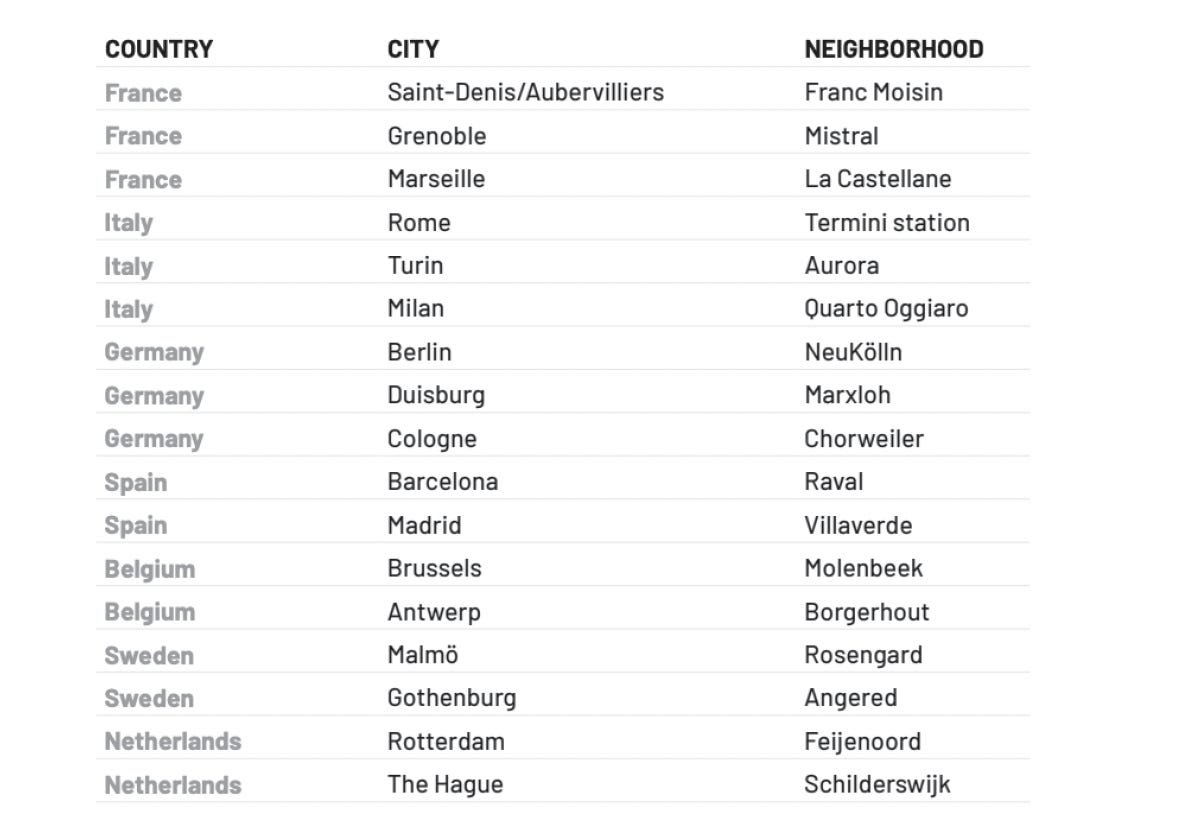
In Belgium, for instance, the Molenbeek neighborhood, one of the poorest districts in the country, has been described as the “jihad capital of Europe,”³⁹ a “police no-go zone,”⁴⁰ and a “magnet for jihadists, gangs, drugs and lawlessness.”⁴¹ The British newspaper The Independent described Molenbeek this way: “As well as being home to many ethnic Moroccans and Turks, Molenbeek is also one of the country’s poorest areas. It has a 30 per cent unemployment rate, and one in four of its 95,000 inhabitants does not have a Belgian passport. Like gang violence, Islamic radicalism has fed on Molenbeek’s marginalisation, despair and festering resentment of authority. Police say the most dangerous among around 30 Brussels gangs come from Molenbeek.”⁴²
Molenbeek has been connected to almost all of Belgium’s terrorism-related incidents in recent years⁴³ and is known as “the Belgian hub of Islamist terrorism.”⁴⁴ The neighborhood “encapsulates all the historical, social, and spatial elements that fuel a suicidal messianism.”⁴⁵
Brice De Ruyver, a security adviser to former Prime Minister Guy Verhofstadt, said Molenbeek suffers from a cocktail of problems. “Youths are poorly educated, attracted by petty crime, have run-ins with police, and then there is a vicious circle, which leads to recruitment by radical groups,” he said. “We don’t officially have no-go zones in Brussels, but in reality, there are, and they are in Molenbeek.”⁴⁶
In France, many no-go zones in Paris are located within the so-called Red Belt (Ceinture Rouge), working-class suburban areas that historically have been dominated by the French Communist Party, which frequently reaches accommodations with Islamists in exchange for votes.⁴⁷ In some cases, municipal authorities have indulged Islamists by disguising mosques or prayer rooms as “community centers” to circumvent France’s 1905 law on secularism. They have also permitted school cafeterias to serve faith-based ‘halal’ meals and made concessions for female-only time slots at municipal swimming pools. In exchange, they have struck tacit agreements with Islamists to secure a reliable voting base.⁴⁸
Saint-Denis, a notorious Muslim enclave northeast of Paris, has been described as “a parallel state, a state within a state, with its own rules and religious courts, where allegiance to Islam comes ahead of fealty to France.”⁴⁹
In Germany, in an expose titled “Ghetto Report Germany,” Bild, the highest-circulation newspaper in the country, described these areas as “burgeoning ghettos, parallel societies, and no-go areas.”⁵⁰ It described parts of major cities as pockets of lawlessness where criminal migrants have usurped control of the streets from German police. The problems are being exacerbated by the German government, which has relocated hundreds of thousands of asylum seekers and refugees into these areas. Osnabruck Police Commissioner Bernhard Witthaut noted: “We know that these areas exist. Even worse: in these areas, crimes no longer result in charges. The power of the state is completely out of the picture.”⁵¹
Multicultural Illusions
In the aftermath of the Second World War, the deadliest military conflict in human history, European policymakers decided that nationalism was responsible for the carnage. They surmised that social engineering could dilute what it means to be French or German and thus diminish the chances of war in the future. This dubious assumption led to five decades of policies promoting multiculturalism through mass migration to Europe from mostly Muslim countries. The ethnic composition of the continent was permanently changed.
These irreversible policies have eroded the social fabric of France, Germany, and many other European nation states by introducing parallel societies in which ethnic or religious minorities separate themselves from mainstream society and remain segregated rather than become culturally integrated into their European host nations.
In France and Germany, mass migration from the Muslim world has fast-tracked the rise of Islam, as evidenced by the proliferation of sharia courts, polygamy, child marriages, and honor violence. Mass migration has also fueled social chaos, including jihadist terrorism, and rising levels of crime, including mass sexual violence against European women, and runaway antisemitism. The result is a vicious cycle in which many immigrants reject their host countries, and the host societies reject the immigrants, leading to permanent estrangement.
Migration Dynamics
To better understand the nexus between no-go zones and the Islamization of Europe, it helps to distinguish between at least two different categories of non-Western immigrants. On the one hand, there are the recent newcomers, sometimes loosely referred to as first generation immigrants. During the past two decades, millions of mostly Muslim migrants from Africa, Asia, and the Middle East have reached European shores. The migration flows accelerated in 2015, when German Chancellor Angela Merkel opened the immigration floodgates and allowed more than 1.5 million refugees and asylum seekers from Syria and elsewhere into countries of the European Union.⁵²
On the other hand, there are the second- and third-generation immigrants who are European-born children and grandchildren of the so-called “guest workers” who arrived in Europe after the Second World War when countries such as France and Germany faced acute labor shortages. The assumption was that the guest workers would eventually return to their countries of origin. Instead, in what is sometimes referred to as the myth of return,⁵³ they stayed in Europe, became permanent residents, and set into motion an endless cycle of chain migration.
In France and Germany, non-Western guest workers hailed mainly from Turkey and from former French colonies in Africa. Many such immigrants lived on the margins of the host society and never properly integrated. In France, millions settled into so-called banlieues, working-class suburbs on the outskirts of large cities. Over time, the banlieues turned into blighted slums with high rates of unemployment and runaway lawlessness. For the original guest workers, moving to the banlieues was a step up the economic and social ladder in comparison to the conditions they left behind in their homelands. For their children and grandchildren, however, living there, where youth unemployment commonly is above 50%, is generally a ticket to permanent despair.
The second- and third-generation migrants who grow up in the banlieues often are effectively stateless citizens. Although they legally are French citizens by virtue of birth, they frequently are regarded as second-class citizens by French society. Many have never left France and do not identify with the culture of their parents or grandparents. They constitute a permanent underclass that numbers in the millions and abhors France and all symbols of the French state.
No-Go Zone Dynamics
Academic research shows a direct correlation between 1) no-go zones and mass migration from the Muslim world, 2) mass migration and Islamization, and 3) Islamization and organized crime. According to the Brussels-based think tank New Direction, mass migration “has concentrated populations with shared religious norms in urban clusters, facilitating the creation of communities that are religiously cohesive and socially distinct, precisely the environments most associated with no-go zone dynamics.”⁵⁴ The Paris-based Montaigne Institute, in a report about no-go zones in the suburbs of the French capital, concurred that some predominantly Muslim suburbs in Paris are turning into “separate Islamic societies.”⁵⁵
In France, failures of urban policy have contributed to increasing impoverishment in the suburbs. As the state retreated from these neighborhoods, Islamists moved in to fill the void. In some areas with spiraling crime and drug trafficking, municipal governments deliberately ceded control of certain neighborhoods to Islamists, most notably the Tabligh movement, to restore order.⁵⁶ By doing so, Islamists gained social legitimacy that they retain to this day.
In a groundbreaking report titled Banlieue de la Republique, Gilles Kepel, one of Europe’s leading experts on Islamism, described a process within no-go zones in which resentment of France by Muslim youths fuels Islamism: “This resentment is also directed at French society, which they view as racist and discriminatory during their job search; as one puts it: “It was always the color of my face that mattered more than my actual skills.” Feeling devalued, they have sought to rebuild a positive self-image through regular attendance at the mosque…. Islam enables them to construct a new identity, at the risk, at times, of a rupture with French society.”⁵⁷
The report noted that roughly half of all residents in these areas fall below the poverty line.⁵⁸ As a result, these neighborhoods act as “catalysts” for “heightened identity-based tension” and the high unemployment and economic insecurity “often serve as decisive factors driving deviant behaviors (delinquency, violence, drug trafficking), a retreat into an insular religious identity, or even the overt assertion of a social and cultural rupture with French society.”⁵⁹
Poverty, however, is not the main factor in what turns a neighborhood into a no-go zone. In Europe there are many areas with high levels of poverty, but they are not no-go zones. According to New Direction, “the variable correlating with no-go zone dynamics is not economic deprivation, but rather the concentration of foreign-born populations.”⁶⁰ The report stresses: “Poverty is neither a sufficient nor necessary condition for the development of such zones.”⁶¹
Belgian political analyst Paul Belien observed the link between Islamism and crime:⁶² “The ZUS are centers of drug trafficking…. Since they [traffickers] operate from within the ZUS the drug dealers are beyond the reach of the French authorities.
“The ZUS exist not only because Muslims wish to live in their own areas according to their own culture and their own Shariah laws, but also because organized crime wants to operate without the judicial and fiscal interference of the French state. In France, Shariah law and mafia rule have become almost identical.”
To address the drug problem and the concomitant rise in violence in no-go zones, the French government spawned the “cultural re-Islamization” movement of the 1990s by encouraging missionaries from Tabligh (the largest pietist movement in Islam) to restore a sense of community. Their fight against drugs provided Islam with a “social, spiritual, and redemptive legitimacy.”⁶³
Islamic Dynamics
The failure of European governments to integrate migrants from the Muslim world has been a boon for Islamists, whose objective is to replace Europe’s liberal democratic order with Islamic law. The purveyors of radical Islam, who oppose Western concepts of freedom of speech and gender equality, scout deprived neighborhoods in Europe in search of socially marginalized youths who feel disillusioned with their lives and for whom Islam fills a spiritual void.
French Islam scholar Bernard Rougier has identified “four forces” that dominate the “Islamist ecosystems” in Europe: The Muslim Brotherhood, Tabligh, Salafists, and jihadists.⁶⁴ The first group is “interested in conquering the institutional political space.” The Tabligh movement is “missionary” in nature, while the Salafists “develop incredible symbolic violence” against European society. “Salafist Islam embraces a break with the values of European societies due to a strict and literal observance of sacred texts,” while the jihadists are directly linked to the “Islamist socialization circles” of the entire Islamic movement.⁶⁵
Islamism in Europe has had a decades-long incubation period, beginning with the civil war in Algeria, a former French colony, during the 1990s. It spiked in the aftermath of the jihadist attacks in the United States on September 11, 2001, the Danish Cartoon Controversy in 2005,⁶⁶ the Arab Spring between 2010 and 2012, and the declaration of a global caliphate by the Islamic State in 2014. During those years, thousands of European Muslims traveled to war zones in Syria, Iraq, Afghanistan, Pakistan, and Yemen to undergo training in jihad. The return of these battle-hardened individuals to their home neighborhoods in Europe led to an increase in radical preaching, especially by Salafists,⁶⁷ but also by the Muslim Brotherhood and Tabligh proselytizers, often with funding from abroad, including Qatar, Saudi Arabia and Turkey.
Germany’s domestic intelligence agency, the Federal Office for the Protection of the Constitution (Bundesamt fur Verfassungsschutz, BfV), reports that Germany is home to nearly 30,000 Islamists, around 9,500 of whom pose an immediate threat of attack.⁶⁸ The largest Islamist movement in Germany is Salafism, an anti-secular ideology that seeks to establish a global Islamic theocracy based on Sharia law and is civilizationally incompatible with Western society.⁶⁹
Islamism in Europe is currently being propagated through two main conduits: mosques and social networks on the internet. French Islam expert Gilles Kepel notes that the mosque “serves as the interface” within the Muslim community.⁷⁰ He writes that the first organizational structures for local Islam emerged in the 1980s. This occurred primarily within premises situated on the ground floors of dilapidated large-scale housing complexes in no-go zones. “The management of these spaces is overseen by religious associations; both their attendance and their doctrinal orientation are heavily influenced by the national origin of the association’s founder or president.”⁷¹ Bernard Rougier adds: “On the one hand, there is a legitimate demand for the construction of mosques and the recognition of Islam as a religion, and on the other, the appropriation of this demand by Islamists through networks that have transformed the ‘urban ghettos’ of major French cities into militant enclaves.”⁷² Meanwhile, Muslim youths search the internet for Islamic “authority figures,” including those who have gained first-hand experience in jihad in Islamic warzones in Africa, Asia, and the Middle East.
Vectors of Islamization
Islamists in European no-go zones use three interrelated tactics to spread their ideology: sharia, halal, and headscarves.
A. Sharia
The most common method to spread Islamism in Europe is through efforts to normalize and enforce Islamic law. Sharia is an all-encompassing framework of Islamic law and ethical principles derived from the Qur’an and Sunnah. It covers every aspect of life, personal conduct, diet, hygiene, clothing ethics, family, finance, contracts, inheritance, governance, criminal justice, conflict, and more, to guide Muslims in their relationship with Allah and society. In Western countries, civil law takes precedence over sharia, but in urban areas with large Muslim populations, sharia is frequently used to adjudicate disputes, often to the disadvantage of women, even though they have equal rights under Western law. Sharia is also leveraged to reject key liberal values, including feminism, homosexual rights, secular education, and legal pluralism. Over time sharia undermines trust in state institutions and promotes active separation from non-Muslim society. Sharia is advanced through several means, including, but not limited to, sharia courts, mosques and Islamic centers, Islamic schools, and Muslim political participation.
Britain, for example, is home to at least 85 sharia courts, unofficial tribunals and councils that apply Islamic law to resolve domestic, marital, and business disputes.⁷³ Although these tribunals have no binding power under British law, they often operate as parallel legal systems that are establishing legal precedents, especially for couples that have a religious but not civil marriage.⁷⁴ These courts also discriminate against women in terms of divorce proceedings, child custody and inheritance, and domestic abuse.⁷⁵ A BBC documentary exposed the systematic discrimination many women suffer at the hands of Muslim jurists.⁷⁶ The undercover investigation found that sharia courts, which operate in mosques and houses in heavily Islamized areas across Britain, routinely issue rulings on domestic and marital issues according to Islamic law that are at odds with British law.⁷⁷ Those subject to the rulings often feel obliged to obey them as a matter of religious belief, or because of pressure from family and community members to do so.⁷⁸
Sharia is also aggressively spread by Islamic political groups. In July 2011, for example, a British Muslim group in Britain launched a campaign to turn twelve British cities, including what it called “Londonistan”, into independent Islamic states.⁷⁹ The so-called Islamic Emirates Project aimed to turn Birmingham, Bradford, Derby, Dewsbury, Leeds, Leicester, Liverpool, Luton, Manchester, Sheffield, as well as Waltham Forest in northeast London and Tower Hamlets in East London into autonomous enclaves ruled by sharia and operate them outside of British jurisprudence.⁸⁰ Muslim patrol gangs have also enforced sharia in parts of London by “informing” people that they are in a “Muslim area” and are required to comply with Islamic law.⁸¹
In Belgium, a Salafist group called Sharia4Belgium operated in the country for many years as a legitimate Muslim organization.⁸² The aim was to transform Belgium into an Islamic state and implement sharia throughout the country. It promoted a political vision of the supremacy of Islam by rejecting both democracy and the separation of church and state. In September 2011, Sharia4Belgium established, in Antwerp, Belgium’s first sharia court.⁸³ Leaders of the group said the purpose of the court was to create a parallel Islamic legal system in Belgium to challenge the state’s authority as the enforcer of the civil law protections guaranteed by the Belgian constitution.⁸⁴ The group was formally disbanded after the arrest of its leader, the Belgian-Moroccan Fouad Belkacem, for hate crimes.⁸⁵
Since then, representatives from the ISLAM party (Integrity, Solidarity, Liberty, Authenticity, Morality) have won seats in municipal elections in Anderlecht and Molenbeek. The party openly asserts its aim to turn Belgium into an Islamic state and establish sharia there.⁸⁶ Meanwhile, at least five municipalities within the Belgian capital Brussels are currently believed to be under the control of the Muslim Brotherhood.⁸⁷
George Dallemagne, a Belgian Member of Parliament, has warned against growing Islamic separatism in the country:⁸⁸ “Salafism and Wahhabism are visions of Islam that antagonize society, pose a clear and serious threat to social cohesion, and can serve to justify violent acts. It is an intolerant form of Islam, incompatible with Belgium’s norms and values.”
In Germany, Muslim radicals began enforcing sharia law on the streets of Wuppertal, a city in North Rhine-Westphalia, the state with the largest Muslim population in Germany.⁸⁹ In what government officials said was a blatant challenge to the rule of law and the democratic order in Germany, groups of young bearded Islamists, some wearing orange traffic safety vests emblazoned with the words “Sharia Police”, declared parts of downtown Wuppertal to be a “Sharia Controlled Zone.”⁹⁰ The self-appointed morality police distributed yellow leaflets that explained the Islamist code of conduct in the city’s sharia zones. They urged both Muslim and non-Muslim passersby to listen to Salafist sermons and to refrain from alcohol, cigarettes, drugs, gambling, listening to music, pornography, or prostitution.
German politicians roundly denounced the Sharia Police. “The state alone, and not the self-proclaimed Sharia police, is responsible for the enforcement of laws,” Germany’s then-Justice Minister Heiko Maas, said. “This much is sure: We will not tolerate an illegal parallel justice system.”⁹¹ A senior politician with the ruling Christian Democratic Union (CDU), Volker Kauder, added: “We cannot tolerate under any circumstances that self-appointed Sharia police are patrolling our streets and want to dictate to people what they can and cannot do. In Germany, German law is determinative, not Sharia law.”⁹² The men were eventually convicted for violating a Weimar Republic-era law that bans the wearing of uniforms that express political ideology.⁹³ In July 2020, Germany’s Federal Court of Justice (Bundesgerichtshof) upheld the convictions.⁹⁴
Islamists are now attempting to enforce sharia beyond the boundaries of no-go zones, including at public schools. In January 2024, for example, Muslim students at a public school in Neuss attempted to enforce Islamic rules, including gender segregation in classrooms and swimming lessons, and archaic punishments such as stoning.⁹⁵ The upper-level students, referred to as Sharia Police, attempted to force female students to wear headscarves and demanded that school be dismissed early for Friday afternoon prayers. The group also demanded a dedicated prayer room at the school. The case is part of a growing trend of Islamic radicalization in German schools. According to Klaus Kother, deputy chairman of the Association for Education and Training (VBE) in North Rhine-Westphalia: “We are currently seeing a clear trend among Muslim students to behave more religiously, including in terms of observing religious rituals and interpreting the Qur’an. Children from more moderate and liberal Muslim families are suddenly becoming more conservative. Students put each other under pressure regarding headscarves and fasting rules. Ultimately, it’s also about the question: Who is the better Muslim?”⁹⁶
North Rhine-Westphalia’s Interior Minister, Herbert Reul, warned: “Unfortunately, we are seeing these days that parts of our society are yearning for an Islamist theocracy.”⁹⁷
Ubiquity of Halal
As Muslim populations grow so do their communitarian demands, beginning with the issue of halal food.⁹⁸ In France, for instance, the growth in the Muslim population and the concomitant marginalization of Muslims in French society has fostered an “intensification” of religious practices.⁹⁹ This manifests itself in increased mosque attendance, the systematic observance of Ramadan, and a broad interpretation of halal, which establishes a “moral boundary” between what is forbidden and what is permitted.
French Islam expert Hakim El Karoui noted:¹⁰⁰ “It is as if a small ideological continent were taking shape before our very eyes, complete with its own system of thought, beliefs, economy, social codes, and organizing principle: ‘halal’. This is far more than merely a method of ritually slaughtering an animal; it is, in fact, a way of life. ‘Halal’ goes hand in hand with ‘haram’; within this ‘halal-haram’ dichotomy, anything can be deemed impure, and, consequently, purified. To avoid contamination, one must therefore be wary of ‘haram’. And what holds true for the process of producing meat for consumption extends to life in general: the scope of ‘halal’ today reaches far beyond food, offering the possibility of a ‘halal life.’ Halal consumption, widespread among Muslims, but also among many non-believers of Muslim origin, is increasingly viewed as a symbol of identity and ethics….
“Today, ‘halal’ extends far beyond the mere question of food. Under the influence of Salafism, which seeks to distinguish itself in every respect from the realm of the impure, it is the entirety of daily life that may be ‘halalized’ and subjected to progressive codification: religious norms are applied to diet, clothing, and all social practices, with the aim of establishing a clean break from the rest of the world. The result is the formation of a narrow, insular community, a counter-society.”
French Islam expert Gilles Kepel describes this phenomenon as “the extension of the domain of halal” in which Islamists seek to impose a binary logic: “nothing is neutral; everything is either permitted or forbidden, and whatever is not permitted is forbidden.”¹⁰¹ Kepel has written about the “ubiquity of halal” inside no-go zones and the “explosion of this form of identity assertion.”¹⁰² According to Kepel: “halal establishes a set of rather complex markers to delineate the licit from the illicit. Its boundaries lay claim to an absolute standard, and to sacrosanct prohibitions.
“Within the urban agglomeration, these boundaries are inextricably linked to the dynamics of social enclosure, social control, and the daily moral order that stems from them.”¹⁰³
Kepel notes that the concept of halal extends into school cafeterias: “The first generations of immigrants enrolled their children in these cafeterias, simply asking them not to eat pork. Some of their children, now parents themselves, prefer to avoid the cafeterias for their own offspring because they do not offer halal options. A worrying factor contributing to this alienation: “Learning to eat together at the school table is one of the ways to learn about future conviviality at the table of the Republic.”¹⁰⁴
Florence Bergeaud-Blackler, an expert on Islamist movements in Europe, has described the current young generation of Muslims, those who came of age during the 2000s, as the “halal generation.”¹⁰⁵ She believes that the rise in halal consumption reflects “a retreat into community and a resistance to integration on the part of second- and third-generation immigrants.”¹⁰⁶
Headscarves
One of the most heated debates regarding the spread of Islamism and the associated cultural distancing by Muslims revolves around the wearing of the hijab, a traditional head covering by Muslim women to signify religious identity. The Qur’an does not formally mention female head-coverings, nor does it prescribe a dress code for women. The headscarf debate has spread to every country in Western Europe.
In France, the Muslim headscarf movement began in October 1989, when three Moroccan students refused to remove their headscarves at a middle school in Creil, a city in northern France.¹⁰⁷ After the girls were expelled from school for violating the French policy of laicite (secularism), a nationwide debate ensued about religious expression in schools. The event, which thrust Islam and its practice into the public square, led to a French law banning “ostentatious” religious symbols in public.
Elham Manea, a Swiss-Yemeni human rights advocate, says that the headscarf is most visible and effective means that Islamists use to control women, and that control “is one of Islamism’s main strategies in its pursuit of global dominance. With it, Islamists mark their territory.”¹⁰⁸ She adds: “A large proportion of women and girls are forced to veil themselves by their clan or family. Some are threatened with hell if they refuse to wear the headscarf. Many of these girls suffer in silence as a result. There is also considerable peer pressure in schools. Young women are led to believe that they won’t find a husband if they don’t wear a headscarf or that they will be considered dishonorable.”
Darya Safai, an Iranian-born Belgian MP, warns against trivializing the Islamic veil: “It’s not really a sign of conviction; it’s a sign of oppression against women. We mustn’t conflate things. If a woman wears a headscarf, we can’t really say it’s her choice, because at a certain point, education teaches that a ‘proper’ woman must cover herself. It’s not something we should trivialize, and certainly not in positions of authority.”¹⁰⁹
Demographics: Europe’s Islamic Future
Europe’s immigration and integration problems are symptoms of a far more serious underlying root cause: demographic collapse. In 2024, every single one of the EU’s 27 member states had sub-replacement fertility rates.¹¹⁰ Replacement level fertility refers to the average number of children born per woman at which a population replaces itself from one generation to the next, without immigration. In developed countries, the replacement fertility rate is around 2.1 births per female. In 2024, the EU’s average fertility rate was 1.34 births per woman, continuing a decades-long trend.¹¹¹ When the fertility rate falls below replacement level, the population simultaneously ages and declines, which results in lower numbers of workers available to sustain overburdened social welfare systems.
European policymakers appear to have concluded that rather than creating the economic conditions needed to promote increased fertility, it is easier to make up the labor shortfall through mass migration of largely unskilled single males. Germany, for instance, will need to take in 300,000 migrants annually for the next 40 years to stop population decline, according to a leaked government report.¹¹² The document revealed that the German state is counting on permanent mass migration, presumably from Africa, Asia, and the Middle East, to keep the current size of the German population (83 million) stable through 2060. The report implied that Chancellor Merkel’s decision to allow into the country some 1.5 million mostly Muslim migrants between 2015 and 2016 was not primarily a humanitarian gesture, but a calculated effort to stave off Germany’s demographic decline and preserve the future viability of the German welfare state. If most of the new migrants arriving in Germany for the next four decades are from the Islamic world, the Muslim population of Germany could jump to well over 20 million and account for roughly 20% of the overall German population by 2060, according to projections by the Pew Research Center.¹¹³
Mass migration to Europe from the Muslim world guarantees that the twin challenges of no-go zones and Islamization will continue. Estimates on the number of Muslims in Europe vary widely, but in 2026 the figure is conservatively somewhere between 50 million and 60 million.¹¹⁴ In addition to those legally residing on the continent, Europe is home to untold millions of illegal immigrants from Muslim countries in Africa, Asia, and the Middle East. The largest Muslim populations (in real numbers) in Western Europe are in France, Germany, and the United Kingdom, respectively. In terms of percentage of the overall population, the largest is France (9.1%), followed by Austria (8.3%), Sweden (8.1%), Belgium (6.8%), the Netherlands (5.5%), the United Kingdom (6.4%), Germany (6.5%), and Switzerland (6.1%), respectively.¹¹⁵ If current rates of migration continue, these numbers will swell within the next decade.
A report on radicalization in Germany revealed that nearly half of all Muslims under 40 years of age in the country are sympathetic to Islamism.¹¹⁶ The MOTRA Monitor 2024/25, an annual report funded by Germany’s Interior Ministry and coordinated by the Federal Criminal Police Office (Bundeskriminalamt), found that 33.6% of Muslims under 40 (ages 18–39) are latent (hidden or concealed) supporters of Islamism, while 11.5% are explicit Islamists.¹¹⁷ According to the study, which was released to the public on March 4, 45.1% Muslims in this age group are overt or covert Islamists.¹¹⁸ The report further showed that 23.8% of Muslims (all age groups) in Germany agree with the statement, “An Islamic theocracy is the best form of government.”¹¹⁹ Moreover, 25.1% of all Muslims in Germany agree, “The rules of the Qur’an are more important to me than the laws of Germany.”¹²⁰
In France, a research survey found that nearly half (46%) of Muslims in the country believe that Islamic law (sharia) should be applied in France.¹²¹ Young Muslims (ages 15–24) are particularly religious: 87% said they are devout.¹²² In 2025, one-third (32%) of young Muslims in France said they support the ideology of the Muslim Brotherhood, which seeks to Islamize Western civilization.¹²³ More than one-third (38%) of Muslims in France support Islamism, a proportion twice as high (19%) as those who supported Islamic fundamentalism thirty years ago (1998).¹²⁴ The report noted that this “over-religiosity” among Muslims as generations change “completely reverses the classic patterns of secularization.”¹²⁵ This strengthening of religiosity is “primarily part of a process of religions re-affiliation of a segment of Muslim youth to a traditionalist form of Islam.”¹²⁶
The report concludes: “What is most striking about these results is the consistency of the generational gradient: on almost every indicator (religiosity, religious practices, headscarves, rejection of gender mixing, rejection of science, primacy of religious law, adherence to Islamism), young Muslims consistently demonstrate greater rigor and radicalization than their elders. This trend suggests that, far from diminishing over time, the process of re-Islamization will, on the contrary, increase with each generational shift.”¹²⁷
Conclusion
Demographic trends indicate that the challenges posed by no-go zones and Islamization will continue to be a permanent feature in Europe unless current migration trends are reversed and governments reassert national sovereignty over areas now controlled by Islamists. Current political realities are that serious discussions of this issue are politically taboo and dismissed as “Islamophobia.”

Notes
Jonathan Wayne-Jones, “Bishop Warns of No-Go Zones for Non-Muslims,” The Telegraph, January 6, 2008, https://www.telegraph.co.uk/news/uknews/1574694/Bishop-warns-of-no-go-zones-for-non-Muslims.html.
Ibid.
Ibid.
Helen Pidd, “Bishop Under Fire for Attack on Muslim ‘No-Go Areas,’” The Guardian, January 7, 2008, https://www.theguardian.com/uk/2008/jan/07/religion.politics.
Jonathan Petre, “Bishop Michael Nazir-Ali Stands By His Views,” January 9, 2008, https://www.telegraph.co.uk/news/uknews/1575040/Bishop-Michael-Nazir-Ali-stands-by-his-views.html.
“No-Go’ Bishop Defends Comments,” February 24, 2008, BBC News, http://news.bbc.co.uk/2/hi/uk_news/7261237.stm.
Foued Nasri, “Les transformations urbaines au prisme de ‘ghetto’: le cas lyonnais au tournant des annees 1970-1980,” Mondes & Migrations, No. 1349, April-June 2025, 29-35, https://journals.openedition.org/mondesmigrations/627.
Nasri.
Foued Nasri, “Les transformations urbaines au prisme de ‘ghetto’: le cas lyonnais au tournant des annees 1970-1980,” Mondes & Migrations, No. 1349, April-June 2025, https://journals.openedition.org/mondesmigrations/627.
“L’ete des Minguettes 1981 «Les rodeos de la colere»,” Radio France, June 22, 2017, https://www.radiofrance.fr/franceinter/podcasts/affaires-sensibles/l-ete-des-minguettes-1981-les-rodeos-de-la-colere-7720633.
Olivier Pironet, “Banlieus: Chronologie 1973-2006,” Le Monde Diplomatique, No. 89, October-November 2006, https://www.monde-diplomatique.fr/mav/89/PIRONET/14098.
“1990, les emeutes de Vaulx-en-Velin,” Institut national de l’audiovisuel, October 4, 2010, https://www.ina.fr/ina-eclaire-actu/1990-les-emeutes-de-vaulx-en-velin.
“Decret n° 2005-1386 du 8 novembre 2005 portant application de la loi n° 55-385 du 3 avril 1955,” Legifrance, https://www.legifrance.gouv.fr/jorf/id/JORFTEXT000000263710.
Gerard Grunberg, “On Gilles Kepel’s book, Terror in France,” Telos, December 21, 2015, https://www.telos-eu.com/fr/societe/sur-le-livre-de-gilles-kepel-terreur-dans-lhexagon.html.
“More Police, Armored Vehicles Will be Deployed to Contain Riots in France,” Le Monde, June 30, 2023, https://www.lemonde.fr/en/france/article/2023/06/30/french-pm-says-all-options-being-considered-to-restore-order_6040117_7.html.
“Emeutes: un milliard d’euros de degats, selon une premiere estimation du Medef,” BFM Business, July 3, 2023, https://www.bfmtv.com/economie/economie-social/emeutes-un-milliard-d-euros-de-degats-selon-une-premiere-estimation-du-medef_AD-202307030873.html.
Daniel Pipes, “The 751 No-Go Zones of France,” Lion’s Den: Daniel Pipes Blog, November 14, 2006, https://www.danielpipes.org/blog/2006/11/the-751-no-go-zones-of-france.
Tom Dalzell, ed., Routledge Dictionary of Modern American Slang and Unconventional English (New York: Routledge, 2008), 698.
David Ignatius, “Wake Up to the Problem: Separate and Unequal in France.” The New York Times, April 27, 2002, https://www.nytimes.com/2002/04/27/opinion/IHT-wake-up-to-the-problem-separate-and-unequal-in-france.html.
“Kerry: Bush Avoiding Reality in Iraq,” Associated Press, September 24, 2004, https://www.foxnews.com/story/kerry-bush-avoiding-reality-in-iraq.
“Muslims in European Cities: A Case for Vigilance, Not Despair,” The Economist, December 4, 2008, https://www.economist.com/leaders/2008/12/04/a-case-for-vigilance-not-despair.
“Les terroristes avaient revendique des 10 heures leurs attaques sur BFM-TV,” Le Monde, January 8, 2015, https://www.lemonde.fr/societe/article/2015/01/09/eux-charlie-hebdo-moi-les-policiers-le-temoignage-des-terroristes-sur-bfm-tv_4552997_3224.html.
Soren Seelow, “Attentat a «Charlie Hebdo» : «Vous allez payer car vous avez insulte le Prophete»,” Le Monde, January 8, 2015, https://www.lemonde.fr/societe/article/2015/01/08/vous-allez-payer-car-vous-avez-insulte-le-prophete_4551820_3224.html.
Caroline Wyatt, “Paris Attack Highlights Europe’s Struggle with Islamism,” BBC News, January 7, 2015, https://www.bbc.com/news/world-europe-30717728.
“Angela Merkel im Interview: “Ich kann Erfolg sehr gut teilen”,” NTV, February 26, 2018, https://www.n-tv.de/politik/Ich-kann-Erfolg-sehr-gut-teilen-article20309326.html.
Clement Cohen and Aurelie Potin-Finette, “Portrait des nouveaux quartiers prioritaires de la politique de la ville en France metropolitaine,” Institut national de la statistique et des etudes economiques, August 28, 2024, https://www.insee.fr/fr/statistiques/8236231.
Priority Neighborhoods: Their Mapping Data (Les quartiers prioritaires : leur cartographie et leurs donnees), https://sig.ville.gouv.fr/atlas/ZUS.
“Amiens Riots Spark Fears of Economic Unrest,” France 24, August 18, 2012, https://www.france24.com/en/20120814-amiens-riots-spark-fears-economic-unrest-france-police-unemployment-underprivileged.
“Securite : la liste des villes que l’Etat veut securiser,” Le Parisien, August 4, 2012, https://www.leparisien.fr/faits-divers/securite-la-liste-des-villes-que-l-etat-veut-securiser-04-08-2012-2113408.php.
“Combien de ZSP?” French Interior Ministry, https://www.interieur.gouv.fr/Archives/Archives-des-actualites/2013-Actualites/ZSP/Combien-de-ZSP.
Stephane Joahny and David Revault d’Allonnes, “Islamisme: Emmanuel Macron cherche un plan,” Le Journal du Dimanche, January 19, 2020, https://www.lejdd.fr/Societe/islamisme-emmanuel-macron-cherche-un-plan-3943893.
“150 quartiers sont “tenus” par les islamistes, selon un document classe secret-defense,” Valeurs Actuelles, January 19, 2020, https://www.valeursactuelles.com/societe/150-quartiers-sont-tenus-par-les-islamistes-selon-un-document-classe-secret-defense.
“Pravention kompakt,” Verlag Deutsche Polizeiliteratur GmbH, https://www.polizei-dein-partner.de/service/praevention-kompakt.html.
“No-Go-Areas in Deutschland: In diese Viertel traut sich selbst die Polizei nicht,” Focus, August 22, 2015, https://www.focus.de/politik/deutschland/nicht-nur-duisburg-betroffen-no-go-areas-in-deutschland-in-diese-viertel-traut-sich-selbst-die-polizei-nicht_id_4895620.html.
“No-Go-Areas in Deutschland: In diese Viertel traut sich selbst die Polizei nicht,” Focus, August 22, 2015, https://www.focus.de/politik/deutschland/nicht-nur-duisburg-betroffen-no-go-areas-in-deutschland-in-diese-viertel-traut-sich-selbst-die-polizei-nicht_id_4895620.html.
“Lagesbild over utsatta omraden,” Polisen, December 2025, https://polisen.se/ce52d3d6cb949b9725f5fbe25439d450/siteassets/dokument/organiserad_brottslighet/utsatta-omraden/lagesbild-over-utsatta-omraden-2025.pdf
New Direction, “No Go Zones: Immigration, Islamisation, and the Rise of Parallel Societies” (Brussels: New Direction, 2026), 11, https://newdirection.online/2018-publications-pdf/ND_report_EN-NoGo.pdf.
Ibid., 11.
“Hele wereld wijst naar ‘jihad-hoofdstad’ Molenbeek,” Nieuwsblad, November 16, 2015, https://www.nieuwsblad.be/regio/brussel/sint-jans-molenbeek/hele-wereld-wijst-naar-jihad-hoofdstad-molenbeek/61197654.html.
Leo Cendrowicz, “Paris Attacks: Visiting Molenbeek, the Police No-Go Zone that was Home to Two of the Gunmen.” The Independent, November 17, 2015, https://www.independent.co.uk/news/world/europe/paris-terror-attacks-visiting-molenbeek-the-police-nogo-zone-that-was-home-to-two-of-the-gunmen-a6735551.html.
Ibid.
Ibid.
Ibid.
Jean-Pierre Stroobants, “Molenbeek, la plaque tournante belge du terrorisme islamiste,” Le Monde, November 16, 2015, https://www.lemonde.fr/europe/article/2015/11/16/molenbeek-la-plaque-tournante-belge-du-terrorisme-islamiste_4810617_3214.html.
Bernard Rougier, “Les territoires conquis de l’islamisme,” (Paris: Presses universitaires de France, January 2021).
Ibid.
Benoit Breville, “Why Parisians Fear and Loathe Saint-Denis,” Le Monde Diplomatique, August 2022, https://mondediplo.com/2022/08/10stdenis.
Ibid.
Hugh Fitzgerald, “A Report from Hell: Seine Saint-Denis (Part One), New English Review, December 13, 2018, https://www.newenglishreview.org/a-report-from-hell-seine-saint-denis-part-one/.
Franz Solms-Laubach, Larissa Krueger, and Kai Weise, “Ghetto-Report Deutschland,” Bild, April 10, 2016, https://www.bild.de/politik/inland/problem/ghetto-report-deutschland-45300680.bild.html.
Soeren Kern, “Police Warn of No-Go Zones in Germany,” Gatestone Institute, August 1, 2015, https://www.gatestoneinstitute.org/6264/no-go-zones-germany.
Tina Hildebrandt and Bernd Ulrich, “In the Eye of the Storm,” Die Zeit, September 20, 2015, https://www.zeit.de/politik/deutschland/2015-09/angela-merkel-refugees-crisis-chancellor.
Jorgen Carling, “Myth of Return,” The Wiley Blackwell Encyclopedia of Race, Ethnicity, and Nationalism, December 30, 2015, https://onlinelibrary.wiley.com/doi/abs/10.1002/9781118663202.wberen228.
New Direction, “No Go Zones: Immigration, Islamisation, and the Rise of Parallel Societies” (Brussels: New Direction, 2026), 26, https://newdirection.online/2018-publications-pdf/ND_report_EN-NoGo.pdf.
Gilles Kepel, Leyla Arslan, and Sarah Zouheir, “Banlieue de la Republique,” (Paris: Institut Montaigne, 2011), https://www.institutmontaigne.org/ressources/pdfs/orderfile/banlieue_republique_resume_institut_montaigne%20(1).pdf.
Arnaud Lacheret, “Montee de l’islamisme radical et banlieues populaires.” Radicalites, La Ville. Instituts d’Etudes Politiques (IEP), November 2017, https://hal.science/hal-01629934v1/document.
Ibid., Kepel, 21.
Ibid, 20.
Ibid.
New Direction, “No Go Zones: Immigration, Islamisation, and the Rise of Parallel Societies” (Brussels: New Direction, 2026), 22, https://newdirection.online/2018-publications-pdf/ND_report_EN-NoGo.pdf.
Ibid.
Paul Belien, “Sensitive Urban Areas,” The Washington Times, January 16, 2008, https://www.washingtontimes.com/news/2008/jan/16/sensitive-urban-areas/.
Luc Bronner, “The Growing Presence of Islam in the Suburbs,” Le Monde, October 4, 2011, https://www.lemonde.fr/societe/article/2011/10/04/banlieues-de-la-republique_1581976_3224.html.
Bernard Rougier, Les territoires conquis de l’islamisme” (The Conquered Territories of Islamism), (Paris: PUF, January 2020).
“A Shocking Book Denounces the ‘Takeover’ of Certain Neighborhoods by Islam,” Valeurs Actuelles, January 2, 2020, https://www.valeursactuelles.com/societe/un-livre-choc-denonce-la-prise-de-controle-de-certains-quartiers-par-lislam.
On September 30, 2005, the Danish newspaper Jyllands-Posten published 12 editorial cartoons depicting Muhammad to challenge self-censorship regarding criticism of Islam. Publication of the cartoons caused widespread protests across the Muslim world and sparked a global debate about the limits of free speech.
Salafism is a movement that seeks to return Islam to is mythological origins by emulating the Salafs, an Arabic term that means “predecessors” or “ancestors.” The term refers to the first three generations of Muslims (the companions of Muhammad, their followers, and the following generation).
Verfassungsschutzbericht 2024, Bundesamt fur Verfassungsschutz, June 2025, 204, https://verfassungsschutzberichte.de/bund/2024.
Ibid., 222-223.
Gilles Kepel, Leyla Arslan, and Sarah Zouheir, “Banlieue de la Republique,” (Paris: Institut Montaigne, 2011), 28, https://www.institutmontaigne.org/ressources/pdfs/orderfile/banlieue_republique_resume_institut_montaigne%20(1).pdf.
Ibid., Kepel, 28.
Bernard Rougier, Les territoires conquis de l’islamisme (Paris: Presses Universitaires de France (PUF), 2020.
Denis MacEoin, “Sharia Law or ‘One Law for All’?” Civitas Institute for the Study of Civil Society, June 2009, https://www.civitas.org.uk/pdf/ShariaLawOrOneLawForAll.pdf.
David Torrance, “Sharia Law Courts in the UK,” House of Commons Library, May 1, 2019, https://researchbriefings.files.parliament.uk/documents/CDP-2019-0102/CDP-2019-0102.pdf.
Pragna Patel, “The Sharia Debate in the UK: Who Will Listen to our Voices?” Open Democracy December 14, 2016, https://www.opendemocracy.net/sharia-debate-who-will-listen-to-us/.
“Secrets of Britain’s Sharia Councils,” Panorama, BBC One, April 22, 2013, https://www.bbc.co.uk/programmes/b01rxfjt.
Soeren Kern, “Britain’s Sharia Courts: “You Cannot Go Against What Islam Says”,” Gatestone Institute, April 23, 2013, https://www.gatestoneinstitute.org/3682/uk-sharia-courts.
Ibid.
Soeren Kern, “Britain’s Islamic Emirates Project,” Hudson New York, July 21, 2011, https://kern.pundicity.com/9961/britain-islamic-emirates-project.
Ibid.
“Muslim Patrol Gang: Police Arrest Three More after Homophobic Video,” The Guardian, January 23, 2013, https://www.theguardian.com/uk/2013/jan/24/muslim-patrol-gang-arrests-homophobic-video.
Soeren Kern, “Let’s Turn Belgium into an Islamist State,” Gatestone Institute, December 19, 2011, https://www.gatestoneinstitute.org/2682/belgium-islamist-state.
Soeren Kern, “Islamic Sharia Law Court Opens in Belgium,” Gatestone Institute, September 15, 2011, https://www.gatestoneinstitute.org/2425/belgium-islamic-sharia-law-court.
Ibid.
“Sharia4belgium stopt ermee,” De Standaard, October 8, 2012, https://www.standaard.be/binnenland/sharia4belgium-stopt-ermee/45250726.html.
Isabelle Louette, “Le parti ‘Islam’ espere que la Belgique deviendra un jour un etat islamiques,” RTBF, October 29, 2012, https://www.rtbf.be/article/le-parti-islam-espere-que-la-belgique-devienne-un-jour-un-etat-islamique-7865358.
“”Les Freres Musulmans ont infiltre la politique”: une deputee N-VA affirme que 5 communes sont deja sous le controle des islamistes,” RTL Info, June 1, 2025, https://www.rtl.be/actu/belgique/politique/les-freres-musulmans-ont-infiltre-la-politique-une-deputee-n-va-affirme-que-5/2025-06-01/article/751813.
“Salafisme et wahhabisme sont une menace serieuse pour le vivre ensemble,” RTBF, February 14, 2017, https://www.rtbf.be/article/salafisme-et-wahhabisme-sont-une-menace-serieuse-pour-le-vivre-ensemble-9529518.
“Islamisten grunden ‘Scharia-Polizei,’” Bild, September 4, 2014, https://www.bild.de/regional/ruhrgebiet/salafismus/scharia-polizei-37540336.bild.html.
Ibid.
“Bundesregierung will gegen „Scharia-Polizei” vorgehen,” Bild, September 6, 2014, https://www.bild.de/politik/inland/salafismus/bundesregierung-alamiert-ueber-wuppertaler-scharia-polizei-37561412.bild.html.
Ibid.
“Urteil vom 11. Januar 2018 - 3 StR 427/17 - LG Wuppertal,” January 11, 2018, https://www.bundesgerichtshof.de/SharedDocs/Entscheidungen/DE/Strafsenate/3_StS/2017/3_StR_427-17.pdf.
“Urteil des Landgerichts Wuppertal im Fall ‘Shariah Police’ rechtskraftig,” July 20, 2020, https://www.bundesgerichtshof.de/SharedDocs/Pressemitteilungen/DE/2020/2020092.html.
Christian Schwerdtfeger, “Schuler spielten sich als „Scharia-Polizei” auf,” Rheinische Post, January 11, 2024, https://rp-online.de/nrw/panorama/gesamtschule-in-neuss-schueler-spielten-sich-als-scharia-polizei-auf_aid-104902983.
Christian Schwerdtfeger, “Sorge vor wachsendem Islam-Einfluss an NRW-Schulen,” Rheinische Post, January 21, 2024, https://rp-online.de/nrw/panorama/neuss-scharia-polizei-an-schule-in-neuss-v5_aid-104905495.
Ibid.
Halal is an Arabic term that means “permissible” or “lawful” under Islamic law (sharia). It refers to actions, behaviors, or consumption items (most commonly food) allowed for Muslims. Sharia requires Muslims to refrain from forbidden substances, including alcohol and pork. The opposite of halal is haram, which means “prohibited” or “unlawful.”
Ibid., Kepel.
Hakim El Karoui, La fabrique de l’islamisme, Institute Montaigne, September 2018, 475, https://www.institutmontaigne.org/ressources/pdfs/publications/la-fabrique-de-islamisme-rapport.pdf.
Kepel, 475.
Kepel, 14.
Kepel, 14.
Kepel, 108.
Kepel, 468.
Kepel, 468.
Camile Bichler, “30 ans de l’affaire du foulard de Creil : le voile de la discorde,” Radio France, October 3, 2019, https://www.radiofrance.fr/franceculture/30-ans-de-l-affaire-du-foulard-de-creil-le-voile-de-la-discorde-7058333.
Helene Aecherli, “Islamisten zielen zuerst auf Frauen,” Cicero, April 5, 2018, https://www.cicero.de/elham-manea-islam-islamismus-koran-kopftuch-nikab-frauenrechte-feministinnen.
“”Les Freres Musulmans ont infiltre la politique”: une deputee N-VA affirme que 5 communes sont deja sous le controle des islamistes,” RTL Info, June 1, 2025, https://www.rtl.be/actu/belgique/politique/les-freres-musulmans-ont-infiltre-la-politique-une-deputee-n-va-affirme-que-5/2025-06-01/article/751813.
“Fertility Statistics,” Eurostat, February 19, 2026, https://ec.europa.eu/eurostat/statistics-explained/index.php?title=Fertility_statistics.
Ibid.
Soeren Kern, “The Islamization of Germany in 2017: Part 1” Gatestone Institute, January 11, 2018, https://www.gatestoneinstitute.org/11728/germany-islamization-2017.
“Europe’s Growing Muslim Population,” Pew Research Center, November 29, 2017, https://www.pewresearch.org/religion/2017/11/29/europes-growing-muslim-population/.
“Europe’s Growing Muslim Population,” Pew Research Center, November 29, 2017, https://www.pewresearch.org/religion/2017/11/29/europes-growing-muslim-population/; “How the Global Religious Landscape Changed from 2010 to 2020, https://www.pewresearch.org/religion/2025/06/09/how-the-global-religious-landscape-changed-from-2010-to-2020/. In 2016, Pew estimated there were 27.8 million Muslims in Europe, or 4.9% of the overall population. In 2020, that number had grown to 45.5 million, or roughly 6% of the overall population. This increase of approximately 19,730,000 during four years, or 4.9 million per year, seems somewhat high, and could be attributed to mass migration, counting errors, or changes in Pew’s methodology.
“Religious Composition by Country, 2010-2020,” Pew Research Center, June 9, 2025, https://www.pewresearch.org/religion/feature/religious-composition-by-country-2010-2020/.
MOTRA-Monitor 2024/25, March 4, 2026, https://www.motra.info/motra-monitor-2024-25/.
Ibid.
Ibid.
Ibid.
Ibid.
“Etat des lieux du rapport a l’islam et a l’islamisme des musulmans de France,” Institut francais d’opinion publique (IFOP), November 18, 2025, https://www.ifop.com/article/etat-des-lieux-du-rapport-a-lislam-et-a-lislamisme-des-musulmans-de-france/.
Ibid.
Ibid.
Ibid.
Ibid.
Ibid.
Ibid.
The easiest and quickest way to decrease this problem dramatically, is to cut off benefits. Without those, the majority of these populations would simply self deport. The balance can more easily dealt with otherwise. The EU administration along with the individual elected government of each nation are intentionally responsible for perpetuating and growing this problem through their own benefit policies.
Need to go in fully armed, round up and deport every jihadi foot soldier.