


Why is the greatest civilization in history so insanely intent on committing collective seppuku? Why has the West regressed from a super-civilized society into the great herd of Gadarene swine stampeding wildly and drowning itself in the sea as in Mark’s Gospel?
Since James Burnham penned his landmark Suicide of the West: An Essay on the Meaning and Destiny of Liberalism in 1964, historians, sociologists, and philosophers have spilled barrels of ink attempting to answer the enigma of Western self-immolation. As it happens, the “suicide of the West” is now a genre in its own right.
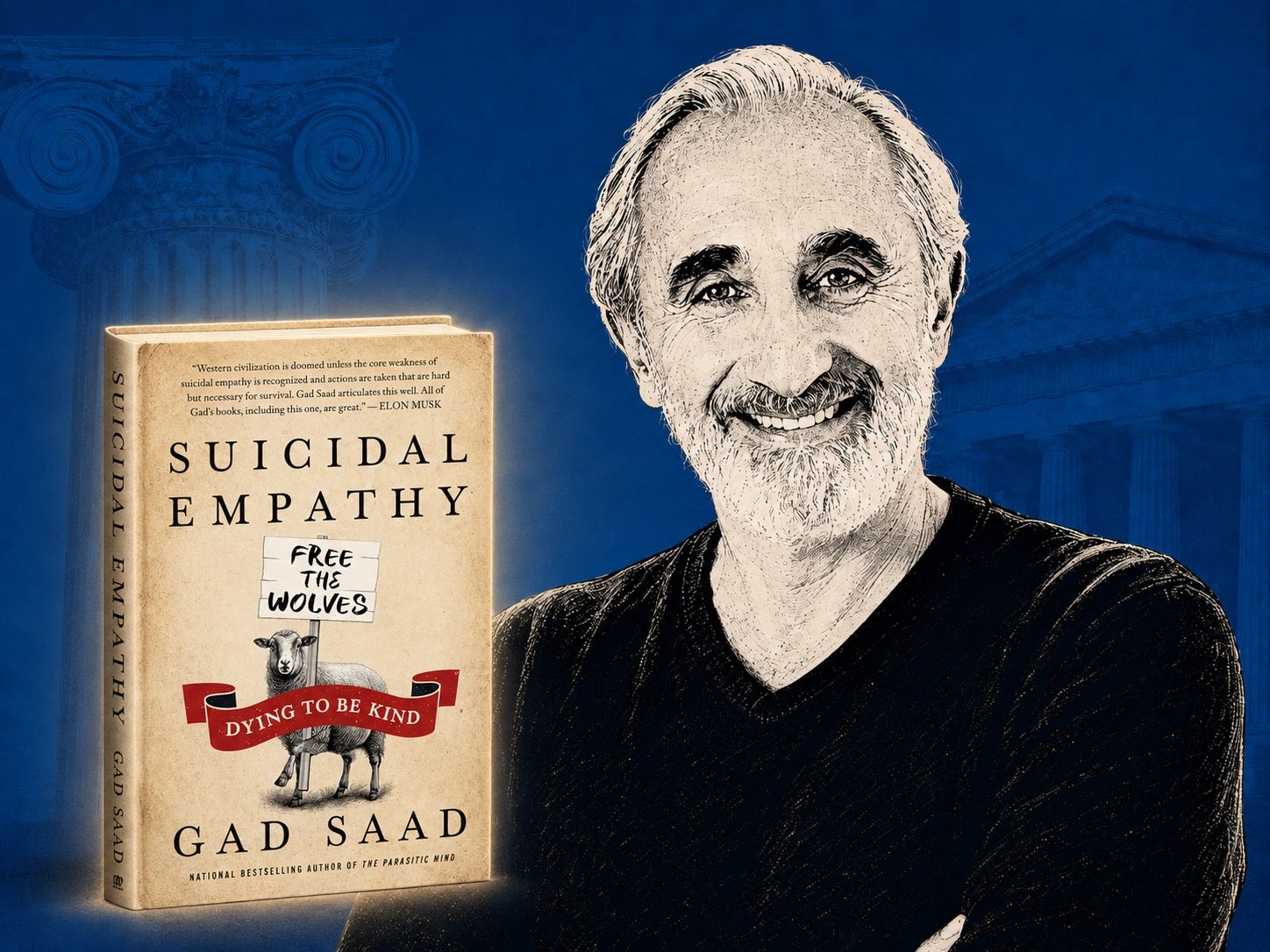
Gad Saad, an evolutionary psychologist who has become a social media sensation because he can speak in a style accessible to the commoner, straddle East and West with the dexterity of a cheetah, but most importantly, because his two-word diagnosis of the West’s hara-kiri has gone viral. For Saad, the psychotropic intoxicant fueling the West’s lunacy is “suicidal empathy.”
Shortly after Saad’s book hit the stands in mid-May, “suicidal empathy” rapidly became a byword to explain Western irrationality. Remarkably, each time I pen a piece on some new lunacy pushed by Western governments, academia, the medical establishment, or even Pope Leo XIV and send it to friends, they almost always chime back with two words: “suicidal empathy.”
Saad’s Jewish family was forced to flee Lebanon and emigrate to Canada to escape the Islamic Jew-hatred plaguing the land of his birth. With Canada now leading the West in pathological empathy, there couldn’t be a better illustration of “out of the frying pan into the fire.” Saad is writing from inside the furnace: it’s what gives his book its evocative voice and diagnostic depth.
The British historian Arnold Toynbee had already postulated that “Civilizations die from suicide, not by murder.” Saad’s key contribution is to field the question of civilizational kamikaze from the perspective of evolutionary psychology. He builds on his 2020 book The Parasitic Mind: How Infectious Ideas Are Killing Common Sense, which explored how human cognition can misfire when it becomes “zombified by ideological rapture.”
Saad defines suicidal empathy as the “orgiastic misfiring” of empathy, one of our most noble virtues. Our evolutionary mechanism has hardwired us to be empathetic whether in romantic mate choice, making friends, or in the caring professions like nursing.
While psychopaths lack empathy, there are also psychiatric disorders involving a display of indiscriminate hyperempathy. Our empathy system could also be “hijacked in suboptimal ways” without necessarily being concomitant with a mental disorder, Saad warns, as in the case of “compassion fatigue.”
Similarly, suicide can be viewed through an evolutionary lens “as the activation of evolutionary-based forms of altruism.” It could be understood as noble and virtuous—Saad cites examples of a radical commitment to one’s belief system (death cults), ultimate devotion (Romeo and Juliet), a means of expiation (seppuku), or an alternative to something far worse (Jews at Masada).
“Suicidal empathy” is the bastard child of Mr. Virtuous Martyrdom and Mrs. Orgiastic Compassion. The suicidally empathetic person engages in this form of ritual disembowelment as the supreme path to attaining and parading one’s virtue. Like Narcissus, they take hubristic pride in their superior virtue. The disorder then spreads like a contagion through society. “Suicidal empathy is a deadly contagion of one of our most noble virtues,” Saad warns. “If not properly contained, it will destroy the West.”
Saad cites the classic illustration of suicidal empathy from Aesop’s fables: an orgiastically compassionate farmer sees a viper freezing to death and tucks it into his coat to keep it warm. The snake bites the farmer as soon as it recovers. One of the many human tales of orgiastic empathy in the book is that of Karsten Nordal Hauken, a Norwegian man raped by a Somali immigrant. When a Norwegian judge decided to deport the rapist back to Somalia, Hauken was traumatized, worrying that his rapist might lead a difficult life in his homeland.
A central argument of Saad’s book hinges on a paradigm shift in Western epistemology (the theory of knowledge). For centuries, Western civilization was predicated on the rigour of the scientific method—the epistemology for seeking truth. It is what contributed to Western greatness and superiority. Jettisoning an epistemology of truth in favour of an epistemology of care leads to a grotesquely perverse epistemological empathy: “I empathize, therefore I am.”
Saad explains how the West was built on deontological principles. Misguided empathy, however, uses consequentialist rather than deontological ethics. Progressive academia, for example, censors “forbidden knowledge” by banning sensitive research topics lest they lead to “negative consequences” for “marginalized” communities. If research on a topic finds Blacks superior on a given task, it is celebrated. If the results find whites superior, it must be binned. One must, of course, be empathetic to serial plagiarism if practised by Black academics like Harvard’s Claudine Gay. Saad’s book was released just before the scandal of Cambridge University’s Jason Arday.
Paradoxically, “marginalized” communities like Muslim migrants may be intent on destroying the host community that welcomes them. But the host refuses to distinguish between embracing the in-group while remaining cautious of the out-group. We do not mete out our “empathy equally to all,” Saad writes. “Suicidal empathy eradicates this evolutionary-based calculus.” In this twisted scheme, there are, nevertheless, out-groups like the Jews who, despite their status as an “out-group,” must never be the recipients of empathy.
Saad applies the construct of “suicidal empathy” to the entire gamut of Western brain sickness, showing how it demonstrates a preferential option for the diversity, inclusion, and equity cult over meritocracy, illegal aliens over citizens, criminals over victims, squatters over homeowners, transwomen over biological women, drag queens over children’s innocence, Hamas over Zionists, socialism over capitalism, wanton foreign aid over judicious reciprocity, and Islam over all other religions.
Saad draws on a range of diverse scholarship, from economist Thomas Sowell’s book on how self-congratulation becomes a destructive basis for policymaking to ethicist Peter Singer’s idea of expanding our moral circle to animals. The book is packed with hair-raising illustrations of the catastrophic cancer of suicidally empathetic policies that are rapidly devouring the West.
Readers who reject evolutionary biology or psychology can still benefit from Saad’s conclusions, while remaining hermeneutically suspicious of his methodological tool. In a later edition, Saad might perhaps delve deeper into the question of why the West has a unique penchant for suicidal empathy. Can evolutionary biology explain this phenomenon?
Why is it that the 57 member states in the Organization of Islamic Cooperation or the 22 Arab countries are unwilling to display the same level of empathy and rehome Gazan refugees? Why do Singapore, Japan, or India not exhibit extravagant empathy as do Germany or Sweden?
Would a metaphysical explanation of how the West is rooted in biblical ethics of compassion and love for the Other, even the enemy, offer a better way to understand the West’s madness by positing that in a post-Christian context it has turned the biblical imperative to love the other into a heresy?
G.K. Chesterton defined heresy as “a truth taught out of proportion.” In his book Orthodoxy, he elaborated: “The modern world is full of the old Christian virtues gone mad. The virtues have gone mad because they have been isolated from each other and are wandering alone.” In a West that has rejected its biblical foundations, it is almost as if a hubris-filled collective is enthroning itself as divine by replicating what the God of the Bible has done for humanity by dying for us “while we were his enemies,” as the Jewish rabbi Paul would write to the Romans.
The Messiah suffered and died to save us in the “out-group” by atoning for our sins—a concept Jesus derived from the Servant Songs of the prophet Isaiah. Godless Westerners reject the Gospel, yet with a self-affirming messianism and savior complex, they believe they are saving the ‘marginalized’ other by ‘dying to be kind’ and becoming self-canonized martyrs.
Policymakers, pastors, and Pope Leo XIV would benefit from reading this book. It might stem the nauseating tide of saccharine suicidal empathy oozing from politicians and pulpits of many churches and from platitudinous papal disquisitions that read as if Greta Thunberg had ghostwritten them. A health warning: do not take the book with you on a beach holiday. It contains too many horror stories of how the road to hell is paved with good intentions.
Rev. Dr. Jules Gomes is a senior fellow at the Ideological Defense Institute
A popular slogan of the totalitarian state envisaged by George Orwell in his well-known dystopian novel, “1984,” is “Ignorance Is Strength.”
This perfectly sums up the ignorance of woke—a collective blindness and historical amnesia that admits of nothing outside its own self-reinforcing paradigm.
Wokeness divides people into ‘oppressors’ and ‘oppressed.’ It tells us who the villains are, who the victims are, and what kind of person we become, based on which side of this analysis we choose to line up on.
Best not to question the narrative or introduce countervailing evidence into the discussion. The reward of being woke isn’t only being ‘right.’ It’s being included. And the penalty for not accepting the woke narrative is excommunication.
Wokesters are primarily driven by fear of exclusion and ostracism. This deliberately cultivated psychological mechanism is far more sinister than it might at first appear.
When the woke encounter someone whose virtue credentials are not obvious, these must be established before all else, so it can be determined that being around them is “safe,” meaning they hold woke views, values, norms, and beliefs on a spectrum of issues.
If they are not from the same “community” or “culture” but give the correct virtue signal, then they are an “ally” and can be included in the woke world.
If they are not an “ally,” then they are an enemy not only of the wokester, but of the wokester’s Club Virtue membership, and hence a threat to the wokester’s place in the “community of the righteous.”
The most common wokester tactic to reassert lost control when confronted by an intellectually better–resourced opponent is argumentum ad hominem, or to use words that even a low watt bulb might understand: playing the man not the ball.
Disagreeing with a wokester means you are directly assaulting their self-image as a ‘good’ person. Thus, they feel entirely justified in personally attacking you in return, by labelling you a ‘bad’ person.
Once they have reclaimed the moral high ground in this manner, in their minds they do not have to engage with your actual argument.
Not buying into the woke narrative makes you racist, sexist, fascist, far right, misogynistic, homophobic, transphobic, Islamophobic, or just plain stupid.
Since labels are not arguments but a sign that you don’t have one, rational discourse with wokesters is impossible. It simply can’t occur, because they are too busy evading any reality that disturbs their internalised self-narrative.
US political columnist Joe Sobran uses the metaphor of a hive of bees, united by a kind of “group mind,” to describe the largely informal body of Leftist groupthink to which these people belong. There’s no central direction as such, but the bees can sense an enemy, and know when to attack.
Sobran says: “To become a bee in this hive is to surrender, voluntarily and eagerly, your own personality: to submerge the self in a collectivity; to prefer the buzzing cliché of the group to individual thought and expression; to take satisfaction in belonging and conforming to a powerful mass while punishing others for failure to conform ... The similarity to an insect colony - where the individual exists only functionally, being both indistinguishable from and interchangeable with its fellows - is not superficial, it is of the essence. To be an insect is to be relieved of the burden of having a soul of your own.”
We encounter these emetics daily in our personal lives, our kindergartens, our schools, our universities, our health system, our workplaces, our churches, our government departments, our advertising industry, our entertainment industry, our HR departments and personnel agencies, our mainstream media, and pretty much anywhere else that they can ram their ideology into the public square.
Once wokesters colonise a place, they make sure that only the like-minded are hired. “Since everyone is ideologically biased,” they reason, “we are entirely justified in excluding competing world views and value systems.”
Every public square in the West has become a giant echo chamber for ideologies deliberately crafted and inserted to white ant ourJudeo-Christian post-Enlightenment culture in order to replace it with a model of the Hive’s own choosing.
When Hitler took over Germany, the majority of Germans were not Nazis. The majority of Germans were irrelevant.
When the Communists took over Russia, the majority of Russians were not Communists. The majority of Russians were irrelevant.
Nobody resisted these people until it was too late. It’s time for the silent majority to stand up and be counted. The only power the woke minority has is its control over the megaphones of our culture. Every individual act of resistance is a small step in wresting back that control.
‘Woke’ is in fact a profoundly religious movement in everything but terminology.
The idea that whites are permanently tainted by their white privilege, gaining moral absolution only by eternally self-flagellating for it, is the ‘woke’ version of original sin.
Consideration as to whether an opinion is “problematic” is equivalent to explorations of that which may be blasphemous.
Cancel culture’s collective beatdown social mauling of the person with “heretical” thoughts and views parallels the excommunication of the heretic.
What we might call “public virtue signalling” channels the impulse that might lead a Christian to an aggressive display of faith in Jesus.
Much of the ‘woke’ cancel culture regarding identity politics displays an almost performative joy in dog-piling onto the transgressor, which under a religious analysis is entirely predictable.
When some ‘wokester’ attests to his white privilege with his hand up in the air, palm outward—which I have observed more than once—the resemblance to testifying in church is clear.
The ‘woke’ secular humanist who views Christians as superstitious kooks reveals himself as, of all things, a parishioner.