


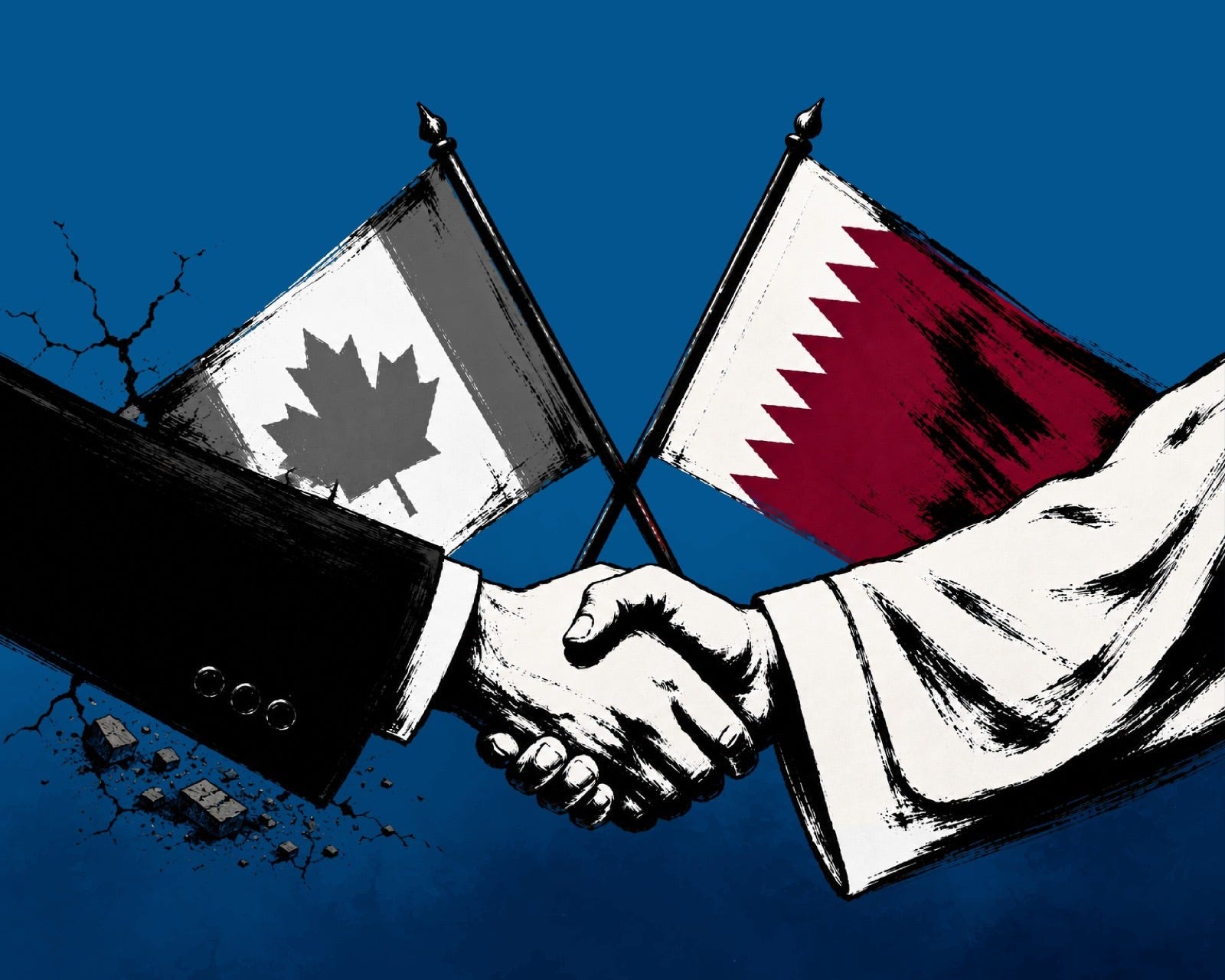
On June 25, Canada’s Public Safety Minister Gary Anandasangaree signed a Memorandum of Understanding with Qatar’s Ministry of Interior, framing it as a step forward in combatting transnational crime, terrorism, and its financing. The five-year agreement commits both governments to facilitate arrangements between the Qatar National Police and the Royal Canadian Mounted Police (RCMP) to advance police-to-police cooperation. It follows Prime Minister Mark Carney’s January 2026 visit to Doha, which produced a broader partnership on trade, investment, and defense.
The announcement was polished, the language reassuring. The logic, though, ran completely backwards.
Qatar is not a counter-terrorism partner. It is the most important state patron of the Muslim Brotherhood and a longtime host to Hamas’ political leadership. The wealthy Gulf state is also home to the International Union of Muslim Scholars (IUMS), a transnational clerical body founded in 2004 by the late Yusuf al-Qaradawi, widely regarded as the Muslim Brotherhood’s most influential spiritual authority. The IUMS, which has long-standing ties to the Qatari government, issued statements after the October 7, 2023, attacks in Israel that praised the Hamas assault and called for violent jihad in support of it.
The record of Qatari commitments is long and unpersuasive. A 2009 State Department cable, published by WikiLeaks in 2010, assessed Qatar’s counter-terrorism cooperation with the United States as the “worst in the region” and faulted Qatar for having “adopted a largely passive approach” to fundraising activities of terrorist groups. By 2014, then-US Treasury Under Secretary for Terrorism and Financial Intelligence David Cohen stated publicly that Qatar had “for many years openly financed Hamas, a group that continues to undermine regional stability.” That same year, bipartisan members of Congress formally requested that the US Treasury impose sanctions on Doha and produce a full report on its financing ties to Hamas, al-Qaeda, and the Muslim Brotherhood.
When the Arab Quartet—Saudi Arabia, Egypt, Bahrain, and the United Arab Emirates—issued thirteen demands in 2017 that included severing ties with the Muslim Brotherhood, al-Qaeda, and other designated groups as the price of ending their blockade, Qatar dismissed them as neither reasonable nor actionable. The blockade was eventually lifted in January 2021 with none of the thirteen demands met.
In July 2017, Qatar and the Trump administration signed a memorandum of understanding committing Doha to combat terrorism and cut off financial support to terrorist organizations. It was neither the first such pledge nor the last: Qatar had signed the Riyadh Agreement and its supplementary accord in 2013 and 2014, and would overhaul its anti-money-laundering legislation in 2019. However, the Counter Extremism Project, an advocacy group that tracks terrorism financing, argues that despite this legislation and Doha’s participation in US-led initiatives, Qatari money has continued to reach internationally designated groups.
Events over the past year have made the divergence between Qatar’s public and private conduct harder to overlook. During the 12-day Israel-Iran war of June 2025, Qatar publicly lamented the United States’ “attacks on the sisterly Islamic Republic of Iran”—even as Iranian missiles were being fired at the Al-Udeid Air Base on Qatari soil, housing roughly 10,000 American troops. Qatar also repeatedly told Washington it would not allow American forces to launch strikes from Al-Udeid—warnings that, while ultimately not acted upon, underscore where Doha’s loyalties lie when they are genuinely tested. More recently, Qatar reportedly proposed a secret arrangement with Iran in the weeks before the March strikes: Doha would suspend production at Ras Laffan—a shutdown that would spike global energy prices and pressure Washington and Jerusalem toward an early ceasefire—if Tehran kept the complex off its target list. One official claimed Qatar’s message to the Iranians was that “you will achieve your objectives without striking us.” However, Qatar categorically denied any such arrangement.
Then there is Al Jazeera. Qatar’s state-funded broadcaster is not merely a news channel with editorial blind spots. It is a deliberate instrument of Islamist soft power, spreading Brotherhood-compatible narratives across the Arabic-speaking world with considerable sophistication. In his book The Lost Spring: U.S. Policy in the Middle East and Catastrophes to Avoid, foreign policy analyst Walid Phares argued that Al Jazeera became the “primary ideological and communication network” of the Brotherhood during the Arab Spring in Tunisia, Egypt, Libya, Yemen, and Syria. Its English-language arm performs the same function for Western audiences more subtly, packaging Islamist-adjacent narratives as progressive anti-imperialism.
There are signs that Qatari influence already extends into Canadian classrooms. Juno News reported that the Ottawa-Carleton District School Board brought a long-time trainer with the Qatar Foundation’s Education Development Institute into a new equity coaching role for Palestinian, Muslim and Arab students, a placement that surfaced in an internal board presentation in November 2024, at a time when antisemitic incidents were rising in Ottawa schools. A second case points to institutional ties rather than personnel: Edmonton Public Schools has maintained a longstanding partnership with Qatar Foundation International—the same organization that has contracted with school districts across the United States—while renewing an Arabic language and culture course that has run since 2011. Critics and watchdog reports have long argued that billions in Qatari funding for North American schools and universities serve as a soft-power tool to shape curricula, promote specific political or religious narratives, and influence how students view the Middle East.
The pattern is consistent. Qatar’s private conduct has repeatedly diverged from its public commitments, which is precisely the problem with signing a public safety MOU with Doha. It is a gift of legitimacy to a government that has spent decades working both sides of the ledger. As Amine Ayoub of the Middle East Forum, an American think tank, argues, no state can serve as America’s most critical regional staging ground and a refuge for Hamas at once.
Minister Anandasangaree’s office has not said what due diligence preceded the signing, or how Ottawa intends to verify that Qatar honors what it has committed to here, considering how little its earlier commitments have produced.
National security cooperation runs on trust that the other side is what it claims to be. Ottawa extended that trust to Qatar without saying what it verified, and the United States will now share the consequences.
Joe Adam George is a fellow at the Ideological Defense Institute
The Middle East, the Muslim world will never be friends of the US. Their main plan is the conquering of America, the entire West. Trump is a fool for thinking he can make a difference. Muslims hate the West and everything it stands for. Their cry of; 'Death to America' isn't just a slogan, its a real threat...'
WTF Canada?