


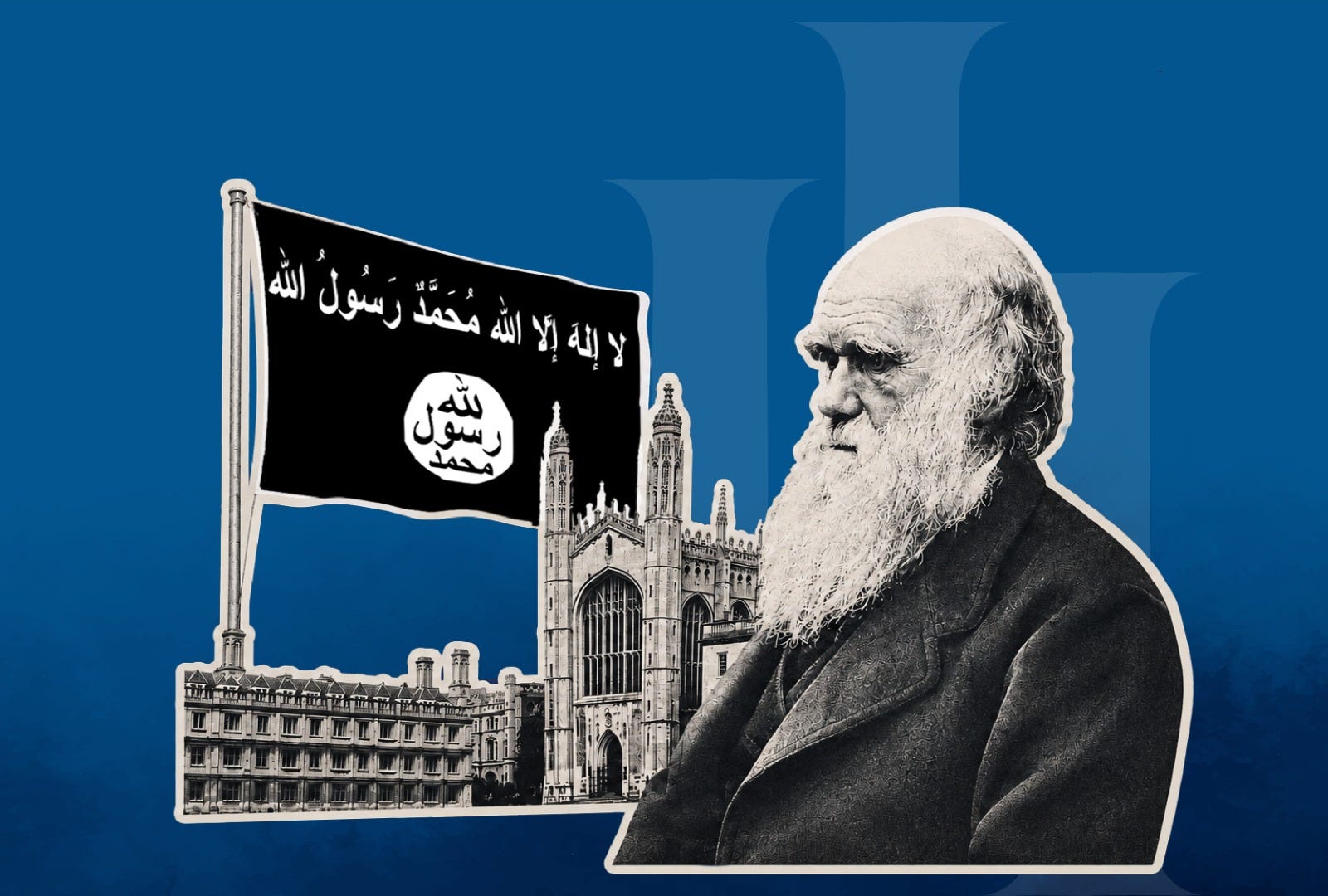
Christian colonialism is an oxymoron—a contradiction in terms. Jesus said: “My kingdom is not of this world. If my kingdom were of this world, my servants would fight.” Islamic imperialism is a pleonasm: it’s like saying “frozen ice.” Muhammad’s farewell speech: “I was ordered to fight all men until they say, ‘There is no god but Allah,’” became the doctrinal underpinning of Islamic expansionism. The Qur’an declares that Allah has made Muslims “his agents, inheritors of the earth” and “promised to… make them rulers in the earth” (24:55, 6:165).
Christian rulers who established empires in Jesus’ name were flagrantly flouting their founder’s teachings. Muslim colonizers who founded empires in Muhammad’s name were following their master’s model and mandate. The Western, ostensibly Christian, colonial project began around 1500. Islamic empire-building began when Muhammad established Medina as the first Muslim state in 622 CE. By the end of the 20th century, Western/Christian empires were as extinct as dinosaurs. In the 21st century, the world confronts the specter of a global Islamic caliphate.
The historical data is undeniable. Yet, for academic activists, the millenarian existence of Islamic imperialism is discombobulating. They would eagerly echo the famous line spoken by Stephen Dedalus in James Joyce’s novel, Ulysses: “History is a nightmare from which I am trying to awake.” These academic insurgents plot to subvert the Judeo-Christian West using Critical Theory and its bastard child, postcolonialism, but the reality of Islamic imperialism effectively dismantles their theoretical framework. In the fable of The Emperor’s New Clothes, Islamic imperialism is the little boy who, watching the fatuous parade of Postcolonial Studies, cries out: “The emperor is naked!”
Postcolonialism: The Trojan Horse of Muslim Academics
Now, in a feat of mega gaslighting, Muslim academics are flipping the imperialist paradigm and using postcolonialism as a Trojan Horse to infiltrate academia. Their goal is two-fold: subvert the West and supplant it with Islam. On August 15, The Spectator reported that Farah Ahmed, an assistant research professor at the Cambridge Faculty of Education, is using Postcolonial Theory to promote Qur’anic creationism through the Islamic Educator Learning Community (IELC) project at Darwin College, Cambridge. The irony is staggering on multiple levels.
First, the college is named after Charles Darwin, the father of evolution and a Cambridge alumnus. Second, a Christian academic promoting biblical creationism at Cambridge would be tarred, feathered, and drowned in the Cam. Third, none of the apostles of postcolonialism would dream of applying the discipline to Islamic imperialism. Fourth, Ahmed is a former supporter of Hizb ut-Tahrir—a movement aiming to revive Islamic imperialism by establishing a caliphate, i.e., a global Islamic empire, as I wrote in my essay The Closing of the Cambridge Mind.
Ahmed’s chapter on “The Western Education System and the British National Curriculum,” in the book Education and Identity: The Dilemma of Muslims in the West, first published as a Hizb ut-Tahrir pamphlet, trashes Western education as inimical to Islam. She insists that Western education is unsuitable for Muslim students, “as the ‘adeeqah [belief system] of the Muslim is in complete contradiction to this.” She excoriates English as “one of the most damaging subjects” because Muslim students who are taught to identify myths and legends in their English courses might conclude that the story of Muhammad riding on a winged horse is as phony as Odysseus escaping from the Cyclops by clinging to the belly of a giant ram.
Ahmed, in case you hadn’t heard, is also a colleague of sociologist Jason Arday, who killed himself after the exposure of his legendary plagiarism and pathological lying went viral.
Islamic Creationism in the British Classroom
For Ahmed and her fellow ideologues, Western education is a tool of imperialism festooned in the fancy dress of “objectivity.” Her colleague, Usama Javed Mirza, also a Muslim academic in the Cambridge Faculty of Education, presents an alternative paradigm he labels: “Islamic Scientific Critical Consciousness.”
British education brainwashes students with “a Western oppressive monoculture of secularised ‘modern’ science,” contends Mirza in his paper “Islamic Scientific Critical Consciousness as a theoretical framework for Muslim science educators.” Muslim students should be taught to identify “colonial ideology being taught as ‘objective’ knowledge.”
Mirza says that “countering colonial hegemony in science education for Muslims” could include “identifying gaps in fossil records to make the case that the evidence of humans descending from apes is inconclusive.” The paper is published on the IELC website and funded by the Bill and Melinda Gates Foundation.
Mirza doesn’t pretend to be objective. He honestly identifies himself as a “decolonial scholar-activist” who wants to promote Qur’anic creationism in the classroom. The great enemy of the Muslim student exposed to Western science is “fitna” (trial, temptation, sedition against God), which occurs 28 times in his paper.
“Fitna,” Mirza warns, “may occur, for example, when a Muslim student in the science classroom begins to believe that humans emerged on Earth without any role played by the Creator.” In contrast, “in the Islamic science tradition, research was viewed as an act of worship, and the scientific discourse was embedded in an Islamic world view and ethical framework.”
Mirza reminds his readers that “there is no compulsion in religion” (Qur’an 2:256). But isn’t that a half-truth? Islamic jurisprudence does frown on forced conversion. What Mirza won’t tell his readers is that the alternative to conversion for the kufr is dhimmitude. Robert Spencer explains in The Critical Qur’an: “They enforce subservience upon those who refuse to convert, such that many of them subsequently convert to Islam to escape the humiliating and discriminatory regulations of dhimmitude—but when they convert, they do so freely.”
And Mirza’s paper is a not-so-subtle manifesto for Islamic dawa (proselytization) aimed at converting the secular kufr. In another paper titled “Regime Change: The Need for Scientific
Critical Consciousness” published in the International Journal of Critical Diversity Studies, Mirza calls for “regime change” to “help overcome the hegemonic ideas” like “scientism, patriarchy, racism and colonialism.”
European colonial powers have committed “epistemicide” by killing “the Islamic Science Tradition in Muslim-majority lands ranging from North Africa to the Asia-Pacific,” he writes. This includes presenting “beliefs in empiricism, positivism, reductionism and determinism as indisputable rational ideas about the nature of the world.” Mirza attempts to subvert this colonial paradigm by offering a “revamped” curriculum of the Cambridge Assessment International Education O Level physics in his paper.
I am not faulting Mirza or Ahmed. They are faithful Muslims carrying out Muhammad’s missiological mandate with Machiavellian finesse. Here are the big questions: why is Darwin’s university feeding the Trojan Horse that is railroading Islam into British education? And why are the experts in postcolonialism silent when it comes to Islamic imperialism?
Cambridge Capitulates: From Newtonian Physics to Postcolonial Poppycock
Mirza holds a position at the university where Newton developed the reflecting telescope, Thomson discovered the electron, Chadwick discovered the neutron, Cockcroft and Walton split the atom, and Crick and Watson discovered the double-helical structure of DNA. Yet he dares to warn Muslims that this “secular Eurocentric ‘monoculture’ of modern science” poses a threat to their religion and identity. And his woke academic colleagues genuflect before him, Ahmed and Jason Arday, as if the three just invented fully autonomous nanobotic medicine to cure genetic diseases at the cellular level.
Why this cringing obsequiousness? “The answer is always: whoever is fighting the West,” writes Dan Burmawi. “The left and Islam make strange bedfellows, but they share a common enemy, and in the logic of the left, that is enough,” he explains in his incisive essay “The Philosophy Behind the Left-Islam Alliance.” Since Islam “is fighting Western power, it serves the interests of the oppressed, which is the only moral category that matters.” The same is true of Postcolonial Theory, which makes it possible to rewrite history because “history is made by men and women, just as it can also be unmade and rewritten,” as Edward Said wrote in his book Orientalism.
The goal of Postcolonial Theory is to deconstruct the West. In their book Cynical Theories, Helen Pluckrose and James Lindsay succinctly sum up what Ahmed, Mirza & Co. are in effect saying: “The West has constructed the idea that rationality and science are good to perpetuate its own power and marginalize nonrational, nonscientific forms of knowledge production from elsewhere. Therefore, we must now devalue white, Western ways of knowing for belonging to white Westerners and promote Eastern ones (to equalize the power imbalance).”
This is also why woke/Muslim academics love wallowing like pigs in the muck of Postcolonial Theory, even though it has been largely discredited together with its siblings like Gender Studies, Queer Theory, and Disability and Fat Studies. Remember when James Lindsay and Peter Boghossian, two respected scholars, wrote a hoax academic article titled “The conceptual penis as a social construct?” to debunk the Mickey Mouse discipline of Grievance Studies? The article was published in the Cogent Social Sciences journal after peer review. It outrageously claimed that “the conceptual penis…is the conceptual driver behind much of climate change.” When the authors revealed that they were pulling a fast one on academia (remember Jason Arday?), the article was retracted and woke academics had egg on their faces.
Islamic Imperialism: The Elephant in the Room
The biggest problem with Postcolonial Theory is that it is congenitally blind to the camel in the faculty lounge—Islamic imperialism. A few biblical scholars have engaged in a postcolonial critique of empires like Assyria and Babylon in the context of ancient Israel, but that only reinforces the case for including Islam in the club of the great colonial powers.
When I taught Islam at a British university, I would project a map of the Middle East, North Africa, Turkey, and Persia. I would then explain that these territories were predominantly Christian, Jewish, Sabean, Zoroastrian, or polytheistic. The seven churches in the book of Revelation are in Turkey. Before Muhammad, Mecca had a small but influential Christian population. Syrian merchants were preaching the Gospel in Mecca. Even members of Muhammad’s Quraysh tribe had converted to Christianity. I then showed my students a second map of the same regions. It took Islamic imperialists just a few decades to conquer these lands and convert their inhabitants or subjugate them as dhimmis paying a burdensome tax. “All the regions conquered by jihad were governed by Islamic legislation,” writes Bat Ye’or in her book Islam and Dhimmitude: Where Civilizations Collide.
Within twelve years of Muhammad’s death, Muslims subjugated Iran and snatched Egypt and Syria from Byzantine rule. By the eighth century, they had conquered Central Asia and much of the Indian subcontinent up to the Chinese border and besieged Constantinople. If not stopped at the Battle of Poitiers (732), they would have entered France and swept over Europe.
Within a century of Muhammad’s death, Islam had created the world’s largest empire (caliphate), “spreading from Arabia at a whirlwind speed to Transoxiana and Sindh (India) in the East, conquering all of Egypt and North Africa and had reached the heart of France in Europe,” M.A. Khan writes in Islamic Jihad: A Legacy of Forced Conversion‚ Imperialism‚ and Slavery.
Non-woke historians are not shy of recording the facts of Islamic imperialism in books published by university presses. “From the first Arab-Islamic empire of the mid-seventh century to the Ottomans, the last great Muslim empire, the story of Islam has been the story of the rise and fall of universal empires and, no less important, of never quiescent imperialist dreams,” observes Efraim Karsh in his book Islamic Imperialism (Yale University Press). The historian Johannes Kramers famously remarked that in medieval Islam there were never real states but only empires, more or less extensive, Karsh notes.
Islam is the quintessentially imperialistic ideology. It remains the only world religion that upholds imperialism as doctrinal indicative and missiological imperative. “Religion is integral to the conquests and the evolution of an Islamic Empire,” asserts Robert G. Hoyland in In God’s Path: The Arab Conquests and the Creation of an Islamic Empire(Oxford University Press).
Muslim colonialism wasn’t benign: lust for booty drove the rapacious invaders; slavery (riqq) of colonized peoples was systemic, endemic, and significantly informed by sharia; and indigenous cultures and civilizations across three continents were expunged and Arabized. Local knowledge bases were plagiarized or erased: Umar, the second caliph, ordered the Great Library of Alexandria to be burned in 642 when Muslims conquered Egypt.
The Illusion of Islamic Science
If Islamic science is greater than Western science, why do students from Muslim countries flock to Western universities to complete doctorates in science and engineering and not return home? Can the reader name a single life-changing invention (lightbulb, steam locomotive, motorcar, television, airplane, refrigerator) that was invented as the fruit of Islamic science?
Why is it that only three Muslims (four if you count one Ahmadiyya—a “heretical” sect) have been awarded the Nobel Prize in the 125-year history of the award? Why is it that, as of 2024, only about 280 of 29,553 scientific journalsoriginate from Arab Muslim countries, accounting for less than 1 percent of the total? In the same year, there were 3,536,265 scientific papers published globally, but only 20,780 from Arab Muslim countries, making the Islamic world’s contribution just 0.59 percent of scientific documents published globally.
If Islamic academics like Ahmed, Mirza & Co. are so confident that Islamic science is great and Western science is the product of an oppressive monoculture, perhaps they might consider following the medical advice of their Prophet? In a hadith from Sahih al-Bukhari, Muhammad ordered his followers in Medina who fell ill to drink camel urine as a medicine. One can only speculate when The Lancet will recognize the glories of Islamic medicine and publish a peer-reviewed article on the “Therapeutic Benefits of Drinking Camel Urine as a Postcolonial Prophylactic Against HIV.”
Rev. Dr. Jules Gomes is a fellow at the Ideological Defense Institute
Nutters everywhere in academia these days.