


On October 7th, 2023, at 6:29 a.m., the first rocket barrage began as Hamas-led attackers breached the border and entered Israel. Times of Israel reported a channel 12 estimate, based on data from the IDF’s Gaza Division, that approximately 6,000 Hamas and their Palestinian supporters entered Israel that day, including 3,800 trained and armed Hamas terrorists from the Nukhba force who brutally murdered Israeli civilians in their homes and at the Nova music festival, and abducted hostages to Gaza. According to the same report, some 1,000 terrorists inside Gaza were responsible for firing rockets at Israel on that day, bringing the total number of Palestinians involved in the attack to 7,000. The scale of the barrage was staggering, “[some] 5,000 rockets were fired at Israel that day, 3,000 of them in the first four hours of the onslaught.”
The Jewish News Syndicate (JNS) reported that approximately 1200 people, mostly civilians were killed and more than 251 were taken hostage. Yet, even these staggering numbers and the barbarity shown that day cannot convey the horror of October 7th. The loss and the brutality are beyond what statistics or words can ever capture or convey. We once again were “in the presence of a crime without a name.”
In the wake of that devastation, a question rose within me. Where was God?
I carried that question with me on one unforgettable afternoon in July 2024 as I walked through the silent grounds of Kibbutz Nir Oz. I could hear bombs exploding in the distance in Gaza. My guide had to tend to an urgent matter, and I was finally alone and I preferred it that way. I wanted to be alone with the birds chirping still over the broken bricks and charred walls; alone to whisper a prayer, shed a tear, and honor those who were no longer there.
Outside some homes, the sukkot still stood. I approached one, its structure was partly damaged and torn cloth fluttered in the air. A mild breeze went through the torn fabric and caressed my face. I was shaken; I felt the anguish of those whose lives had been shattered pass through me.
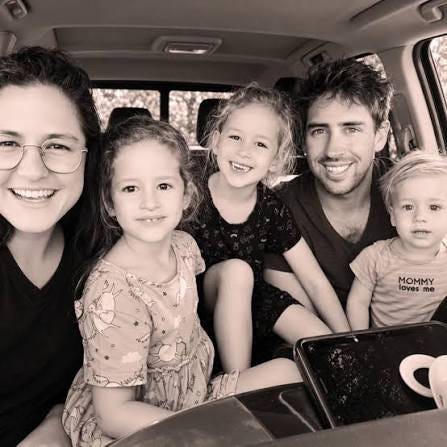
On a blackened wall hung pictures of a family; a mother, a father, and their three children. They may have been celebrating Simchat Torah the night before they were mercilessly murdered. With every footstep, the ground seemed to tremble beneath me, as if the earth itself still held within it the pain of that frightful day. Later, I learned their names and their stories. “Tamar Kedem Siman Tov, 35, her husband Yonatan ‘Johnny’ Siman Tov, 36, their 5.5-year-old twin daughters, Shahar and Arbel, and son Omer, 2, were all murdered by Hamas terrorists in their home in Kibbutz Nir Oz on October 7.” The Siman family was remembered as delightful and loving; their lives was cut short far too soon.
A month later, Tamar’s mother wrote: “‘Tamar, John, Arbeli, Shahar and Omriko, our beloved. The world has seen only your names written on my skin, but I want the world to know what a shining and huge light you were for us. In this world and the world to come. I love you my angels and fairies. Forever and ever you will light our world.’”
As I approached the other homes, I paused out of respect. I imagined the ordinary lives interrupted within them, their traces still visible to the world; tea flasks, broken breakfast cups, burnt cooking devices, and shoes charred to a crisp. Outside the Bibas family’s house; the children’s toys were scattered on their front lawn.
I do not need to explain what happened there. I can only bear witness to what I felt as I walked through the silence.
I could not walk away from Nir Oz before asking God: “Where were You in these homes? Did You see parents trying to protect the children who were set ablaze before their very eyes? Did You hear a mother’s shriek? Did You feel a father’s horror? Were You there or were they alone?
As I left Nir Oz, the question I carried with me has led me to the Book of Job. His story is important here not because it explains or justifies suffering, rather it helps us better understand that grief cannot be easily explained. Job brought his anguish directly to God. This act and his example illustrate that amidst despair, we must approach our Father and question Him. Job’s story of loss leaves us with lament, moral questioning, and the courage to speak honestly before God. But this does not settle the question I carried from Nir Oz, Was God present in their suffering? That question leads me to the Jewish concept of the Shekhinah.
In the Bible, God has promised to be with the one who suffers, and in turn, the believer naturally longs to experience God’s presence and nearness in times of pain and sorrow. This promise is stated in Isaiah 57:15, “For thus said the One who high aloft forever dwells, whose name is holy: I dwell on high, in holiness; yet with the contrite and the lowly in spirit, reviving the spirit of the lowly, reviving the hearts of the contrite.” The Jewish tradition offers us insight into God’s presence among His suffering children through the Shekhinah, a term derived from the Hebrew root meaning “to dwell.” Although the name Shekhinah does not appear in the Torah, it is frequently mentioned as the indwelling presence of God, the Ruach (spirit) within every human being. There are numerous verses in the Bible that attest to the presence of God among His people; Genesis 46:4 states: “I will go down with you into Egypt,” and Isaiah 43:14 says, “For your sake I was sent to Babylon.” Psalm 22 begins with the anguished words “My God, my God, why have you forsaken me,” same words uttered by Jesus on the cross.
Scripture does not erase that cry of distress, and these texts do not give reason to the suffering, but they give the afflicted words with which to cry out and insist that their suffering is seen and heard by their Father.
In the confines of the tunnels beneath Gaza, Hersh Goldberg-Polin, reportedly comforted his fellow hostages with repeating a line he had read in Viktor Frankl’s Man’s Search for Meaning, “‘He who has a Why to live for can bear almost any How.’” Or Levy, who had been held alongside Hersh, later told the world that Hersh shared these words with fellow hostages.
I do not know whether Hersh ever wondered where God was or whether he believed God suffered along with him and his fellow hostages. I cannot know what truly sustained him. I only know what Or Levy later recounted, which explains how Hersh offered the other hostages a way to hold on to hope.
The theological tension remains. Some traditions insist that God, being beyond human limits, cannot suffer as humans do. Jewish tradition states that the Shekhinah followed Her people into exile, and Christian theology, in its distinct language, speaks of God’s participation in human suffering through Christ. These are very specific and distinctive ways of addressing God’s nearness to His creation. However, neither explains tragedies unfolding across the globe or the enduring human suffering.
The question I carried from Nir Oz remains; Was God with them, and what does that presence mean when no rescue ever came?
Three years after the tragedy of October 7th, an ethical responsibility continues to be placed upon us. In Pirke Avot (Ethics of the Fathers) 1:18, we read “Rabban Shimon ben Gamaliel used to say: ‘On three things does the world stand: on justice, on truth, and on peace, as it is said: ‘execute the judgment of truth and peace in your gates.’ (Zechariah 8:16).” This teaching implicates us to remain committed to the truth, to seek the truth that seeks us.
We will never fully comprehend the savagery committed on October 7th or the suffering inflicted on the innocent. To acknowledge this is not to walk away and become indifferent, but to approach the victim stories with honor and humility. Job’s protest, the Indwelling presence of the Divine, the Christian witness to the Cross, Frankl’s words, and Hersh’s resolve and message of hope do not explain or justify human suffering. They leave us with a tremendous responsibility; to remember the victims, to stand with the survivors, and to tell the truth about October 7th. Even from the depths of the silence shrouding Nir Oz, God cries out to us, as He cried out to the first human being, “Where are you?” My answer is, Hineni, Here I Am: To remember and to bear witness.