


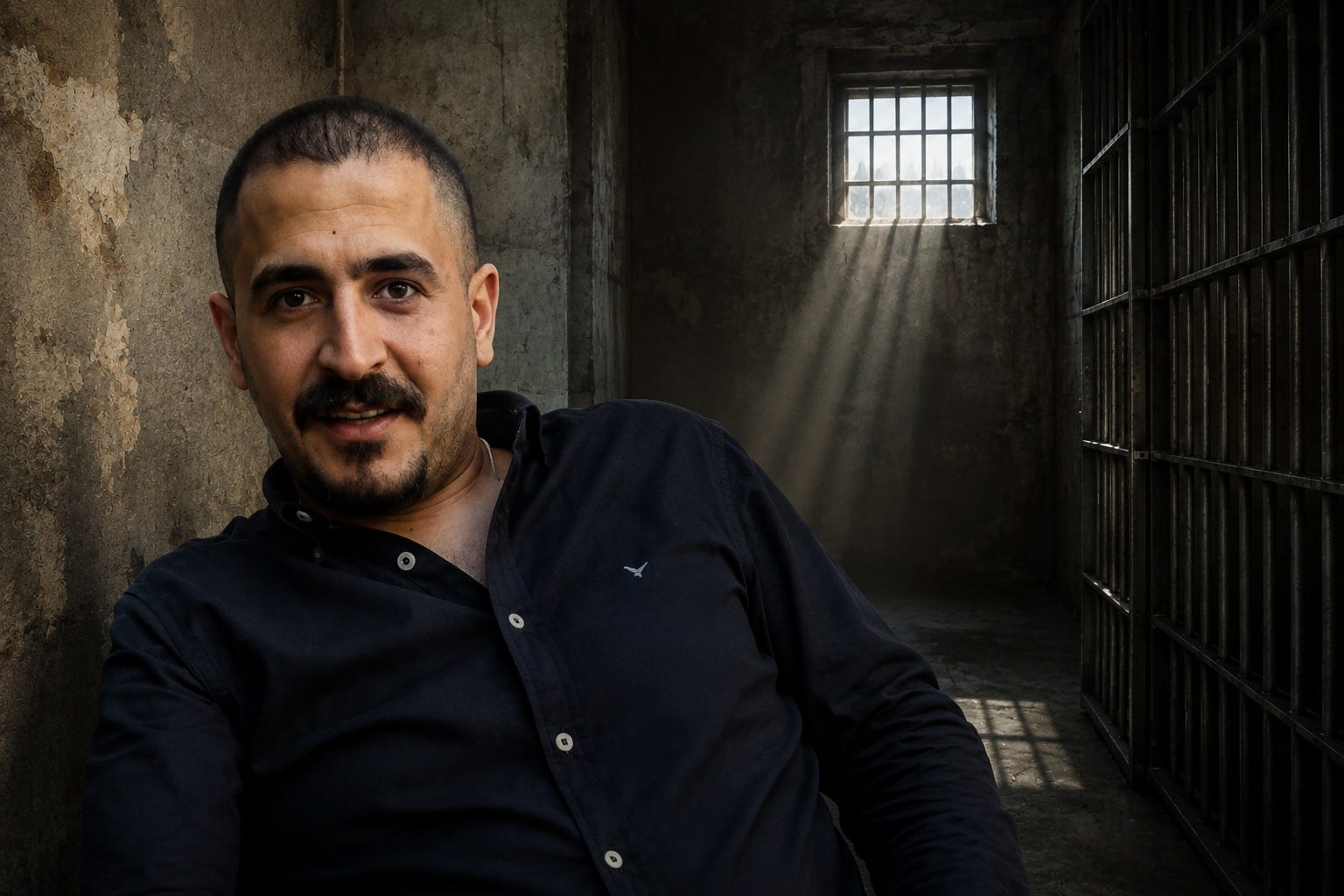
What happens when a Muslim attempts conversion to Christianity in Egypt? The case of Said Mansour Rezk Abdelrazek, an Egyptian national and Christian convert, provides a chilling example. He has been arbitrarily detained in Cairo since 15 July 2025 simply for exercising his fundamental right to freedom of belief.
Abdelrazek’s continued imprisonment reflects a persistent and alarming pattern of Christian persecution in Egypt, particularly against individuals who convert from Islam.
Abdelrazek converted to Christianity in 2016. Since that time, he has endured severe and sustained persecution by Egyptian authorities. This includes repeated arbitrary arrests, torture and ill-treatment, forced divorce, forced separation from his young son, continuous surveillance, denial of access to legal representation, medical negligence, repeated attempts to coerce him into renouncing his faith, and ongoing punishment for leaving and criticizing Islam.
The next hearing is scheduled for 6 September. Abdelrazek is facing a potential life imprisonment or death sentence for his conversion to Christianity.
Notably, Abdelrazek is tried in the First Criminal Terrorism Circuit Court in Badr. By referring Abdelrazek to a terrorism court on charges such as “joining a terrorist organization,” Egyptian authorities have reframed a matter of personal belief and conscience into a national security threat.
In 2018, Abdelrazek attempted to leave Egypt and seek asylum in Russia. Egyptian authorities blocked this and summoned him to the National Security Office, where he recounted being insulted and humiliated. He eventually reached Russia through a tourist visa, applied for asylum, and formally converted into the Russian Orthodox Church. While there, his outspoken critics of Islam induced backlash.
He was then imprisoned for 11 months in Russia. Despite holding documentation from the UN High Commissioner for Refugees (UNHCR) confirming that he qualified for international protection, he was deported back to Egypt in 2024. This was in violation of the non-refoulement principle. The Russian government revoked his refugee status after receiving threats from Muslim groups. They feared that Abdelrazek’s online criticism of Islam might trigger mass social unrest.
Upon his forced return to Egypt, Abdelrazek was detained and then released following warnings from national security officers. Additionally, he was forced to undergo a painful procedure to remove a Christian tattoo he had received in Russia. Abdelrazek later confided to close friends that during his detention, he had been suspended with his hands tied to a wall in a “crucified position” for several hours each day over the course of a week.
Following his release from prison, Abdelrazek lived under constant surveillance and psychological pressure. On 15 July 2025, he was again arrested in Cairo after seeking legal avenues to update his official identity documents to reflect his Christian faith.
Abdelrazek then appeared before the State Security Prosecution Office, where he was told that he would be charged with “joining a terrorist organization, disturbing public order, spreading false information and receiving illegal funding.” His detention has since been repeatedly renewed without due process. To this day, Abdelrazek remains imprisoned.
Abdelrazek is engaged to an Australian citizen and resident, Sofia, who is seeking his safe release and reunification. The Australian Department of Home Affairs acknowledged receipt of his XB (subclass 202) visa application on 8 May 2024, yet no substantive action has followed.
To help free Abdelrazek from prison, the organization Coptic Solidarity (CS) is petitioning the Australian government. CS’s Freedom4Said petition can be signed here. The appeal is an urgent request asking for the Australian government to petition Egypt for his release and his protection.
Another appeal to Tony Burke, Minister for Home Affairs of Australia, was signed by several international human rights organizations and individuals. It stated:
“The conflation of religious conversion with terrorism represents an extreme and dangerous criminalization of freedom of belief. His [Abdelrazek’s] lawyers have been denied access to his case files, and he has reportedly been deprived of basic necessities, including medication and clothing.”
“This case bears particular relevance to Australia,” the appeal added. “Australia therefore has a clear humanitarian interest and a meaningful opportunity to intervene.”
Lindsay Rodriguez, the Senior Director of Advocacy and External Relations of Coptic Solidarity, told IDI that Abdelrazek’s latest hearing was held on 15 June (Case No. 5664 of 2025):
“The defense team was present, along with representatives of several human rights organizations monitoring the case.
“The prosecution witnesses were to testify and be cross-examined by the defense, pursuant to the court’s previous order summoning them. The session was also expected to include the examination of the forensic expert regarding the technical reports submitted in the case.
“But the hearing did not include the testimony of the witnesses or the examination of the forensic expert. The court, instead, adjourned the proceedings to 6 September 2026 for the hearing of the prosecution witnesses and the forensic expert, and for their examination by the defense.”
The Public Prosecution has brought multiple charges against Abdelrazek. This includes “establishing and leading a group in violation of the law, joining a group allegedly founded unlawfully, financing such a group, promoting ideas and beliefs deemed harmful to national unity and social peace, and showing contempt for Islam and challenging its fundamental principles.”
So far, Abdelrazek has had about 5 or 6 detention renewal hearings. He has had 2 trial hearings. This includes a 21 April that was postponed to 15 June which would cross-examine the witnesses. Because they did not appear at this hearing, it was postponed to 6 September 2026.
“The revolving door of extending detention and pushing back hearings has become the standard procedure by the administration of Abdel Fattah El-Sisi for these types of cases. In this way, they perpetually extend the period of detention,” Rodriguez said.
“The prosecutors are demanding maximum sentencing. In terrorism circuit courts imprisonment for life and the death penalty are both possible sentencings. The preceding judge Mohamed Saeed El-Sherbiney, has an international reputation for giving mass death sentences.”
Abdelrazek is also denied access to regular visits from his lawyer and exposed to abuse and medical negligence:
“The last time his attorney Said Fayaz was able to communicate with Said [Abdelrazek] was on 21 April 2026 at the hearing. Attorney Fayez was able to visit Said only a single time on 15 January 2026, and in the courtroom on 21 April. They did not see each other on 15 June. No other request has been approved.
“Said reported to his attorney on the 21 April hearing that he had severe back and urinary track pain. We have news through the family member of another detainee that Said is in urgent need of medical care and they are worried for him. His fiancé explained that he has an undiagnosed health issue which they believe to be a heart condition that causes him to lose consciousness. To date, Said has not been able to get treatment.
“His fiancée believes that Said is being mistreated. In addition to being refused visits and access to his attorney and medical care, authorities have even refused to allow the delivery of clothes and blankets during the winter as well as food and medicine.”
According to Rodriguez, Abdelrazek’s imprisonment is a message by the Egyptian state to other citizens who are considering to leave Islam.
“Abdelrazek is not the only one targeted by his government for becoming Christian. We know anecdotally that there are numerous converts who have been imprisoned in Egypt. But we don’t have a way to get an accurate count.
“Marco Girgis was the first convert to try to change his ID to reflect his new Christian faith. He was imprisoned and tortured until he recanted. Said lost everything for his conversion. Both cases send a clear message to anyone else who would like to officially reflect a change of faith away from Islam.
“The case also exposes Egypt’s hypocrisy in that the Constitution affirms that ‘freedom of belief is absolute,’ yet in practice, conversion from Islam is routinely penalized, and in this case elevated to a terrorism offense—revealing a stark, and systematic, gap between declared commitments and actual practice.”
Rodriguez warned of the manipulative actions of the Egyptian lobby in Washington:
“The US government has been slow to notice or even react to the Egyptian lobbying machine in Washington, DC. Until last year when Coptic Solidarity published a report documenting their activities as recorded on the Department of Justice website under FARA filings, the State Department was still meeting with a registered Foreign Agent who is also the head of all Protestant Churches of Egypt, Rev. Andreas Zaki. After being caught bribing former Senator Menendez, Chair of the Senate Committee on Foreign Relations, we still see no clear repercussions or efforts to stop the Egyptian government’s illegal efforts.
“Just recently, a lobbying firm hired by Egypt helped place an oped by then Egyptian Ambassador to the US, Motaz Zahran, titled ‘Egypt’s religious freedom tradition an asset to America, the world: El-Sissi walks the walk on tolerance for all faiths.’“The claims made by the Ambassador are in direct contradiction to the actual actions of the Egyptian government with regard to religious freedom, as Coptic Solidarity documented in our last report, Erosion of Citizenship in Egypt: State-Managed Religious Governance and Institutional Islamization under President Abdel-Fattah el-Sisi. But the Egyptian government is still laundering their reputation with little pushback.”
Rodriguez called on the governments of Australia and the US to help secure Abdelrazek’s release and protection:
“The US government and individual US legislators should be speaking about Said’s case frequently and publicly. It is only urging the Egyptian government to uphold the rights of its own citizens in the way in which it claims they already do.“To date, Australian authorities have shown no real interest in intervening and have passed the responsibility to others within their own government. The best outcome would be for the Australian government to approve Said’s asylum request.”
Uzay Bulut is a fellow at the Ideological Defense Institute
Please sign the statement. I did.
Where is the Peace and Mercy?