


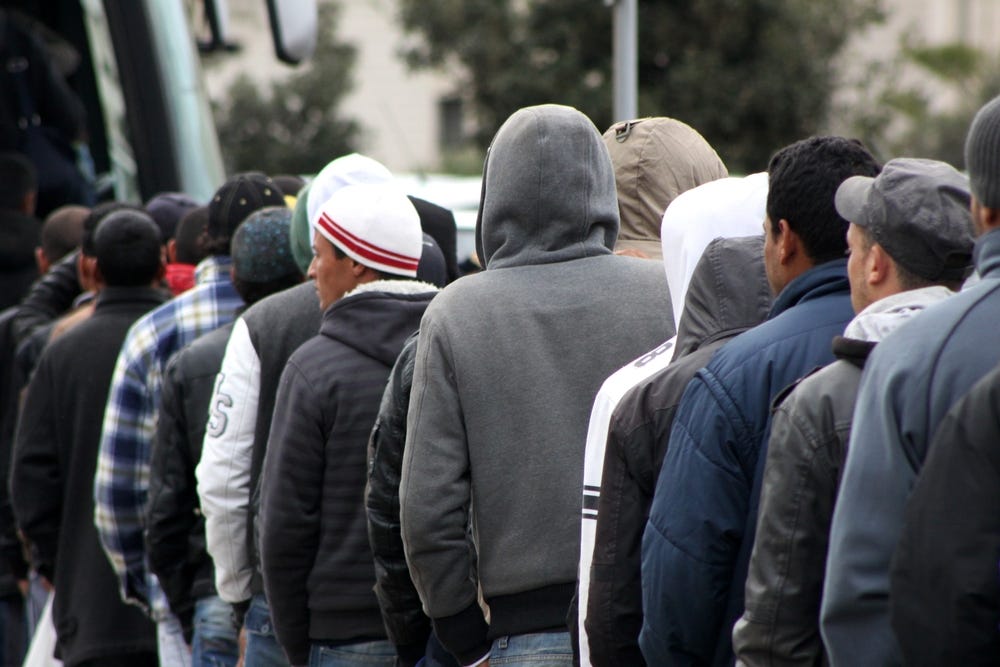
Europe is host to approximately 46 million Muslims in 2025, roughly 6 percent of the continent’s population of 745 million. The figure was 29.6 million in 1990. The Pew Research Center projects it will exceed 58 million by 2030 even on the most conservative assumptions about future migration. France alone contains an estimated 5.7 million Muslims and contributes roughly 30 percent of its births from a population that is 9 to 10 percent of the total. Germany contains 4.95 million, the United Kingdom 4.13 million. By 2050, on Pew’s midpoint scenario, the Muslim share of the population reaches 30.6 percent in Sweden, 19.7 percent in Germany, 18 percent in France, 17.2 percent in the United Kingdom, and 18.2 percent in Belgium.
A substanitial portion of this population has not integrated into European life. In 2019, Europol recorded 119 foiled, failed, and completed Islamic terrorist attacks across 13 EU member states, with 1,004 arrests on terrorism-related charges. In 2023, the figure rose to 120 attacks. In 2024, 58 attacks were recorded across 14 member states. In February 2024, the Islamic State spokesman released an audio recording titled Kill Them Wherever You Find Them (Quran 2:191), calling for attacks against Western civilians worldwide.
These numbers count only attacks Europol categorizes as terrorism. They do not count the parallel street violence that has reshaped European cities across two decades: the Cologne New Year’s Eve sexual assaults of 2015 in which over a thousand women were assaulted by men identified by German police as overwhelmingly North African and Arab; the British grooming-gang cases that the Casey audit of 2025 finally forced into the political record, with perpetrators overwhelmingly identified as British-Pakistani men exploiting non-Muslim girls. The Swedish gun-homicide rate that has become one of the highest in the developed world, driven by criminal networks operating out of Muslim-majority suburbs; the Berlin knife crime statistics; the French no-go zones. None of this appears in the Europol terrorism figures.
This is the scale at which European migration policy has been operating, and these are the populations the policy has been admitting, retaining, and protecting through procedural mechanisms, family reunification, asylum acceptance, citizenship for the second and third generations regardless of integration outcomes, legal protections against deportation even after criminal conviction. While these populations have been admitted, retained, and protected, the European Union Agency for Asylum has been doing the opposite work in parallel. It has been rejecting the populations the European asylum system was created to protect.
The Syrian transitional Jihadist government has presided over the most systematic persecution of Christian, Druze, and Alawite populations in modern Syrian history. In March 2025, security forces and affiliated militias killed approximately 1,400 people, mostly Alawite civilians, in coastal Syria, in what the United Kingdom House of Commons Library now classifies as targeted sectarian violence. In April 2025, militants associated with the government killed 134 people in a Druze suburb of Damascus. In July 2025, sectarian violence in Suwayda province killed roughly 1,000 civilians and militants and displaced 187,000 people. On June 22, 2025, jihadists attacked Mar Elyas Greek Orthodox Church in Damascus during Sunday mass and murdered 25 Christians. The U.S. Commission on International Religious Freedom’s July 2025 report documented Hay’at Tahrir al-Sham-affiliated forces conducting “door-to-door interrogations and select executions” of Alawites in January and February 2025, escalating to “full-blown sectarian massacres” by March.
Yet the European Union Agency for Asylum’s December 2025 country guidance shifted the operative framework for Syrian asylum claims toward presumed safety for return. Germany and the Netherlands have implemented the new framework in their case law. Recognition rates for Syrian Christian, Alawite, and Druze applicants have collapsed across the bloc even as the documented evidence of persecution has accumulated. The evidentiary burden the European system imposes on Syrian minority applicants is impossible to satisfy. A Christian family from a village in Latakia whose church was burned and whose neighbors were executed in March 2025 cannot produce the documentary record the asylum tribunal demands. The perpetrators are the local authorities. The state media will not report the events.
The 1951 Refugee Convention was written for exactly this case, populations targeted by their own government on the basis of religion, ethnicity, or political opinion, for whom internal relocation is not possible because the persecution is state-affiliated or state-tolerated. It is now refusing protection to the populations the principle was written for, while continuing to admit and protect the populations whose ideological orientation produces the security crisis the new vetting architecture is supposedly designed to address.
The corrective requires Europe to make a distinction. A Syrian Christian family from Hassakeh whose church was burned in 2025 is not ideologically hostile to liberal democratic Europe. They are fleeing an Islamic-supremacist regime. The value-set of liberal democratic Europe is what they are trying to reach. The persecuted minorities of the Islamic world, Christians, Yazidis, Druze, Alawites, Ahmadis, Bahá’ís, Mandaeans, have been, on the documented record across two decades, the most successful integrators into European life and the most loyal new citizens of the countries that admitted them. They have been admitted in pitifully small numbers. The populations that have been admitted in mass numbers, across the same period, have produced the violence that plagues the continent year after year.
Admit the persecuted minorities of the Islamic world. Reject populations whose documented ideological orientation is incompatible with European civilization. Deport those whose presence in Europe was secured through asylum fraud or whose conduct after admission has demonstrated permanent incompatibility with the legal and civic order of the receiving society. The wrong people are inside Europe. The right people are being turned away at its borders. The migration policy of the continent should not continue to admit those who hate Europe and reject those who would have died for the chance to live inside it.
Sally Obeid is a fellow at the Ideological Defense Institute.
What Is IDI ?
The most trusted source of information on the Middle East, Islam, and the ideological threats facing the West.
Subject-matter experts, former Muslims, Arab Christians, and Western thought leaders, coming together to equip policymakers to prevent destructive foreign ideas from being translated into law, restore confidence in the biblical principles that built the West by empowering the Church to reengage the public square, and provide the public with solid analysis to combat the confusion that is making the West vulnerable.