


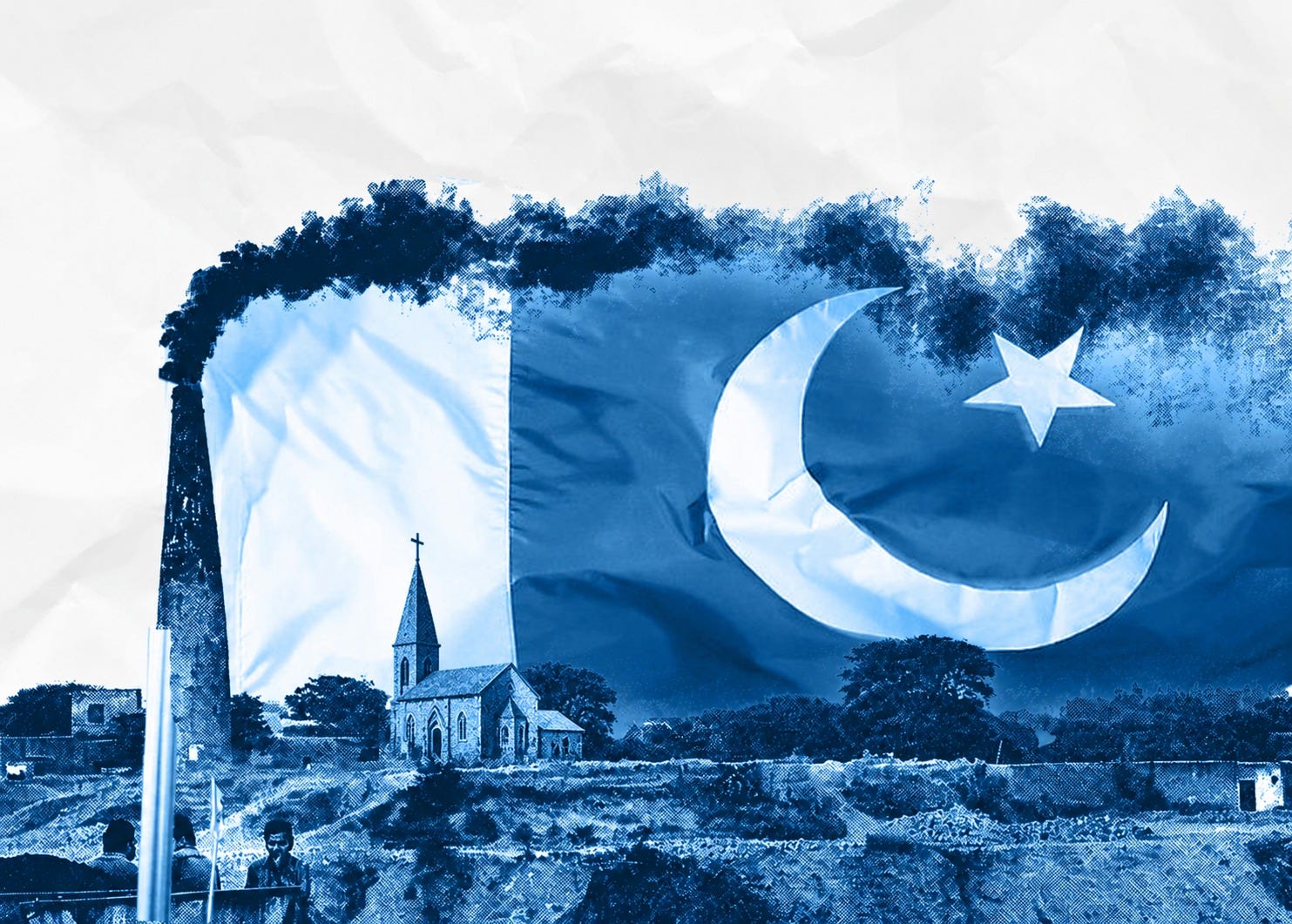
In Pakistan, Christians frequently face systemic discrimination that forces them into hazardous labor with minimal safety protections. They are often allowed to only occupy lower-status jobs such as cleaning and sanitation work, or as bonded laborers in brick kilns. Many Christians are trapped in debt.
Workers are forced to descend into deep sewers without protective gear (like masks or gloves), exposing them to toxic gases. This exploitation continues to take lives.
On May 7, Shabbir Masih, a 33-year-old Christian sanitation worker in Pakistan, died after inhaling toxic gases after his supervisors forced him to perform a dangerous task.
Masih died working inside a 25-foot-deep mainline sewer operated by the Water and Sanitation Authority (WASA). According to his widow, Masih was fully aware of the danger posed by the work. For three consecutive days, he refused to descend into the sewer. On the final night, WASA officials arrived at his home at 10 p.m. and took him away.
“He knew it was a death trap,” his widow said. “He was very worried for the last three days and told me that they were threatening him [if he did not] go deep into that sewer.”
Masih’s widow is demanding justice for her husband. She says WASA forced him to work in the sewer against his will. WASA has refused accountability in Masih’s death, claiming he was hired as a contractor, a deliberate outsourcing arrangement designed to avoid responsibility.
Masih is not the first Christian to die because of this pattern of systemic discrimination. Labor rights groups assert that the recent fatalities highlight ongoing discrimination and marginalization faced by Christians.
While Pakistan’s Christians comprise less than 2% of the country’s population, they work 80% of sanitation jobs. These workers are not given proper training or protective equipment to carry out their job responsibilities. They are sent into deep sewers without any safety measures; if they refuse, they are threatened with job loss. The Christian community, which lives below the poverty line, constitutes a large portion of this workforce.
In May and April, at least five other Christian sanitation workers lost their lives. One remains in serious condition after inhaling toxic gases while working in sewers in Pakistan’s Punjab and Sindh provinces.
On May 4, two workers (Shakeel Masih and Samar Masih) died in Sahiwal, Punjab. They were cleaning a manhole without any protective equipment. On April 17, three other workers (Wilson, Waqas, and Nazeer) were killed while clearing a blocked sewer line in Surjani Town, Karachi, Sindh Province.
Justice Raja Inam Amin Minhas of the Islamabad High Court noted that over 70 Christian sanitation workers have died since 1988 due to exposure to toxic gases.
International Christian Concern notes:
“Christian workers are deliberately assigned to the most dangerous, undesirable jobs. According to the Center for Legal Justice (CLJ), from 2011 to 2023, at least 40 Christians lost their lives in manholes due to a lack of proper training and safety equipment. Workers often don’t refuse dangerous assignments, even when they know it may cost them their lives, because sudden job termination is a risk they cannot afford. Most are the sole providers for their families.”
Meanwhile, bonded labor is still a widespread form of slavery. Laborers become trapped, unable to repay their loans due to high interest rates. In 2024, the organization Global Christian Relief reported of this type of “Christian slavery” in Pakistan:
“Today, there are 20,000 brick kilns across Pakistan. An estimated 3.5-4 million people working in the kilns as bonded slaves—many of them are Christians. An estimated 3.5-4 million people working in the kilns as bonded slaves—many of them are Christians.
“As the minority, Christians in Pakistan comprise less than 2% of the population. And many believers in this small bracket are steeped in poverty and hold the most undesirable jobs: sewer cleaners, street sweepers, house cleaners, and, of course, brick makers.
“Bonded slavery is technically illegal in Pakistan, but the government chooses to ignore it or accept it as a societal norm. Here’s how it works: Brick kiln owners, preying on desperation, extend loans to those in dire need—a perceived lifeline for medical emergencies, wedding expenses, or simply putting food on the table. With no other options, many, including Christians, unaware of the trap, accept these offers. However, the relief is short-lived, as the loans become shackles that bind families to the kilns. Interest rates devour their daily wages, leaving them with a meager payout that condemns them to decades of servitude.”
Dr. David Fischler, a pastor and Chairman of the Board of Directors of the Here I Am Charitable Foundation, told IDI:
“The US government needs to start taking widespread human rights violations in Pakistan seriously. A first step would be assisting Christians who want to leave the country to do so, enabling them to go wherever they desire, particularly to the US after proper vetting. A second would be expanding sanctions beyond the country’s ballistic missile and nuclear programs. For instance, members of Pakistan’s police forces and judiciary who refuse to enforce basic protections of Christians should be specifically cited and prohibited from receiving funds from the federal government or family abroad. Export prohibitions could be put in place against any sector of Pakistan’s economy where Christians are exploited or mistreated. The US could also cut off all non-humanitarian aid, which would amount to about $150 million.”
Nick Donnelly, a deacon with the Diocese of Lancaster, also calls on the international community not to ignore the plight of Christians in Pakistan. In an interview with IDI, Donnelly said:
“The international community needs to recognize that Islamist Pakistan is systematically imposing apartheid on Christians, as severe as the daily injustices, cruelty, and violence of apartheid-era South Africa. From the 1960s to the early 1990s, the international community, led by the UN, applied escalating diplomatic, economic, and cultural pressure to isolate the apartheid regime. Just as the international community condemned and punished South Africa, it urgently needs to do the same to Pakistan.
“The US and EU need to lead the world in banning new investments, loans, and imports of goods. We need to encourage consumer boycotts of Pakistani goods and campaign for sports and cultural isolation. Pakistan must be excluded from the Olympics. Pakistan’s politicians must be banned from international travel and their personal bank accounts and assets frozen. Islamist Pakistan must become an international pariah until it abandons its persecution and violence against Christians. If only Pope Leo XIV would consistently speak out against the bigotry and chauvinism inherent in Islam, then the international community might take action.”
Uzay Bulut is a fellow at the Ideological Defense Institute.