


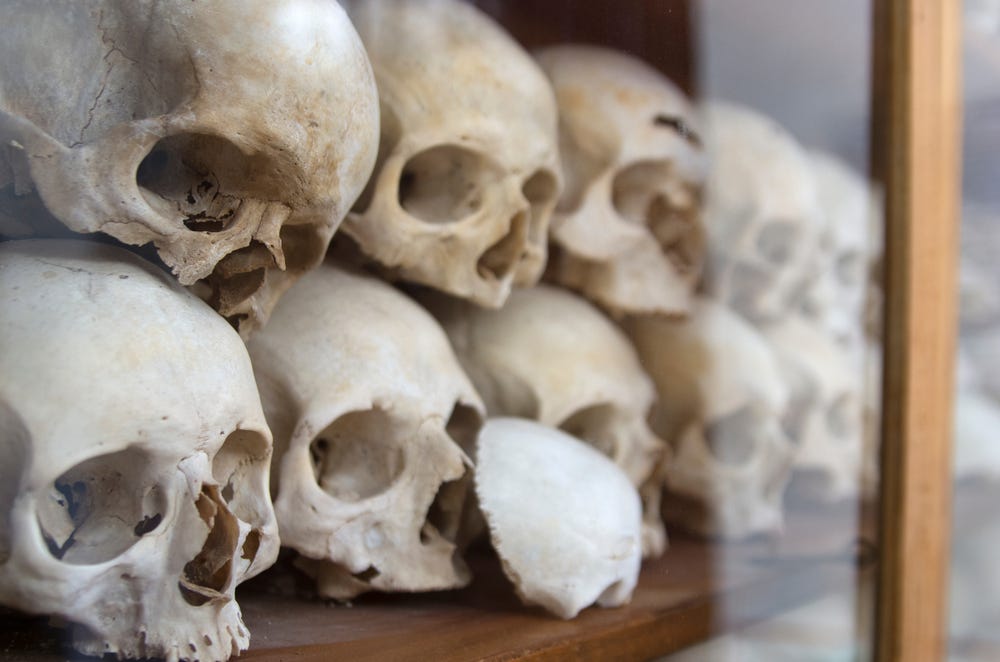
“I see heads that seem real with blood on them, but when I reached out to touch them, they are not there.”—Reverend Mother Mariam, Abbess of Nea Moni
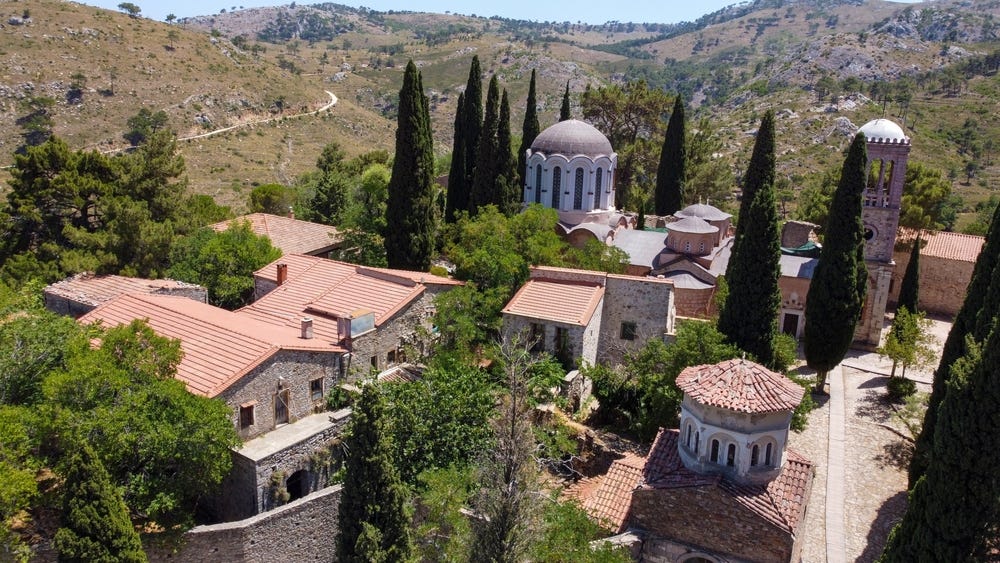
Nea Moni is an 11th-century Greek Orthodox monastery complex, now utilized as a convent and history museum, located on the beautiful Greek island of Chios.
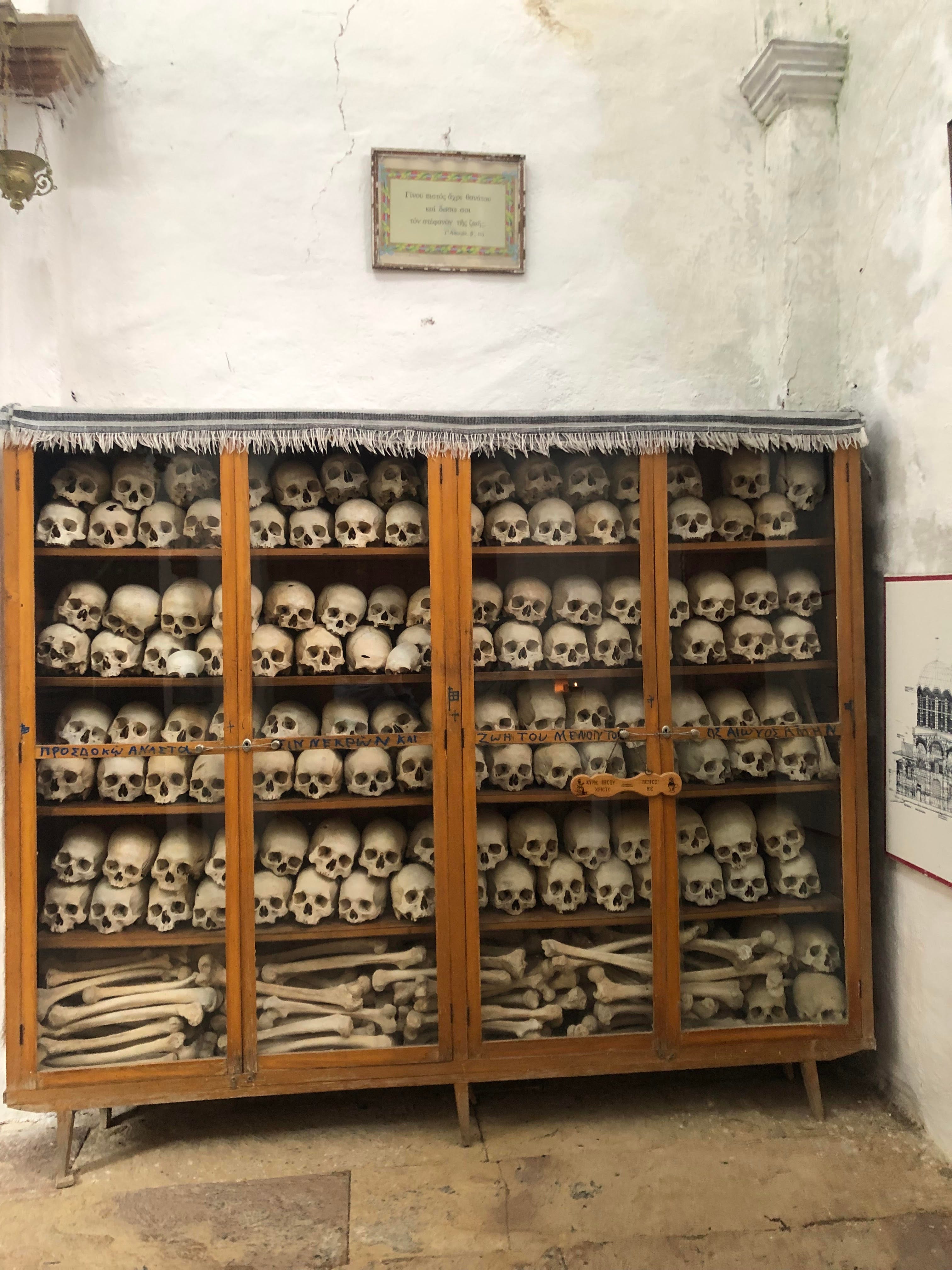
Nea Moni’s ossuary displays the skulls and bones of some of the victims of an 1822 massacre with the words, “I await the resurrection of the dead and life everlasting. Amen.”
As a visitor to Chios between March 18 and 20, I made the journey up the mountain above the city to see the convent, the site of the horrific massacre at the hands of Ottoman Turks during the Greek War of Liberation in 1822.
In the words of Colette Burton, who, in 2023, published her master’s degree thesis for Brigham Young University entitled “Remembering Martyrdom: Delacroix’s Massacre of Chios as a Site of Collective Memory”:
“Three thousand refugees hid in the abbey of Nea Moni, but when Turkish soldiers penetrated the outer wall, all were killed. Another three thousand refugees hid at [the monastery of] Agios Minas. According to records, every one of these refugees died when, on Easter Sunday, April 14th, Turkish troops burned the sanctuary to the ground with the refugees trapped inside.”
I photographed the skulls and bones of some of the victims of the massacre which are now kept in a glass cabinet in a small chapel within the monastery complex. The experience was heart-wrenching and chilling.
Greece celebrated its Independence Day on March 25, a date long associated with the start of the 1821 Greek War of Independence against Ottoman rule. However, the revolution actually began weeks earlier (in mid-February), unfolding then across multiple regions through a series of uprisings.
On February 22, 1821, Alexander Ypsilantis (leader of the secret revolutionary organization Philiki Eteria) launched the first military actions in the Danubian Principalities. Although these initial efforts were unsuccessful, they should be situated around the wider context of multiple other revolts which were beginning in Greece about the same time.
March 25 is symbolically significant. It coincides with the Greek Orthodox celebration of the Annunciation and is also the day that independence was officially proclaimed in 1822. The date was formalized as a national holiday in 1838 through a royal decree and has been subsequently observed as the official Independence Day for Greece.
The road to Greek independence was marked by the selfless sacrifice and courage of many Greek women and men. The 1822 Chios massacre, in the midst of a period when atrocities by the Ottoman Turks against Greek civilians were numerous and vicious, was one of the bloodiest.
Approximately three-quarters of the Chios’ population (which totaled 120,000) were killed, enslaved, or died of disease after thousands of Turkish troops landed on the eastern Aegean island to end a rebellion.
How did the Ottoman occupation of mainland Greece and Anatolia/Asia Minor (present-day Turkey) even begin?
The Greek presence in Asia Minor dates back to the 11th century BC. The cities in Anatolia were built and enriched by Greeks, Armenians, Assyrians and other indigenous peoples.
Before the Ottoman invasions, the Balkans, Greece, Anatolia, Egypt, Syria, the Holy Land, and North Africa, amongst other areas, were part of the Greek-speaking Byzantine/Eastern Roman Empire.
In the 11th century, Turkic Muslim tribes from Central Asia invaded Anatolia, which was then part of the Byzantine/Eastern Roman Empire. They would later, in the 13th century, form an Ottoman state in western Anatolia.
In the 7th century, Arab Muslims began attacking and capturing then-Greek-ruled, majority-Christian Levantine lands. Ottoman Turks invaded and captured Constantinople (Istanbul) in the 15th century, bringing an end to the Byzantine Empire.
For more than 600 years, from its Anatolia founding in 1299 through its end in 1922, the Ottoman Empire occupied nations across three continents. These nations included most of the Balkans, (such as Greece, Bulgaria, Serbia, Albania and Romania), Hungary, Cyprus, Egypt, Syria, Jordan and Israel (then part of southern Syria), Lebanon, some of Arabia and a considerable amount of North Africa.
During this period, many crimes were systematically committed against non-Muslims, including:
The ghulam system: the enslavement, conversion, and training of non-Muslims to become warriors and statesmen;
The devshirme system: the forced recruitment of Christian boys who were abducted from their families in Christian countries, converted to Islam and enslaved for service to the sultan in his palace and to join his janissaries (“new corps”);
Forced conversions to Islam resulting from social, religious and economic pressure and persecution;
The sexual slavery of women and children, deportations and massacres.
Ottomans also abducted Europeans primarily through the Mediterranean slave raids by both Barbary corsairs and land-based raids by the Crimean Khanate. Most victims were captured from coastal towns across Europe.
Key locations for the Ottoman abductions of European women and children included the Mediterranean Sea and coastline (Italy, Spain, Portugal, France, and islands like Malta), Northern Atlantic (raids reached as far as Iceland in 1627), Eastern Europe (Russia, Poland-Lithuania, and Moldova), and the Balkans (Greece, Serbia, Bulgaria, and others.) Some of the captives were sold in the markets of Constantinople, but many were taken to other Ottoman markets such as North Africa. The Christian boys abducted from those nations were the primary source for the Ottoman devshirme system.
The period of Ottoman occupation in mainland Greece lasted from the mid-15th century until the successful 1821 Greek War of Independence. The First Hellenic Republic was proclaimed in 1822. The Greeks who remained under Ottoman control in Anatolia (today’s Turkey) continued to suffer as second class subjects of the empire. The indigenous Christian residents of Anatolia were largely annihilated as a result of centuries-long Islamic oppression that culminated in the 1913-23 genocide in Ottoman Turkey.
After nearly four centuries of Ottoman occupation, Greeks initiated a war of liberation in 1821. Ottoman Turks responded with unmitigated brutality, massacring or enslaving thousands of innocent people.
In 1822, a year into Greece’s war of independence, the Ottoman sultan sent his commander-in-chief of the navy (the Kapudan Pasha), Kara Ali, to Chios with 15,000 men. The massacre began in late March, accelerating the following month, following the arrival of a massive Turkish fleet. The Ottoman troops slaughtered or sold into slavery tens of thousands of islanders.
In 2022, Richard Calvocoressi, the descendant of a prominent Kampos family from Chios, wrote in the New Statesman an article entitled “My family and the forgotten massacre of Chios.”
He noted that the bloodbath was “essentially a holy war.” His three-times-great-grandfather Ioannis Kalvokoresis “had his fingers chopped off one by one for refusing to hand over gold to his captors and for resisting conversion to Islam.” Ioannis’s “90-year-old mother, her arms outstretched in the form of a cross, was walled up alive for refusing to renounce her faith.”
Brutality raged across the island. Ottoman troops were reported to have brought severed heads and ears of Greeks to their commander, seeking monetary rewards or recognition for their actions.
Sexual violence was rampant during the massacre. Burton writes that “in remembering the innocence of the young Chiot girls in his pre-massacre visit, the French Count Mario de Marcellus mourned over their fate: ‘Poor young girls, of the most beautiful island in the sea, what has become of you?’” The count’s language is reminiscent of the lamentations in the third chapter of Isaiah describing the fall of the ‘beautiful daughter of Zion.’ One can easily equate the biblical descriptions with the fate of Chios:
“‘And it shall come to pass, that instead of sweet smell there shall be stink; and instead of a girdle a rent; and instead of well set hair baldness; and instead of a stomacher a girding of sackcloth; and burning instead of beauty. Thy men shall fall by the sword, and thy mighty in the war. And her gates shall lament and mourn; and she being desolate shall sit upon the ground.’
“With men fallen by the sword and the stink of death in the air, the formerly prosperous island was in the process of being razed to the ground. Burning had replaced beauty. The rape imagery found in the rent girdles and lamenting gates described in Isaiah further speaks to the sexual violence experienced by Chiot women. More concretely, these verses seem to describe Delacroix’s painting with desolate women sitting on the ground, clothes rent. Around them, men have fallen by the sword, and their beautiful island burns in the distance. Like the captive daughter of Jerusalem, these women would later find themselves sold ‘like animals’ in the markets of Istanbul, Smyrna, and Asia Minor.”
Alexander M. Vlastos wrote about the 1882 Chios massacre in his book, “A History of the Island of Chios A.D. 70-1822”:
“The Turks, two days after the arrival of the fleet, when they had finished burning the churches and houses, and had killed, or made prisoners all the inhabitants of the town, still thirsting for Christian blood, turned their steps to the mountains. Again everywhere blood, everywhere murder, everywhere droves of women and children being dragged into captivity. They kill or burn 3000 Christians, who had shut themselves up in the monasteries of Néa Monè and Agios Minas; they dishonour the nuns of Chalandra and Kalimasià and carry them off. Howling curses, they heap up Christian bodies at each step. Having exterminated the inhabitants of St. George and Anavato, they proceed to the highest parts, in search of further victims.”
In June of 1822, an attempt was made by Greek naval powers to stop Kara Ali’s fleet from leaving Chios and strengthening the Ottoman navy elsewhere. Led by Constantine Canaris of Psara, thirty-two men crept into the harbor and boarded the Turkish ship. In the morning of June 19, the flag-ship exploded, killing over 2,000 men, as well as Kara Ali himself, in the blaze.
“By the end,” writes Burton, “out of roughly 120,000 Chiots, 25,000 were dead from violence or plague, 45,000 had been sold into slavery, and roughly 20,000 were left alive on the island. The rest, a number of about 30,000, had become refugees on the continent in what would later be known as the Chiot diaspora.”
According to Chiot historian Philip P. Argenti, nine-tenths of the island’s 120,000 were massacred or sold into slavery, leaving, according to more liberal estimates, 10,000 survivors.
The massacre shocked Europe. Volunteer organizations collected money to support the Greek Revolution by providing arms and weapons while many Westerners arrived in Greece to fight the Ottomans.
Many famous artists dedicated their works to this heinous event. The French painter Eugene Delacroix immortalized the massacre in his 1824 Massacre at Chios, which hangs in the Louvre. Today, a replica of Delacroix’s painting resides on the island inside the entrance of the Chios Byzantine Museum, located in a converted mosque built on the ruins of a Christian church.
Furthermore, Victor Hugo’s poem about the massacre, the Child/L’enfant, highlights the brutality that the victims suffered at the hands of the Ottomans.
Since its founding in 1923, Turkey has continued its attempts at wiping out Greeks from the region—from the genocide of 1913-23 in Anatolia to the pogrom against Greeks in Constantinople in 1955—not to mention the forced deportations of Greeks from the city in1964 and the 1974 military invasion of Cyprus. The atrocities go on and on.
Chios is just 9 nautical miles (around 16 km) from Turkey, which makes the island an attractive and easy-to-reach tourist spot for Turkish citizens. However, the Greek government should turn this gorgeous island into an international tourism center, publicize its unique beauty on a global scale, and not allow it to rely on Turkish tourism solely for its survival.
Should the Greek government expend even a small amount of effort to make known on a broader scale the island’s beauty, including the exclusive location of the Mastic tree, the products of which are known and prized for their excellent healing properties, its local merchants might be released from dependence on the Turkish market into their own nook on the world stage.
Greeks were occupied in mainland Greece by Ottoman Turks for 400 years. They became second class subjects of an Islamic empire, paying the “jizya” tax to the same Muslim overlords who frequently abducted their children to forcibly convert them to Islam and turn them into soldiers (janissary troops), or forcibly marry them and make them their “brides,” sex slaves, or domestic slaves. This only ended when the Greeks fought back to end the Ottoman occupation starting in 1821.
The history of Greeks—both in mainland Greece and Anatolia as well as the Levant—should be objectively taught at schools in the West as a case of an indigenous people who suffered for centuries at the hands of a brutal, occupying force, gaining their freedom only after winning a fierce war of independence which they themselves fought.
Uzay Bulut is a fellow at the Ideological Defense Institute.
What Is IDI ?
The most trusted source of information on the Middle East, Islam, and the ideological threats facing the West.
Subject-matter experts, former Muslims, Arab Christians, and Western thought leaders, coming together to equip policymakers to prevent destructive foreign ideas from being translated into law, restore confidence in the biblical principles that built the West by empowering the Church to reengage the public square, and provide the public with solid analysis to combat the confusion that is making the West vulnerable.
Such a horror these endured . You’re right it must be known and told in the West. Thank you for writing this.
The Greek struggle for independence highlights Islam's intention to wipe out all other faiths. As such it is unwelcome knowledge to Western elites.