


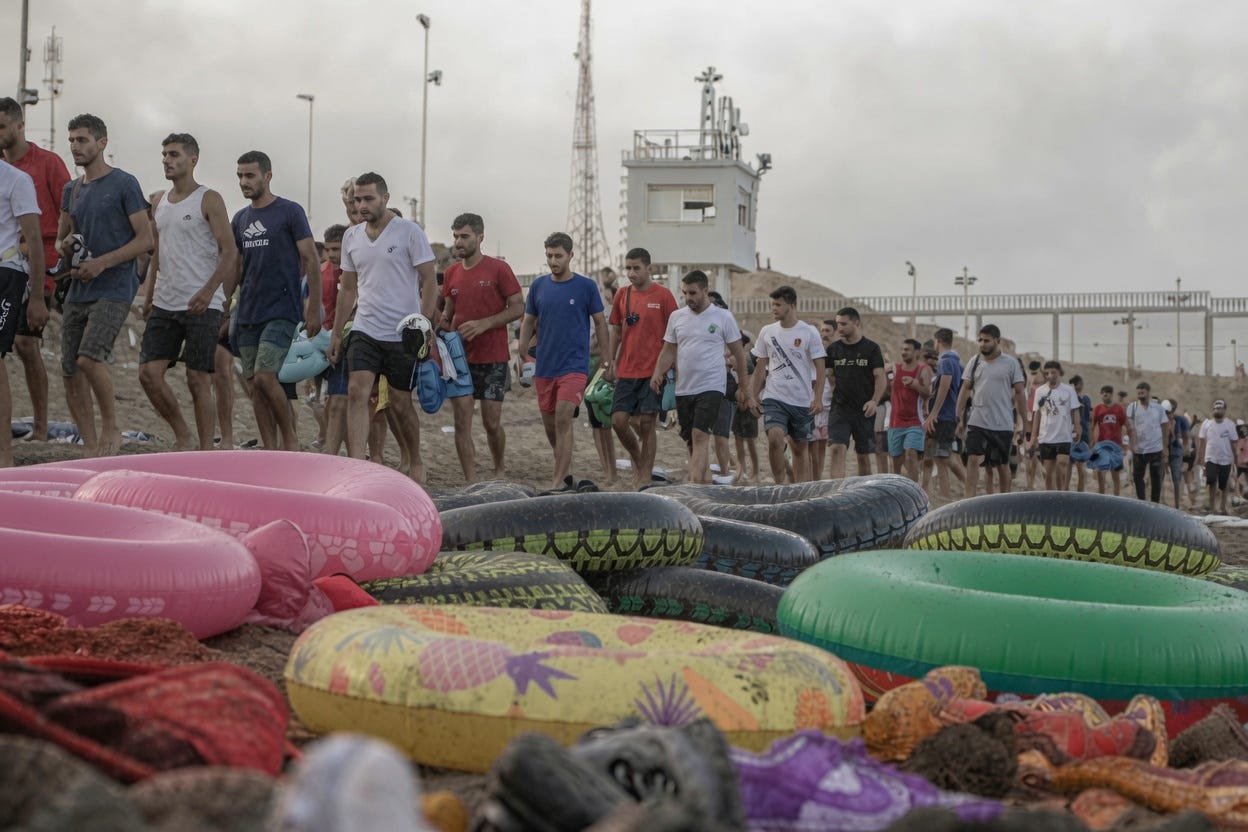
On July 30, in less than 24 hours, an estimated 60,000 Moroccans crossed into the Spanish enclave of Ceuta. The overwhelming majority were young men in their teens and twenties, headed for what they believed was the European dream.
Videos circulating online showed Moroccan border guards allowing people to move toward the border. Some footage appeared to show security officers directing migrants where to go and how to cross. On the Spanish side, the small contingent of border guards was quickly overwhelmed. Parts of the fencing collapsed under the pressure. Ceuta has just 85,000 residents, yet in a single day it faced a migrant influx equal to nearly 80 percent of its population.
The Moroccan government offered no meaningful public explanation. There was no national appeal urging citizens not to travel north. No warning that the journey was dangerous. No visible effort to stop the movement. The authorities simply watched.
As a Moroccan, I know how Morocco’s security apparatus functions. The country is one of the most tightly monitored states in North Africa. The Makhzen, Morocco’s powerful state establishment, maintains an extensive network of intelligence and security services. Large gatherings, organized movements, and transportation of thousands of people never escape official attention. Looking at what unfolded in Ceuta, it is difficult to avoid the conclusion that this operation was, at the very least, tolerated.
In May 2021, approximately 8,000 migrants crossed into Ceuta after Spain admitted Brahim Ghali, the leader of the Polisario Front, for medical treatment. Morocco considered Spain’s decision a hostile act because Ghali leads the movement challenging Morocco’s sovereignty over Western Sahara. European officials interpreted Morocco’s response as deliberately relaxing border controls to send Spain a political message.
The current crisis appears far larger.
Thousands of people traveled from different regions of Morocco to the north. Social media pages openly encouraged people to head toward Ceuta. Buses, trucks, and private vehicles transported migrants across hundreds of kilometers. Anyone who has driven through Morocco knows the country’s extensive network of police and gendarmerie checkpoints. Drivers are routinely stopped, identification is checked, and vehicles are inspected.
How did thousands of people travel across the country without intervention?
Videos showed trucks unloading migrants in the presence of gendarmes who neither arrested the drivers nor dispersed the crowds. Other footage showed overloaded vehicles carrying dozens of people toward the border. Journalists interviewed migrants who claimed Moroccan police pointed them toward crossing points instead of turning them back.
At the same time, King Mohammed VI was in Fnideq, only seven kilometers from Ceuta, officially to mark Throne Day celebrations. Whether coincidental or not, the timing inevitably raises questions. It is difficult to believe that tens of thousands of people could converge so close to the King’s location without every layer of Morocco’s security apparatus being fully aware.
Some argue Morocco was trying to reclaim Ceuta and Melilla. But if Morocco wishes to pursue sovereignty over those territories, there are only two avenues: diplomacy through international institutions or military force. Sending tens of thousands of unarmed civilians into Spanish territory accomplishes neither. The migrants were walking directly into the hands of Spanish police, where many were returned.
The more plausible explanation is political pressure.
Only days earlier, Spanish Prime Minister Pedro Sánchez visited Algeria to revive bilateral relations after years of diplomatic tension. Algeria remains Morocco’s principal regional rival and the main supporter of the Polisario Front. Reports of renewed energy cooperation inevitably alarmed Rabat. King Mohammed VI has repeatedly stated that Morocco judges its international partnerships through the lens of the Sahara issue. Countries that support Morocco’s position are considered partners. Those that do not should expect consequences.
Migration has become one of Morocco’s strongest bargaining chips.
Spain also provided an opportunity. Sánchez’s government has pursued more permissive immigration policies, including the regularization of hundreds of thousands of migrants. Recent court rulings have strengthened procedural protections for certain migrants arriving by sea. Social media pages promoted the idea that reaching Spain meant obtaining legal status and eventually remaining in Europe. For young Moroccans facing unemployment approaching 30 percent among those aged 15 to 24, that message was powerful. Thousands believed their lives could change simply by reaching Ceuta.
Spain’s policies may have acted as an incentive, but someone had to allow the movement to happen.
The human cost has been devastating. Dozens of people reportedly died trying to reach Spain, with some estimates approaching seventy fatalities. The final number may prove even higher. The tragedy becomes even more striking when viewed alongside the King’s Throne Day speech delivered only a day earlier. The speech celebrated Morocco’s economic growth, industrial expansion, tourism, stability, and international prestige. Yet within twenty-four hours, the world watched tens of thousands of Moroccans risk death to escape that same country.
The images erased years of public relations efforts. Morocco has presented itself as a stable investment destination, a tourism success story, a trusted Western partner, and a host of major international sporting events. Instead, television screens showed desperate migrants. Those images will shape international perceptions far longer than any government promotional campaign.
Perhaps Morocco will secure political concessions from Spain. Sánchez leads a fragile coalition and may choose compromise over confrontation. But if political gains come at the cost of the country’s reputation and the lives of its own citizens, the price is extraordinarily high.
From Rabat to Gaza, the cheapness of human life is a constant across the Islamic world, and so is the wager placed on how much others value it. Morocco would never attempt this maneuver against Algeria, because Algiers would feel nothing at the sight of desperate young men pressed against its fence; the gambit works only against Spain, precisely because Spaniards can be counted on to treat the migrants as human beings.
It is the same calculus Hamas makes when it fights from behind civilians: the strategy prices its own people at zero and bets everything on the enemy’s conscience.
This instrumental view of the human being flows from an ideological inheritance that has long cast individuals as deployable instruments of a higher cause, assets of the collective first, persons second. A state shaped by that inheritance can watch sixty thousand of its young walk toward the sea and see not a tragedy, but a lever.
Brother Rachid is a senior fellow at the Ideological Defense Institute
This spectacle was obviously a political maneuver using human beings as pawns in an invasion. The goal was not the immediate one but rather part of a long-range strategy. The individuals in the invasion were healthy and chosen to be able to endure the effort involved in the invasion. No one should confuse invasion with immigration. This was a surprise attack, without question. It proves two obvious things. Morocco was organized for it and Spain was not prepared for it.
Thank you - that is a fantastic piece!