


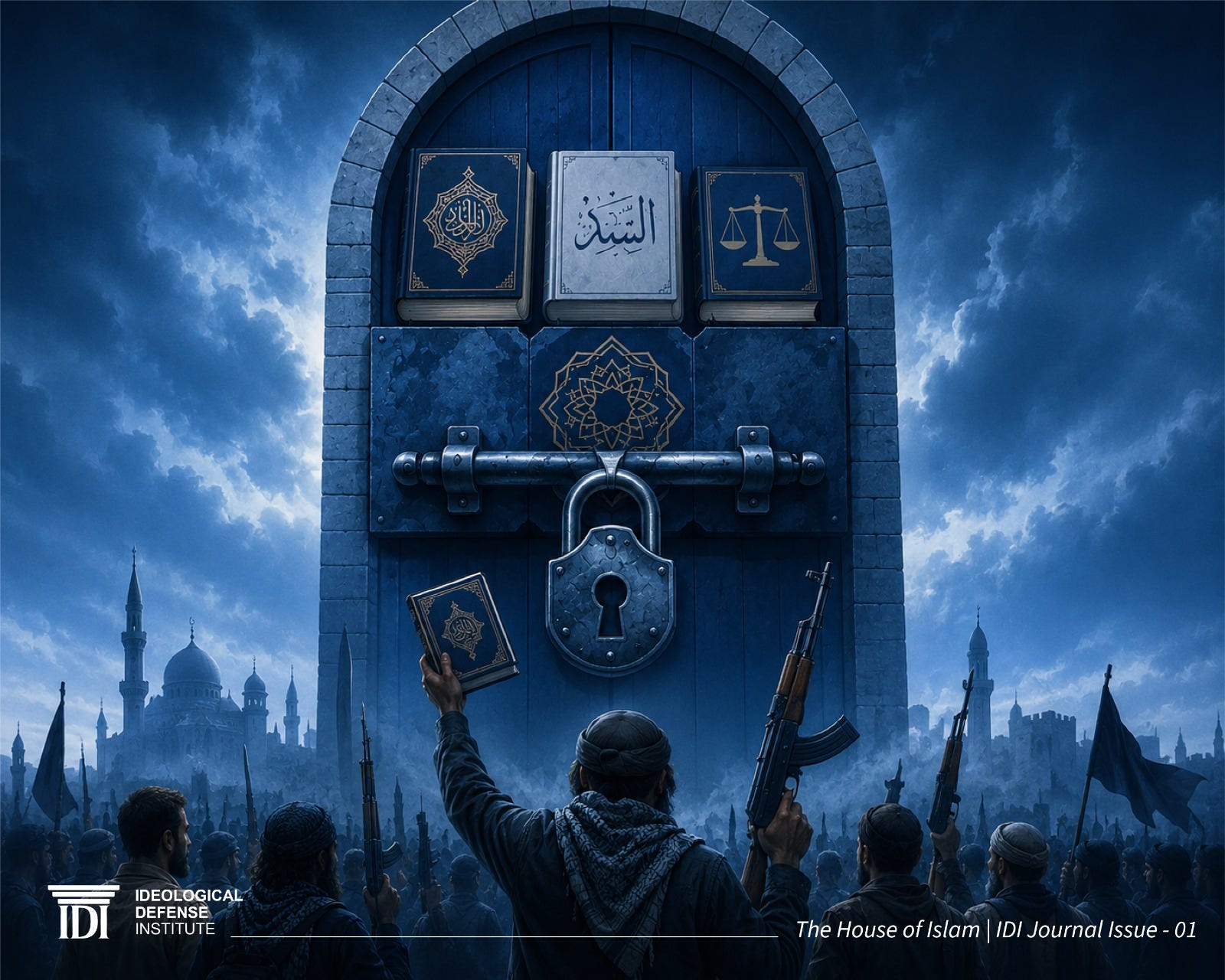
The Islamic theological-juridical system rests on three layers of authority in strict hierarchical relationship. The first and foundational layer is the Qur’an, understood within all schools as the direct, verbatim word of God, preserved without alteration and binding for all time. This is not a contested position even within the self-described reforming movements; the divine origin and perfect preservation of the Qur’an is the single most consistently enforced doctrinal position across all schools and centuries. Any challenge to the Qur’an’s divine authorship, completeness, or eternal applicability is treated as kufr, unbelief, of the most serious variety.
The second layer is the Sunnah, the recorded words, actions, and tacit approvals of Muhammad, transmitted through chains of narrators and collected in the canonical hadith compilations. Where the Qur’an commands prayer without specifying its form, the Sunnah supplies the form; where it commands punishment for theft without specifying the threshold, the Sunnah supplies it. Its authority is treated as effectively divine because Muhammad’s conduct is understood as divinely guided. Rejection of the Sunnah as a source, as the Qur’anist movement attempts, is treated by all four Sunni schools and by Shia jurisprudence as bid’ah (heretical innovation) at minimum, and apostasy in many rulings.
The third layer is fiqh, the jurisprudential tradition produced by the great legal schools over the first four centuries of Islam. The four Sunni schools (Hanafi, Maliki, Shafi’i, Hanbali) and the Shia Ja’fari tradition systematize the rulings derivable from the Qur’an and Sunnah into a legal architecture covering worship, commerce, family law, criminal penalties, governance, and the law of jihad. Fiqh is human interpretation, a point reformers have used as an entry point for change, but its millennium of accumulated consensus (ijma) renders it authoritative. To reject established fiqh is to reject the consensus of the scholars, which is itself treated as a form of heresy.
What makes this system distinctive is how it handles interpretive authority. The key concept is ijma. Jurisprudence treats the consensus of qualified scholars as binding, derived from the hadith “My community will not agree upon an error.”¹ Once a ruling achieves consensus over centuries, it becomes effectively irreversible: a scholar who argues the consensus was wrong must either charge the scholars themselves with error, bordering on challenging the prophetic promise, or claim that the textual evidence was misread, which requires overturning centuries of accumulated interpretation. A scholar who argues that a ruling was too restrictive, that the death penalty for apostasy was historically contingent and no longer applicable, must overcome the full weight of ijma, risking the charge of bid’ah or riddah. A scholar who argues that a ruling applies more broadly or forcefully, that individual Muslims may carry out the apostasy penalty when the state fails to, occupies murkier ground, and the system has no equivalent mechanism for censuring his maximalism. The interpretive space is therefore bounded on the minimalist side by sharp, well-enforced walls and left largely open on the maximalist side. The logical consequence is that the system’s internal pressure consistently pushes toward maximalism rather than restraint.
The Asymmetry
The record of the system’s enforcement activity against those who reduce textual authority is extensive, consistent across political contexts, and institutionally rooted. The following cases represent a systematic pattern across multiple countries, decades, and legal traditions. Farag Foda, a secular Egyptian intellectual who argued against the imposition of sharia, was assassinated in June 1992. Five days earlier, the Al-Azhar Scholars’ Seminar had published a statement declaring his political current a danger to the nation, and a senior Al-Azhar figure, Mahmoud Mazrou’a, had published an article branding him an apostate who had dedicated his life to fighting Islam. In a 2017 interview, Mazrou’a described meeting Foda’s future killers the night before the murder: they asked the ruling on killing an apostate; he told them it must be done, and that if the ruler will not act, the obligation falls on ordinary Muslims.² At trial, the senior Al-Azhar scholar Muhammad al-Ghazali volunteered for the defense, testifying that Foda was in the ruling of an apostate, that apostates are forfeit of blood, and that the defendants’ only offense was “encroachment on the authority of the judge in applying the hadd.”³ The killers confirmed that this testimony was sufficient for them. They used it correctly, seeking scholarly authorization, receiving it through legitimate channels, and acting on it as religious compliance.
Access the full Journal here:

