


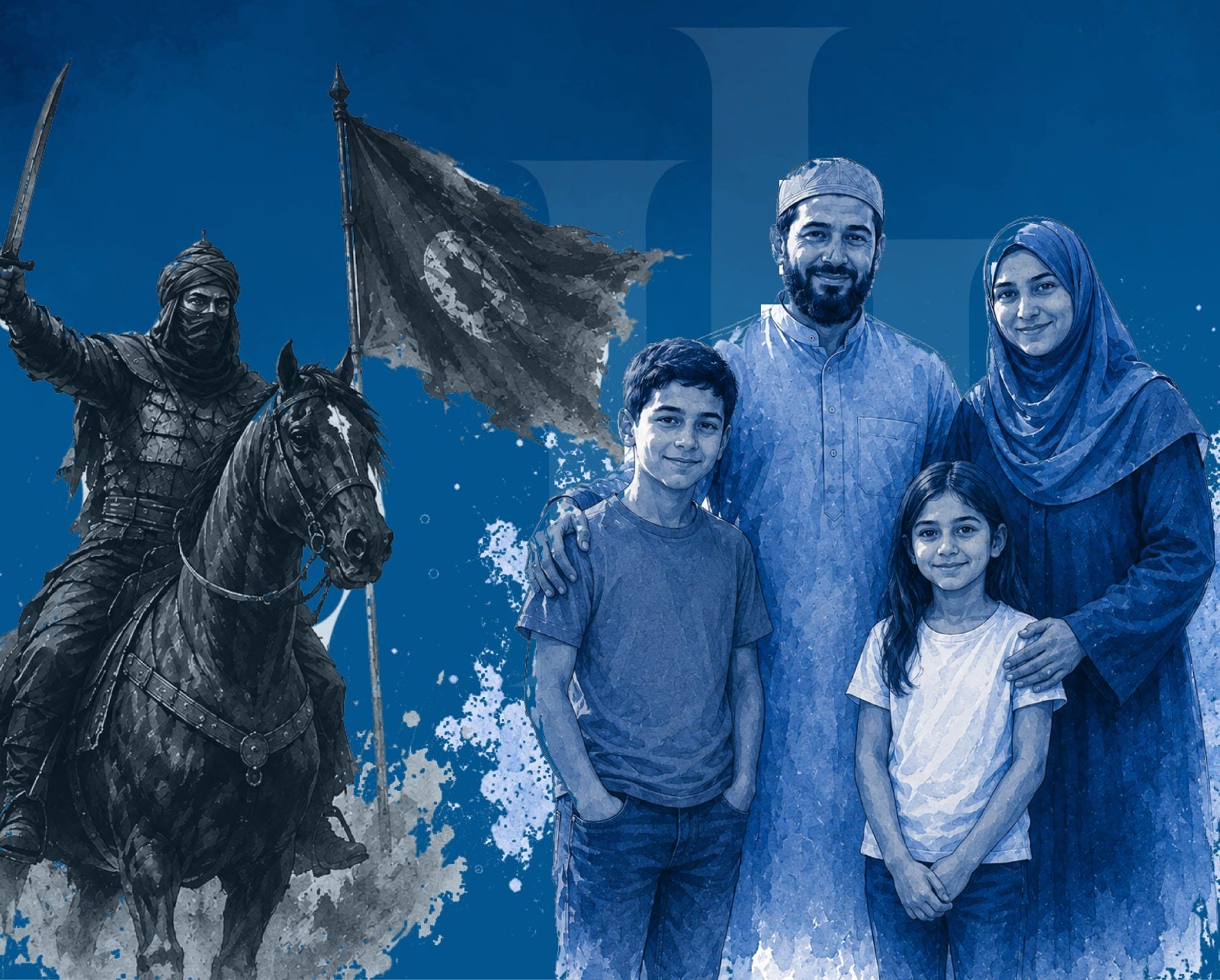
An Afghan from the province Nuristan – formerly Kafiristan (“land of infidels”) told me his story: in early 1896, his region was the last to be conquered and folded into the Emirate of Afghanistan. His great-grandfather had gathered his eight sons – who at that time still worshiped the ancient gods and goddesses of the region – to discuss the choice their invaders had set before them: accept Islam or die.
Beginning with the eldest, son after son announced his choice: death. Their father begged his two youngest sons to accept Islam in order to carry on the family lineage. The man sitting across the table from me was the grandson of the youngest who had agreed to his father’s request and, not long after, had watched helplessly as six of his brothers were murdered for refusing to submit to Islam.
I was horrified. I was also confused. The man before me presented as a Muslim. He worked for a Muslim organization. His headscarf-adorned wife fussed over prayer times and whether processed foods contained gelatin or other forbidden ingredients.
I leaned forward and quietly asked, “So, are you still a Muslim?”
He told me that he was.
“Why?” I pressed boldly. “You live in America now. You are free. You can be whatever you want. Do you really believe in Islam, even after six of your grand-uncles were murdered for rejecting it? Muhammad killed people for rejecting Islam – the Qur’an tells Muslims to do that. Is that the prophet you want to follow, and the god you want to worship?”
He just shrugged. He barely knew me; what could he possibly say? Islam punishes apostasy by death. Even here in the Land of the Free, leaving Islam comes at great cost. In his case, it would start with his paycheck and his wife. And then – who knew what the total cost would be?
Even so, it astounds me that Islam maintains its hold over descendants of those who submitted to it under duress. His case is not unique. The Islamic doctrinal sources make clear that the vast majority submitted unwillingly. Even the Qur’an acknowledges Islam’s spread by force:
“He it is Who has sent His Messenger with guidance and the religion of truth to make it victorious over all religions even though the mushrikun (polytheists) hate it.”¹
How many submitted by faith, and how many for other reasons? If not by faith, how long before it collapses from within?
Motivations among the Quraysh of Mecca
According to The Life of Muhammad, Alfred Guillaume’s English translation of Sirat Rasul Allah generally attributed to Ibn Ishaq, even Muhammad himself needed convincing. After the incident in the cave, Muhammad thought he had been possessed. He tried to commit suicide.²
It was his wife Khadijah and her cousin Waraqa who convinced him he was a prophet³ – their efforts likely saved his life.
Clearly some were true believers. Muhammad bestowed on his best friend Abu Bakr the moniker “al-Siddiq” – The Loyal – and indeed Abu Bakr remained loyal even after Muhammad’s death.⁴ Ali, who lived with Muhammad as a son at the time, was ten years old when he submitted to Islam.⁵ Bilal was abused for his faith in Muhammad, and he won his freedom from slavery because of his loyalty.⁶
Family ties played their part as well. Umar submitted to Islam in remorse for punching his sister.⁷ Muhammad’s uncle Hamza joined in anger at seeing his nephew mocked.⁸ Two other uncles, Abu Talib and Abbas, were supportive of Muhammad, but there is no solid indication that either accepted his claim of prophethood. After 13 years of preaching in Mecca, Muhammad’s followers numbered about 125, including women and children.
Most Meccans submitted years later, when Muhammad surrounded the city with ten thousand warriors from among his conquered peoples across Arabia. Abu Sufyan, Mecca’s chief, came out to negotiate.
[Muhammad] said, “Woe to you, Abu Sufyan, isn’t it time that you recognize that I am God’s apostle?”
[Abu Sufyan] answered, “As to that I still have some doubt.”
[Abdullah ibn Abbas] said to him, “Submit and testify that there is no God but Allah and that Muhammad is the apostle of God before you lose your head,” so he did so.⁹
After witnessing Muhammad’s vast army, Abu Sufyan returned to Mecca and told his people, “This is Muhammad with ten thousand, wearing iron, so submit!”¹⁰ Most did, lining up before Muhammad to make their pledges.¹¹
Motivations among the men of Medina
The men of Medina invited Muhammad to their city to end their generations-long civil war, saying, “No tribe is so divided by hatred and rancour as [ours]. Perhaps God will unite them through you. So let us go to them and invite them to this religion of yours, and if God unites them in it, then no man will be mightier than you.”¹²
Muhammad united both armies, turning their warriors outward to conquer Arabia and beyond.
At the battle of the trench, one of his men complained, “Muhammad used to promise us that we would eat the treasures of Chosroes (the Persian Emperor) and Caesar and today not one of us can feel safe in going to the privy!”¹³
Is this a man motivated by faith, or by the promise of war booty? Muhammad complained a great deal about the “hypocrites”; the Qur’an contains 37 instances of the word “hypocrite” in its various forms.¹⁴
Slaves submit and win their freedom
In Muhammad’s siege of Ta’if, his herald called out, “Any slave who comes down from the fortress and comes out to us, is free!”¹⁵
Sahih Muslim tells us:
“There came a slave and pledged allegiance to Allah’s Apostle (peace be upon him) on migration; he (the Prophet) did not know that he was a slave. Then there came his master and demanded him back, whereupon Allah’s Apostle (peace be upon him) said: Sell him to me. And he bought him for two black slaves, and he did not afterwards take allegiance from anyone until he had asked him whether he was a slave (or a free man).”¹⁶
Slaves could expect to be set free if Muhammad accepted their pledge to Islam.
Submission of Arabs from other tribes
The Islamic historian al-Waqidi lists more than 70 raids and military expeditions led or dispatched by Muhammad during the ten years between his migration to Medina and his death in 632 A.D.¹⁷
Muhammad offered the defeated polytheists only two options: submit to Islam or die.¹⁸ Jews and Christians were offered a third choice: to pay tribute (jizya) of an amount intended to keep them small and powerless.¹⁹ The first jizya was imposed on the Jews of Khaybar: half the harvest every year. In the desolate sands of Arabia, losing half the harvest must have left little on which to survive.
Motivated by Fear
After Muhammad’s conquest of Khaybar – consisting of seven towering fortresses on tops of mountains, and ten thousand armored warriors²⁰ – few dared fight him. Town after town and tribe after tribe submitted to his army and to Islam without a fight.²¹ In contrast to the 125 followers he garnered during his 13 years of preaching in Mecca, Muhammad amassed tens of thousands over the next ten years, after having acquired Medina’s battle-seasoned warriors who rode out to attack, on average, more than seven times each year.
Islam’s Apostate Wars
Any doubt that the overwhelming majority of Arabs submitted unwillingly can be dismissed by the accounts of the Apostate Wars. Ibn Ishaq writes that Aisha used to say, “When the apostle died the Arabs apostatized and Christianity and Judaism raised their heads and disaffection appeared.”²²
Abu Bakr, as the newly-appointed Caliph, spent nearly a year leading the army of Islam throughout Arabia to re-conquer them and bring them back into submission.²³ That is not faith – it is nothing but brute force.
What about Islam’s Narrators and Chroniclers?
Signs of disbelief can be found even among the narrators and chroniclers Islam’s history – in the very sources Muslims look to for their religious doctrines.
Ibn Ishaq recounts that, when rebuilding the Ka’ba, stones with inscriptions were found. Across the ancient world, it is common to find stones repurposed from one structure to another, but one allegedly read, “grapes cannot be gathered from thorns.”²⁴ Christians will recognize these words as Jesus’ warning about false prophets: “Are grapes gathered from thorn bushes, or figs from thistles?”²⁵ Not only would this suggest that a stone used in the construction of the Ka’ba – allegedly built by Abraham and Ishmael – had been repurposed from an old church, but imagine: Jesus’ famous warning about false prophets carved in stone on the Ka’ba in Mecca!
Muhammad Suffers the Qur’anic Punishment for False Prophets
The punishment for fabricating verses in the name of Allah is spelled out in the Qur’an as follows: “And if Muhammad had made up about Us some false sayings, We would have siezed him by the right hand, then We would have cut from him the aorta.”²⁶
According to Sahih al-Bukhari – the most trusted source for Sunni Muslims, second only to the Qur’an itself – Muhammad on his deathbed said, “O ‘Aisha! I still feel the pain caused by the food I ate at Khaybar, and at this time, I feel as if my aorta is being cut from that poison.”²⁷
Most people complain of stomachaches. Headaches. Body aches. Dizziness. Fatigue. When was the last time you heard someone complain, “I feel as if my aorta is being cut”? What is the likelihood that this was just a coincidence, that Muhammad just happened to suffer from the exact ailment the Qur’an promises for making up false sayings and attributing them to Allah?
Muhammad at Khaybar: A story replete with oddities
According to Islamic tradition, Muhammad and his army defeated each of Khaybar’s seven fortresses, surrounded by date palm plantations, one by one. Then he accepted a roasted goat (or lamb) as a gift from a Khaybarite woman and invited some of his companions to join him for dinner.²⁸ It was this poisoned meat which caused Muhammad to suffer for the next several years until his death, ultimately making him feel that his aorta was being severed.
How realistic is this story? Is it possible that the man who rose from orphaned shepherd boy to conqueror of Arabia could have been so gullible? Did it not occur to him that she might not have his best interests in mind? Were the corpses of her father, her uncles, and her husband still lying on the ground when she delivered this “gift” to her conqueror?
But there is more. Sahih al-Bukhari reports, “Narrated Sa`d: I heard Allah’s Messenger saying, “Whoever takes seven ‘ajwa dates in the morning will not be affected by magic or poison on that day.”²⁹
Both Medina and Khaybar were famous for their ajwa dates – both were surrounded by large date palm plantations. With ajwa dates all around him, did he he miss his breakfast that morning?
At table, Muhammad took meat from the goat’s foreleg, put a morsel in his mouth, and announced, “Stop! Surely this foreleg informs me that it is poisoned.”³⁰ His companion Bishr had already eaten some of the meat, and subsequently died from it. If the meat informed Muhammad that it was poisoned, why did it not tell him two minutes sooner?
Bishr tells us that he had tasted the poison. “By God, I found that from the bite I ate, and what prevented me from spitting it out was that I hated to spoil your pleasure at your food, for when you swallowed what was in your hand I would not favor myself over you.”³¹ Bishr did not need the meat to talk. But if the meat did not talk, why did Muhammad claim that it had? What other claims of supernatural communications might Muhammad have fabricated?
Muhammad also claimed that women were deficient in intelligence.³² Yet, in this odd story, Muhammad himself is easily outsmarted by a woman – outsmarted unto his own death.
Muhammad called her and asked, “Did you poison the shoulder?”
She said, “Who told you?”
He replied, “The shoulder.”
She said, “Yes.”
He asked, “What persuaded you to do that?”
She said, “You killed my father, my uncle, and my husband. You took from my people what you took. I said to myself, if he is a prophet, he will be informed. The sheep will inform him of what I did. If he is a king, we will be relieved of him.”³³
So, when Muhammad ate the meat, did he fail her test? Given all the oddities in this story, is it even possible that its narrators and chroniclers believed Muhammad was a prophet?
Auf ibn al-Harith: Islam’s First Suicide Killer
At the battle of Badr, Auf ibn Harith asked Muhammad, “O apostle of God, what makes the Lord laugh with joy at his servant?”
[Muhammad] answered, “When he plunges into the midst of the enemy without mail.”
Auf drew off the mail coat that was on him and threw it away: then he seized his sword and fought the enemy until he was slain.³⁴
Why did Muhammad encourage this man to cast aside his protective chain mail coat, thus throwing his life away? Just to see if he could make him do it? To a modern-day military tribunal, this would be a war crime. To a Christian, this deed carries the odor of the deadly sin of pride.
Again, could the narrator of this tale possibly be a faithful, believing Muslim?
Mixed-Up and Heretical Bible Stories
Even the Qur’an itself is full of mixed-up and heretical Bible stories. For example, the Qur’an confuses Moses’ marriage story with Jacob’s. In the Bible, Jacob works for seven years to earn the hand of his bride Leah, then another seven years to win the hand of her sister Rachel.³⁵ Moses is freely given the hand of Zapporah, the eldest of Jethro’s seven daughters.³⁶ Yet the Qur’an says that it was Moses who worked for eight to ten years for the hand of one of two sisters.³⁷ The Prophet Hosea corroborates the story of Jacob’s work tending sheep to win a wife.³⁸
In the Book of Judges we find the story of Gideon testing his soldiers at the river and sending away the vast majority of them, based on whether they lifted the water in the hand to drink or got down on their hands and knees and lapped.³⁹ The Qur’an tells this story as well, but attributes it to Saul.⁴⁰
The Qur’an’s Angel Gabriel addresses Maryam – the Arabic name for Mary, the mother of Jesus – as “sister of Aaron” – apparently confusing Maryam with Miriam, the sister of Moses and Aaron who lived some 1400 years earlier.⁴¹ The Qur’an also calls Maryam the wife or woman of Imran.⁴² Islam rejects the notion of Jesus’ mother ever having a husband. Mary’s father was Joachim – Miriam’s father was Amram.
The Qur’an recounts a story of the boy Jesus breathing life into a clay bird, which then flies away.⁴³
This is from the heretical “Infancy Gospel of Thomas.”⁴⁴ It was much too late to have been written by Thomas, and it portrays the boy Jesus as a rascal – by his word, killing two boys who annoyed him. The Church declared this work heretical for good reason. Yet, its story found its way into the Qur’an.
The Islamic Dilemma
The Qur’an claims Jesus as a prophet who performed miracles; however, it does not contain a single one of Jesus’ teachings. Rather, it denies the crucifixion⁴⁵ – in spite of extensive historical evidence for it. Moreover, the Qur’an itself repeatedly affirms the authority, authenticity, and preservation of the Bible. This creates an inescapable dilemma for Muslims: if the Bible is correct, then the Qur’an is false, because the Qur’an contradicts the Bible. If the Bible is false, then the Qur’an is false, because it repeatedly confirms it. For details see: The Quran, the Bible, and the Islamic Dilemma (David Wood)
These are only a few examples of errors, mix-ups, and contradictions in the Islamic sources. The stockpile of evidence suggests that the “unlettered prophet” was sabotaged by his own chroniclers.
One did. Abdullah ibn Sa’d ibn Abi Sarh al-Amiri, Muhammad’s scribe, left Islam and started saying, “I used to direct Muhammad wherever I willed. He would dictate to me ‘Most High, All-Wise’, and I would write down ‘All-Wise’ only. Then he would say, ‘Yes it is all the same.’ On a certain occasion he said, ‘Write such and such’, but I wrote ‘Write’ only, and he said, ‘Write whatever you like.’” So when this scribe exposed Muhammad, he wrote in the Qur’an, “And who does greater evil than he who forges against God a lie, or says, ‘To me it has been revealed’, when naught has been revealed to him.”⁴⁶
When Muhammad later conquered Mecca, he ordered his men to kill him and some others, “even if they are found beneath the curtains of the Ka’ba.”⁴⁷
How Long will Muslims Cling to what Oppressed their Ancestors?
The Islamic sources cry out, again and again, that the overwhelming majority of Arabs submitted to Islam under duress. Even the narrators and chroniclers themselves indicate their inward rejection of the belief system they claim with their pens to represent. Beyond Arabia, Islam’s military conquests.
Elaine Jones is a fellow at the Ideological Defense Institute
Notes
Qur’an 61:9 and 9:33, Mohsin Khan translation
The Life of Muhammad, a Translation of Ibn Ishaq’s Sirat Rasul Allah, Guilliaume, A. page 106
Ibid, page 107
The History of al-Tabbari, Vol. X, The Conquest of Arabia, translated by Donner, Fred M. Page 14
Guilliaume, page 114
Ibid, page 144
Ibid, page 156
Ibid, page 132
Ibid, page 547. This story appears also in The Life of Muhammad: Al-Waqidi’s Kitab al-Maghazi, Edited by Rizwi Faizer, page 403
Al-Waqidi/Faizer, page 405
Guilliaume, page 553
Ibid, page 198
Ibid, page 454
The Quranic Arabic Corpus - Quran Dictionary (search for root “n-f-q” excluding “spend” and other meanings)
Al-Waqidi/Faizer, page 456
Sahih Muslim Book 10 Hadith 3901
Al-Waqidi/Faizer
Qur’an 9:5, also Sahih al-Bukhari hadith 25
Qur’an 9:29
Al-Waqidi/Faizer page 312-13
Guilliaume, A.
Guilliaume, A. page 689
The History of al-Tabbari, Vol. X, The Conquest of Arabia, translated by Donner, Fred M.
Guilliaume, A. page 86
Matthew 7:16
Qur’an 69: 44-46: Sahih International translation
Sahih al-Bukhari 5:59:713
Al-Waqidi/Faizer
Bukhari 5779, 5445, 5768, and 5769
Al-Waqidi/Faizer page 333
Al-Waqidi/Faizer page 334
Bukhari 304
Al-Waqidi/Faizer page 334
Guillaume, A. page 300
Genesis 29: 15-29
Exodus 2: 15-21
Qur’an 28: 23-29
Hosea 12:12
Judges 7: 1-8
Qur’an 2:249
Qur’an 19:28
Qur’an 3:35
Qur’an 3:49
Infancy Gospel of Thomas — Gospels.net
Qur’an 4:157
Al-Sira by al-Iraqi
Guillaume, A. page 550
Islam is a political religion. By definition, Communism is also a political religion. Why are people clinging to communism and Islam? Communism replaces a deity with the state. But Islam was not the first political religion. Before the birth of Jesus the Jews built their own political religion 150 years before Jesus walked the streets of Jerusalem. They took the Mosaic law and created 613 “divine” commandments. Mohammed admired the power of the Jews political religion and in the darkness of that Cave of Hira plagiarized their Torah and twisted it to create the Quran and another political religion: Islam.
Scott wrote "If you can't beat them join them...", and Islam beats those who try to leave.
The really real history of Islam. Read it and realize it’s a house of cards.
www.thepraisedone.org