


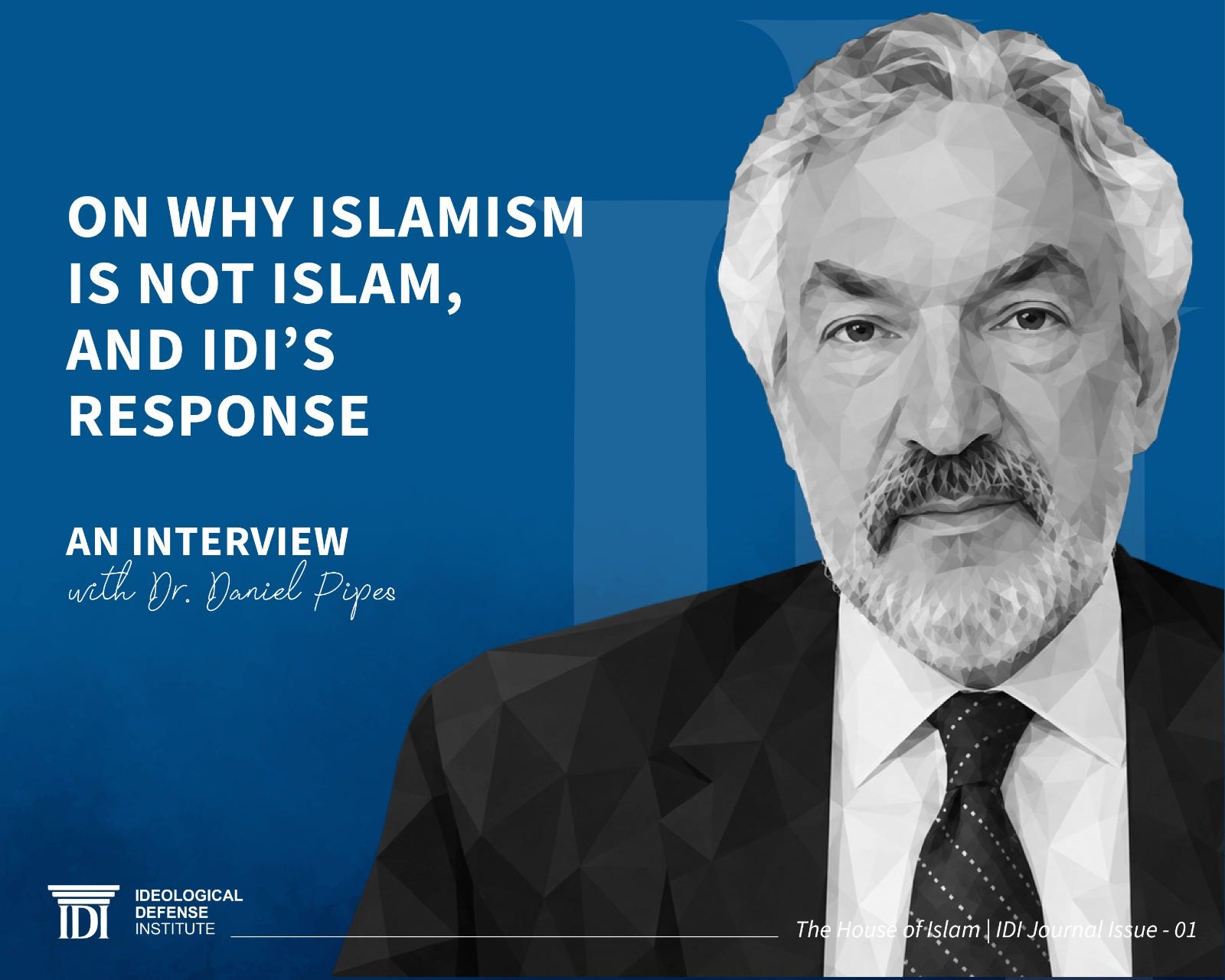
Daniel Pipes is the founder of the Middle East Forum and the author of more than a dozen books on Islam and the Middle East, including In the Path of God (1983) and Militant Islam Reaches America (2002). He has spent more than five decades studying Islamic political movements and is among the most widely read analysts of Islamism in the English-speaking world. This interview was conducted by Danny Burmawi, founder of the Ideological Defense Institute. The response was prepared by Brother Rachid, IDI Fellow.
Burmawi: Last year when we first met, I asked you why you consistently use the term “Islamism” rather than “Islam.” You answered in part that the entire Islam/Islamism debate ultimately comes down to two fundamental questions: those skeptical of Islamism as a concept ask, “Was Muhammad a Muslim or an Islamist?” Those advocating it ask, “If you give up on Muslims reforming Islam, how will you battle Islamism?” Please clarify and expand on what you meant.
Pipes: “Was Muhammad a Muslim or an Islamist?” Islam’s founder was a plain Muslim, not an Islamist. Islamism, a totalitarian ideology, emerged a century ago in the penumbra of fascism in Italy and communism in the Soviet Union.
“If you give up on Muslims reforming Islam, how will you battle Islamism?” Dismissing anti-Islamist Muslims undercuts their effort to offer a moderate alternative.
Burmawi: In this issue, we argue that Islamism is not a separate ideology but simply Islam itself. We present Islam as a complete “House” in which religion, prayer, fasting, personal piety, is only one room. The other rooms: politics, sharia, governance, jihad, and total societal control, are equally integral to the structure, all built according to the Qur’an, the Sunnah, and the Hadith. Those who fully occupy the political, legal, and jihad rooms are not “Islamists” living in a different building; they are the most consistent Muslims. How do you respond?
Pipes: The very most extreme of Islamist groups, ISIS, learnedly draws on precedents from 1,400 years ago and quite accurately applies them to modern life. Its emergence in 2014 alienated most Muslims, who do not wish to emulate its bizarrely anachronistic behavior, including, to take one example, its treatment of Islamic rules on slavery as fully valid today. This is not consistency but crazed and widely rejected extremism.
Burmawi: What are the canonical scriptures of “Islamism”? Aren’t they exactly the same as those of Islam, the Qur’an and the Hadith? Who is the prophet of Islamism, isn’t it the same Prophet Muhammad? What are the authoritative interpretation texts that Islamists rely upon, aren’t they the same core tafsirs and fiqh texts used in mainstream Islam for fourteen centuries? Doesn’t the use of the term “Islamism” deceive people into thinking it is some kind of fringe or modern deviation, when in reality it represents the most fundamental and authentic presentation of classical Islam?
Pipes: Of course, Islamism shares the same sources with other interpretations of Islam. Likewise, Thomas of Torquemada shared the same sources of Christianity as Pope Francis. Your question reminds me of a quote by an Egyptian professor of philosophy, Hasan al-Hanafi: the Qur’an “is a supermarket, where one takes what one wants and leaves what one doesn’t want.”
Burmawi: Do you agree that the linguistic and conceptual distinction between Islam and Islamism has become the dominant paradigm in Western policy and academia?
Pipes: No, I see wide rejection of the distinction, from US Rep. Randy Fine preferring dogs over Muslims to leftists screaming “Islamophobia” in response to critiques of Islamism.
Burmawi: In our judgment, this distinction hinders the West’s ability to understand and respond to the civilizational challenge posed by Islam and has, perhaps unintentionally, served as a shield for the House itself. Your response?
Pipes: The Islam/Islamism distinction has a crucial role in developing an effective response to Islamism. First, modern secular states can fight an ideology but not a religion, they cannot become crusader states. Just as they previously fought fascism and communism, they can now fight Islamism. Second, only anti-Islamist Muslims can offer a modern, moderate alternative to Islamism. The distinction permits an alliance between them and non-Muslims. The Western victors in World War II distinguished between Germans and Nazis, and therefore could rely on Konrad Adenauer to build a peaceful Federal Republic of Germany. Third, Muslims deserve the same rights and duties as every other citizen, neither special rights nor unique disabilities.
Burmawi: The term Islamism originally emerged during the Enlightenment as largely synonymous with Islam itself; today it carries multiple and often conflicting meanings. The Iranian scholar Mehdi Mozaffari has even described it as a URO, an “Unidentified Religious Object.” Given the lack of a single agreed-upon definition, how can the term be useful analytically?
Pipes: Yes, as Martin Kramer has shown, the word has had a long and colorful career. But so have many other words that evolved over the centuries and acquired a specific meaning today. When I was young, the adjective gay meant happy; now the noun means homosexual. By the way, Islam is also difficult to define: does it include the Ahmadiyya? Alawism? The Nation of Islam and its derivative groups? As for defining Islamism: an ideology that claims to solve all modern problems by reverting to a medieval law code, the sharia.
Burmawi: Pew Research Center surveys show significant majorities in many Muslim countries support the implementation of sharia in some form. If support for sharia is a defining feature of Islamism, does that not imply that a majority of Muslims worldwide would qualify as Islamists, and if so, does the term not lose its utility?
Pipes: No and no. The sharia has two components, private and public. The former concerns personal cleanliness, prayer ritual, food consumption, and sexual relations. The latter concerns authority, justice, taxation, and warfare. To some degree, most Muslims follow the private sharia; this alone does not make them Islamists. In contrast, demanding the application of public sharia nearly always signals an Islamist mentality, from the privileging of Islam and Muslims to the waging of jihad.
Burmawi: You have often argued that “radical Islam is the problem, moderate Islam is the solution,” and that the West should support moderate Muslims. Can a Muslim truly be “moderate” while continuing to affirm the full authority of the Qur’an and the Prophetic Example as perfect and eternal models for all aspects of life?
Pipes: Yes. Plenty of Muslims follow the private sharia and not the public one. They pray five times a day but have no intention of going off to war to acquire slaves. A pious Muslim need not be an Islamist.
Burmawi: Looking at Europe today, do you believe the continent still has the cultural confidence and political will to halt the expansion of “political” Islam into its neighborhoods, or have they passed the point where containment is realistic?
Pipes: It might. We are still at the beginning of a long story. Should indigenous Europeans decide to halt or reverse the Muslim presence, they can do so, they outnumber Muslims by roughly 14 to 1. If they decide they have had enough of Islamism, they can do what they want to fight it.
Burmawi: You have dedicated more than five decades to studying and warning about Islamism. As you look back, what has been the most important lesson you have learned?
Pipes: I have come to recognize Islamism’s variations. My first book on the topic, In the Path of God, treated what in 1983 was called the Islamic revival as basically a single phenomenon. Only with time did the full range, including its criminal and lawful variants, from Al-Qaeda to the Gülen movement, become apparent.
Burmawi: If you could sit down with your younger self in the 1970s, just beginning this journey, what would you tell him about the true scale and character of the threat?
Pipes: Islamism is not confined to Africa and Asia but threatens globally. Until the crisis over Salman Rushdie’s 1988 novel The Satanic Verses, I did not fully appreciate the Islamist potential in the West. I count myself as the third analyst to recognize this danger, following Bat Ye’or and Steven Emerson.
A Response by Brother Rachid
On Moving Goalposts
Dr. Pipes argues that Muhammad was a Muslim rather than an Islamist because Islamism is a totalitarian ideology that emerged a century ago, in the shadow of fascism and Soviet communism. But Muhammad was by any serious measure a totalitarian ruler, and the system he established, Islam as a governing order, functioned as a totalitarian system from the first day of the Medinan state. To exclude him, Dr. Pipes adds a time qualifier: Islamism requires modernity. But if the defining characteristic of Islamism is its totalitarian claim over all domains of life, Muhammad and his successors satisfy it. Adding “modern” as a criterion does not define the concept, it functions as a device to insulate the tradition’s founding period from the scrutiny the concept was designed to provide.
The argument that those who reject the word “Islamism” are trying to condemn all Muslims indiscriminately is a false premise. The West has pressured Muslim societies to abandon specific practices, public amputations, slavery, the execution of apostates, without the Islam/Islamism distinction. Saudi Arabia did not curtail certain practices because Western analysts distinguished between Islamism and Islam; it did so because of external pressure and consequences. The distinction was not needed.
On What Majority Opinion Proves
Dr. Pipes uses ISIS’s rejection by most Muslims as evidence that its practices are not genuinely Islamic. But Islam is not defined by what most of its adherents prefer at any given moment. The Qur’an itself acknowledges that jihad was prescribed even when it was disliked by the early community (Qur’an 1:216). Slavery was practiced across the Muslim world, including in Saudi Arabia, until 1961, not because it was popular but because it was held to be religiously legitimate. It was abandoned under external pressure, not internal theological revision. A generation that grew up after abolition may find slavery repugnant, but that does not make it non-Islamic by the tradition’s own standards. Al-Azhar, for all its criticism of ISIS, did not excommunicate it. It declared differences, the kind of differences that exist among many Islamic schools without removing any of them from the faith.
On the Torquemada Analogy
When pressed on the fact that Islamists use exactly the same sources as mainstream Islam, the same Qur’an, the same hadith, the same tafsir tradition, the same fiqh texts, Dr. Pipes compares this to Torquemada and Pope Francis sharing Christian scripture. The analogy fails. Torquemada represents a specific, eventually repudiated episode in Christian history, not a continuous foundational precedent tied to Christianity’s origins. What is called Islamism is not a modern deviation from an otherwise peaceful tradition. It is the continuous, mainstream institutional expression of how Islam has governed wherever it has had the power to govern, from the Medinan state through the Rashidun caliphate, the Umayyads, the Abbasids, the Ottomans, and the contemporary states that designate sharia as a primary source of legislation.
On the Shielding Effect
Asked directly whether the Islamism concept shields Islam from criticism, Dr. Pipes does not answer the question. He instead lists three advantages of the distinction. The shielding effect is precisely what the question was about. When a scholar criticizes “Islamism” while the practices being criticized, the apostasy penalty, the hudud criminal system, the subordination of non-Muslims, exist continuously within Islamic jurisprudence, the terminological choice locates the problem in a modern deviation rather than in a 1,400-year tradition. That is the shield.
His three advantages: the claim that modern secular states can fight ideologies but not religions is a false dichotomy. Nobody is proposing that states declare war on a religion. The argument is that states addressing Islamic violence should be permitted to name the tradition from which that violence draws its authority, rather than being required to attribute it to a modern perversion of an otherwise peaceful faith. Cooperation between non-Muslims and reform-minded Muslims does not require the Islamism distinction. Mahmoud Mohammed Taha addressed problematic elements within Islamic texts directly and paid for it with his life, not because he used the wrong terminology but because the tradition’s own enforcers recognized him as a genuine threat to its authority.
On the Pew Data
Dr. Pipes distinguishes between private sharia (personal practice) and public sharia (governance and law), arguing that support for the former does not make someone an Islamist. The Pew questions, however, were not about personal practice. They asked whether respondents wanted sharia implemented as the law of the land. Majorities in Afghanistan, Iraq, Pakistan, Egypt, Jordan, Palestine, Morocco, and Bangladesh answered yes. By Dr. Pipes’s own definition, that demanding public sharia signals an Islamist mentality, large portions of these populations would qualify as Islamists. At that scale, the distinction between Islamism and Islam is not a useful analytical tool. It is a label applied to a minority severe enough to be politically problematic while the majority holding identical doctrinal positions is categorized differently.
The Underlying Disagreement
Dr. Pipes’s framework rests on the premise that there exist, in substantial and politically meaningful numbers, Muslims committed to the full authority of the Qur’an and the Prophetic Example who do not support the public sharia, Muslims whose faith is genuinely compatible with the foundational premises of liberal democratic order. IDI’s framework holds that such Muslims exist as individuals but not as a theologically grounded tradition, because the authoritative sources of Islam do not provide the basis for permanently renouncing the public sharia. They can be set aside tactically, as the tradition’s own jurisprudence on treaty-making and circumstances of weakness demonstrates. They cannot be renounced as invalid without departing from the tradition’s own authority structure.
This is not a disagreement about the moral worth of individual Muslims. It is a disagreement about the nature of the tradition they inhabit and what realistic reform of that tradition would require. Dr. Pipes believes reform is possible and that the West’s support for anti-Islamist Muslims is the mechanism that makes it more likely. IDI believes that what is called reform, if it genuinely reaches the tradition’s foundational architecture, requires the kind of break with authority that the tradition’s own mechanisms are specifically designed to prevent, and that policy built on the expectation of that reform arriving in time to matter is policy built on hope rather than evidence.
Interesting. A couple of decades ago I would have thought Mr. Pipes distinction plausible. Having seen the impact Islam is having on the West, however, I am not at all convinced. There is now a deep unease about the number of Muslims in our public services in the UK. I would be interested to know what we are to make of the UK's Home Secretary, Shabanah Mahmood, when she says that her faith informs every decision she mades
Based on your analysis, here are five sharp questions that implicitly answer the assertions made in the IDI interview:
1. If Islam is a monolithic "House" with a fixed blueprint, how do we account for fourteen centuries of jurisprudential divergence—from the Hanafi to the Ja'fari schools—on the very questions of governance and jihad?
2. Is it historically coherent to label the 7th-century Medinan confederation "totalitarian" while exempting the state-church fusion of Theodosian Rome or the Papal States from that modern, Arendtian category?
3. If scriptural regulation of slavery renders a faith "inherently violent," does the Biblical mandate for perpetual bondage (Leviticus 25) or the "Curse of Ham" render Christianity equally irreformable?
4. Does the "civilizational" threat lie in Islam, or in a shared Abrahamic history where the Doctrine of Discovery and Christian Zionism weaponized scripture for global dispossession?
5. If Islamic reform is merely "tactical dissimulation," why have scholars like Mahmoud Mohammed Taha faced execution by authoritarian regimes for the very theological convictions that Pipes dismisses as public relations?
V.A. Mohamad Ashrof, India