


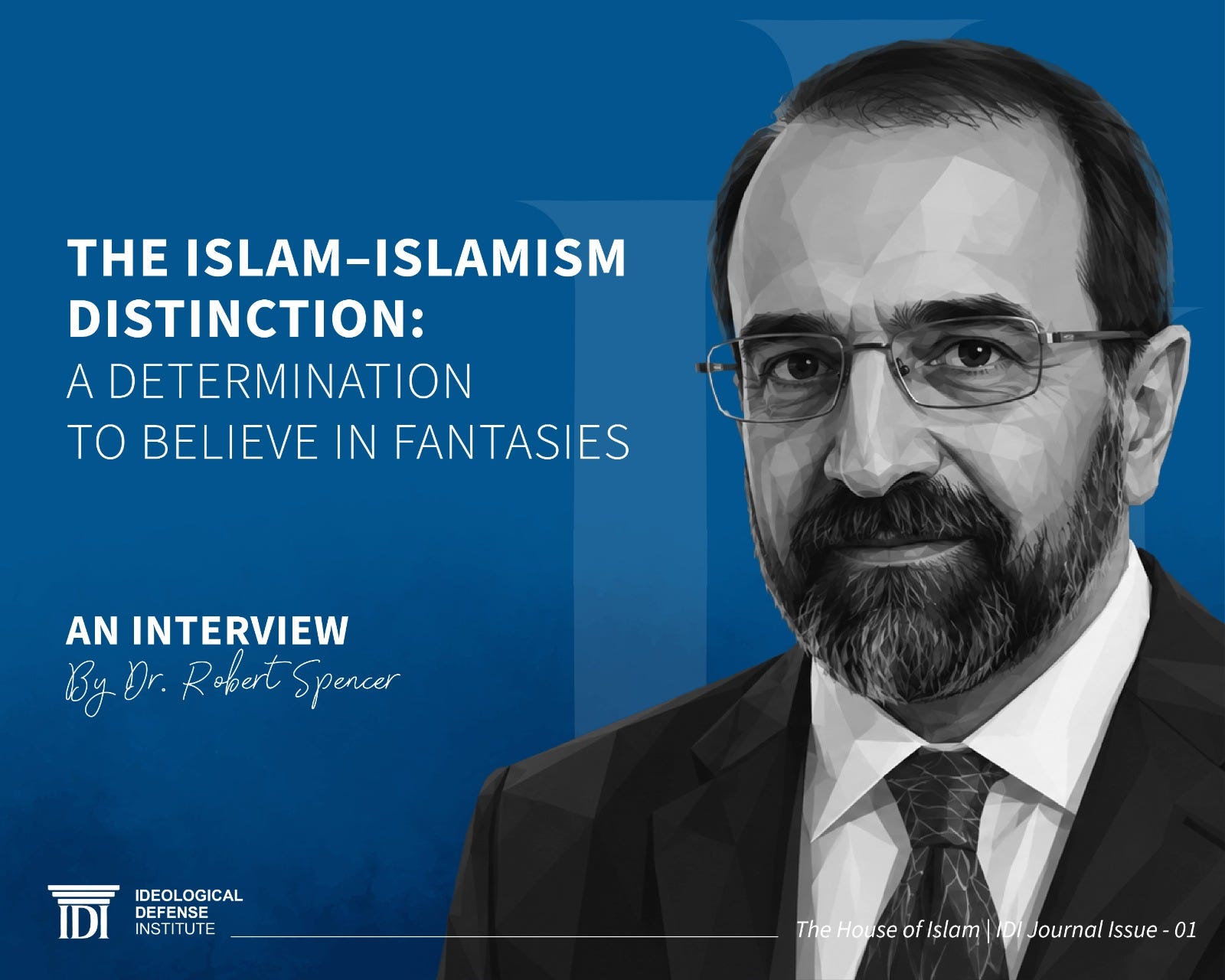
Dr. Robert Spencer is founder and director of Jihad Watch, and author of more than thirty books about Islam, including The History of Jihad, The Critical Qur’an, and Muhammad: A Critical Biography. This interview was conducted by Danny Burmawi, founder and chief executive of the Ideological Defense Institute.
Burmawi: Dr. Spencer, thank you for joining us for the inaugural issue of The IDI Journal. Your work has been instrumental in exposing the doctrinal roots of jihad and Islamic supremacism for over two decades. We are honored to have your perspective in this first edition.
Spencer: Thank you, Danny. I’m honored to be here.
Burmawi: You have spent decades arguing that the problem is Islam itself, not a distortion called “Islamism.” Yet critics often say that by focusing so heavily on doctrine, you downplay the role of culture, politics, economics, and human agency. Isn’t it possible that many Muslims are simply behaving like normal human beings shaped by their circumstances rather than being strict adherents to a 7th- century blueprint?
Spencer: Of course. In fact, I’ve said exactly that many, many times. You’ll find in many of my speeches on YouTube I speak about Muslims, like everyone else, being susceptible to a wide variety of influences, priorities, desires and goals, with the religious impulse being just one of these. That is an obvious and undeniable fact.
However, the truth of it actually has nothing whatsoever to do with the question of whether the political, supremacist, expansionist and violent aspects of Islam can really be separated, as “Islamism,” from Islam proper. There is not now and never has been such a distinction within Islamic theology and law, and even today, there is no major sect or school of jurisprudence that does not teach that under certain circumstances, Muslims must wage jihad, understood as physical warfare with guns and other weapons, in order to establish the hegemony of sharia over a hitherto non-Muslim entity.
The desire to separate “Islamism” from “Islam” stems from nothing within Islam itself, but from the impulse of non-Muslim Westerners to regard Islam as a benign entity having to do purely with spiritual matters, and to exonerate Islam from the crimes done in its name and in accord with its teachings by consigning those to the realm of “Islamism,” which is understood to be a certain adulteration or bastardization of the genuine, benign Islam. This is just wishful thinking on a grand scale.
Finally, as far as the charge goes that in focusing on Islamic doctrine, I downplay the role of culture, politics, economics, and human agency, I am merely correcting the glaring deficiency of mainstream analysts. They routinely ignore the role of Islamic doctrine altogether when they examine the Israeli-Palestinian conflict, Iran’s conflict with Israel, terrorism in the West, and many other issues.
Islamic doctrine actually plays a decisive role in all of those, so I am correcting their myopia and error of omission.
Burmawi: You frequently cite the example of Muhammad in Medina as the normative model for Islamic behavior. But some scholars argue that the Meccan period, the peaceful, persecuted phase, represents the “true spirit” of Islam, and that the Medinan period was a temporary adaptation to circumstances. How do you respond to those who claim the House of Islam is more flexible and context- dependent than you present?
Spencer: Here again, scholars who argue that the Meccan period takes precedence over the Medinan are engaging in wishful thinking, if not outright deception. This is not my judgment, but the consensus of Islamic theology across the various sects and schools of jurisprudence. The Tafsir Anwarul Bayan explains the traditional view: “While the Muslims were in Makkah, they were weak and few in number, never possessing the capability nor the divine permission for Jihad (religious war). After migrating to Madinah, they received the order to fight their enemies in defense, as a verse of Surah Hajj [sura 22 of the Qur’an] proclaims: ‘Permission (to fight) has been granted to those being attacked because they are oppressed [Qur’an 22:39]. ’Later on the order came to fight the Infidels (kuffar) even though they do not initiate the aggression.”
The Tafsir Anwarul Bayan is a twentieth-century exposition of the Qur’an, but this view of the three stages of development of the Qur’an’s teaching on warfare is quite ancient. Muhammad’s earliest biographer, an eighth-century Muslim named Ibn Ishaq, explains (in Ibn Hisham’s ninth-century recension of his work) that there is a progression of Qur’anic revelation about warfare. First, he says, the Muslims preached tolerance, because they were a small, powerless band that depended upon the indulgence of larger forces. When the Qur’an says, “To you your religion, and to me my religion,” (Qur’an 109:6) it isn’t generously granting to non-believers the right to practice their own religions. It is demanding that tolerance from the non- believers.
When the Muslims gain political and military power, however, they stop preaching tolerance. The second stage of the Qur’an’s teaching on warfare, Ibn Ishaq explains, is defensive jihad. “Permission is given to those who fight,” says the Qur’an, “because they have been wronged, and Allah is indeed able to give them victory.” (Qur’an 22:39) Even that, however, was not Allah’s last word on the circumstances in which Muslims should fight. Ibn Ishaq explains offensive jihad by invoking a Qur’anic verse: “Then God sent down to him: ‘Fight them so that there be no more seduction,’ i.e. until no believer is seduced from his religion. ‘And the religion is God’s’, i.e. Until God alone is worshipped.”
The Qur’an verse Ibn Ishaq quotes here (Qur’an 2:193) commands much more than defensive warfare: Muslims must fight until “the religion is God’s”, that is, until Allah alone is worshipped. “Fight them,” says another Qur’an passage, “until persecution is no more and religion is all for Allah.” (Qur’an 8:39) The Muslim community passes from one stage to the next as its numbers grow. Only when the community is small and weak, lacking political and military power, does it preach tolerance. When it becomes more powerful, the more violent stages come into play.
This was not just the idea of Ibn Ishaq alone. The great medieval scholar Ibn Qayyim (1292-1350) also outlines the stages of the Muhammad’s prophetic career: “For thirteen years after the beginning of his Messengership, he called people to God through preaching, without fighting or Jizya, and was commanded to restrain himself and to practice patience and forbearance. Then he was commanded to migrate, and later permission was given to fight. Then he was commanded to fight those who fought him, and to restrain himself from those who did not make war with him. Later he was commanded to fight the polytheists until God’s religion was fully established.”
In other words, he initially could fight only defensively, only “those who fought him”, but later he could fight the polytheists until Islam was “fully established.” He could fight them even if they didn’t fight him first, and solely because they were not Muslim.
Nor do all contemporary Islamic thinkers believe that that command is a relic of history. According to a 20th century Chief Justice of Saudi Arabia, Sheikh Abdullah bin Muhammad bin Humaid, “at first ‘the fighting’ was forbidden, then it was permitted and after that it was made obligatory.” He also distinguishes two groups Muslims must fight: “(1) against them who start ‘the fighting’ against you (Muslims) . . . (2) and against all those who worship others along with Allah . . . as mentioned in Surat Al-Baqarah (II), Al-Imran (III) and At-Taubah (IX) . . . and other Surahs (Chapters of the Qur’an).” (The Roman numerals after the names of the chapters of the Qur’an are the numbers of the suras: Sheikh Abdullah is referring to Qur’anic verses such as 2:216, 3:157-158, 9:5, and 9:29.) Many other Islamic authorities say the same, and this is the consensus of the various schools of jurisprudence: that offensive jihad, i.e., the Medinan sections of the Qur’an, are Allah’s final word on this matter, and thus warfare, not peace, is the fundamental stance of Muslims toward non-Muslims. It would be nice if it were otherwise, but it isn’t.
Burmawi: You have long criticized the term “Islamism” as misleading. However, many analysts argue that the distinction, even if imperfect, has practical value: it allows the West to work with Muslims who genuinely reject jihad and sharia supremacy. By rejecting the distinction entirely, don’t we risk alienating potential allies and making the challenge appear even more insurmountable?
Spencer: I don’t see why that would be so. Don’t the Muslims who reject jihad and Islamic supremacy know that these are core features of Islam? The value of basing foreign or domestic policies on fiction and fantasy seems limited at best: at a certain point, reality will reassert itself. And in fact, that is exactly what is happening now. The European Union has brought in millions of Muslims, assuming that they were not “Islamists,” or that only a tiny minority were “Islamists,” and that there would be no problem with assimilation, as the non- “Islamist” Muslims would readily adopt European secular values. In reality, however, what the West regards as “Islamism” includes integral aspects of Islam, and now Europe is discovering, to the horror of many, that the continent is now full of “Islamists.” Assuming that “Islamism” was distinct from Islam didn’t stop the “Islamists” from streaming in.
Burmawi: In your work you emphasize that jihadists are the most faithful Muslims. Yet we see millions of Muslims living peaceful, integrated lives in the West who do not engage in violence or political Islam. Are they truly living in the same “House,” or have they effectively created a different, diluted version of Islam that the doctrinal House cannot fully account for?
Spencer: If they have created a different, diluted version of Islam, where is it? Where is their different Qur’an? Their different Muhammad? Where is their theological system articulated? Where is there a distinction made between the mosques of this new sect and those of the older sects, a la the distinction between churches of different denominations? I’ve never seen a sign for an “American mosque,” or a “different, diluted mosque.” There are indeed millions of Muslims living peaceful, integrated lives in the West, and many of these have discarded sharia values and adopted Western values.
Many, however, have not, and there is also quite a bit of overlap between the two camps. Mujahida bint Usamah was a British doctor who took full advantage of the educational and career opportunities women have in Western countries. But after becoming devout in her observance of Islam, she gave up her medical career and headed for the Islamic State. The heart-stopping photo on her Twitter feed showed the doctor posing happily with a severed head. Her caption?
“Dream job, a terrorist doc.”
Maher “Mike” Hawash was a popular and wealthy Intel executive in Portland, Oregon, a pillar of his community and the very model of a moderate, assimilated American Muslim. The Wall Street Journal stated that he had “fully integrated himself into the mainstream community where he lived. In many respects he had attained the American dream. He owned his own home and was respected at microchip-maker Intel, one of the U.S.’s preeminent high-tech giants.
He was exceptionally popular and known in the community for his volunteer activities.”
However, Hawash began to grow devout in his observance of Islam, and as he became more zealous in his observance of the religion, he began to change, until ultimately he served time in prison for recruiting Muslims to join al-Qaeda and the Taliban in Afghanistan.
There are so very many such stories. On March 3, 2006, Mohammed Reza Taheri-azar, a student at the University of North Carolina at Chapel Hill, rented an SUV and drove it onto campus, trying to kill as many students as he could.
Taheri-azar killed no one, but he did injure nine people. In court later, he said he was “thankful for the opportunity to spread the will of Allah.” He wrote a detailed letter attempting to explain his actions, ascribing them entirely to his newfound Islamic faith: “In the name of Allah, the merciful, the compassionate. To whom it may concern: I am writing this letter to inform you of my reasons for premeditating and attempting to murder citizens and residents of the United States of America on Friday, March 3, 2006 in the city of Chapel Hill, North Carolina by running them over with my automobile and stabbing them with a knife if the opportunities are presented to me by Allah.”
He wrote a series of letters, detailing how he had turned from a life of debauchery and dissipation to service to Allah, and jihad, simply by reading the Qur’an. These letters were noteworthy for being entirely the result of his own study. He had not been involved with campus Islamic groups. He was not known to have frequented the local mosque. He presented his conclusion that Allah required him as a believer to do violence to unbelievers entirely as the result of his study of the Qur’an. How did he miss the book’s allegedly benign teachings?
Why did all these Westernized Muslims (and there are many others) ultimately turn to jihad? Hadn’t they adopted a different, diluted version of Islam? If so, why did they finally determine that such a version of Islam was deficient?
Burmawi: Some argue that the West’s own secularism, moral relativism, and loss of civilizational confidence are the primary reasons it is vulnerable to Islamic expansion, not the strength of the Islamic House itself. To what extent do you believe the crisis is driven more by Western self-loathing than by the inherent nature of Islam?
Spencer: Both are responsible. If not for the inherent nature of Islam, there wouldn’t be so many Muslims in Europe or North America who have contempt for Western laws and no hesitation regarding stealing from, raping, or even killing non-Muslims. But there wouldn’t be so many supremacist and violent Muslims in Europe in the first place it hadn’t been for the West’s secularism, moral relativism, and loss of civilizational confidence. The current leaders of the European Union and the leftist political and media establishment in general will go down in history as the destroyers of European civilization. They couldn’t have done it, however, without help from their jihadi friends.
Burmawi: You have been sounding the alarm for over twenty years. Looking at current trends in Europe and North America, demographic change, institutional capture, and political correctness, do you sometimes worry that your warnings may have come too late?
Are we already past the point where the House of Islam can be meaningfully contained inside the West?
Spencer: My warnings didn’t come too late in the 1990s or even in the early 2000s. But they were not heeded then, and now the problem has grown exponentially worse. The House of Islam cannot be meaningfully contained inside the West; there will be increasing pushes to institute elements of sharia until the whole thing is in force and Muslims wield all of the political power. There will likely be civil wars here and there to try to prevent that, but we are way past the time when the problem of Islamization and the spread of sharia could have been solved peacefully by means of changing immigration policies.
The large-scale disenfranchisement and demonization of those who oppose mass migration policies and the growing and increasingly aggressive Muslim communities and sharia enclaves in the West mean that the future of Europe and Canada, and possibly also of the United States, is Islamic. The native population lacks the will to resist, having been endlessly told that to do so is “racist,” “fascist,” and “Islamophobic,” and even if it recovers that will, it is rapidly losing the strength to take any effective and peaceful action.
Burmawi: If the “House of Islam” framework is correct and the problem is doctrinal at its core, what realistic hope is there for the 1.8 billion Muslims in the world? Is the only long-term solution mass conversion or mass defection, or do you see any viable path for large- scale internal reform?
Spencer: For twenty-five years and more I’ve been hearing about how Islamic reformers will change Islam from within. Or that “it’s time for the vast majority of moderate Muslims to step up and make themselves heard.” Yet the reformers have for the most part turned out to be deceivers, intent on fostering complacency and ignorance among non-Muslim Westerners by making them think that the vast majority of Muslims reject jihad and sharia, and the moderates have never shown themselves to be anything but non-observant or semi- observant Muslims. “Muslims against terror” protests repeatedly brought out only a handful of Muslims at best. If the West’s fantasies about Islam and “Islamism” were true, we would expect, twenty-five years after 9/11, to see a massive anti-terror movement within Islam, comprising tens of millions of Muslims. There is nothing even close to that, and there will not be, due to the nature of Islam itself.
Burmawi: After more than thirty years and thirty-two books dedicated to this fight, what frustrates you most about how the West continues to misunderstand or mishandle the Islamic threat?
Spencer: The determination to believe fantasies rather than reality.
Thank you, Danny. I much appreciate the opportunity to explain these issues to a larger audience.
