


The Founders wrote a guarantee for private faith. They never imagined a faith that wants to be the state.
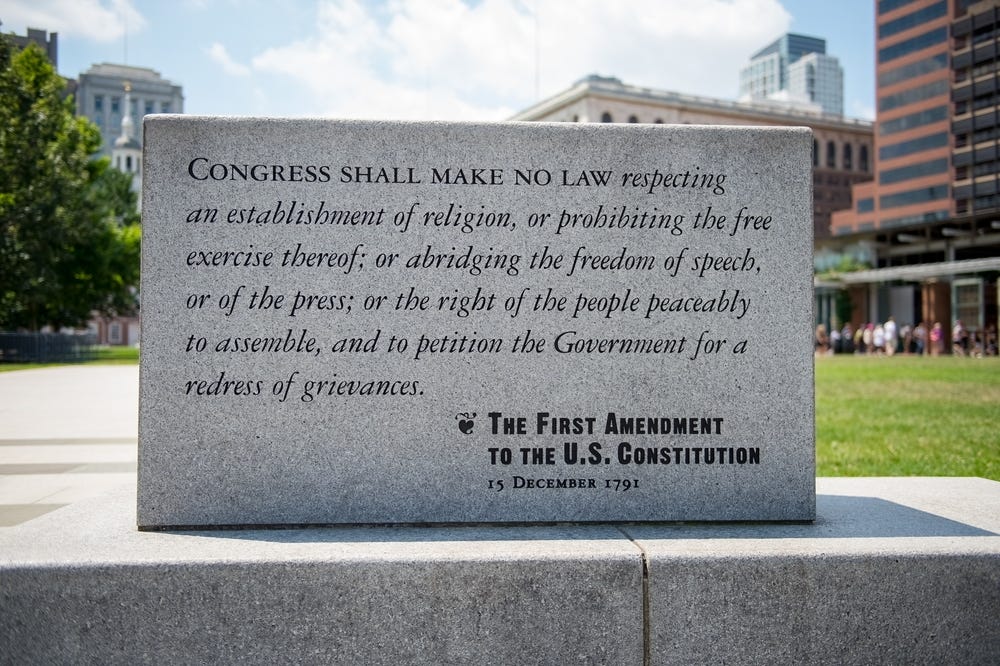
When the men who wrote the First Amendment guaranteed the free exercise of religion, they had a specific picture of religion in their heads, and Islam was not in it. The world they knew was Christian and Jewish. Religion, to them, meant what a person believed about God, how he prayed, what he held to be right and wrong, a matter of conscience, lived out in private and in the pews, and walled off from the apparatus of the state. They were not legislating about a system that aspires to run the state itself, write its laws, and order the lives of believers and non-believers alike under a single divine code. They had no reason to. Nothing in their experience looked like that.
That gap between what the Founders meant by religion and what Islam actually is may be the quietest and most consequential confusion in the modern West.
The Western concept of religion is, at bottom, a Christian inheritance, and it carries Christian assumptions whether or not anyone still believes the theology. Chief among them is that faith is private. What a person holds about God is between him and his conscience; he is free to believe, to doubt, or to walk away, and no civil authority hands down a creed. The separation of church and state did not happen to this tradition by accident. It grew out of it. The thing being separated, an interior, voluntary faith, was already understood to be separable.
Islam does not sit inside that definition. It is not a body of beliefs and rituals that happens to have political opinions attached. Prayer and fasting are one part of it; alongside them stand a theory of state law, rules of war, a judicial code, and detailed provisions for governing non-Muslim populations under Muslim rule. To peel the spiritual away from the political and keep only the first is not a reform. It is a mutilation of the thing itself.
Put the question the way the Founders would have had to face it. Had they been staring across the Atlantic at an Islamic caliphate rather than at the Christian empires of Europe, it is hard to imagine them extending the protections of the First Amendment to a system whose announced purpose was to replace constitutional self-government with rule by divine law, a system that treats the consent of the governed not as the source of legitimate authority but as a usurpation of God’s. The Amendment was written to keep the state out of the church. It was not written to license a church that intends to become the state.
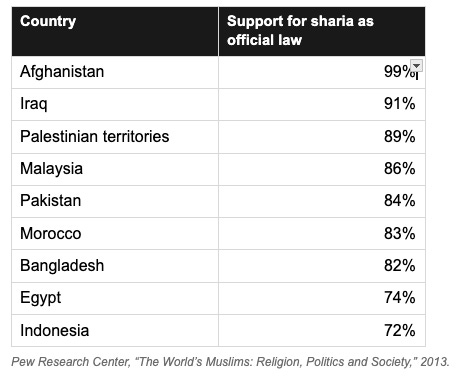
The reassuring claim is that the political reading of Islam belongs to a fringe, a small, loud minority of radicals at odds with the quiet majority. The largest survey ever taken of Muslim opinion does not support that claim. In 2013 the Pew Research Center polled some thirty-eight thousand Muslims across thirty-nine countries. Asked whether sharia should be enshrined as the official law of the land, majorities said yes across most of the Muslim world, and in several countries the majorities were overwhelming:
Strip away the euphemisms and the incompatibility between Islam and Western constitutionalism comes down to three collisions, none of them about extremism and all of them about the system as it has been taught for more than a thousand years.
The first is the separation of powers. Islamic governance gathers authority in the caliph, whose mandate descends from God rather than rising from the governed, and classical theory builds in nothing like the deliberate division of legislative, executive, and judicial power that the American framers treated as the central safeguard against tyranny. Where the entire design assumes a single divinely sanctioned authority, there is nothing to separate.
The second is the vote. In Islam the ruler is not chosen by the population at large. He is selected by a body of qualified scholars, and the office is closed to women and to non-Muslims by definition. The republican premise, that legitimate power flows upward from the consent of all the people, has no counterpart in Islam, where legitimacy flows downward from God through His law and the men qualified to interpret it.
The third is freedom of religion. The First Amendment protects the right to hold any faith or none, and above all the right to change one’s mind. Islamic law prescribes death for the apostate. The right that the First Amendment guards most jealously is the one Islamic law most flatly forbids.
This leaves the West with a dilemma: move to restrict Islamic political activity, and a government risks open conflict with Muslim populations at home and Muslim states abroad, and lays itself open to the charge of trampling the very liberties it claims to be defending. Decline to move, and the steady growth of Muslim populations in Western cities, together with the patient political pressure to accommodate Islamic law piece by piece, wears down the constitutional order from the inside.
The most direct way out does not run through Western policy at all. It runs through the Muslim world, which is the only place the underlying tension can actually be resolved. That would mean one of two things. Either Islam develops and formally institutionalizes a genuinely private, spiritual practice, one that explicitly renounces sharia as a project of state governance and means it, or it states honestly Islam remains what its own texts describe, an expansionist political and legal order at odds with the foundations of the modern constitutional state, and the world deals with that fact rather than pretending it away. What cannot continue indefinitely is the present arrangement, in which the political claims are real, advancing, and unacknowledged.
For decades the West managed the question by insisting it did not exist. That option has closed. Western cities are changing in plain view. Saying clearly what Islam is, and what the First Amendment was and was not built to protect, is not bigotry. It is the bare precondition for an honest conversation about everything that comes next, a conversation the West can no longer afford to keep postponing.
Brother Rachid is a senior fellow at the Ideological Defense Institute
Islam is as much a political system as a religious one. And will destroy the West unless we wake up.
Freedom of expression and free speech should mean that we have the collective ability, intelligence and confidence in our western liberal democratic values to have exactly this conversation. Unfortunately, our ignorance, arrogance and complacency means that the majority of the population are under the impression that Islam is simply another religion, and our desire to protect minorities at all costs, leaves us more concerned to talk about the misnomer of 'islamophobia', at precisely the point when islam should be subject to far more analysis and discussion. The more the population understands about Islam the better.