


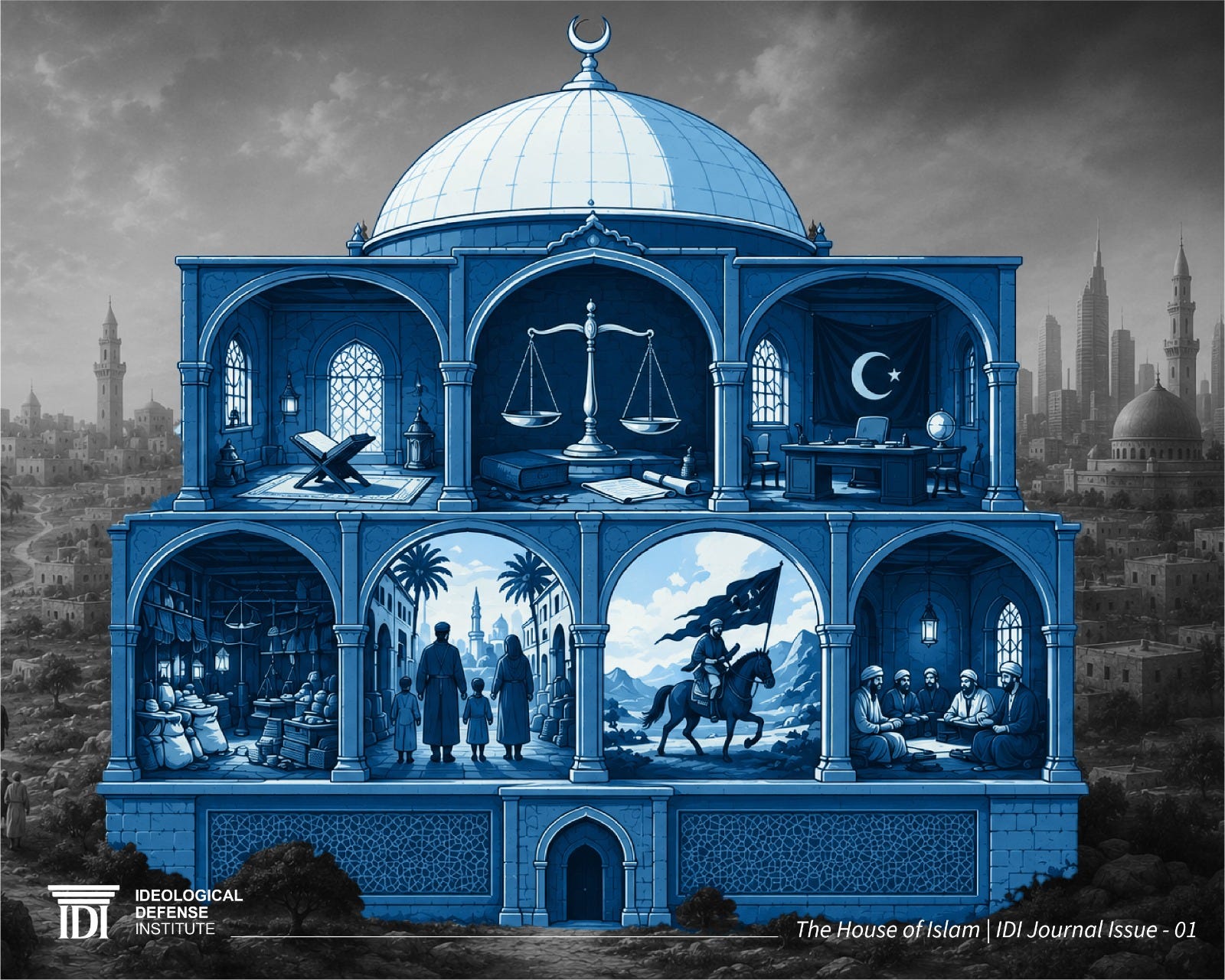
The West has consistently misread Islam’s expansion into liberal societies by treating Islam as a religion in the Western sense, private belief distinguishable from politics, law, and governance. This paper argues that categorization is false. Islam, as constituted in the Qur’an, the Sunnah, and the jurisprudential tradition, is a total civilizational system, a House, in which religion is one room among several, inseparable from sharia, governance, economic regulation, social control, and expansion through jihad. Examining each structural component in turn and tracing the architecture from the Rashidun period through its contemporary expression, the paper concludes that the distinction between ‘moderate’ and ‘extremist’ Islam is not a distinction between two different systems or two interpretations, but between faithful adherence and nominal adherence to the same one.
The Western Misreading and Its Consequences
There is a specific intellectual error at the foundation of Western engagement with Islam, one that is not accidental, not the product of ignorance, and not easily corrected by more information alone. It is the error of category: the assumption that Islam is a religion in the sense that Christianity is a domain of private conscience and personal practice, distinguishable from and in principle subordinate to secular political authority.
This assumption has a history. Western political thought arrived at the separation of religious from civil authority through a specific and traumatic historical process: the Wars of Religion, the Peace of Westphalia, the philosophies’ systematic critique of ecclesiastical power, and eventually the constitutional settlements that placed religious practice under the protection of the state while simultaneously removing it from the state’s own governing logic. The experience was so formative and so paradigm-shaping that it produced a general theory of what religion is, a theory in which the Thirty Years’ War functions as the empirical premise and the separation of church and state as the necessary conclusion.
When Western observers, policymakers, and scholars apply this framework to Islam, they are not making a neutral analytical move. They are projecting a historically specific category, the privatized, politically subordinate religion of post-Westphalian Europe, onto a tradition whose foundational texts, institutional history, jurisprudential development, and normative self-understanding all point in the opposite direction. The result is a systematic misreading whose consequences have been documented across a generation of failed integration policy, inadequate security frameworks, and diplomatic engagements built on the assumption of a “moderate Islam” awaiting liberation from its “extremist” distortion.
The architecture of Islam as actually constituted, as the Qur’an establishes it, as Muhammad instantiated it in Medina, as the classical schools of jurisprudence developed it across fourteen centuries, and as its most faithful contemporary adherents understand it, is not a chapel with political implications. It is a House: a total civilizational order in which the spiritual, legal, political, economic, social, and military dimensions are not merely related but structurally unified, designed from the foundation to operate as an integrated and indivisible system.
This paper examines that architecture room by room.
The Foundation

Every structure rests on a foundation, and the foundation of the Islamic House is a single, uncompromising theological premise: sovereignty belongs to God alone. The Arabic term is hakimiyya, divine sovereignty over all human affairs, without exception or remainder.
The Qur’anic basis is explicit and repeatedly emphasized. Surah Yusuf (12:40) states: “Legislation (hukm) belongs only to Allah.” Surah Al-An’am (6:57) reinforces: “The decision is only for Allah.” Surah Al-Ma’idah (5:44) draws the consequence with maximum clarity: “And whoever does not judge by what Allah has revealed, such are the disbelievers (kafirun).” Verse 5:45 repeats the judgment for wrongdoers (zalimun), and 5:47 for transgressors (fasiqun). The structural implication is total: a legal or political system that derives its authority from any source other than divine revelation is not merely imperfect or incomplete, it is, by the Qur’an’s own terms, an act of unbelief.
This is the foundation on which everything else in the House is built, and it is precisely what makes the Western concept of “secular Islam” a structural impossibility rather than merely a theological innovation. In the Christian tradition, the distinction between sacred and secular authority has a textual basis: “Render unto Caesar what is Caesar’s, and unto God what is God’s” (Matthew 22:21). The New Testament does not contain a theory of governance; it contains a theory of salvation. Christian rulers from Constantine onward imposed their own theories of governance onto a tradition that had not provided one, with predictably violent results, but also with the eventual possibility of separation, since the tradition’s foundational texts did not require their union.
The Islamic foundation provides no equivalent basis for separation. The Qur’an is not merely a guide to personal salvation; it is, by explicit self-description, a complete “guidance for mankind” (Qur’an 2:185), containing specific rulings on commercial transactions, criminal penalties, inheritance, warfare, and the governance of non-Muslim subjects. These are not analogies or allegories; they are legal prescriptions. The tradition has understood them as such from the beginning, and the jurisprudential schools that developed over the first three centuries of Islamic civilization treated the task of deriving law from revelation as the primary intellectual enterprise of the tradition.
The twentieth-century political theorist who gave hakimiyya its most systematic modern expression was Sayyid Abul A’la Maududi, the Pakistani founder of Jamaat-e-Islami, who argued that sovereignty in Islam admits of no human component: “In Islam, the legislative power and the sovereignty belong to Allah alone.”¹ Maududi was not inventing a new doctrine; he was giving systematic political form to a premise present in the tradition from its foundation. Sayyid Qutb, the Egyptian Muslim Brotherhood theorist whose work has served as the primary intellectual source for jihadist movements since the 1960s, drew the consequence explicitly: any society not governed by God’s law is a society in a state of jahiliyya (pre-Islamic ignorance), and the Muslim’s obligation is to work toward its transformation.² These are not fringe positions; they are the logical development of the tradition’s foundational premise.
The Load-Bearing Walls
If hakimiyya is the foundation, sharia is the load-bearing walls, the legal framework that gives the House its shape and keeps it standing. The most consequential misconception in Western discourse about Islam is the treatment of sharia as a set of religious guidelines, roughly analogous to canon law or Jewish halakha, that a Muslim community applies internally while remaining subject to the civil law of the surrounding society. This understanding is not merely incomplete; it inverts the tradition’s self-understanding.
Classical Islamic jurisprudence (fiqh) does not recognize a distinction between religious and civil law. It recognizes a distinction between acts of worship (ibadat), prayer, fasting, pilgrimage, Zakat, and transactions (muamalat), commercial law, family law, criminal law, and the law governing relations between Muslims and non-Muslims. Both categories are equally divine in their origin and equally binding in their authority. The jurist’s task in both domains is identical: to derive the correct ruling from the Qur’an, the Sunnah, consensus (ijma), and analogical reasoning (qiyas). There is no secular sphere to which sharia is inapplicable; there are only domains where the relevant rulings have or have not yet been worked out.
The comprehensiveness of the classical tradition is not a matter of scholarly dispute. Joseph Schacht, the Oxford legal scholar whose work remains the authoritative introduction to Islamic law in Western academia, was explicit: “Islamic law is the epitome of Islamic thought, the most typical manifestation of the Islamic way of life, the core and kernel of Islam itself.”³ Wael Hallaq, perhaps the most distinguished contemporary scholar of Islamic legal history, describes fiqh as “a total discourse” that “regulated virtually all areas of human life.”⁴ These are not polemical observers; they are the tradition’s most careful scholarly analysts.
The specific rulings that follow from sharia’s totalizing scope are not peripheral to the present analysis, they are its substance. Surah An-Nisa (4:65) states: “But no, by your Lord, they will not [truly] believe until they make you judge concerning that over which they dispute among themselves.” Surah Al-Ma’idah (5:49) commands the Prophet, and by extension, the Muslim community, to judge according to what Allah has revealed and to beware of their inclinations. The message is structural: the community of believers is not one legal jurisdiction among several; it is the jurisdiction that supersedes all others.
The criminal law provisions illustrate the depth of this structure. The hudud offenses, adultery (punishable by flogging for the unmarried and stoning for the married), theft (amputation of the hand), apostasy (death), highway robbery, and wine-drinking, are specified directly in the Qur’an and the Sunnah and are held by the classical tradition to be non-derogable: they cannot be reduced, commuted, or replaced by human legislation without departing from the tradition’s foundational premises.⁵ The family law provisions, polygamy (up to four wives, Qur’an 4:3), a husband’s right of unilateral divorce (talaq), women’s reduced inheritance share (Qur’an 4:11), the permissibility of striking a disobedient wife (Qur’an 4:34), are similarly grounded in revelation and maintained across all four major Sunni legal schools, not as cultural accretions but as divine rulings.⁶
The argument sometimes advanced, that these rulings represent one interpretation among several equally valid alternatives, is not supported by the tradition’s own internal authority structure. The four major Sunni schools (Hanafi, Maliki, Shafi’i, and Hanbali) differ in their application of specific rulings, but they agree on the framework: Sharia governs all human activity, its source is divine revelation, and human legislation that contradicts it is invalid. This is not a minority position held by radicals; it is the mainstream consensus of the tradition across its entire intellectual history.
The Economic Engine
The House of Islam is not merely a political and legal structure; it is also an economic system, and the economic system is as structurally integrated into the whole as any other component. Two mechanisms define this integration: the mandatory alms tax (zakat) and the prohibition of interest (riba).
Zakat is one of the Five Pillars of Islam, which places it at the center of the tradition’s religious obligations. But its function within the total system extends beyond personal piety. Surah At-Tawbah (9:60) specifies the categories of permitted zakat expenditure: the poor, the needy, those employed to collect it, those whose hearts are to be reconciled (a category that classical jurists understood to include political allies and potential converts), those in bondage (for emancipation), those in debt, for the cause of Allah (fi sabil Allah, a term that classical jurists extended to jihad), and travelers. The “cause of Allah” expenditure category created a legitimate and institutionalized funding mechanism for military expansion within the religious tax system itself. This is not a modern jihadist innovation; it is a classical jurisprudential consensus.⁷
The prohibition of riba (interest, Qur’an 2:275–278) creates a structural incompatibility between the Islamic economic framework and the interest-based financial systems of Western economies. The incompatibility is not merely practical, a matter of finding Islamic-compliant alternatives for specific financial instruments. It is foundational: an economic system built on the time-value of money and the compounding of debt operates on premises that the Islamic tradition holds to be divinely forbidden. The development of Islamic finance, sukuk bonds, murabaha contracts, ijara leasing arrangements, represents an attempt to navigate this incompatibility while maintaining both economic functionality and formal sharia compliance. But it also represents the tradition’s insistence on maintaining a distinct economic jurisdiction: the Muslim who participates fully in the Islamic economic framework remains economically embedded in the House rather than fully integrated into the surrounding economic order.
The Surveillance Mechanism
A totalizing system requires a mechanism for internal enforcement, and the Islamic House provides one in the concept of hisba, the duty to “command the good and forbid the evil” (al-amr bil-ma’ruf wa’l-nahy ‘an al-munkar). The Qur’anic basis is Surah Al Imran (3:110): “You are the best nation produced for mankind. You enjoin what is right and forbid what is wrong.”
In its classical jurisprudential development, hisba was not merely a spiritual aspiration but a public institution. The Muhtasib was an official appointee whose responsibility was to enforce commercial ethics, public morality, and correct religious practice in the markets and public spaces of Islamic cities.⁸ The institution extended the reach of sharia into the everyday texture of public life in a way that no formal legal system alone could achieve.
But the more consequential dimension of hisba is its individual application. The hadith in Sahih Muslim (hadith 49) records the Prophet as saying: “Whoever of you sees an evil, let him change it with his hand; and if he is not able to do so, then with his tongue; and if he is not able to do so, then with his heart, and that is the weakest of faith.” This command turns every Muslim into a potential enforcer of the community’s normative standards. It creates a distributed social control mechanism that operates horizontally through community pressure as well as vertically through official enforcement.
The contemporary expression of this principle ranges from the Saudi Committee for the Promotion of Virtue and Prevention of Vice (the religious police, or mutawwiin), which enforced gender segregation, prayer attendance, and dress codes in public spaces until its enforcement powers were significantly curtailed in 2016, to the social pressure that operates within Muslim diaspora communities in Western cities to maintain Islamic dress, prayer, and dietary practices even in the absence of formal enforcement.⁹ The mechanism adapts to context, but its structural function, the elimination of a genuinely private sphere where Islamic norms do not apply, remains constant.
The Expansion Mechanism
Jihad is the expansion mechanism of the House, the theological and legal doctrine that obligates the Muslim community to extend the domain of Islamic governance into territory not yet under its authority. Its centrality to the tradition is not a matter of selective reading or radical interpretation; it is documented in the Qur’an, the hadith, and the classical jurisprudential tradition with a density and consistency that makes the claim to marginality impossible to sustain.
The Qur’an’s jihad verses are not contextual instructions to a specific community in a specific historical emergency; they are legal rulings addressed to the Muslim community as such, with their abrogation and application worked out by the classical jurists across the tradition’s first three centuries. Surah Al-Baqarah (2:216) declares: “Fighting has been enjoined upon you while it is hateful to you.” Surah At-Tawbah (9:5), the “Verse of the Sword,” commands: “When the sacred months have passed, kill the polytheists wherever you find them, and capture them and besiege them and sit in wait for them at every place of ambush.” Surah At-Tawbah (9:29) extends the obligation to the People of the Book: “Fight those who do not believe in Allah or in the Last Day and who do not consider unlawful what Allah and His Messenger have made unlawful and who do not adopt the religion of truth from those who were given the Scripture, fight until they give the jizyah willingly while they are humbled.”
The classical jurists divided the world into two domains: Dar al-Islam (the House of Islam, territory governed by Sharia) and Dar al-Harb (the House of War, territory not yet under Islamic governance). The obligation of jihad, understood in its primary classical meaning as armed struggle to extend the domain of Islamic governance, was held to be a collective obligation (fard kifaya) on the Muslim community as a whole, meaning that if sufficient members of the community fulfill it, the rest are released from individual obligation; but if no one fulfills it, the entire community is in a state of sin.¹⁰ This is not a fringe position; it is the consensus of all four major Sunni legal schools and the mainstream of classical Shia jurisprudence.
The distinction that Western discourse typically draws between “defensive” and “offensive” jihad, arguing that Islam permits only the former, does not survive contact with the classical sources. Ibn Rushd (Averroes), the twelfth-century Andalusian jurist and philosopher celebrated in the West as a transmitter of Greek rationalism, wrote in his jurisprudential work Bidayat al-Mujtahid: “Most scholars agree that offensive jihad against non-Muslims who have not attacked Muslims is an obligation.”¹¹ Ibn Khaldun, the fourteenth-century Tunisian historian and sociologist, was equally direct in the Muqaddimah: “In the Muslim community, the holy war (jihad) is a religious duty, because of the universalism of the Muslim mission and the obligation to convert everybody to Islam either by persuasion or by force.”¹²
The hadith record is consistent. Sahih al-Bukhari (hadith 2785) records the Prophet’s statement: “Know that Paradise is under the shades of swords.” Sahih al-Bukhari (hadith 25) records: “I have been commanded to fight the people until they testify that there is no deity worthy of worship except Allah and that Muhammad is the Messenger of Allah, establish prayer, and pay zakat.” These are not metaphors; they are the legal foundation on which fourteen centuries of Islamic jurisprudence on warfare has been built.
The jihadist who reads these texts and draws the obvious conclusion is not a deviant who has misread the tradition. He is, by the tradition’s own internal standards, the most consistent reader. What Western discourse calls “Islamism,” the political program of extending Islamic governance through organized violence or institutional subversion, is the tradition’s mainstream logic applied with particular thoroughness and urgency. The “moderate” who rejects it has not found a better reading of the tradition; he has decided, for personal, cultural, or prudential reasons, to occupy fewer rooms than the blueprint provides.
Dhimmitude and Subordination
A totalizing House that encounters populations unwilling to convert requires a mechanism for managing their presence without compromising the House’s fundamental hierarchy. This mechanism is the Dhimmi system, the legal framework governing non-Muslims who live under Islamic governance and who have accepted a subordinate but protected status in exchange for payment of the jizyah (tribute).
The Qur’anic basis is Surah At-Tawbah (9:29), which specifies that People of the Book (Jews and Christians) may be fought until they pay the jizyah “while they are humbled” (wa-hum saghirun). The condition of humiliation is not incidental; it is structural. The classical tradition developed this condition into a comprehensive set of disabilities, codified most systematically in the “Pact of Umar,” a set of restrictions attributed to the second caliph Umar ibn al-Khattab, that defined the terms of Dhimmi existence: prohibition on building new houses of worship or repairing existing ones beyond their current state, prohibition on ringing church bells or practicing religious rituals publicly, prohibition on riding horses (donkeys were permitted), requirements to wear distinctive clothing, requirements to give way to Muslims on the street, and prohibition on holding public office over Muslims.¹³
The Dhimmi system is not a form of tolerance in the sense that Western liberalism understands tolerance, the equal standing of all beliefs in the public sphere, protected by the state’s neutrality. It is a form of protected subordination: the non-Muslim is permitted to exist, to practice his religion privately, and to maintain his community, but he does so as a second-class subject of an Islamic political order that does not consider him its equal, in principle or in practice. The protection is real; the subordination is equally real.
The modern relevance of this architecture is not historical. When the Islamic State captured Mosul in June 2014 and Raqqa in March 2013, one of its first acts was to issue Dhimma contracts to the remaining Christian populations of these cities, requiring payment of jizyah in gold, prohibiting the ringing of church bells, requiring distinctive dress, and prohibiting public religious practice, citing Surah 9:29 and the Pact of Umar explicitly.¹⁴ Western commentators described these measures as “un-Islamic” and evidence of ISIS’s perversion of the tradition. What they were, in fact, was the literal application of the classical tradition’s mainstream rulings, carried out by people who had read the jurisprudential texts and applied them to a context in which they had the power to do so. The basement, as designed, was reopened and reoccupied. This is not a pathology of the tradition; it is the tradition operating as intended.
Apostasy and the Non-Voluntary Jurisdiction
The most decisive architectural proof that the House of Islam is a political jurisdiction rather than a voluntary religious community is the treatment of the exit. In a voluntary religious association, a church, a synagogue, a temple, membership is freely chosen and freely relinquished. The state does not criminalize departure, and the tradition does not mandate lethal response to it.
In the House of Islam, the exit door is locked. Ridda (apostasy), the abandonment of Islam by a Muslim, is specified in the hadith as a capital offense. Sahih al-Bukhari (hadith 6922) records the Prophet’s command: “Whoever changes his religion, kill him.” All four major Sunni legal schools affirm the death penalty for apostasy for men; Maliki, Shafi’i, and Hanbali schools also affirm it for women (Hanafi jurisprudence prescribes imprisonment until repentance for women).¹⁵ The tradition does not present this as a harsh measure imposed reluctantly on an extreme case; it presents it as the necessary enforcement mechanism of a community bound by a divine covenant that cannot be unilaterally dissolved by the individual.
The implications for the present analysis are structural rather than merely humanitarian. A community that kills those who leave is not a religious community in the voluntary sense; it is a political jurisdiction, one that asserts total authority over those born within it and enforces that authority through violence when challenged. The apostate is not being punished for incorrect belief (which would be a theological matter); he is being punished for abandoning allegiance to a political-religious order, which is a political act, the Islamic equivalent of treason.
As of 2023, the death penalty for apostasy is encoded in the statutory law of Afghanistan, Iran, Mauritania, Qatar, Saudi Arabia, the United Arab Emirates, and Yemen; imprisonment for apostasy is a legal penalty in additional jurisdictions including Malaysia, Jordan, and Brunei.¹⁶ In Muslim-majority societies without formal apostasy laws, social enforcement through family pressure, community ostracism, and extralegal violence effectively maintains the locked exit in the absence of formal legal mechanism. The door is locked from the inside, and the locking mechanism has not been dismantled.
The Original Proof of Concept
The claim that the House of Islam as described above is the original, intended, and normatively correct architecture, rather than a subsequent distortion of a purer, more spiritual founding vision, can be tested against the historical record of the tradition’s first generation.
The four Rightly Guided Caliphs (Rashidun), Abu Bakr (r. 632–634 CE), Umar ibn al-Khattab (r. 634–644 CE), Uthman ibn Affan (r. 644–656 CE), and Ali ibn Abi Talib (r. 656–661 CE), were Muhammad’s closest companions, present throughout the formation of the Medinan community. They are held by the Sunni tradition as the most authoritative interpreters of the Prophet’s intentions, second only to the Prophet himself. Their conduct constitutes the original proof of concept.
Abu Bakr’s first act as caliph, following Muhammad’s death in 632 CE, was to launch the Ridda Wars, military campaigns against tribal confederations that had submitted to Muhammad personally and sought to withdraw their political and financial allegiance (specifically, their payment of zakat) after his death. Abu Bakr’s refusal to distinguish between religious faith and political-financial allegiance is the founding statement of the tradition’s rejection of any such distinction. He did not argue that tribes could maintain their faith while withdrawing from the political system; he argued that withdrawal from the political system constituted apostasy, and he went to war to enforce the unity of the House.¹⁷
Under Umar, the House expanded at a pace that remains historically extraordinary. The Byzantine province of Syria fell between 634 and 638 CE. Egypt was conquered between 639 and 642 CE. The Sasanid Persian Empire, one of the two great powers of the ancient world, was effectively destroyed between 633 and 651 CE, its last emperor killed by his own subjects while fleeing Islamic armies. In each case, the conquering armies operated under the framework of Jihad as established in the Medinan period: offer Islam, then the Dhimmi status with jizyah, then war.¹⁸ The expansion was not incidental to the religious project; it was understood by its participants as the fulfillment of the divine mandate established in the texts examined above.
The caliphate system that emerged from this period institutionalized the integration of religious and political authority in a single office. The Caliph was simultaneously the political ruler of the Muslim community, the military commander-in-chief, and the guarantor of the tradition’s correct interpretation and practice. The religious scholars (ulama) served as advisors, judges, and legitimators; the judges (qadis) were appointed by political authority and ruled by religious law. There was no institutional church distinct from the state because there was no state distinct from the religious community. The ummah, the political community, and the legal jurisdiction were a single entity, as Muhammad had designed them to be in Medina.
The House in its Modern Forms
The House of Islam has not been demolished. It has been refurnished, renovated, and in some cases strategically remodeled, but the load-bearing walls remain standing, and the foundation of hakimiyya has not been replaced.
Saudi Arabia represents the most explicit contemporary expression of the original blueprint. The Basic Law of Governance (Royal Decree No. A/90, 1992) states in Article 1: “The Kingdom of Saudi Arabia is a sovereign Arab Islamic State. Its religion is Islam. Its constitution is Almighty God’s Book, the Holy Qur’an, and the Sunna (Traditions) of the Prophet.” Article 7 adds: “Government in Saudi Arabia derives its authority from the Book of God Most High and the Sunna of His Prophet.” This is not a nominal religious reference; it is a structural statement about the source of legal authority. The religious establishment (the Council of Senior Scholars) exercises genuine authority over legislation, and the legal system applies sharia directly across all domains, including the hudud criminal penalties that most Muslim-majority states have formally suspended.¹⁹
Iran under the Islamic Republic represents the Shia variant of the total House, institutionalized through the doctrine of Velayat-e Faqih (Guardianship of the Jurist) developed by Ayatollah Khomeini. The Iranian Constitution of 1979 (amended 1989) establishes the Supreme Leader, a senior religious jurist, as the highest authority in the state, with jurisdiction over the military, the judiciary, foreign policy, and the religious establishment. This is the most radical modern institutionalization of the House’s architectural principle: the religious hierarchy is not separate from the political administration, it is the political administration.²⁰
Pakistan was established in 1947 explicitly as a state for the Muslim population of the Indian subcontinent, the political expression of the principle that the ummah constitutes a political as well as a religious community. Pakistan’s constitution declares Islam to be the state religion, prohibits legislation repugnant to Qur’an and Sunnah, and maintains blasphemy laws that carry the death penalty under Article 295-C of the Pakistan Penal Code.²¹ The Pakistani case demonstrates that the House does not require a caliphate or a formal theocracy to maintain its structural integrity; the nation-state model can be adapted to serve as the House’s political form.
Qatar operates what might be called a strategic Majlis, maintaining formal sharia governance domestically while simultaneously hosting a major American military base, financing Hamas and the Muslim Brotherhood internationally, and projecting soft power through Al Jazeera and international sports sponsorship. Qatar’s constitution designates sharia as the principal source of legislation. Its maintenance of relationships with both Western powers and Islamist movements illustrates the House’s capacity for strategic flexibility without structural compromise: the rooms remain intact; their public presentation varies by audience.²²
The UAE represents the most sophisticated contemporary architectural experiment, what might be called strategic sovereignty. Abu Dhabi has actively opposed the Muslim Brotherhood and political Islamism across its regional interventions (Yemen, Libya, Egypt, Somalia), invested heavily in counter-extremism infrastructure, and built the Abrahamic Family House as a public statement of religious coexistence. Yet the UAE’s personal status law remains anchored in sharia, its legal system maintains Islamic criminal provisions, and its public culture enforces Islamic behavioral norms in significant domains. The UAE has locked the most violent residents out of the House’s public spaces while maintaining the House’s foundational architecture. It is, in the metaphor of this paper’s framework, a renovated fortress rather than a demolished one, proof that the rooms can be selectively closed without the blueprint being withdrawn from the library.
The Accessible Blueprint
The preceding analysis makes the position of the “moderate” Muslim legible in a way that the standard Western binary of moderate versus extremist obscures. The moderate Muslim is not the practitioner of a different religion from the jihadist. He is the resident who has chosen, for reasons of personal temperament, cultural formation, prudential calculation, or genuine moral conviction, to occupy fewer rooms than the blueprint authorizes.
This is a real and important distinction, the moderate who lives only in the religion room and the jihadist who occupies all of them are not equivalent moral actors, and policy that treats them as such is both analytically wrong and practically counterproductive. But the distinction is a distinction of occupancy, not of architecture. The blueprint remains the same. The rooms the moderate has chosen not to enter are still there, still described in the foundational texts, still validated by the classical jurisprudential tradition, and still available to anyone in the community who decides to read the plans and take them seriously.
This is the structural paradox of the “moderate” as a political asset for the West. The moderate is genuinely moderate, genuinely committed to a version of Islam that does not pursue political dominion, does not endorse violence against non-Muslims, does not seek to impose sharia on surrounding society. He is also, by the tradition’s own internal standards of authority, on weaker theological ground than the jihadist who cites chapter and verse for every position he holds. The moderate’s moderation is not well-grounded in the texts; it is a position maintained in spite of the texts, through a variety of interpretive strategies, contextualizing the Medinan verses as time-bound, prioritizing the Meccan spiritual verses over the Medinan political-legal ones, emphasizing the hadith of mercy while de-emphasizing the hadith of warfare.
These are genuine attempts to live in a tradition whose full architecture the modern moderate finds uninhabitable. But they are always vulnerable to the challenge of a more literalist reader who says: you are choosing to ignore the plans. The Medinan model is sitting on the library shelf, authenticated by fourteen centuries of scholarly consensus, waiting for the generation that decides to pick it up and build with it.
As long as the Prophet Muhammad is held to be the perfect model (uswa hasana, Qur’an 33:21), as all orthodox expressions of Islam require, and as long as his Medinan political and military career is acknowledged as part of that model, as the tradition universally insists, the blueprint cannot be permanently decommissioned. It can be archived, temporarily ignored, or selectively applied. It cannot be declared invalid without making a claim that the tradition’s own internal standards of authority do not permit.
Conclusion: The Blueprint Remains in the Library
The argument of this paper does not require the conclusion that every Muslim is a jihadist, that every mosque is a jihadist institution, or that Muslim immigration is identical to military invasion. It requires a considerably more modest and more consequential conclusion: that the House of Islam, as constituted in its foundational texts and developed in its classical jurisprudential tradition, is a total civilizational system whose load-bearing walls, divine sovereignty, comprehensive legal authority, economic regulation, social control, an expansion mechanism, a framework for subjugating non-Muslims, and a locked exit, are not peripheral features that can be removed without the structure collapsing. They are the structure.
The jihadist is not a deviant who has distorted the tradition. He is the resident who has read the full plans and decided to live in every room. The moderate is not the representative of a different, purer Islam. He is the resident who has chosen to occupy fewer rooms, for reasons the tradition does not validate and cannot authorize without departing from its own foundational premises.
Western policy built on the assumption that the moderate represents the real Islam and the jihadist a distortion of it will always fail to address the actual challenge, because the actual challenge is not a population of bad actors within an otherwise compatible civilization. It is a civilization whose architectural blueprint is structurally incompatible with liberal democratic order at the level of foundations, not ornament. The foundation of hakimiyya rejects the popular sovereignty on which democratic governance rests. The load-bearing walls of sharia reject the human-made, democratically revisable law on which constitutional order depends. The locked exit door of apostasy law rejects the freedom of conscience on which religious liberty is premised.
Adelle Nazarian is a fellow at the Ideological Defense Institute
Notes
Sayyid Abul A’la Maududi, The Islamic Law and Constitution, ed. Khurshid Ahmad, 7th ed. (Lahore: Islamic Publications, 1980), 147–148.
Sayyid Qutb, Milestones (Ma’alim fi al-Tariq) (Indianapolis: American Trust Publications, 1990), 47–76. For the intellectual genealogy of Qutb’s hakimiyya concept and its derivation from Maududi, see William Shepard, “Sayyid Qutb’s Doctrine of Jahiliyya,” International Journal of Middle East Studies 35, no. 4 (2003): 521–545.
Joseph Schacht, An Introduction to Islamic Law (Oxford: Clarendon Press, 1964), 1.
Wael Hallaq, An Introduction to Islamic Law (Cambridge: Cambridge University Press, 2009), 1–2.
The non-derogability of hudud penalties is a consensus position in classical fiqh; see Rudolph Peters, Crime and Punishment in Islamic Law: Theory and Practice from the Sixteenth to the Twenty-First Century (Cambridge: Cambridge University Press, 2005), 1–30.
The Qur’anic basis for Qur’an 4:34 (”strike them”) and its jurisprudential treatment across the four schools is documented in Kecia Ali, Marriage and Slavery in Early Islam (Cambridge: Harvard University Press, 2010), 117–152.
On the classical interpretation of “fi sabil Allah” as including military expenditure, see Michael Bonner, Jihad in Islamic History: Doctrines and Practice (Princeton: Princeton University Press, 2006), 55–79.
Michael Cook, Commanding Right and Forbidding Wrong in Islamic Thought (Cambridge: Cambridge University Press, 2000), 13–38; on the Muhtasib as institution, see 448–495.
On the Saudi mutawwiin and their curtailment after 2016, see Thomas Hegghammer and Stéphane Lacroix, “Rejectionist Islamism in Saudi Arabia: The Story of Juhayman al-’Utaybi Revisited,” International Journal of Middle East Studies 39, no. 1 (2007): 103–122.
On jihad as fard kifaya in classical jurisprudence, see Majid Khadduri, War and Peace in the Law of Islam (Baltimore: Johns Hopkins University Press, 1955), 55–82; and David Cook, Understanding Jihad (Berkeley: University of California Press, 2005), 1–48.
Ibn Rushd (Averroes), Bidayat al-Mujtahid wa Nihayat al-Muqtasid, trans. Imran Ahsan Khan Nyazee as The Distinguished Jurist’s Primer, 2 vols. (Reading: Garnet Publishing, 1994–1996), 1:454. The passage is discussed in Patricia Crone, God’s Rule: Government and Islam (New York: Columbia University Press, 2004), 362–363.
Ibn Khaldun, The Muqaddimah: An Introduction to History, trans. Franz Rosenthal, 3 vols. (Princeton: Princeton University Press, 1958), 1:473.
The Pact of Umar (also known as the Covenant of Umar) exists in several versions; the most widely cited is translated and analyzed in Milka Levy-Rubin, Non-Muslims in the Early Islamic Empire: From Surrender to Coexistence (Cambridge: Cambridge University Press, 2011), 56–82.
The ISIS Dhimma contract issued in Mosul in July 2014 is documented and translated in Aymenn Jawad Al-Tamimi, “The Islamic State and the Christian Question,” Middle East Forum, October 2014. See also Wood Graeme, “What ISIS Really Wants,” The Atlantic, March 2015.
The cross-school consensus on the apostasy penalty is documented in Peters, Crime and Punishment in Islamic Law, 63–70; and in Abdullah Saeed and Hassan Saeed, Freedom of Religion, Apostasy and Islam (Aldershot: Ashgate, 2004), 50–90.
US Commission on International Religious Freedom, Annual Report 2023 (Washington, DC: USCIRF, 2023), 14–18; Pew Research Center, “Which Countries Still Outlaw Apostasy and Blasphemy?,” May 28, 2014 (with updates through 2023).
On the Ridda Wars and their significance for the integration of religious and political authority, see Fred Donner, The Early Islamic Conquests (Princeton: Princeton University Press, 1981), 82–90; and Hugh Kennedy, The Prophet and the Age of the Caliphates, 3rd ed. (London: Routledge, 2016), 51–60.
The expansion under Umar is documented in Kennedy, Prophet and the Caliphates, 67–105; and Robert Hoyland, In God’s Path: The Arab Conquests and the Creation of an Islamic Empire (Oxford: Oxford University Press, 2015).
Saudi Arabia, Basic Law of Governance, Royal Decree No. A/90 (1992), Arts. 1, 7, available via Constitute Project, https://www.constituteproject.org/constitution/Saudi_Arabia_2013.
Islamic Republic of Iran, Constitution of the Islamic Republic of Iran (1979, amended 1989), Arts. 5, 57, 107–112; translated version available via Iran Chamber Society.
Constitution of the Islamic Republic of Pakistan (1973, as amended), Arts. 1, 2, 31, 227–229; Pakistan Penal Code, Sec. 295-C (blasphemy provisions).
Qatar, Constitution of the State of Qatar (2004), Art. 1 (”Qatar is an independent sovereign Arab State. Its religion is Islam. Its constitutional system is democratic.”); Art. 1 also designates sharia as a principal source of legislation.