


Every year on April 24, the world pauses to remember the first genocide of the twentieth century, the systematic destruction of the Armenian people at the hands of the Ottoman Empire and its successors. The American ambassador to the Ottoman Empire at the time, Henry Morgenthau Sr.,¹ described what he witnessed as the killing of a nation. The United States Congress later designated April 24 as a Day of Remembrance of Man’s Inhumanity to Man.
The Ottoman state and its heir, modern Turkey, committed a series of massacres against Christian minorities so vast and so systematic that the death toll between three to six million people, more than half of them Christian. What began in the spring of 1915 with the arrest and execution of more than 350 Armenian community leaders and intellectuals, a deliberate decapitation of the people’s civic and cultural backbone, became the first methodically organized genocide in the modern era: mass killing, death marches, the rape of women, the abduction of children, and the destruction of entire communities stretching back centuries.
But Ottoman crimes against Christians did not begin in 1915. They stretched back generations.
A Long History of Ottoman Massacres Against Christians
The fall of Constantinople on May 29, 1453, opened with three days of sanctioned pillage, killing, rape, and enslavement. What followed across the next four and a half centuries was a recurring pattern of organized violence against the empire’s Christian minorities, Greeks, Armenians, Assyrians, and Syriacs, whose cumulative death toll represents one of the largest sustained campaigns of communal destruction in the pre-modern and modern world combined.
Among the documented massacres:
The Constantinople massacre of 1821–1830, carried out against the Greek population during the Greek uprising. Tens of thousands were killed, churches burned, property seized. The Greek Orthodox Patriarch Gregory V was hanged in full vestments on Easter morning 1821, by order of Sultan Mahmud II.
The Badr Khan massacres of 1847 against the Assyrians, in which approximately ten thousand people were killed.
The Hamidian massacres of 1894–1896, ordered by Sultan Abdul Hamid II, known as the Red Sultan for the scale of his killing, in which approximately 300,000 Christians were killed by irregular cavalry units known as the Hamidiye.
The first Armenian massacre of 1909, in which approximately 30,000 Armenians were killed in the Adana region.
The Seyfo massacres, meaning “sword” in Syriac, against the Assyrian and Syriac populations, which claimed approximately 500,000 lives between 1914 and 1922.
The Armenian Genocide of 1915–1922, which killed approximately 1.5 million Armenians.
The Greek genocide of 1914–1923, which killed between 350,000 and 600,000 Greeks depending on the source consulted.
The names associated with these crimes, Sultan Abdul Hamid, Said Halim Pasha, Enver Pasha, Talaat Pasha, Cemal Pasha, Midhat Pasha, belong in the same catalogue of history’s perpetrators as those of the twentieth century’s other architects of mass death.
The ultimate achievement of this campaign was demographic: a Christian population in Anatolia estimated at between 2.5 and 3 million people was effectively eliminated. Those who survived were those who converted to Islam. The land was emptied of its ancient Christian communities and has remained so ever since.
The Evidence: Irrefutable and Extensive
The Armenian Genocide is among the most thoroughly documented atrocities in history. The evidence comes from multiple independent streams, none of which can be attributed to Armenian partisanship alone.
First: Approximately 400,000 survivors carried detailed first-hand accounts that they transmitted to their children and grandchildren, ensuring that the history remained a living rather than merely archival record.
Second: Diplomatic dispatches from the ambassadors of the United States, Great Britain, Russia, France, and Austria, nations with no common interest in fabricating such accounts, describe the killings in real time. These documents are preserved in the national archives of those countries and in their major museums.
Third: In 1916 the British government published what became known as the Blue Book, a compilation of eyewitness accounts and diplomatic evidence of the genocide, with an introduction written by the historian Arnold Toynbee, who concluded that the plan had no purpose other than the extermination of the Christian populations living inside the Ottoman state.
Fourth: Ambassador Morgenthau compiled his contemporary diaries into Ambassador Morgenthau’s Story and wrote a separate volume called Murder of a Nation, in which he stated:
“In the spring of 1914 the Turks drew up their plan for exterminating the Armenian people, and criticized their predecessors for failing to rid themselves of the Christian peoples or guide them to Islam… The Turkish rulers gave orders to destroy an entire race… The history of humanity has never before seen such horrifying events.”
Fifth: The German researcher Hilmar Kaiser² identified 350 documents issued by the Turkish government between 1915 and 1916 confirming orders for the extermination of Armenians.
Sixth: The Turkish historian Taner Akçam³, who fled Turkey and continued his research in exile, established that the decision to exterminate the Armenians was taken on October 31, 1914, just 31 days after the Ottoman Empire entered the First World War, and that the chief Islamic religious authority of the time issued a fatwa declaring the Armenians to be infidels and traitors, and that killing them was jihad, a religious obligation on every Muslim.
Seventh: The Turkish journalist and historian Murat Bardakci⁴ obtained Talaat Pasha’s personal documents from his widow Hayriye in 1982 and published them in 2008 in The Remaining Documents of Talaat Pasha. Talaat himself wrote, with evident pride, that he had accomplished in a matter of months what Sultan Abdul Hamid had failed to accomplish in thirty years.
Eighth: In 1997, the International Association of Genocide Scholars (IAGS) formally recognized the Armenian events as the first genocide of the twentieth century. In 2007 the same body recognized the Assyrian, Syriac, and Aegean Greek massacres as genocide as well.
Ninth: Under Sultan Abdul Hamid, architect of the Hamidian massacres of 1894–1896, the Grand Vizier Said Halim Pasha declared publicly that the Armenian question could only be resolved by the complete elimination of the Armenians from existence. The Ottoman government went further, announcing severe penalties for any Muslim or non-Muslim who provided sanctuary to Armenian victims.
Tenth: Elie Wiesel⁵, the American Jewish novelist, Holocaust survivor, and Nobel Laureate, wrote a public letter recognizing the Armenian Genocide, signed by 53 other Nobel Prize recipients.
Finally: From the Allied declaration of May 28, 1915, the first use of the phrase “crimes against humanity” in international law, issued specifically in response to the Armenian massacres, to the United Nations War Crimes Commission of 1948, to the UN Human Rights Commission, to the Vatican and the World Council of Churches, to the United States Congress and dozens of other national parliaments, to hundreds of specialist historians: all have affirmed that what happened to the Armenians was a deliberate, premeditated genocide against a nation and a people.
And it was the Armenian Genocide that gave the world the word “genocide” itself. The Polish-Jewish jurist Raphael Lemkin⁶, who would lose 49 members of his own family in the Holocaust, became interested in mass atrocity law as a young law student in the 1920s after learning of the Ottoman destruction of the Armenians. He stated explicitly in a 1949 CBS television interview:
“I became interested in genocide because it happened so many times, to the Armenians, then after the Armenians, Hitler took action.”
He coined the word “genocide” in 1944 by combining the Greek genos (people, race) with the Latin cide (killing), and his tireless lobbying produced the UN Genocide Convention of 1948. The Armenian Genocide did not merely precede the Holocaust, it inspired the legal framework through which the Holocaust would eventually be named and prosecuted.
How the Armenian Genocide Paved the Way for the Holocaust
The relationship between the Armenian Genocide and the Holocaust is not merely sequential, one atrocity followed by another in the general moral deterioration of the twentieth century. It is structural: the Armenian Genocide created the conditions, the precedents, the conceptual frameworks, and the institutional lessons that made the Holocaust possible.
The most cited evidence for this connection is a statement attributed to Hitler on August 22, 1939, one week before the German invasion of Poland. Addressing his commanders at Obersalzberg, Hitler authorized the physical destruction of men, women, and children of Polish ethnicity in pursuit of Lebensraum, living space, and concluded with the question:
“Who, after all, speaks today of the annihilation of the Armenians?”
The deeper connection is the one documented by the historian Stefan Ihrig⁷ in his 2016 study Justifying Genocide: Germany and the Armenians from Bismarck to Hitler (Harvard University Press), the most comprehensive scholarly examination of the relationship between the two genocides. Ihrig demonstrates that Germany’s decades-long habituation to excusing and then openly justifying Ottoman violence against Armenians created a cultural and ideological environment in which genocide could be conceived as a legitimate solution to an ethnic problem. From the 1890s onward, Germany, a close Ottoman ally, became accustomed to defending massacres of Armenians as a foreign policy necessity.
After the First World War, German nationalists participated in what Ihrig calls “the great genocide debate” of 1921–1923, in which they first denied and then openly justified the extermination. The Nazis absorbed this justificatory tradition: in their reading of history, the Armenian Genocide had produced the astonishing rise of Kemalist Turkey, proof that the destruction of an inconvenient ethnic group could be accomplished, survived, and even rewarded by history.
The conceptual parallel between the Ottoman “solution” to the Armenian question and the Nazi Final Solution to the Jewish question is not metaphorical. Said Halim Pasha had stated explicitly that the Armenian question could only be resolved by the complete elimination of the Armenians. This is the same logic, translated almost verbatim, that Hitler applied to the Jews. The Ottoman policy of creating a homogeneous Anatolian Islamic space⁸ by eliminating its Christian populations, a Sason without Armenians, as the original formula went, applied to territory after territory, was the direct structural antecedent of Hitler’s Lebensraum doctrine.
The Turanist ethnic nationalism that drove Ottoman genocide policy, the ideology of a unified Turkic racial identity superseding all other identities within Ottoman territory, was the direct ideological ancestor of the Aryan racial nationalism that drove Nazi policy. Hitler drew from this well explicitly. The Nazis studied the Ottoman experiment with attention.
The impunity that the Ottoman perpetrators enjoyed after 1918 was perhaps the most consequential lesson of all. A Turkish military tribunal convicted Talaat Pasha, Enver Pasha, and several others in absentia for their roles in the genocide. But the convictions produced no punishment. The perpetrators fled, lived in exile, and Turkey reconstituted itself as a republic with no systematic international consequences. The lesson available to any future planner of mass murder was clear: it can be done; the world will not remember; there will be no lasting punishment.
That answer, the answer of impunity, was the enabling condition of Auschwitz.
Islamic Nazism: The Third Thread
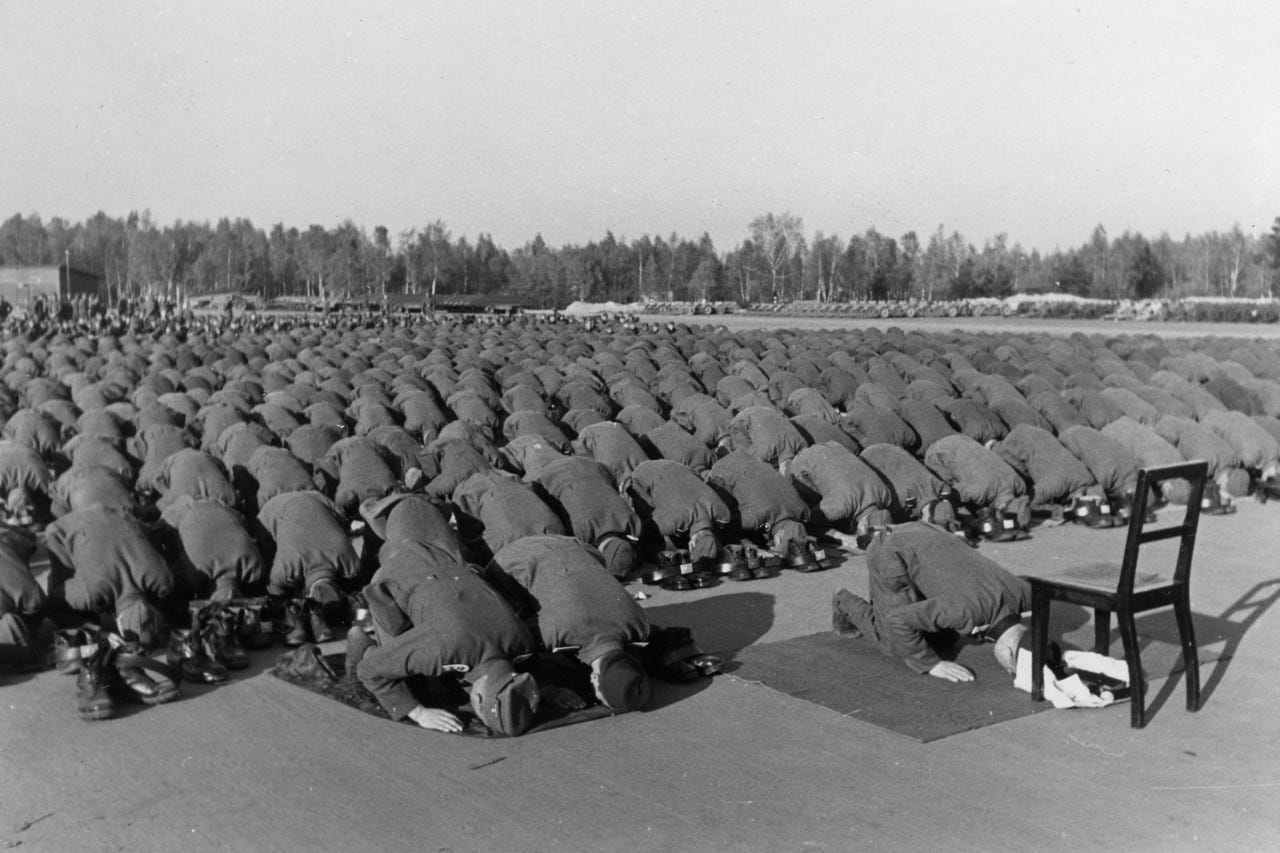
The Grand Mufti of Jerusalem, Hajj Amin al-Husseini, met with Hitler in November 1941 and provided active support for the Nazi extermination program, recruiting Muslim volunteers in the Balkans for the Waffen-SS, working to block the emigration of European Jews to Palestine, and collaborating with the Nazi leadership. Benjamin Netanyahu cited al-Husseini’s role at the United Nations General Assembly in 2015, and while historians continue to debate the precise degree of his operational influence on the Final Solution’s timing, his documented collaboration and enthusiasm for the program are not in question.
This represents the convergence of two distinct but structurally related traditions: the Ottoman-Islamic tradition of eliminating Christian minorities in the name of religious and ethnic consolidation, and the Nazi tradition of eliminating Jews in the name of racial purification. Different foundations. The same target. The same method. The same willingness to pursue annihilation as a political solution.
The theological dimension cannot be separated from this history. The hadith recorded in Sahih Muslim (hadith 2922), in which the Prophet describes a time when Muslims will kill Jews hiding behind stones and trees, which will call out to their pursuers, is canonical within the tradition, its authenticity not seriously disputed, and its content has been incorporated into the Hamas charter, recited at Hamas rallies, and invoked as theological justification for the October 7 massacres. The Ottoman state eliminated its Christian millions. Hitler eliminated six million Jews. The theological program preserved in Islamic eschatology identifies the killing of all Jews as a divine promise to be fulfilled before the Day of Judgment.
The Ottomans had their Final Solution to the Christian question. Hitler had his Final Solution to the Jewish question. The theological tradition carries its own Final Solution to the Jewish question, one that predates both and outlasts them.
Sources
Morgenthau, Henry Sr. Ambassador Morgenthau’s Story. Garden City, NY: Doubleday, Page & Company, 1918.
Morgenthau, Henry Sr. Murder of a Nation. New York: Armenian General Benevolent Union of America, 1974.
Toynbee, Arnold J., and James Bryce. The Treatment of Armenians in the Ottoman Empire, 1915–16 (The Blue Book). London: His Majesty’s Stationery Office, 1916.
Kaiser, Hilmar. The Extermination of Armenians in the Diyarbekir Region. Istanbul: Istanbul Bilgi University Press, 2014.
Akçam, Taner. A Shameful Act: The Armenian Genocide and the Question of Turkish Responsibility. New York: Metropolitan Books, 2006.
Akçam, Taner. The Young Turks’ Crime Against Humanity: The Armenian Genocide and Ethnic Cleansing in the Ottoman Empire. Princeton: Princeton University Press, 2012.
Bardakci, Murat. Talat Pasha’nin Evrak-i Metrukesi (The Remaining Documents of Talaat Pasha). Istanbul: Everest Yayinlari, 2008.
Ihrig, Stefan. Justifying Genocide: Germany and the Armenians from Bismarck to Hitler. Cambridge, MA: Harvard University Press, 2016.
Ihrig, Stefan. Atatürk in the Nazi Imagination. Cambridge, MA: Harvard University Press, 2014.
Bardakjian, Kevork B. Hitler and the Armenian Genocide. Cambridge, MA: Zoryan Institute, 1985.
Lemkin, Raphael. Axis Rule in Occupied Europe. Washington, DC: Carnegie Endowment for International Peace, 1944.
Lemkin, Raphael. CBS Television interview with Quincy Howe, 1949. Transcript cited in United States Holocaust Memorial Museum Encyclopedia, “Coining a Word and Championing a Cause: The Story of Raphael Lemkin.”
International Association of Genocide Scholars (IAGS). Resolution on the Armenian Genocide, 1997. Resolution on Assyrian, Syriac, and Greek Genocides, 2007.
Sahih Muslim, hadith 2922. In Sahih Muslim, compiled by Imam Muslim ibn al-Hajjaj (817–875 CE). Standard Arabic edition with English translation by Abdul Hamid Siddiqui.
United Nations. Convention on the Prevention and Punishment of the Crime of Genocide, December 9, 1948. UN Doc. A/RES/3/260.
Allied Powers Declaration of May 28, 1915, regarding Ottoman massacres of Armenians. Reproduced in Vahakn N. Dadrian, The History of the Armenian Genocide. Providence: Berghahn Books, 1995.
United States Holocaust Memorial Museum. “Coining a Word and Championing a Cause: The Story of Raphael Lemkin.” encyclopedia.ushmm.org.
Wiesel, Elie, et al. Open letter recognizing the Armenian Genocide, signed by 53 Nobel Laureates. Available through the Armenian National Institute, Washington, DC.
Magdi Khalil is a senior fellow at the Ideological Defense Institute.
What Is IDI ?
The most trusted source of information on the Middle East, Islam, and the ideological threats facing the West.
Subject-matter experts, former Muslims, Arab Christians, and Western thought leaders, coming together to equip policymakers to prevent destructive foreign ideas from being translated into law, restore confidence in the biblical principles that built the West by empowering the Church to reengage the public square, and provide the public with solid analysis to combat the confusion that is making the West vulnerable.
A very important book on the aftermath of this genocide, into the 1990s, is From The Holy Mountain, by William Dalrymple, whete he noticed the continuing destruction of the remenants of Armenian presence.
The Russian Empire had clear and realistic plans to proceed to Constantinople but "the West" blocked this. Only the Russian occupation of Armenia itself prevented total murder.
The actions of the West, up to today, have been a catastrophe the original Christians.
They are coming for us and half the country, the gay faggy half that would be killed first, way before conservatives, welcome them. Haven’t they seen any of those gay guys getting tossed off of roofs videos?
If you have time, take a look at two of my essays.
The Demographics of Denial: How Islam’s Radical Minority Outnumbers America
What Europe’s Collapse Means for America's Future - Demographics, Denial and the Slow Death of Freedom https://mrchrisarnell.com/p/the-demographics-of-denial-how-islams
and
The Islamic States of America?
How Progressive Idealism Opened the Gates to Political Islam
https://mrchrisarnell.com/p/the-islamic-states-of-america