


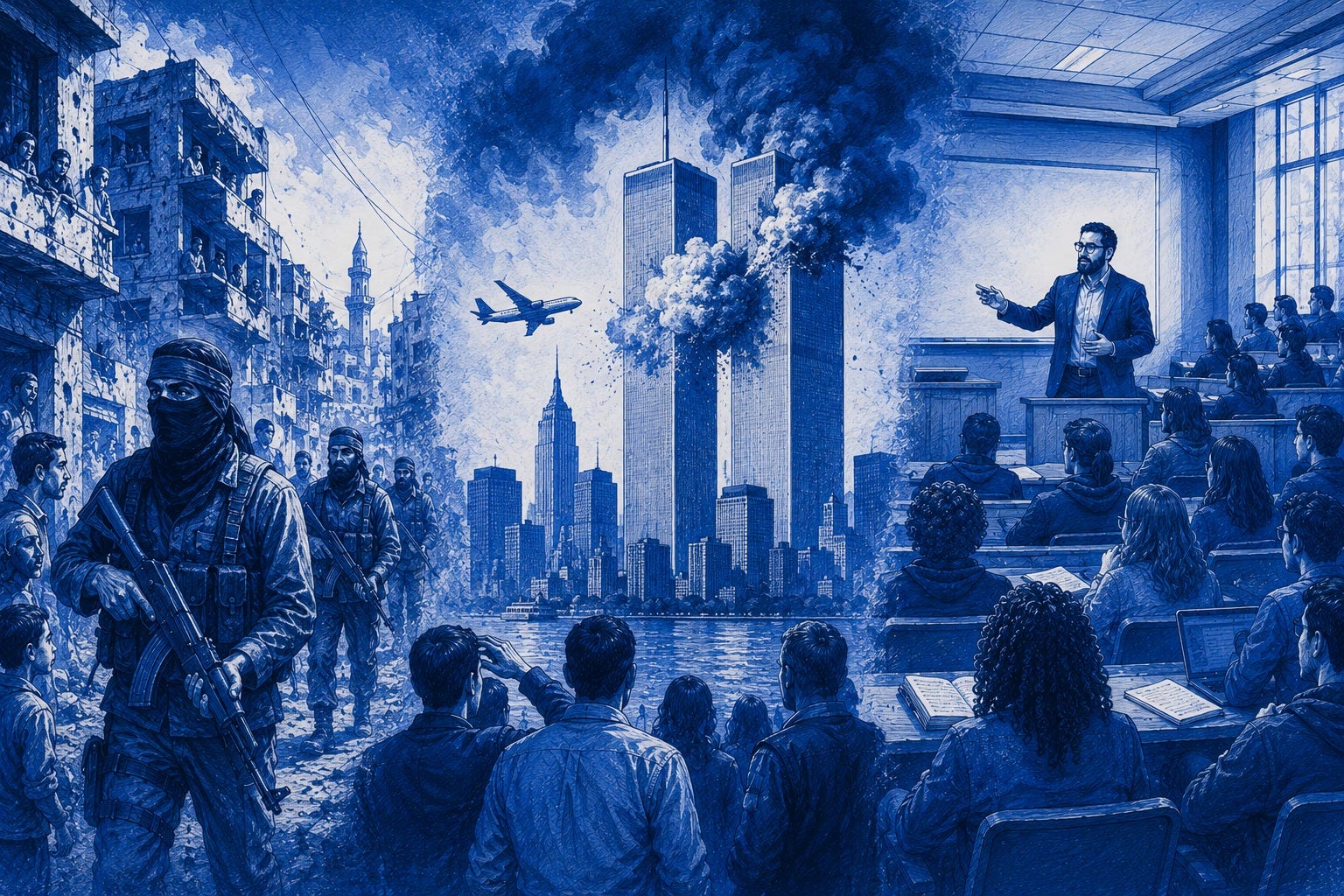
I learned the word jihad before I understood what it meant. Growing up in Beirut, I watched militias and armed men move into civilian neighborhoods, and I saw neighbors kill neighbors over religion and sect. Years of it nearly destroyed the country. And all of it was carried out in the name of jihad, jihad for Allah, Allah is with the jihadis, slogans that flooded the radio, the newspapers, the conversations on my own street. Decades later, the word still runs across the news, in the Muslim world and the Western press alike, and it has not lost its meaning.
September 11, 2001, broke something in the American mind, the comfortable assumption that all is well because all religions are basically the same, and that no faith teaches the killing of the innocent. I was in Indianapolis that morning, meeting with the missions committee of an evangelical church, when we watched the second plane hit the tower and the buildings come down. A word millions of Americans had never spoken entered their vocabulary overnight.
In the days after, imams went on television to explain that Islam is a religion of peace and that the men who did this were not Muslims. It was a campaign built to reassure Americans and to move their attention somewhere safer. Others called the attacks a tragic accident, an aberration, something jihad is not.
The years since have answered them. Jihad did not recede; it spread. Jihadi movements and terror attacks multiplied, not only in the lands they call kufar, the territory of the unbelievers, but across the Muslim world itself. The Islamic State slaughtered Christians, Yazidis, and Kurds, and then slaughtered fellow Muslims, Sunni and Shia, for being the wrong kind. In the West, an American woman converted to Islam, named herself Jihad Jane, and announced she had joined the global jihad. An Englishman converted and surfaced in execution videos as Jihadi John. The convert tells you what the convert was converted to.
If Islam is a religion of peace, why does the new convert so often arrive at the knife? The notion of a peaceful Islam is not a description of the thing. It is a tool, used to disarm the societies the thing intends to subdue. Thomas Jefferson met the same reality at the founding of this country. Rather than keep paying tribute to the Barbary states that preyed on American ships in the name of holy war, he sent the Navy, and the Marines, whose hymn still carries the line “to the shores of Tripoli” from that fight. He concluded that force, not negotiation, was the only language those raiders understood.
The Qur’an sets out jihad in Surah 9, verses 5, 29, and 111, and Surah 47 turns to the waging of war and the killing of enemies. I have read the Qur’an in Arabic more than forty-five times, so I can say plainly what the apologists obscure when they insist it can only be understood in Arabic: the meaning is clear. The Qur’an, like the Hadith, sorts humanity into Muslim and kafir, and it places Jewish and Christian believers among the kuffar, the blasphemers. The fashionable claim that the three faiths are simply “Abrahamic” cousins does not survive a reading of the book itself.
What Muhammad set in motion was a permanent fault line, between his religion and every other, and within his religion as well. The Sunni-Shia war is itself a jihad, a contest over who truly follows Allah and his messenger, and it does not end. Under Khomeini, the Iran-Iraq war consumed something close to a million lives on both sides in eight years, Muslim killing Muslim. Today American forces stand in the region largely as a buffer between a radical Shia regime and the Sunni Arab states it targets with rockets and drones. Jihad can be turned on anyone judged insufficiently faithful.
Once, speaking on jihad and the Middle East, a man in the audience told me jihad will end when the whole world becomes Muslim. I answered him with the history above. The Muslim world has not found peace within itself, and it will not, not until the ideology changes, until the way Muslims are taught to see other peoples and other nations changes. Islam has given neither inner peace nor social peace, and I do not foresee it.
I do not write this from a distance. My friend and classmate Waleed was killed by Palestinian jihadis. I had cousins die in the Golan Heights. For years I carried the hatred those losses earned, hatred for Palestinians, hatred for Jews. There are many peace-loving Muslims in spite of Islam, not because of it, and I am not speaking against them; I am speaking against an ideology that permits the killing of the kafir and the seizure of his land, and calls it obedience to God.
What changed me was not politics and not time. It was the Gospel. I asked God to forgive the hatred in me, and I trusted that Christ had paid the penalty I owed and risen to give me power over sin. I became a different man, able to feel compassion for all people, ready to ask God’s blessing on every nation. That is why I have given my life to Christ, and why I founded Crescent Project. In the years since, I have spoken with hundreds of Muslims, many of them once drawn to jihad, and I have found the same thing in them again and again: a thirst. A thirst for a God who is near and who saves. You cannot satisfy that thirst with seawater, and Islam is seawater.
This is where the Church has work to do. Speaking the truth about Islam is not Islamophobia, it is love. Christ told us the truth would set people free, and I have watched it do so. Many Muslims are leaving Islam now, turning away from an ideology that divides the world into believer and unbeliever. Some have come to Christ; some have not yet. But the door is open, and the people on the other side of it are thirsty.
Fouad Masri is a fellow at the Ideological Defense Institute.
Hopefully the leaders of Western Democracies (hard to call them “liberal” anymore) will start listening to those Muslims and ex-Muslims who know Islam intimately and are willing to openly discuss the threat that Islamists pose to the 6.5 non-Muslims and 1.0+billion Muslims (non fundamentalists). Thanks for your constant messaging and educating.
This was a moving article that we all need to hear. We need to love Muslims just as Jesus does. May the Church understand the mission to love them enough to share the love God has for them.