


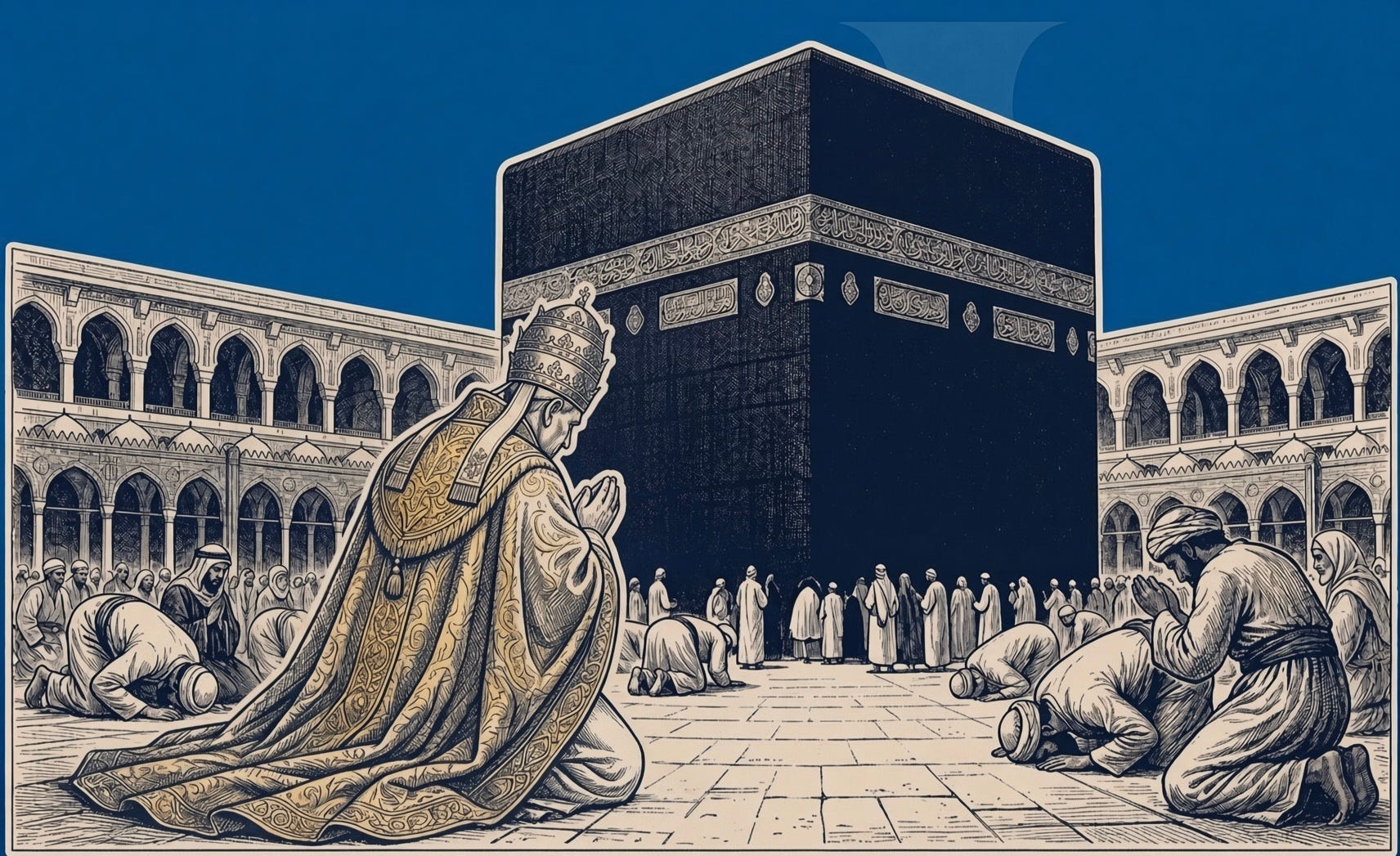
On Christmas Day 2017, more than 5,800 former Muslims who converted to Catholicism published an open letter to Pope Francis. They challenged him to reconsider his words in Evangelii Gaudium, an exhortation concerning evangelism in which Francis wrote, “authentic Islam and the proper reading of the Koran are opposed to every form of violence.”
“If Islam is a good religion in itself, as you seem to teach, why did we become Catholic?” they asked. “Do not your words question the soundness of the choice we made at the risk of our lives? Islam prescribes death for apostates (Quran 4.89, 8.7-11), do you know? In accordance with (Jesus’) teaching (Lk 14:26), we preferred Him, the Christ, to our own life. Are we not in a good position to talk to you about Islam?”
Their letter featured a stinging indictment.
“Many of us have tried to contact you on many occasions and for several years and we have never received the slightest acknowledgement of our letters or requests for meetings.”
Undaunted, Francis in 2019 signed the Document on Human Fraternity for World Peace and Living Together with Imam Ahmed el-Tayeb, the head of the most prestigious university in the Sunni Muslim world, Al-Azhar. The document provides a framework for Catholicism and Islam to work toward common goals that build peace, freedom, justice, and prosperity.
Francis’ attitude reflects the Vatican’s policy of indulging Islam to the point of appeasement and enabling it at the expense of the Catholic Church’s moral credibility.
William Kilpatrick, a professor emeritus at Boston College who has written numerous books and articles about the relationship between Christianity and Islam, makes a more devastating accusation.
“The Church’s attitude toward Islam goes beyond appeasement and enablement,” Kilpatrick said, adding:
“At this point, and I speak as a Catholic, it’s more accurate to speak about complicity.
“By speaking only good about Islam, and by remaining silent about the bad, the Church has covered-up much of the truth about Islam. In doing so it has put Catholics and other Christians in a much more vulnerable position vis-à-vis Islam—more vulnerable because (the church is) misinformed.”
The church’s attitude reflects the views of Louis Massignon, a French-Catholic scholar from the 20th century who believed the God of Abraham was the God of Muhammad. Massignon also described Islam as “the faith of Abraham revived with Muhammad,” he wrote, and the Qur’an as reflecting a level of divine inspiration.
Because Muslims are Abraham’s descendants, Massignon concluded, “they have the right to equality among the monotheisms descended from Abraham to participate in the double promise made to Abraham, that of the Messiah and that of the Holy Land,” he wrote.
Massignon’s work appeared while secularism’s influence increased in Europe, creating “an underlying dissatisfaction with modernity, and with our liberal, capitalist, individualistic arrangements,” French-Catholic scholar Alain Besancon wrote in 2004. As a result, “an entire literature favorable to Islam has grown up in Europe, much of it the work of Catholic priests under the sway of Massignon’s ideas.”
“Alarmed by the ebbing of religious faith in the Christian West, and particularly in Europe, these writers cannot but admire Muslim devoutness,” Besancon wrote. “Surely, they reason, it is better to believe in something than in nothing, and since these Muslims believe in something, they must believe in the same thing we do.”
The Catholic Church embraced Massignon’s ideas at the Second Vatican Council, which took place between 1962-65 to address the church’s role in the modern world. One document, Nostra Aetate, which focused mainly on Judaism, addressed Islam:
“The Church also regards with esteem the Muslims. They adore the one God . . . they take pains to submit wholeheartedly to even His inscrutable decrees, just as Abraham, with whom the faith of Islam takes pleasure in linking itself, submitted to God. Though they do not acknowledge Jesus as God, they revere Him as a prophet.”
Another document from the council, Lumen Gentium, declared that “the plan of salvation also includes those who acknowledge the Creator. In the first place among these are the Muslims, who, professing to hold the faith of Abraham, along with us adore the one and merciful God.”
That passage made the 1992 Catechism of the Catholic Church.
Pope John Paul II, who published that catechism, plotted the course for appeasement by making an unprecedented commitment to engage in dialogue with Islam.
“For Karol Wojtyla (John Paul’s given name), religious dialogue is necessary in order to foster the common good of humanity,” Renzo Guolo, an expert in Islam at the University of Trieste, wrote in 2003. “This dialogue is sustained by the awareness that there are common values across cultures, because these values are rooted in human nature. These include the defense of the family, opposition to abortion, and peace.”
In the late pope’s mind, no obstacle would be too powerful to overcome.
“He seems to believe,” Guolo added, “that only the prophetic gesture, the utopian perspective, the mystical leap powered by an intense spirituality, can achieve this objective.”
John Paul used such dialogue to try to forge a de facto alliance with Islam against Western secularism after the demise of European Communism.
“The Church is aware that it can offer a sort of new civil religion to the United States of Europe,” wrote Enzo Pace, sociology professor at the University of Padua. He added:
“Islam thus becomes the most important moral interlocutor because the Church sees it as a well-structured religion which is on the increase in contemporary Europe.
“To ensure this integration, the Catholic Church believes it is necessary to accept the idea of recognizing Islam as a universal religion, while, at the same time, inviting Islam to accept at least the basic moral and juridical principles of European Christian culture.”
Bishops implemented that directive by selling underutilized churches and schools to Muslim groups, with churches becoming mosques. In 2006, the Capuchin Franciscan friars agreed to help the Union of Islamic Communities and Organizations in Italy build a mosque in Genoa.
The union, affiliated with the Muslim Brotherhood, advocates “an extremist version of the Qur’an, where Christians, Jews and Westerners are criminalized, as well as women and other Muslims who don’t submit to their rule,” reportedMilan’s Corriere della Sera. The group’s president, Mohamed Nour Dachan, refused to sign a document pledging Muslims to accept Italy’s constitution, denounce terrorism and recognize Israel’s right to exist.
Nevertheless, a Vatican cardinal suggested Muslim students receive Islamic religious instruction in Italian schools during the hour reserved for Catholic instruction.
“If there are 100 Muslim children in a school, I don’t see why they shouldn’t be taught their religion,” Cardinal Renato Martino, president of the Pontifical Council for Justice and Peace, said in 2006. “If we said ‘no’ until we saw equivalent treatment for the Christian minorities in Muslim countries, I would say that we were placing ourselves on their level.”
In 2008, the bishops of England and Wales asked Catholic schools to reserve prayer rooms for Muslim students and to adapt lavatories for ritual washing before prayer. “The demands go way beyond legal requirements on catering for religious minorities,” reported the Daily Mail.
But the worst appeasement occurred in Belgium.
Bishops turned their churches into homes for Muslim migrants to force the government to grant amnesty. In 2006, more than 30 Belgian churches served that purpose. About 300 migrants occupied Antwerp’s Magdalena Chapel. Other churches held as many as 700.
At Brussels’ Our Lady of Succor Church, migrants lived in small tents donated by Catholic relief agencies, conducted Muslim services, erected computer tables near the pulpit and even set fires on the floor. The Rev. Herwig Arts described the scene at Antwerp’s Jesuit chapel for Gazet van Antwerpen in 1998.
“(Migrants) removed the tabernacle, (and) installed a television set and radios, depriving us of the opportunity to pray in our own chapel and say Mass,” Arts said. “It has upset me very much. For me, the place has been desecrated. I feel I cannot enter it anymore.”
Belgium’s bishops were not amused.
“Everybody is entitled to a good place in our society,” said Monsignor Luc van Looy, the bishop of Ghent, including what he called “illegal fugitives.”
Cardinal Godfried Danneels, the archbishop of Brussels and Belgium’s leading prelate, added that “solidarity cannot be limited to one’s own nation.”
Bishops thus silenced Arts and other priests who held similar opinions.
While Catholic bishops disregarded the needs of their own congregants, John Paul ignored the plight of Christians in the Muslim world. Bishops remembered how John Paul, “who ordinarily speaks about all topics,” Guolo wrote, “had spread a veil of silence over the persecution of Christians in Muslim countries.”
In 2002, an Arab convert named Nura told Corriere della Sera: “We feel abandoned. After our conversion, we have no one to support us. We ask the Church and Italy: Protect us, defend us.”
Pope Francis accelerated the momentum by reinforcing the link between migration and Islam. In 2015, Francis askedparishes in Europe to take in at least one family escaping civil disorder in Syria. In 2016, the pope visited the Greek island of Lesbos, home to thousands of Syrian refugees, and brought 12 Muslim refugees from three families with him on the return trip to Rome.
During his visit to Lesbos, Francis lectured about the moral imperative to help migrants “who have faces, names and individual stories,” he said. As European governments imposed immigration restrictions, the pope criticized their “fanaticism of indifference” while visiting Marseilles in 2023.
Yet when confronted with Muslim violence, the Vatican and Western bishops display their own “fanaticism of indifference.”
Middle East Forum reported in 2019 that French authorities recorded 1,063 attacks on churches in 2018. In Germany, “crosses are broken, altars are smashed, Bibles are set on fire, baptismal fonts are overturned and the church doors are smeared with Islamic expressions such as ‘Allahu Akbar.’”
In the midst of hundreds of thousands of Muslim immigrants overwhelming Europe and engaging in criminal behavior, Catholic bishops either issue sentimental boilerplate or remain silent.
“Have you heard one English bishop express sympathy for the English people’s concerns about criminal aliens invading our country? I haven’t,” the Rev. Nick Donnelly, a British Catholic deacon, wrote last year during massive nationwide protests. “Have you heard one English bishop express outrage over the hundreds of thousands of English girls raped by men from foreign cultures? I haven’t.”
As IDI examined, Pope Leo propels Francis’ agenda. In an impromptu press conference while returning from Lebanon in December, he insisted upon dialogue as the solution to long-standing problems between Christians and Muslims.
“I think one of the great lessons that Lebanon can teach to the world is precisely showing a land where Islam and Christianity are both present and are respected and that there is a possibility to live together to be friends,” the pope said. “We should perhaps be a little less fearful and look for ways of promoting authentic dialogue and respect.”
Only breathtaking naïveté can explain such a response after visiting a nation ravaged by more than five decades of religious civil war.
“The Church has, in effect, become an enabler of Islam,” Kilpatrick said, “by lending legitimacy to Islam through dialogue, joint statements from the Pope and Islamic leaders, Islam-friendly school curriculums and so forth—but mostly by keeping silent about the worldwide persecution of Christians by Muslims.”
In the current clash of civilizations, Rome’s relationship to Mecca resembles Vichy’s to Berlin during World War II.
Joseph D'Hippolito is a contributor to the Ideological Defense Institue
Thank you for this post. Now I can see it’s really worst than I thought. The Catholic Church has joined the useful idiots brigade.
It makes me weep. Betrayed to Islam by the very people that should be standing against it. Jesus help us all.