


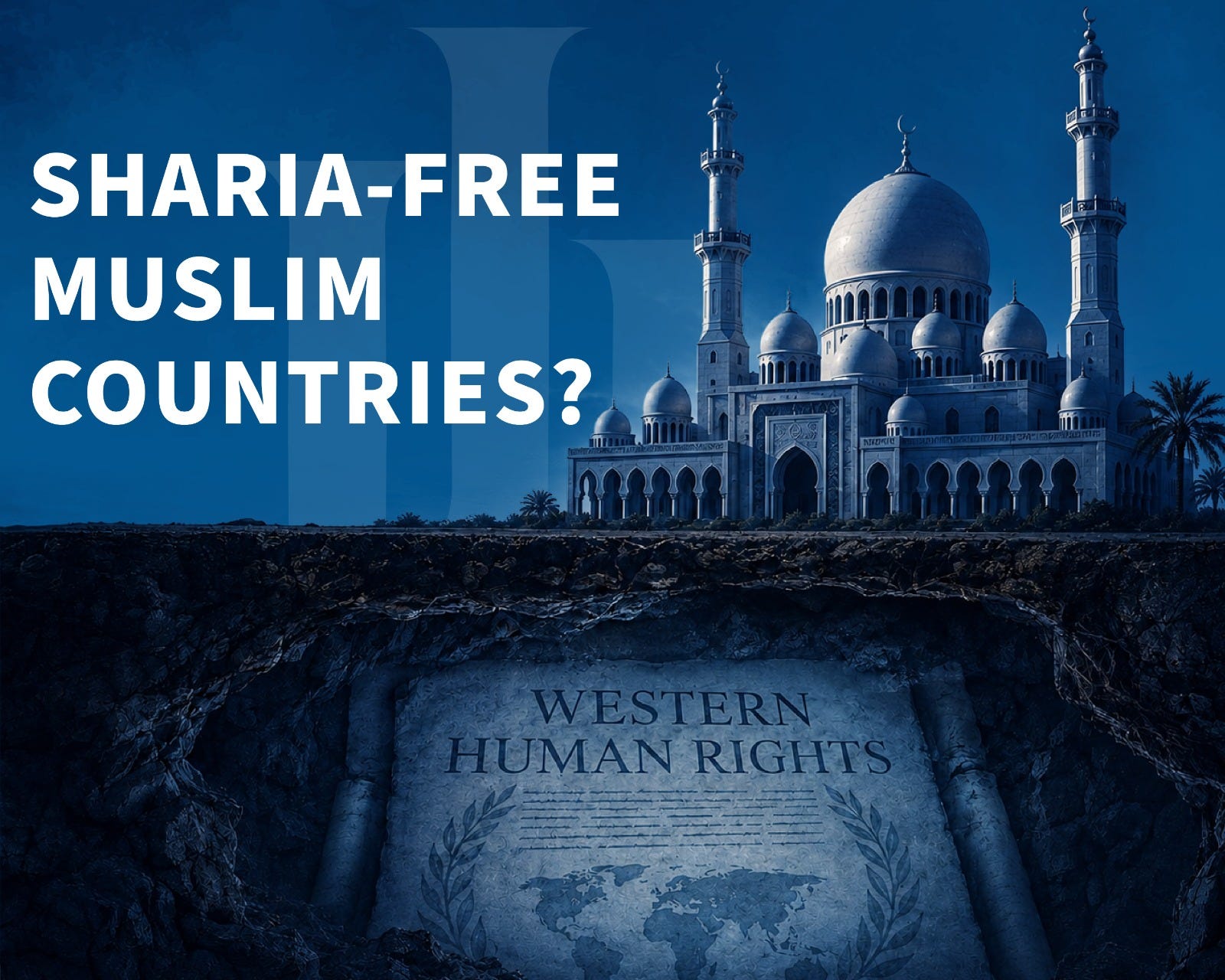
Islamic law, sharia, produces a specific catalog of binding prohibitions and obligations. The criminal hudud penalties prescribe stoning for adultery, amputation for theft, and crucifixion or death for certain categories of brigandage and apostasy. The jizya tax is levied on non-Muslim populations living under Islamic political authority, who occupy the subordinated status of dhimmis. Conventional interest-based lending is prohibited under the doctrine of riba. Women are placed under the male guardianship of fathers, husbands, or other male relatives for major life decisions, and their testimony in evidentiary procedure is treated as half the value of a man’s. The political authority of non-Muslims over Muslims is prohibited, and the territorial expansion of Islamic authority is treated as a binding collective obligation under the doctrine of jihad.
These laws are not the inventions of modern extremists. They are the outputs of the canonical Islamic scripture.
Islamic law has been impractical for modern statecraft since the first attempts to build Muslim-majority states inside the international order that emerged in the nineteenth and twentieth centuries. It cannot be applied inside the contemporary international order. A state that imposes the hudud cannot maintain extradition treaties with non-Muslim states. A state that collects the jizya cannot host the diplomatic presence of non-Muslim governments. A state that prohibits riba cannot participate in the international banking system. A state that enforces the male guardianship of adult women cannot generate the labor-force participation, the educational attainment, or the consumer economy that modern productivity requires. A state that executes apostates cannot maintain freedom-of-religion treaty obligations or attract international professional populations. The laws are incompatible with modern statehood as such.
Every Muslim-majority polity that has attempted to participate in the modern international order has had to deactivate substantial portions of sharia to do so. Egypt does not stone adulterers; the modern Egyptian civil code was derived predominantly from the French Civil Code, with selective sharia references rather than the other way around.¹ Pakistan’s Hudood Ordinances of 1979 formally brought hudud penalties into the criminal code, but the evidentiary requirements, four adult male Muslim eyewitnesses to the act of penetration for zina prosecutions, rendered the ordinances largely inert in practice. The Women’s Protection Act of 2006 further constrained their operation.²
Indonesia, with the world’s largest Muslim population, operates a secular criminal code derived from the Dutch colonial system, with Islamic criminal law existing only in the Special Region of Aceh. Morocco reformed its Mudawwana family code in 2004 to remove the male guardianship requirement for adult women, heavily restrict polygamy, and equalize inheritance rights in significant respects. Tunisia, under Habib Bourguiba’s Code of Personal Status of 1956, abolished polygamy outright. The deactivation of Islamic law is therefore the rule across the Islamic world, not the exception.
THE DEACTIVATION OF SHARIA IN THE UAE
The United Arab Emirates has accomplished a deactivation more complete than any other Muslim-majority state.
Cohabitation and zina: Islamic law prohibits zina, defined as sexual relations outside marriage, with binding criminal consequences extending to cohabitation between unmarried adults of opposite sex. The UAE deactivated this prohibition through Federal Decree-Law No. 15 of 2020, signed by President Sheikh Khalifa bin Zayed Al Nahyan on November 7, 2020.³ The reform was consolidated in the new federal penal code under Federal Law No. 31 of 2021, effective January 2, 2022. Consensual cohabitation and consensual extramarital sex between adults are no longer criminal offenses.
Alcohol: The Qur’anic prohibition on alcohol is among the more textually direct provisions of Islamic law (Qur’an 5:90-91). The same Federal Decree-Law No. 15 of 2020 amended Article 313 of the federal penal code to decriminalize the consumption, possession, and trade of alcoholic beverages by persons over twenty-one in licensed venues.⁴ Dubai operates a particularly permissive regime calibrated to support the international tourism economy.
Dhimma and non-Muslim religious practice: Islam permits the practice of certain non-Muslim faiths only within the dhimma framework: payment of jizya, prohibition on the construction of new houses of worship, prohibition on public display of non-Muslim religious symbols, and a generalized social subordination of dhimmi populations.⁵ The UAE has done none of what this framework requires. No jizya is collected. New churches, Hindu temples, gurdwaras, and Jewish synagogues have been built in the twenty-first century with state authorization. The Abrahamic Family House on Saadiyat Island, inaugurated on February 16, 2023 and opened to the public on March 1, 2023, contains the Imam Al-Tayeb Mosque, the St. Francis Church, and the Moses Ben Maimon Synagogue in a single architectural complex.⁶
Women: Islamic law produces several binding constraints on women’s social and economic role: male guardianship, prohibition on free mixing between unrelated men and women, modesty requirements with specific provisions on covering, half-share inheritance, and limitations on women’s testimony. The UAE has deactivated most of these. Emirati women hold senior positions in the federal cabinet, the diplomatic corps, the judiciary, and corporate leadership. The guardianship system has been progressively dismantled. Women travel internationally without male escort. Free mixing is the normal condition of professional and social life. Dress is essentially voluntary. The inheritance rules retain their Islamic form in personal-status law for Muslims but operate inside a federal system that has permitted non-Muslim residents to opt out through Federal Decree-Law No. 41 of 2022 on Civil Personal Status for Non-Muslims.
Finance and riba: Islam prohibits riba (usury) and prescribes specific contract forms incompatible with the conventional global financial system. The UAE applies English common law rather than Islamic jurisprudence to its international financial sector. The Dubai International Financial Centre, established in 2004, and the Abu Dhabi Global Market, established in 2013, operate under English common law with independent court systems whose judges are predominantly drawn from common-law jurisdictions worldwide.⁷ Conventional interest-based lending operates freely. Sharia-compliant Islamic finance exists as a parallel product line, not as the system’s operative framework. The legal certainty that attracts international capital comes from the imported common-law system.
Friday sermons and religious speech: A polity applying Islamic law would face the question of how to manage the Friday sermon, historically the primary medium of political-Islamic mobilization. The UAE has centralized the regulation of Friday sermon content under the General Authority for Islamic Affairs and Endowments. Sermons are written by the state and read aloud in mosques with deviation producing professional consequences for the imam. The content excludes political-Islamic themes and avoids the doctrinal positions on jihad, on Jews, on non-Muslims, and on the proper political role of Islam that mainstream Islamic preaching elsewhere continues to articulate.
Religious education: Across most of the Arab Islamic world, religious education transmits specific positions on jihad, on the religious status of Jews and Christians, on al-wala’ wal-bara’ (loyalty to Muslims and disavowal of non-Muslims), and on the political role of Islam in the state. Al-Azhar University in Cairo continues to teach and publish in this tradition. Following the October 7, 2023, Hamas attacks, Al-Azhar issued a statement that “salutes with utmost pride the resistance efforts of the proud Palestinian people,” and on October 18, 2023, released a fatwa declaring that “Zionist civilians on occupied land do not [at all] qualify the description of ‘civilians.’”⁸ The UAE has systematically revised its national religious-education curriculum across the past fifteen years, removing this material and foregrounding abrogated tolerant Qur’anic verses.⁹
Apostasy: Even though Emirati law formally criminalizes apostasy by death, no Emirati Muslim has been criminally prosecuted for apostasy in living memory. Emiratis who quietly stop practicing are not pursued. The state does not investigate the personal religious convictions of its citizens. Private apostasy is, in fact, available in the UAE in a way it is not in other Islamic countries where social policing, family enforcement, or state action produce consequences that the UAE’s regime does not produce.
Israel and the Islamic political consensus: The majority of Muslims treats the rejection of the State of Israel as a binding political and religious commitment, anchored doctrinally in Qur’an 5:51 and in the jurisprudence on Dar al-Islam, which treats any territory once incorporated into Islamic political authority as permanently Islamic. The Khartoum Resolution of September 1, 1967, codified the Arab and Islamic position into the three no’s: no peace with Israel, no recognition of Israel, no negotiations with Israel. The formula held as the binding consensus across Arab states and Islamic movements for fifty-three years. The UAE deactivated this commitment on September 15, 2020, by signing the Abraham Accords and establishing full diplomatic, economic, and security relations with Israel.¹⁰
The war on the Muslim Brotherhood: The deactivation is paired with active opposition to the international organizational infrastructure of political Islam. The UAE designated the Muslim Brotherhood a terrorist organization in November 2014, under Federal Law No. 7 of 2014. The cabinet’s terrorist-entity list of November 15, 2014 contained 83 organizations, including the Brotherhood’s Emirati affiliate Al-Islah, Brotherhood-aligned organizations across Europe (the Association of Italian Muslims, the Finnish Islamic Association, Geneva-based Alkarama), Islamic Relief Worldwide in Birmingham, and the two largest Brotherhood-descended Muslim civil-society organizations in the United States, the Council on American-Islamic Relations (CAIR) and the Muslim American Society (MAS).¹¹ On January 8, 2025, the UAE expanded the list further, adding eleven individuals and eight UK-based companies linked to the Brotherhood.¹² A state applying Islamic law in even attenuated form would not be the most aggressive opponent in the Muslim-majority world of the largest organized movement to apply Islamic law globally. The UAE has decoupled itself from Islamic governance and identified the international movement to apply Islamic governance as a strategic enemy.
THE TYRANNY OF PUBLIC OPINION IN ISLAMIC STATES
If the deactivation of Islamic law is the requirement of modern statecraft, why has it not consolidated across the wider Islamic world? Why are the patterns of failure, Iran 1979, Sudan 1985, Algeria 1991, Egypt 2012, so consistent? The answer is the constraint Tocqueville identified in Democracy in America as the tyranny of public opinion, applied here to societies whose public opinion has been shaped by fourteen centuries of religious political theology.¹³
In a society where the Friday sermon, the religious educational system, the social authority of the religious scholars, and the inherited moral imagination of the population continue to treat Islamic laws as binding, the state’s formal deactivation of those provisions is in permanent tension with the beliefs of its citizens. The state may write the law one way. The population believes the law should be written the other way. The gap is the political space in which Islamic movements grow, in which secular regimes lose legitimacy, and in which the deactivation is reversed whenever conditions permit.
Egypt under Anwar Sadat liberalized economically and signed the peace treaty with Israel in 1979. Sadat was assassinated on October 6, 1981, by members of Egyptian Islamic Jihad.¹⁴ Tunisia under Bourguiba and his successor Zine El Abidine Ben Ali ran the most aggressively secular Arab regime for fifty years. The regime was overthrown in 2011, after which the Islamic Ennahda party won the first free elections, demonstrating that the deactivation had been a state-imposed operation the population had not internalized. The Shah of Iran ran the most ambitious Islamic-world modernization program of the twentieth century: land reform, women’s suffrage, mass education, and aggressive economic liberalization. The Shah was overthrown in February 1979 by a revolution led by Ayatollah Khomeini and supported by an alliance of the religious scholarship, the bazaar merchants, and the masses whose Islamic political theology the modernization program had failed to reach. Algeria’s secular socialist regime faced the Islamic FIS in the first round of parliamentary elections in December 1991. The FIS won decisively, prompting a January 1992 military coup and a civil war that killed approximately 150,000 people across the following decade.
In each case the state’s formal apparatus had been substantially modernized and Islamic law had been substantially deactivated in operative content. In each case the population, shaped by religious institutions the state did not fully control, retained the political capacity to demand the reinstatement of Islamic political authority whenever the state’s legitimacy weakened.
The problem is therefore not the absence of administrative will to deactivate. Egypt, Tunisia, Iran under the Shah, and Algeria all had the administrative will. The problem is the public opinion the deactivation cannot survive. Where the population is open to political mobilization through religious channels the state does not control, through independent mosques, through religious scholarly authority outside the state’s discipline, through religiously formed civil-society organizations, through electoral processes that allow Islamic parties to compete, the deactivation cannot be made permanent. The Islamic intellectual and political constituencies are organized at a scale and with a depth of legitimacy that ruling regimes cannot indefinitely override.
IS THE UAE DIFFERENT? AND WILL IT LAST?
The UAE has escaped the public-opinion constraint through a specific combination of conditions that no other Islamic polity shares.
The federation was established on December 2, 1971, from seven Trucial sheikhdoms that had existed under British protection since the nineteenth century. The founding was the product of negotiated agreement among ruling families, Sheikh Zayed bin Sultan Al Nahyan of Abu Dhabi and Sheikh Rashid bin Saeed Al Maktoum of Dubai as architects, rather than imposition by force or mass political mobilization. The federation has governed since 1971 through consensus among ruling families and a small Emirati citizenry, embedded in a non-citizen resident population of expatriates from more than 200 nationalities.
This is the demographic and political configuration that has made the UAE’s deactivation possible. The Emirati citizen population is roughly one million in a total population of approximately ten million. The state determines the content of the Friday sermon, the religious educational curriculum, the legal framework, and the public posture on the major political-theological questions. There is no independent religious scholarly establishment outside state discipline. There are no Islamic political parties because there are no political parties. There is no electoral process at which an Islamic program could be tested against the regime’s program. The independent civil-society infrastructure through which Islamic mobilization could occur does not exist in the UAE.
The deactivation in the UAE is therefore in alignment with a public opinion that the state has built. The Emirati citizen who grows up inside the Emirati educational system, watches Emirati state media, attends mosques where the state writes the sermon, and lives in a federation whose ruling families have governed by consensus since 1971 has been formed inside the legitimating frame of the deactivation rather than against it. The state has not had to overcome a hostile religious popular sentiment because the state has prevented that sentiment from forming in political shape.
The UAE is different not because it has solved the doctrinal problem of Islamic reform but because it has conditions, small population, federal monarchy, total state control of the religious public sphere, absence of independent Islamic political mobilization, that other Islamic countries do not possess. The Emirati model cannot be replicated in larger or more politically open Islamic polities because the conditions that make the model work are precisely the conditions those polities lack.
Whether the UAE’s project will last depends on whether these conditions hold. Three risks deserve attention.
The first is generational. The deactivation has been built over the past two decades under the leadership of Sheikh Khalifa bin Zayed and his successor Sheikh Mohamed bin Zayed. The current architecture rests on the cohesion of the ruling families, the continued exclusion of independent Islamic political organization, and the maintenance of a small citizen population relative to the non-citizen resident population. A succession crisis, a fracture among the ruling families, or a demographic shift that gave native Emiratis a different relationship to the state’s chosen course could destabilize the configuration.
The second is regional. The UAE is embedded in a region where Iran, Qatar, Turkey, and elements of the Muslim Brotherhood continue to project political-Islamic influence. The Emirati domestic deactivation is sustained partly by the active war on the Brotherhood and the broader infrastructure of political Islam. A regional shift, an Iranian success in projecting power into the Gulf, a Muslim Brotherhood return to political viability in Egypt or Tunisia, a Qatari-Turkish strategic realignment, could place pressure on the Emirati model from the outside.
The third is demographic. The non-citizen resident population sustains the UAE’s economy but cannot be assimilated into Emirati citizenship under the existing constitutional framework. The state’s ability to maintain the deactivation depends on continued political control by the small citizen population. If the non-citizen population grew in political weight, or if economic conditions forced the state to extend political participation to expatriates, the public-opinion constraint that the UAE has escaped could begin to operate.
THE HOUSE OF ISLAM

The House of Islam: The Case Against the Islam/Islamism Divide is the inaugural issue of The Ideological Defense Institute Journal, a new publication dedicated to examining the doctrines, movements, and ideological conflicts shaping the future of the West.
NOTES
Enid Hill, “Al-Sanhuri and Islamic Law: The Place and Significance of Islamic Law in the Life and Work of ‘Abd al-Razzaq Ahmad al-Sanhuri, Egyptian Jurist and Scholar, 1895-1971,” Arab Law Quarterly 3, nos. 2-3 (1988): 182-218, 287-310.
Government of Pakistan, The Offence of Zina (Enforcement of Hudood) Ordinance, 1979; and Protection of Women (Criminal Laws Amendment) Act, 2006. Statutes archived at the National Assembly of Pakistan, https://na.gov.pk/.
United Arab Emirates, Federal Decree-Law No. 15 of 2020 Amending Certain Provisions of Federal Law No. 3 of 1987 Concerning the Penal Code. Text archived at the UAE Ministry of Justice, https://www.moj.gov.ae/. For analytical summary, see Trowers & Hamlins LLP, “United Arab Emirates Legal Reforms,” November 10, 2020, https://www.trowers.com/.
Anish Pailoor, “UAE: Reforms in Personal Status and Criminal Law,” Solicitors Journal, April 11, 2023.
Yohanan Friedmann, Tolerance and Coercion in Islam: Interfaith Relations in the Muslim Tradition (Cambridge: Cambridge University Press, 2003).
Maria-Cristina Florian, “The Abrahamic Family House, Adjaye Associates’ Interfaith Complex in Abu Dhabi, Opens to the Public,” ArchDaily, March 1, 2023, https://www.archdaily.com/997156/the-abrahamic-family-house-adjaye-associates-interfaith-complex-in-abu-dhabi-opens-to-the-public.
Dubai International Financial Centre, https://www.difc.ae/; Abu Dhabi Global Market, https://www.adgm.com/.
Institute for National Security Studies, “Al-Azhar at a Crossroads,” January 2024, https://www.inss.org.il/.
Mariam Alhashmi, Naved Bakali, and Rama Baroud, “Tolerance in UAE Islamic Education Textbooks,” Religions 11, no. 8 (2020): 377, https://doi.org/10.3390/rel11080377; Zeynep Ozgen and Soha I. El Shishtawy Hassan, “Meaning of a Textbook: Religious Education, National Islam, and the Politics of Reform in the United Arab Emirates,” Nations and Nationalism 27, no. 4 (2021): 1181-1197, https://doi.org/10.1111/nana.12734.
US Department of State, “The Abraham Accords Declaration,” September 15, 2020, https://www.state.gov/the-abraham-accords/.
“List of Groups Designated Terrorist Organisations by the UAE,” The National (UAE), November 16, 2014; “UAE Designates 83 Groups as Terrorist Organisations,” MEED, November 17, 2014.
Human Rights Watch, “UAE: Dissidents, Relatives Designated ‘Terrorists,’” April 22, 2025, https://www.hrw.org/news/2025/04/22/uae-dissidents-relatives-designated-terrorists.
Alexis de Tocqueville, Democracy in America, vol. 1 (1835), chap. 15.
On the assassination of Anwar Sadat on October 6, 1981, by members of Egyptian Islamic Jihad, see the historical record consolidated in the U.S. Department of State Office of the Historian, “Egypt and the Camp David Accords,” https://history.state.gov/.