


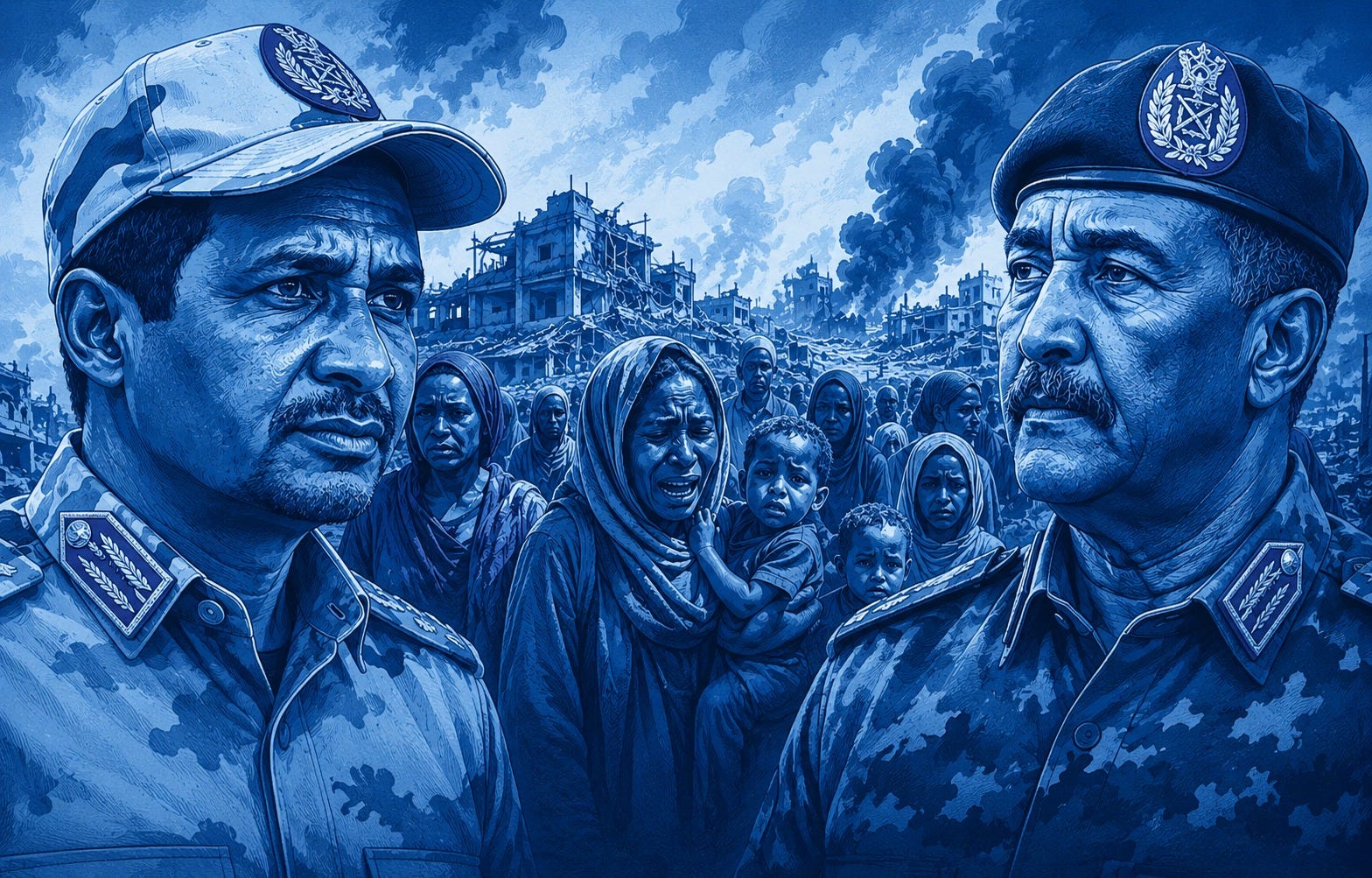
On April 15, 2023, a devastating civil war broke out in Sudan between two war criminals: Abdel Fattah al-Burhan, commander of the army, and Mohamed Hamdan Dagalo, known as Hemedti, commander of the Rapid Support Forces. Both men lead military forces that were once part of the Sudanese army; this is, in other words, a state of fracture and military conflict following an alliance, and following war crimes both sides had committed against the Sudanese people and against the civilian opposition. In 2003, al-Burhan and Hemedti took part, on the orders of Omar al-Bashir, in the savage massacres in Darfur that claimed more than 300,000 lives. In October 2021, the two men joined together in the coup against the civilian government that had been formed after the Sudanese uprising.
The war has plunged Sudan into total ruin. According to international reports, between 150,000 and 200,000 Sudanese have been killed and hundreds of thousands wounded, with more than 50,000 missing. Roughly 14 million Sudanese have been displaced inside and outside the country, and 34 million suffer from widespread hunger. Thousands of women have been raped: according to Doctors Without Borders, 3,396 women were sexually assaulted in Darfur alone between 2024 and 2025, and international reports estimate that hundreds of women across Sudan have taken their own lives as a result of this rape. Six million children have been forced out of school, along with 714 university students; 89 percent of farmers have lost the ability to work their land; and infrastructure has been destroyed on a vast scale across the whole of Sudan.
Mass graves. Mass rape. Ethnic cleansing. Forced displacement. Enforced disappearance. Torture. War crimes. Extrajudicial executions. The largest humanitarian crisis in the world. The most dangerous famine in the world. A surge of hate crimes. Even chemical weapons have been used in this filthy war, by the Sudanese army.
And yet, for all the horror of what is happening, Sudan has drawn no real attention from the international community. There is no media coverage of what is taking place there; not a single demonstration has been held against the continuation of this war, even as thousands of demonstrations have filled the streets of the West on behalf of Gaza. This war has earned no global concern whatsoever, and we have heard not one voice from the women’s organizations against the mass rape of Sudanese women. All of this is because the Arabs and Muslims wanted to steer attention and money toward shining the spotlight on Gaza alone, for the sole reason that Israel is the other party in the equation.
Foreign intervention has prolonged the war, deepened the crisis, and fed the conflict, for there are states backing each side of the war for reasons of their own. Egypt, for instance, backs al-Burhan because it supports military rule and has stood behind every military coup in Sudan’s history. The opposite is true of the UAE, where, over the past fifteen years, Mohammed bin Zayed has pursued two principles without apology: a determined campaign against the Muslim Brotherhood, and the conviction that the UAE is entitled, like any sovereign state, to put its own interests first. Both are at work in Sudan. With the Muslim Brotherhood holding the Sudanese army in its grip, Abu Dhabi had every reason to back the other side, and its economic ties to Hemedti gave it a further, perfectly ordinary national interest in the outcome.
As for Saudi Arabia, which was in a cold war with the military regimes back in the 1960s, it backs al-Burhan for one reason only: because the UAE backs the other side, as part of the current rivalry between the Saudis and the Emiratis.
There are many other parties entangled in the Sudanese crisis as well, South Sudan, Chad, Libya, the Central African Republic, Turkey, Russia, Ethiopia.
The most dangerous intervention America has observed is the Iranian one: arming the Sudanese army with drones, and training the Muslim Brotherhood elements fighting alongside that army. This is a dangerous scenario that Iran had been planning, to close the Bab al-Mandab strait and disrupt international trade through the Red Sea by means of its Houthi allies in Yemen and the Brotherhood in Sudan. For this reason the American administration designated the Brotherhood organization in Sudan a terrorist group in 2026 and warned al-Burhan against cooperating with Iran.
It is these international interventions that have blocked any solution to the crisis. On July 30, 2025, the Washington meeting on the Sudanese crisis collapsed over an Egyptian-Emirati dispute: the United States had circulated a draft plan for a settlement that everyone, including the UAE, accepted, and Egypt rejected, and so the meeting failed.
Sudan’s Crisis Is an Old One
But the crisis in Sudan is old, and it can be summed up in three words: England, Egypt, and Islamic sharia.
England, for the sake of its own interests, assembled an enormous Sudanese state out of mismatched ethnic, religious, and linguistic groups, Arabs and Africans, Muslims and Christians and pagans, warring tribes, clashing races, forming the largest country in Africa until the secession of South Sudan, and currently the third largest.
Egypt, for its part, has backed military rule and supported the coups in Sudan, from Ibrahim Abboud’s coup in 1958 to al-Burhan and Hemedti’s coup against the civilian government in 2021.
And Islamic sharia bred a contest and a bidding war over Islamization between the military and the Islamists. Across the seventy years since Sudan’s independence, the military has ruled for fifty-nine years and civilians for only eleven, and even those civilian years were divided between two Islamist movements, the Mahdiyya and the Khatmiyya. Military rule, too, was blended with Islamic rule: General Jaafar Nimeiri imposed strict sharia law in September 1983, and Omar al-Bashir ruled for thirty years, a Brotherhood government under military cover, since al-Bashir was himself a member of the Muslim Brotherhood. And now al-Burhan’s army is controlled by the Brotherhood.
Islamic sharia also fed a surplus of hatred, a surplus of violence, a surplus of tyranny, and a religious supremacism and persecution against non-Muslims, along with a supremacism over non-Arabs. The imposition of sharia ignited a war in southern Sudan that killed millions, until South Sudan gained its independence on July 9, 2011.
This is why the Sudanese scene has been marked by:
Arab supremacism and persecution of Africans. (During the rape of girls in Darfur in 2003 and 2004, the soldiers would say to the African women: “You should be proud, slave, that the one raping you is an Arab, so that you will give birth to an Arab.”)
Religious supremacism and persecution of non-Muslims.
Military supremacism over civilians.
The Sudanese army is fighting an existential battle on behalf of the ruling military class, allied with the Muslim Brotherhood, which wants to be rid of a man of its own making, Hemedti, and no longer sees him as representing it.
Hemedti, too, is fighting an existential battle, for himself and his family. He runs the largest private army in Africa, controls a vast gold trade that has widened his alliances, and has been able to operate a mercenary trade serving African and Arab conflicts. He sees himself as the representative of a large region attempting to break away, the region of Darfur.
Because each side regards this war as existential and zero-sum, because the parties to the conflict are being fed by various states, because neither side can win it outright, and because of the hatred rooted deep in Sudan’s components, the solution, in my view, is a new partition of Sudan, to reduce this hatred, this strife, and these civil conflicts.
Magdi Khalil is a senior fellow at the Ideological Defense Institute
This is such an outrage. There is a solution - not a pleasant one, but a necessary one
What about Ethiopia? it's not just a rive called Da Nile