


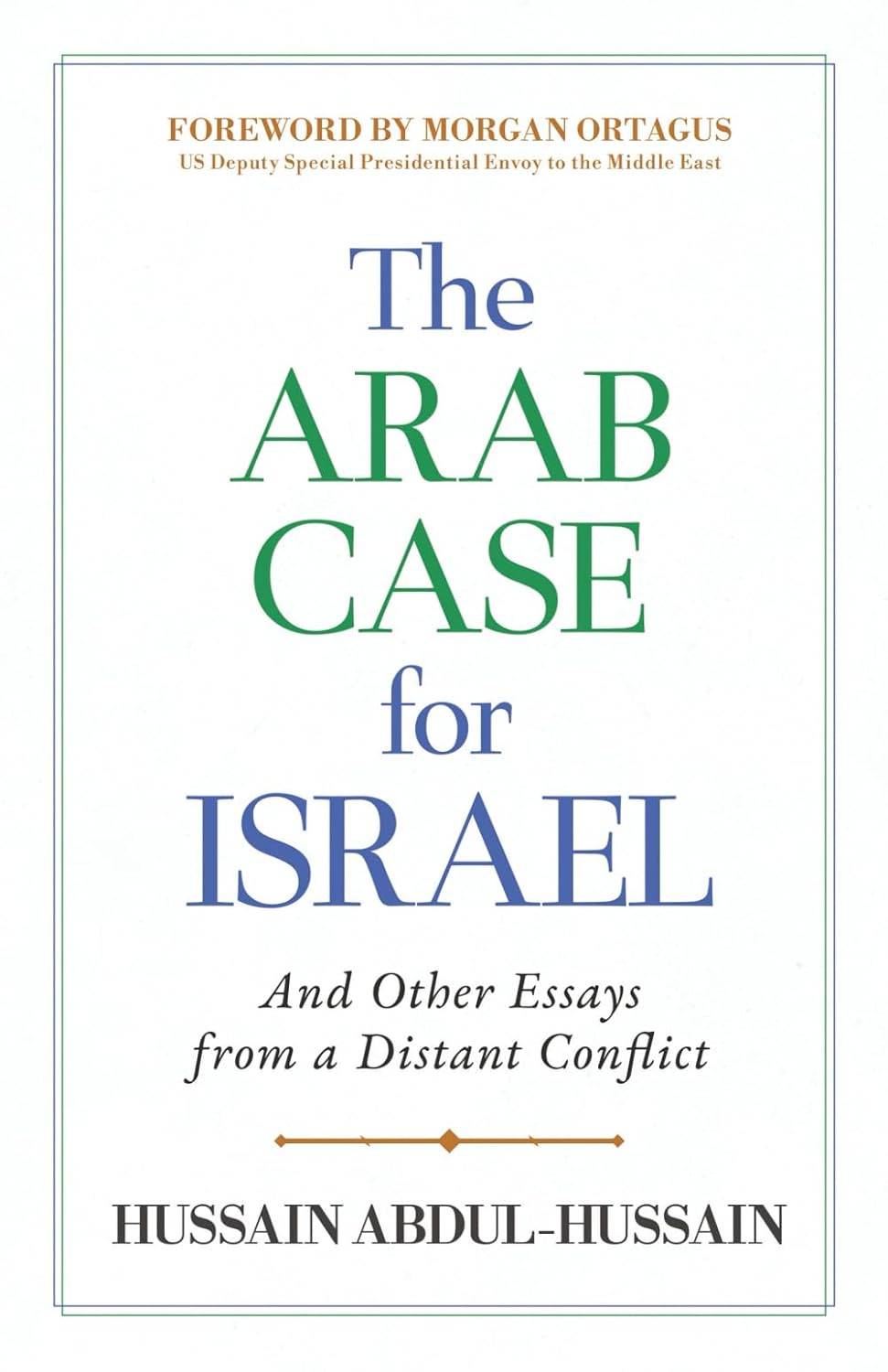
The Arab Case for Israel is a serious and valuable book. Abdul-Hussain is a rigorous analyst with deep regional knowledge, and several chapters justify the book’s existence on their own terms. His treatment of Iran’s proxy strategy, leveraging Hezbollah, the Houthis, and Iraqi militias, is sharp, detailed, and well-supported. The chapter on Qatar’s soft-power campaign against Israel is among the more systematic accounts available in English. His analysis of how Arab regimes, from Nasser onward, instrumentalized the Palestinian cause for domestic legitimacy is grounded in primary sources and carries real scholarly weight.
Likewise, his discussion of the Abraham Accords offers a credible and pragmatic case for normalization decoupled from Palestinian statehood. It is a serious argument that reflects how the region is already thinking. These are not minor achievements; they justify the book’s place in current policy conversations.
There is, however, a larger book inside The Arab Case for Israel, one that would have been uniquely important. It would have been the account of a Muslim-born Arab who grew up steeped in anti-Zionism, who held those beliefs with conviction, who was shaped by them at the level of identity and faith, and who then, through a process of intellectual and moral reckoning, came to see Israel’s existence as not merely tolerable but legitimate. That book would have been rare, necessary, and far more disruptive than policy analysis alone.
I approached this book with that expectation, partly because I share a similar journey, though from a different direction. As an Egyptian who underwent a comparable transformation, and as an author whose book about that experience is coming out later this year, I read Abdul-Hussain not as a distant critic but as an unusually situated peer. I have also long admired his writing and analytical clarity.
Abdul-Hussain opens his first chapter with a striking declaration: that he was once “an ardent opponent of Zionism” who saw it as “a stain on human conscience.” It is the most compelling line in the book because it promises something deeper than analysis, a confrontation with the intellectual and moral system that made such a belief possible in the first place. Yet the book moves past that moment too quickly, shifting from what he believed to when he became a “staunch supporter of the State of Israel,” without fully addressing the theological transformation that shaped that belief in the first place.
What follows focuses far more on external factors than on that underlying system itself. His earlier anti-Zionism is presented largely as something shaped by the political environment: narratives, manipulation, and propaganda. All of this is true. But it is not sufficient.
Because anti-Zionism in the Arab and Islamic world is not merely political. It is not simply the product of regimes or media. It is rooted in a deeper framework, religious, historical, and civilizational, that gives it durability and legitimacy in the minds of those who hold it. That framework remains largely unexamined in the book.
Intellectual transformation on this issue is not just a matter of correcting false information. It requires confronting the structure that made those beliefs compelling: the theological assumptions, the inherited view of Jews, the historical narrative that frames Israel as an illegitimate intrusion rather than a restoration. Without dismantling that structure, the argument remains incomplete.
A similar limitation appears in the historical framing. Abdul-Hussain writes that “Arab Marxists had no quarrel with Jews or Israel per se.” This may reflect certain intellectual circles, but the broader cultural record of the Arab left, its rhetoric, literature, and political expression, reveals a far more complex and often hostile reality. That dimension is not seriously engaged.
The Arab Case for Israel is, at its center, a strategic case: Israel should be accepted because it is useful, against Iran, for economic and technological cooperation, and as a stabilizing force in the region.
This is a real argument. But it is not the full argument.
Because a strategic case explains why states might align. It does not explain why societies resist alignment, nor does it address the beliefs that sustain that resistance. The hostility toward Israel is not primarily a policy position, it is a conviction shaped by theology, reinforced by history, and embedded in culture.
Strategic alignments are contingent. If the shared threat disappears, so does the foundation of the alliance. The experience of Egypt and Jordan demonstrates how normalization at the state level did not produce reconciliation at the societal level. The underlying worldview remained unchanged.
This is where the book could have gone further. The deeper question is not only whether Arab states benefit from normalization, but whether Arab societies, formed by religious doctrine and assumptions, can come to see Israel differently at a foundational level. Abdul-Hussain acknowledges antisemitism, but largely treats it as a political instrument rather than as something embedded within a broader intellectual and theological tradition. That distinction is critical. Because what is embedded cannot be reversed by policy arguments alone.
The Arab Case for Israel is fundamentally a work of policy analysis. It is the case a sophisticated regional thinker makes for why Arab states should reconsider their strategic posture toward Israel. On those terms, it succeeds.
But the title points to something larger. A true “Arab case for Israel” would require confronting not only political narratives, but the religious foundations that gave rise to them—and that made the rejection of Israel appear self-evident for generations. It would require addressing the beliefs themselves, not merely their consequences.
Abdul-Hussain is a genuine believer in peace, a true philosemite who has crossed the bridge from hostility to reconciliation. This book should not be read because it was written by an Arab, but because of the case it makes. Yet the case is only partially made. Until the Arab world confronts its theologically rooted antisemitism, reconciliation with Israel will remain driven by utility and convenience rather than principle and conviction.
Salam Almasri is a fellow at the Ideological Defense Institute.
What Is IDI ?
The most trusted source of information on the Middle East, Islam, and the ideological threats facing the West.
Subject-matter experts, former Muslims, Arab Christians, and Western thought leaders, coming together to equip policymakers to prevent destructive foreign ideas from being translated into law, restore confidence in the biblical principles that built the West by empowering the Church to reengage the public square, and provide the public with solid analysis to combat the confusion that is making the West vulnerable.
"Intellectual transformation on this issue is not just a matter of correcting false information. It requires confronting the structure that made those beliefs compelling: the theological assumptions, the inherited view of Jews, the historical narrative that frames Israel as an illegitimate intrusion rather than a restoration. Without dismantling that structure, the argument remains incomplete."
Do you believe it's possible?
Looking forward to your book.