


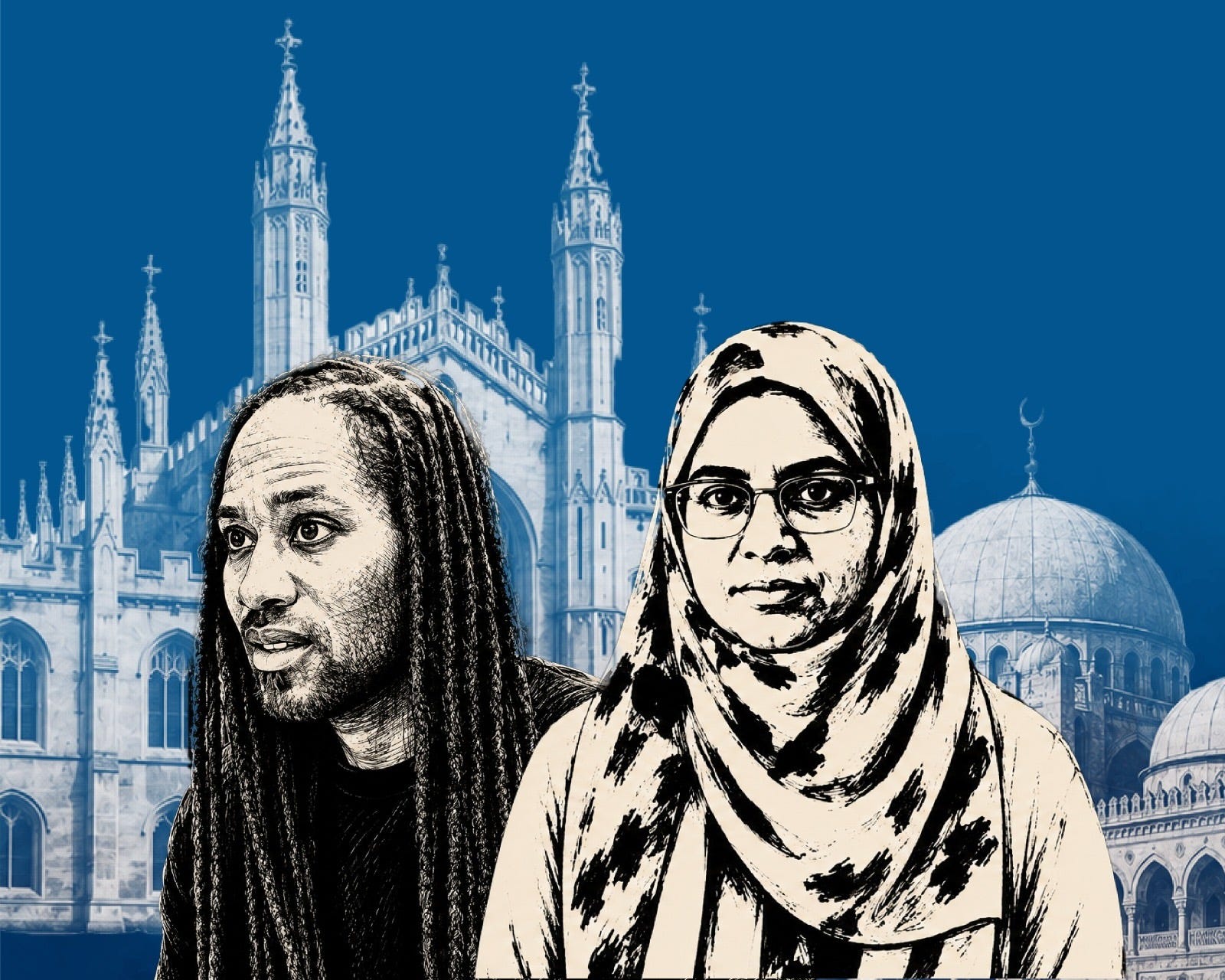
Like Humpty Dumpty on the wall, Cambridge University has just had a great, epic fall. And all its woke academics spouting gender studies sociobabble and all its Islamophilic critical theorists wailing before Allah like the prophets of Baal can’t seem to put Cambridge back together again.
It’s been a triple whammy for my alma mater—and all in the course of a week. First, the anti-hubris legend of Jason Arday: a sociology professor who, like a DEI Icarus, has his fake feathers burned to a crisp and comes crashing down into a pool of plagiarized Critical Race Theory slop.
Second, the Kafkaesque tale of Farah Ahmed: an educationist who turns out to be a former punter for Hizb ut-Tahrir—a movement aiming to establish a global caliphate and ban bacon butties. Ahmed is also cross that British schools dole out condoms but frown on child marriage.
Third, the cautionary parable of vice-chancellor Deborah Prentice: a COVID-19 tyrant from Princeton who has pioneered the discipline of “collective delusion,” but allowed Cambridge to be spellbound by Arday’s DEI Black magic. She also ignored a whistleblower who reported misogynistic bullying at Cambridge University’s Institute of Astronomy.
Cambridge hadn’t yet gone down the rabbit hole of Islamo-wokeism when I was finishing my doctorate at the university in 2004. Many of my batchmates were Americans who had fled to British universities to escape the smog of woke groupthink in American Ivy League schools.
But there were signs of Islamo-wokeist creep into faculties like sociology and education. Islam was taught by a white convert without a doctorate, like Mormon Sunday School, with no heavy-duty critical tools applied as we did in biblical studies. And when Edward Said came to deliver a series of guest lectures, he was welcomed like a Palestinian Nelson Mandela.
By 2005, the university’s student newspaper was trumpeting: “Cambridge is woke—that’s no bad thing.” Sure, it isn’t a bad thing if Islamofascists who now dominate Western academia wish to eliminate critical thinking—the foundation of Western education since Descartes, actually starting earlier with the Hebrew prophets and Greek philosophers like Socrates and Aristotle.
But critical thinking and ideological/dogmatic conformity cannot co-exist. Critical thinking is prophetic: it uses intentional questioning and evidence-based argumentation to evoke a vision and version of reality that offers an alternative to the ideologies that seek to domesticate and draw us back into the slavery of Pharaoh, with the lure of state-subsidized cucumbers and melons the Hebrew slaves ate in Egypt (Numbers 11:5).
Hence, the ideology of wokeism and the dogma of Islam, which both vie for hegemony, must collude, at least temporarily, to neutralize their chief rival—critical thinking. The crisis involving Arday and Ahmed—Cambridge’s poster boy and poster girl in its department of education—illustrates penetratingly how wokeism and Islam have colluded to kill critical thinking.
The Closing of the American Mind: A Warning Unheeded
We might have saved British academia if we had heeded prophetic warnings from America. In 1987, the philosopher Allan Bloom published his groundbreaking book The Closing of the American Mind: How Higher Education Has Failed Democracy and Impoverished the Souls of Today’s Students. Bloom showed how postmodern relativism had destroyed American higher education.
“There is one thing a professor can be absolutely certain of: almost every student entering the university believes, or says he believes, that truth is relative,” Bloom wrote. “The danger they have been taught to fear from absolutism is not error but intolerance.”
“The study of history and of culture teaches that all the world was mad in the past; men always thought they were right, and that led to wars, persecutions, slavery, xenophobia, racism, and chauvinism. The point is not to correct the mistakes and really be right; rather it is not to think you are right at all,” he summed up.
Bloom recounts an experiment he would conduct, asking his Harvard students if the British rulers of India were right to abolish the Hindu practice of sati—where a wife is forced to immolate herself on her husband’s funeral pyre when he dies. The students, mentally muzzled by relativism, could not/would not answer. I ran the experiment with my university students in England years later. The results were the same.
From Relativism to Wokeism: A Logical Conclusion
All Jason Arday had to do was drive relativism off the cliff’s edge where his academic forebears had parked it for decades. With objective standards defunct, intersectional identity—defined by race, gender, sexuality, or class—becomes the primary lens for defining reality.
Maria Krylova’s essay “From Relativism to Wokeism: A Path of Confusion, Fallacy and Self-Destruction” traces the descent from the “tolerant relativism” of the 60s and 70s to current fanatical wokeism. And Karlo Broussard shows how wokeism is actually relativism in new clothes in his book The New Relativism: Unmasking the Philosophy of Today’s Woke Moralists.
So why did academics like Professor Hilary Cremin, the head of Cambridge’s Faculty of Education, gush over Arday, calling him “the best in the world” in terms of his research? Because to “judge” the intellectual output of a Black DEI appointee would be to blaspheme against the Gospel of Critical Race Theory, which is predicated on the conviction that the Original Sin of Western education is its Eurocentricity.
According to CRT’s ex cathedra dogma, other paths, including Arday’s sociobabble, Haitian voodoo, and Islamic Salafism, are, epistemologically speaking, equally valid.
When Mr. Woke Met Ms. Islam
That’s where Mr. Woke meets his doppelgänger, Ms. Islam aka Farah Ahmed—the two have a torrid affair in Cremin’s faculty lounge. In 2025, Cremin named Ahmed an assistant research professor in the Faculty of Education. Never mind her past links with Hizb ut-Tahrir—a terrorist movement aspiring to establish a global Islamic Caliphate.
Ahmed’s philosophy of education is unblushingly anti-Western and unapologetically Islamic. I obtained a copy of her chapter, “The Western Education System and the British National Curriculum,” in the book Education and Identity: The Dilemma of Muslims in the West. It was first published as a Hizb ut-Tahrir pamphlet.
“Those of us who have been through the Western education system, and have subsequently started practicing Islam, can recognise the effect on our personalities. It takes many years before even the most obvious Kufr concepts and values can be completely removed and our behavior substantially improved,” Ahmed warns in her screed, masquerading as scholarly discourse.
Ahmed attacks English as “one of the most damaging subjects.” Why? Because children are taught to identify genres of myths, legends, and fables and might end up identifying the story of Mohammad riding a winged horse as “also a made-up legend.” Ahmed trashes religious studies because it puts Islam “on the same level” as Christianity and other religions and promotes the idea of “inter-faith” and “religious tolerance.”
“Issues such as the definition of women’s awrah [body parts that must be covered] and the concept of men being allowed to marry up to four wives are put on a forum for discussion. Hence, the words of man are being placed above the words of Allah (swt) and His Messenger Mohammad (saw),” Ahmed cautions.
The Western education system “will not be suitable to the needs of Muslim students as the ‘adeeqah [belief system] of the Muslim is in complete contradiction to this,” she emphasizes.
“The Islamic State produced mathematicians who surpassed each other in their brilliance, yet this fact is completely ignored,” she laments. “The impression is given that science is purely a Western discipline and that this is part of what makes Western civilisation superior.”
The Closing of the Muslim Mind: Oxymoronic “Islamic Education”
Really, Farah? Isn’t “Muslim education” as oxymoronic as “Jewish bacon?” Actually, Jews can buy “Facon” (fake bacon), which is beef cured to taste like bacon! Similarly, I’ve published several reports reviewing textbooks in Qatar, Jordan, and the Palestinian territories, where I show how “Facon Muslim education” in these countries celebrates jihad, demonizes Jews, condemns Christianity and Judaism as corrupt religions, and promotes Islamic supremacism.
Surely if Muslim education is so great and Western education is so dysfunctional, Ahmed should be teaching at Al-Azhar University, no? But she won’t because Muslim education, or at least its Sunni version, began its intellectual euthanasia in the second year of the reign of Caliph Ja’afar Mutawakkil (847-861), Robert Reilly argues in his book The Closing of the Muslim Mind.
It was the Ash‘arite sect and its leading theologian, Imam al-Ghazali (d.1111), who switched off the life support apparatus, leaving much of Islam clinically brain-dead, Reilly explains. Because reason leads to questioning, it is inimical to Islam, which demands unquestioning submission to Allah, al-Ghazali observed in his treatise The Incoherence of the Philosophers. Rather than the confusion and contradiction generated by the rationalism of Plato and Aristotle, one should rely solely on the clarity of Qur’anic revelation.
In his foreword to Reilly’s book, philosopher Roger Scruton writes: “Policy makers beware: unless you are ready to admit that you are facing an essentially theological problem in the Middle East, do not go about prescribing solutions, for you may actually make matters worse—particularly by creating the false impression that economic, sociological, or political programs can fix what is, in fact, a delusion of faith.”
Dogmatic Delusions Vs. Critical Inquiry
Wokeism and Islam are both delusions of faith. Both demand servile submission to an ex cathedra authority. Western education, in contrast, has its roots not in a religion of uncritical compliance but in the Judeo-Christian tradition of robust questioning and critical inquiry beginning with Abraham and culminating in the Reformation.
It is no accident that the Passover narrative used in the Haggadah on Pesach is triggered by Jewish children asking questions. “Judaism is the rarest of phenomena: a faith based on asking questions, sometimes deep and difficult ones that seem to shake the very foundations of faith itself,” Rabbi Jonathan Sacks preached in a sermon on Parashat Bo (Exodus 10:1-13:16).
“Judaism is not a religion of blind obedience,” Sacks concludes. As a university chaplain in London, I remember debating with Muslim students. I would open my critical editions of the Hebrew Bible and the Greek New Testament and show them the textual apparatus. “I’m happy to rigorously question even my most sacred texts,” I’d say. “Now let’s do that with the Qur’an.” The response was always the same: “We cannot dare to question Allah. It’s blasphemy.”
Cambridge University’s old Cavendish Laboratory features a famous inscription on its door from Psalm 111:2: “Great are the works of the Lord, studied by all who delight in them.” Isaac Barrow, the first Lucasian Professor of Mathematics at Cambridge and Isaac Newton’s mentor, would say that God had written two books—the Book of Scripture and the Book of Nature. And both were to be studied with equal rigor. No wonder the atom was first split at the Cavendish Laboratory and not at Al-Azhar University.
Rev. Dr. Jules Gomez is a fellow at the Ideological Defense Institute
This is so sad! Reminded me of another professor, at Harvard University, who'd also plagiarized on her Ph.D. I hope this article stimulates the universities to improve. I think students need professors who can really teach them - and not only about various subjects but also about honor and integrity.
Boy Jules.
This is excellent
You won't need me to mention Sokhardoo? Bat Ye'or or your pal Nazir.Ali.
Am sure you that you'll know Neil Postman and Christopher Lasch too
Felt you would know these cases, I was a friend of Denis McEoin ,who was televised getting removed from Newcastle University for countering the coming Sunni takeover in 1987.
Great article, well laid out and up to date.