


A half-truth is like soft porn. It teases with semi-nudity and implication but withholds the explicit acts. Hard porn at least has the decency of candour; soft porn invites the spectator to complete the picture himself, and in that act of completion the mischief is done. The consumer of hardcore porn is often riven by guilt and driven to repentance. The soft porn addict can reassure himself that he is technically not consuming porn and may never repent.
With great fanfare, the Vatican’s Pontifical Institute for Arabic and Islamic Studies (PISAI) and the Italian Bishops’ Conference (CEI) have published their soft porn document on Islam. The 105-page book is pretentiously titled Fact Sheets for Learning about Islam (Schede per conoscere l’Islam). The handbook, intended for use in schools, is the interfaith equivalent of a scented candle: perfumed, posh-looking, and designed to mask the stench of inconvenient facts about Islam.
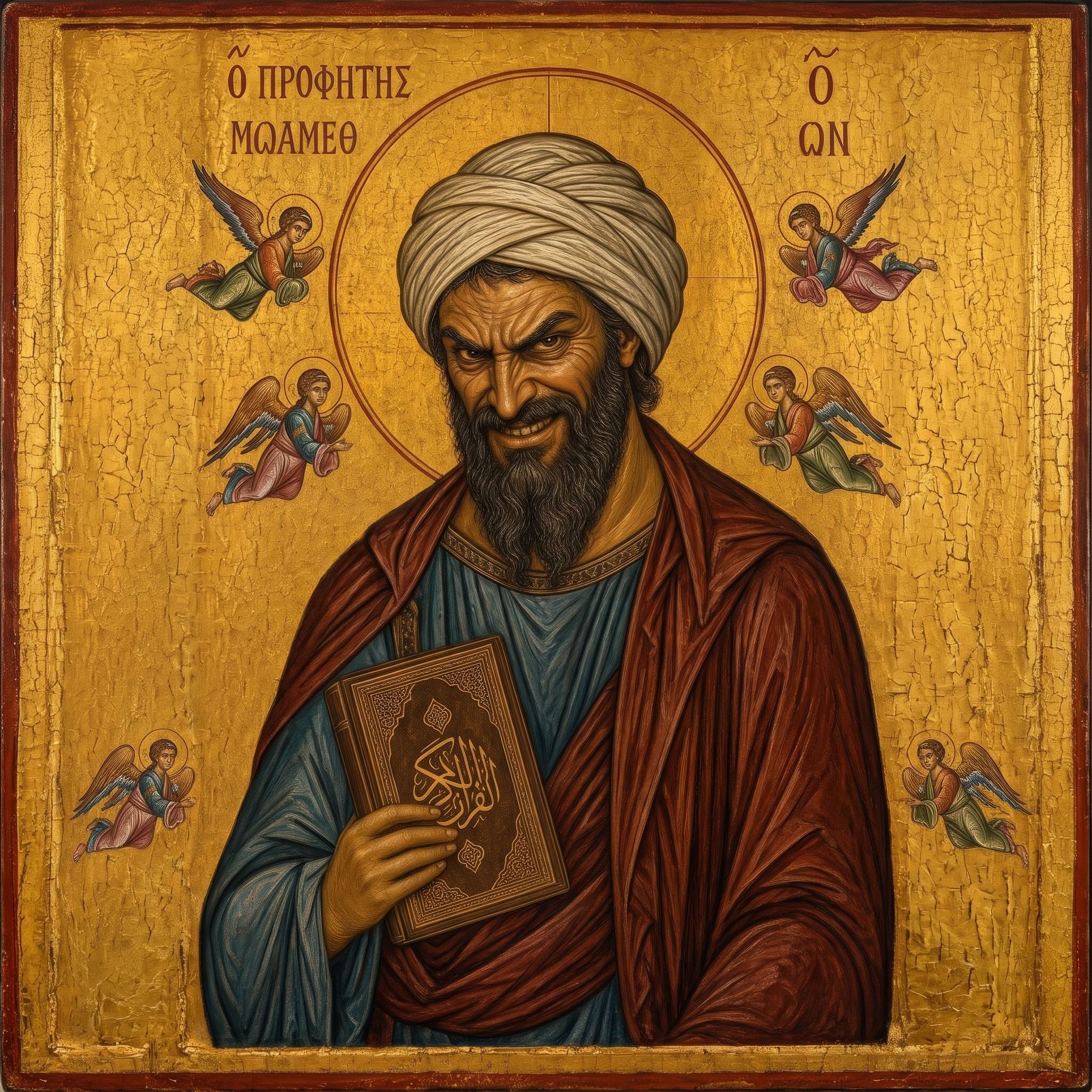
Like soft porn, the half-truth does not merely mislead; it recruits by titillation. It hands the viewer a half-naked fact and trusts him to supply the rest from his own store of optimism, ignorance, suicidal empathy, or tribal-ideological loyalty. In the CEI book’s incensed version of Islam, the Qur’ān is “fundamentally pacifist,” Islam is a “religion of peace,” and “Islam is sometimes improperly considered a religion of violence.” Rome’s fact sheets turn Muslims into Mennonites. The document beatifies Mohammed as “chosen by God” who “embodies the ideal believer, exemplifying perfect orthodoxy and orthopraxy.” If Karen Armstrong rebranded Mohammed as a peacenik running a tea-stall at a Quaker convention, the bishops are making a case for his canonization.
Cardinal Matteo Zuppi, best known for sacrilegiously revamping the famed Italian tortellino recipe with chicken instead of pork to appease Muslims in Bologna, presented the 11 fact sheets on October 21 at the Italian Embassy to the Holy See. Zuppi, president of the Italian Bishops’ Conference, was on stage with Yassine Baradai, the national secretary of the Union of Islamic Communities of Italy (UCOII), the largest umbrella organization of Islamic communities in Italy. In 2020, Baradai sparked outrage after trashing Judaism and Christianity as a “manipulation of the original message of the prophets.” At the presentation, an undaunted Zuppi, who taught religion for seven years, blabbered: “Mutual understanding helps counter suspicion, stereotypes, and Islamophobia.” One envisions a Bolognese nonna drowning herself in the broth.
Bishops Parade Aunt Nostra Aetate with Thick Makeup
The fact sheets begin by wheeling out, like a favourite aunt who has just left money in the will, Vatican II’s Nostra Aetate quote about Muslims adoring the same God as Christians. The aunt’s warts and wrinkles, violence, apostasy laws, dhimmi status, are covered with a thick layer of makeup and papered over as deviations, historical complications, or the dark deeds of pesky “Islamists.” The document quarantines “Islamism” as a post-Ottoman political invention, sometimes extremist, occasionally violent. Islam itself is noble, spiritual, and diverse.
One must never confuse Islam with Islamism, lest one be misled by “simplifications or ideological and populist propaganda,” the fact sheets warn. The “dangerous linguistic confusion” can occur particularly in Italian, “whereislamismo is sometimes used to refer to the Islamic religion” and the adjectives musulmano (Muslim), islamico(Islamic), and islamista (Islamist) are sometimes used as if they were synonyms,” it adds.
As I read this section, I found myself picturing Danny Burwami and the entire cohort of my ex-Muslim colleagues at the Ideological Defence Institute, torn between hysterical laughter and peak despair at the concentrated imbecility of the document. “Doesn’t the use of the term ‘Islamism’ deceive people into thinking it is some kind of fringe or modern deviation, when in reality it represents the most fundamental and authentic presentation of classical Islam?” asks Burwami in The House of Islam: The Case Against the Islam/Islamism Divide.
Never mind the testimony of ex-Muslims who have read the texts, survived the consequences, and written it up in academic journals; here is Rome marching with a poker face into a thicket of self-inflicted absurdity, with that special combination of faux authority and vacuity which makes the Catholic hierarchy an object of both comedy and despair.
Repacking Jihād and Islamic Imperialism
Jihad is given the full aromatherapy treatment. We are told its “etymological meaning” is one’s “utmost effort” for the cause of goodness and the purification of the soul. The “fundamentally pacifist” Qur’an generally permits “only defensive war.” Mohammed embodies this teaching by urging Gandhian non-violence in Mecca even when persecuted. In Medina, we are led to believe Islam’s prophet fought only defensive wars, humming John Lennon’s “All You Need Is Love.”
The bishops magically airbrush Mohammed’s raids on Meccan caravans, pitched battles, and Mohammed’s beheading of adult males from the Jewish tribe of Banu Qurayza in the hundreds, and the enslavement of Jewish women and children, from their hagiography of St. Mohammed. The document concedes the existence of the tiresome verses urging war against unbelievers, assuring us that fundamentalists misuse them to “justify their violence,” but equally guilty are Westerners who maliciously use them to denigrate Islam.
The document doesn’t deny early Muslim conquests and the long history of Islamic expansion. It handles the Umayyad and ʿAbbāsid caliphates and the Ottoman, Mughal, and Ṣafavid empires with the exquisite manners of the quintessential English butler. Even a cursory glance at IDI’s incisive articles on Islamic imperialism, published to mark our Infidel Awareness Month, would demonstrate how the document is marketing a version of Islam that will not frighten the horses (or infidels, for that matter). Historian Will Durant called the Mughal conquest of India “probably the bloodiest story in history.” Approximately 60–80 million Indians died as a result of Islamic invasions and Mughal rule from roughly 1000 to the early 1500s.
Muslim invaders occasionally spared the lives of Christians, Jews, and Zoroastrians, requiring them instead to pay the jizya, a word that occurs just once in the fact sheets. But the Hindus, Jains, and Buddhists in India were not People of the Book, and hence no jizya could be demanded from them. The thirteenth-century Muslim historian Zakariya ibn Muhammad records that Mahmud of Ghazni slaughtered fifty thousand in Gujarat alone.
None of this features in the fact sheets. Rather, they emphasize that “the Mughals ushered in a new era of unity, art, and administration in the Indian subcontinent” and the Mughal Empire “developed rapidly under capable rulers, combining military skill with a policy of tolerance.” In her essay on “The Infidels of South Asia,” my Pakistani-British colleague Nuriyah Khan presents a very different picture of Mughal rule. “Forget everything your textbook told you about Islam’s ‘golden age of tolerance’ in India. Forget the Sufi poetry, the spice-route romance, the multicultural Mughal miniature paintings hanging in museums funded to whitewash the brutal Islamic conquest,” she notes. What built the Mughal empire was the sword, sieges, mass executions, burned and beheaded idols, and a poll tax engineered to starve the infidel into submission. Khan would wag her finger at Islam’s useful idiots from Rome: “Historians who launder Islamic barbarity into a story about traders and intermarriage are fraudsters.”
The Crusades: A Case Study of Islamic Amnesia
The section on the Crusades opens with a rare and almost startling candour. The bishops concede that the papacy launched these expeditions “to liberate and defend” Christian holy places from “Muslim conquest.” Yet this same passage promptly collapses into a specimen of clerical fatuity: the claim that the Crusades’ historical and cultural residue is “decidedly more significant” for Christians than for Muslims, among whom the wars are said to be remembered chiefly for their “local military impact” rather than for any lasting “symbolic or cultural significance.”
One is left to wonder whether the authors have ever listened to contemporary jihadists. Muslims of the militant persuasion do not treat the Crusades as a minor medieval skirmish; they invoke them — often as harb al-salib (the “war of the cross”). They recast them as the template of Western Christian aggression against Islam, and a justification for jihad.
Osama bin Laden, the late impresario of al-Qāʿida, drew upon a long-standing Arab-Muslim habit of branding Westerners as “crusaders,” a usage he deployed both before and after the massacres of 11 September 2001. ISIS propaganda organs, Dabiq and Rumiyah, present an unbroken continuum of “crusader” hostility that stretches from the seventh century to the present, neatly pressed into the service of an apocalyptic ideology. Ayatollah Khomeini spoke of prosecuting “the last stage of the historical Crusades.” Sayyid Qutb, whose writings shaped Salafi-jihadism and al-Qāʿida theology, detected a “Crusader spirit” that courses through the blood of Westerners. Even the freshly minted British pressure group calling itself The Muslim Vote has taken to likening its own electoral exertions to Saladin’s recapture of Jerusalem.
Of course, according to the fact sheets, none of the above qualify as true Muslims, so we can all light the peace candles and join hands for a round of Kumbaya.
Conclusion
Many of the document’s assertions like the above are not merely historically illiterate; they are myopic to the point of unadulterated buffoonery. One pictures poor Italian schoolteachers explaining this to pasta-fed pupils who keep asking why the news keeps showing bearded suicide bombers shouting Allahu Akbar and quoting the Qur’an rather than the works of al-Ghazālī.
One can only imagine a cheeky student interrogating the teacher about the 72 virgins who get offered as a lavish reward to the jihadi in Mohammad’s celestial brothel, which the document expunges with the passion of a papal anathema. Not to worry: the bishops have the answer: “One cannot enter Paradise without being in peace because Paradise is the abode of peace.”
“The rules are simple: they lie to us, we know they’re lying, they know we know they’re lying, but they keep lying to us, and we keep pretending to believe them,” the writer Elena Gorokhova wrote in her memoir, A Mountain of Crumbs, the story of a young Soviet girl who discovers her country’s brazen lies.
This quote is often misattributed to Alexander Solzhenitsyn, the Russian writer and dissident who wrote about the big lie underpinning Soviet totalitarianism. In his famous 1974 essay “Live Not by Lies,” he warned: “In our country the lie has become not just a moral category but a pillar of the State.” Under Pope Leo XIV and the Italian episcopate, the same operation is now performed in cassock rather than commissar’s uniform: the lie about Islam has been elevated from a tactical inconvenience to a hermeneutical category and a load-bearing pillar of the Church. The difference is one of vestments.
These bishops and the pope act like they became muslims. I dont understand why a christian leader lay down to Islam? They dont know Jesus?
Canon Gomes is right. The document is soft porn.
The Vatican’s Pontifical Institute for Arabic and Islamic Studies and the Italian Bishops’ Conference have published a 105-page handbook for schools that calls the Qur’an “fundamentally pacifist,” Islam a “religion of peace,” and Mohammed “chosen by God” who “embodies the ideal believer.” Cardinal Zuppi presented it alongside the secretary of Italy’s largest Islamic umbrella organization. The half-truth is deliberate. It teases with the early Meccan verses, the language of mercy, and the Nostra Aetate claim that Muslims adore the same God, then withholds the rest and invites the reader to complete the picture with optimism or ignorance.
The classical sources do not cooperate. Abrogation is not a fringe theory. Al-Suyuti, Ibn Kathir, and al-Tabari treat the later Medinan revelations—the Sword Verse (9:5) and the command to fight until religion is all for Allah (8:39)—as superseding the tolerant passages. The death penalty for apostasy rests on the most authoritative Hadith collections. Banu Qurayza is narrated in the Sira as straightforward fact: adult males executed, women and children enslaved. The marriage to Aisha at six and consummation at nine is accepted by the traditional commentators. These are not “Islamism.” They are the mainstream jurisprudential inheritance.
The handbook quarantines violence as the work of “Islamists” and “fundamentalists” while airbrushing Mohammed’s raids, the Banu Qurayza executions, and the long record of conquest. It praises the Mughals for “unity, art, and administration” while historians record the bloodiest chapters of Indian history. It treats the Crusades as more culturally significant for Christians than for Muslims, ignoring the continuous jihadist invocation of harb al-salib from bin Laden to ISIS to Khomeini. The jizya is mentioned once. The primary documents are not.
This is the same operation already measured by the First Commandment. Nostra Aetate and its practical outworking seat another system at the table while the earlier saints—John of Damascus, Anastasius of Sinai—classified the teaching of Mohammed as a heresy that denied the Incarnation, the Cross, and the Trinity and refused it a place on the altar. The primary sources have not changed. The willingness to rebrand them as pacifist has.
Christ remains the sole Mediator. Another gospel is still another gospel. Galatians 1 has not been abrogated.
Semper Fi Brother and have a Blessed day Sir 🙏