


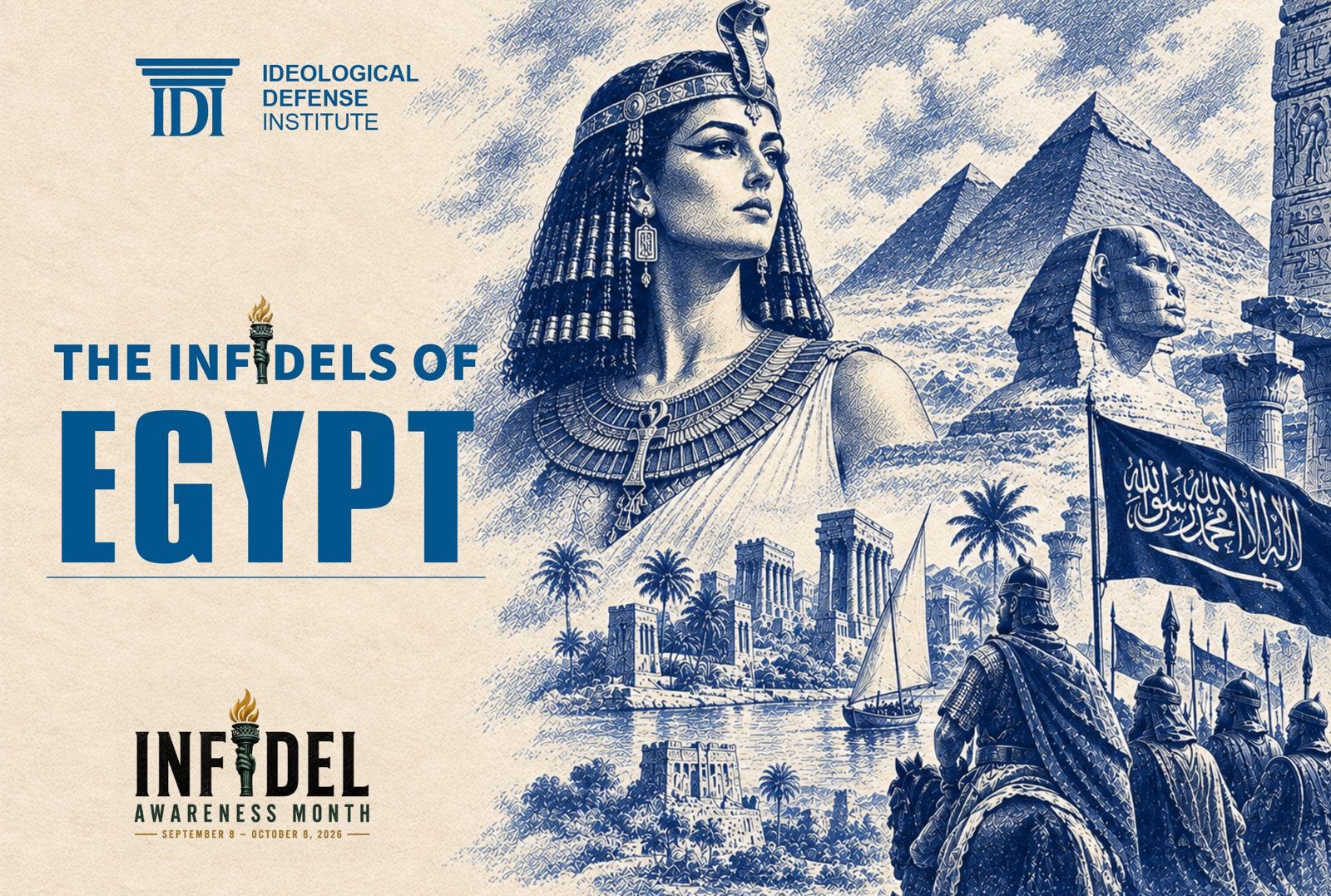
By the fourth century, Egypt was one of the intellectual and spiritual capitals of the Christian world. Alexandria stood alongside Rome, Constantinople, Antioch, and Jerusalem as one of the five great patriarchal sees of Christendom. It was in Alexandria that Origen and Clement built the first great Christian catechetical school, that Athanasius fought the Arian heresy and helped write the Nicene Creed, and that the Desert Fathers, Anthony, Pachomius, the monks of Scetis and Wadi Natrun, invented Christian monasticism itself, a movement that would later spread to Ireland, to Gaul, to the whole of Christian Europe.
The native population spoke Coptic, the last living form of the ancient Egyptian language, written in a script adapted from Greek. The word “Copt” itself comes from the Greek Aigyptios, “Egyptian”, filtered through Arabic into Qibṭ. The Copts were not a minority in Egypt. They were Egypt. The word for the people and the word for the Christians of the country were, for centuries, the same word.
The Conquest: 639–642 AD
In December 639, an Arab army of perhaps 4,000 men under Amr ibn al-As crossed the Sinai into Egypt on the orders of the Caliph Umar ibn al-Khattab. This was an invasion of a province that had been Christian for over three centuries, launched seven years after Muhammad’s death, as part of the same wave of conquest that had already torn Syria and the Levant away from Byzantium at the Battle of Yarmouk in 636.
Amr’s forces took Pelusium after a month-long siege, then moved on Babylon Fortress (the core of what is now Old Cairo), which fell after a siege of roughly seven months. Alexandria itself, the jewel of the eastern Mediterranean, capitulated in November 641 under a treaty that saw Byzantine forces withdraw by sea. The Byzantines briefly retook the city in 645 before Amr crushed the counter-attack and secured Egypt for the Caliphate permanently in 646.
Egypt’s Muqawqas, the Byzantine governor who negotiated Alexandria’s surrender, was reviled in later Coptic tradition as a traitor. Within a generation, the new rulers had a name and a legal category for everyone who had not converted: dhimmi, literally “the protected,” but protected on terms decided entirely by the party doing the conquering.
The rules imposed on Egypt’s Christian and Jewish population were formalized under the so-called Pact of Umar, attributed to the Caliph Umar ibn al-Khattab: non-Muslims could practice their religion and keep their lives and property, in exchange for:
The jizya, a poll tax paid by every adult non-Muslim male, collected in a ritually humiliating manner in many periods, historical accounts describe tax collectors striking dhimmis on the neck or head as the tax was extracted, a practice grounded in the Quran 9:29’s demand that the People of the Book pay “while they are humiliated.”
A ban on building new churches or repairing old ones.
A ban on public displays of Christian worship, no bells, no crosses carried in public, no loud liturgy audible to Muslim ears.
A requirement to wear distinguishing clothing or badges, the ghiyar, so Muslims could identify dhimmis on sight.
A ban on carrying weapons, riding horses (donkeys only, and only ridden side-saddle) or building homes taller than a Muslim neighbor’s.
Exclusion from testifying against Muslims in court.
The death penalty for any Muslim who converted to Christianity, and for any Christian who insulted Islam or the Prophet.
Under Umayyad rule (661–750), the jizya burden on Coptic Egypt intensified as the empire’s finances came to depend on it. Governors periodically raised the tax rate, conducted brutal census sweeps to prevent Copts from evading it by fleeing to monasteries, and in some documented cases tattooed or branded taxpayers to track them, a practice recorded under governor Usama ibn Zayd al-Tanukhi in the early eighth century, who ordered the hands of Coptic monks and taxpayers marked with lead seals bearing their names and villages to stop tax flight.
The pressure produced open revolt. Between roughly 725 and 832, Egypt’s Copts, concentrated in the Nile Delta region of al-Bashmur, rose up repeatedly against Muslims tax policy the Bashmuric Revolts, a series of at least six uprisings over a century. The last and largest, in 831–832, was crushed by the Abbasid Caliph al-Ma’mun in person, who marched into Egypt with his army specifically to suppress it. The revolt’s suppression was devastating to the Bashmur region: villages destroyed, populations deported or sold into slavery, and the Coptic language’s last regional stronghold broken as a demographic force. Islamic sources themselves record that al-Ma’mun ordered the destruction of the region and had captured rebels’ hands cut off.
This is the actual mechanism of Egypt’s conversion from Christian-majority to Muslim-majority country: not a peaceful, gradual drift of individual conscience, but successive waves of taxation calibrated to make Christian life economically unbearable, punctuated by military crackdowns whenever the pressure produced resistance.
The Fatimid Caliph al-Hakim bi-Amr Allah, who ruled Egypt 996–1021, is remembered as one of history’s most erratic and violent persecutors of non-Muslims. Al-Hakim ordered the systematic destruction of churches and synagogues across Egypt and the Levant, historical estimates place the number of churches demolished on his orders at up to 30,000, including, in 1009, the deliberate razing of the Church of the Holy Sepulchre in Jerusalem, the holiest site in Christianity, an act so shocking to Christian Europe that was the direct grievances that ignited the Crusades nearly a century later.
Al-Hakim’s decrees against dhimmis in Egypt itself included forcing Christians and Jews to wear black turbans and, for a period, to wear heavy wooden crosses around their necks in public as a mark of humiliation; banning them from riding horses; confiscating church properties; and issuing repeated waves of forced-conversion pressure that drove many Copts and Jews to convert to Islam under duress.
The Crusader Period and Mamluk Egypt
The Crusades put Egypt’s Muslim rulers on a war footing against Christian powers abroad, and Egyptian Christians paid the price. Coptic communities faced recurring waves of suspicion, forced conversion, and violence during the twelfth and thirteenth centuries precisely because their coreligionists in Europe were at war with the Ayyubid and later Mamluk states.
Under Mamluk rule (1250–1517), anti-dhimmi legislation reached some of its harshest points. The reign of Sultan al-Nasir Muhammad ibn Qalawun saw repeated waves of church demolitions and forced conversions in the early fourteenth century, driven by Muslim mobs whipped into action by preachers and by the state’s own periodic crackdowns. 1301 and 1354 were particularly severe years, with mass closures and destructions of churches across Cairo and the provinces, and Coptic officials purged from the civil administration where they had historically been disproportionately employed as scribes and tax officials, a position of quiet economic value that repeatedly made them targets of Muslim resentment and mob violence whenever political or economic tension rose.
By the end of the Mamluk period, the near-continuous pressure of thirteen centuries, taxation, legal subjugation, episodic massacre, and forced or incentivized conversion, had finally done what military conquest alone had not: it had turned Egypt from an overwhelmingly Christian country into an overwhelmingly Muslim one. Historians estimate the Christian share of Egypt’s population, which had likely remained a majority as late as the tenth or eleventh century, was reduced to a minority by sometime around the fourteenth century, a transition that took roughly seven hundred years of sustained pressure to accomplish.
Ottoman Egypt
The Ottoman Turks folded Egypt into their empire in 1517 after defeating the Mamluks, and the dhimma system continued essentially unbroken for another four hundred years. Copts and Jews remained legally second-class subjects, paying jizya, barred from public religious display, subject to periodic local violence with little recourse. Ottoman-era Egypt saw its Christian population reduced to a small, impoverished minority concentrated in Upper Egypt and pockets of Cairo, holding on to a Coptic liturgical identity even as the Coptic language itself died out as a spoken tongue, surviving only in the church’s rites.
It was not internal reform but outside pressure, European commercial and diplomatic pressure on the Ottoman Empire, formalized in reform edicts like the 1839 Hatt-i Sharif and the 1856 Hatt-i Humayun, that finally forced the formal abolition of the jizya and, on paper, granted non-Muslims legal equality across Ottoman territory including Egypt. Muhammad Ali’s dynasty, which ran Egypt with growing autonomy from the Ottomans through the nineteenth century, allowed Copts somewhat greater access to state employment and education than they had seen in centuries.
But formal legal equality is not the same as social reality, and Egypt’s Christians continued to face a society whose habits of second-class treatment had been reinforced for well over a millennium and did not evaporate because a decree was signed in Constantinople.
Twentieth Century: The Squeeze Returns
Egypt’s brief liberal period, the 1923 constitution through the 1952 coup, did see Copts rise into parliament, the judiciary, and business at levels not seen before or since, and Coptic figures like Boutros Ghali (assassinated as prime minister in 1910, in part for his role negotiating with the British) and Makram Ebeid were major national political figures.
That opening narrowed sharply after 1952. Gamal Abdel Nasser’s nationalizations disproportionately hit Coptic-owned businesses, since Copts were overrepresented in commerce and the professional classes relative to their share of the population. The Islamic awakening steady expansion from the 1970s onward, tolerated and at times cultivated by the state as a counterweight to the left, produced a rising current of anti-Coptic sectarian violence that has never fully receded:
The Al-Zawya al-Hamra riots of 1981 in Cairo left dozens dead in sectarian clashes between Muslims and Christians.
The 1990s saw a wave of attacks on Coptic communities in Upper Egypt, including the 1997 Abu Qurqas massacre, in which gunmen killed a group of Coptic Christians.
The Kosheh massacre of January 2000, in the Upper Egyptian village of al-Kosheh, left 20 Copts dead after days of violence; no one was ultimately convicted for the killings, a pattern of near-total impunity that recurs through nearly every incident against the Copts.
The Alexandria church bombing of New Year’s Eve 2010–2011, at the Two Saints Church, killed 23 worshippers leaving midnight Mass, one of the deadliest single attacks on Copts in modern Egyptian history.
The Maspero massacre of October 2011, in which Egyptian military vehicles ran over and soldiers opened fire on Coptic demonstrators peacefully protesting a church attack in Aswan, killed at least 27 people in the heart of Cairo, live on camera, carried out by the state’s own army.
ISIS’s Sinai affiliate and other jihadist cells carried out a sustained bombing campaign against Copts through 2016–2017: the December 2016 Cairo Cathedral bombing (29 dead, mostly women and children attending Sunday Mass), and the Palm Sunday bombings of April 2017 at churches in Tanta and Alexandria, which killed at least 45 people on one of Christianity’s holiest days.
The Minya bus attacks of May 2017 and November 2018, in which gunmen ambushed buses carrying Coptic pilgrims to the Monastery of St. Samuel, killed a combined total of over 35 people, many of them children.
The north Sinai exodus of 2017, in which ISIS’s local affiliate explicitly targeted Coptic Christian residents of El Arish for assassination, murdering at least seven in a matter of weeks and forcing effectively the entire remaining Christian population of the town to flee, a modern, small-scale but unmistakable case of religious cleansing carried out with the openly stated goal of making the area judenrein of its Christian population.
Today, Egypt’s Christian population, overwhelmingly Coptic Orthodox, with smaller Coptic Catholic and Protestant communities, is generally estimated at somewhere between 10 and 15 percent of the country’s population, though the state has never conducted an honest, transparent religious census, a fact Copts themselves regularly point to as evidence the real number, and the real decline, is one the state has no interest in documenting.
The Living Present: What Fourteen Centuries Look Like Today
For years, Coptic advocacy organizations, Coptic Solidarity, the Set Free Movement, Christian Solidarity International, and Coptic families themselves, have documented a recurring pattern: young Coptic women and girls, some as young as early teens, vanish from their communities, later surfacing married to Muslim men and formally converted to Islam, with the marriage and conversion papers already filed by the time the family can act. Families describe the pattern as effectively identical across cases: a period of courtship or grooming, often initiated by an older Muslim man toward a Coptic girl in school, at work, or online; disappearance, sometimes with signs of coercion, sometimes reported to police as a straightforward kidnapping; and then a fully executed conversion and marriage certificate that Egyptian courts treat as settled fact, because Islamic law does not recognize a Muslim’s marriage to a non-Muslim as void once the conversion has been registered, however that conversion came about.
Coptic families report police routinely refusing to investigate these cases as abductions once a conversion paper exists, on the reasoning that an adult Muslim woman’s residence with her husband is not, on its face, a crime, even when the family insists the girl was a minor, coerced, or never freely consented. The government does not publish official statistics on this pattern, which functions as its own form of denial.
Egypt has never had a Coptic president, prime minister, minister of defense, minister of interior, or head of general intelligence in the republic’s history. Copts are functionally absent from the senior officer ranks of the armed forces and the police, from state security leadership, and from the leadership of the ruling party’s inner circles, in a country where the military and security services are the actual center of power regardless of which civilian face sits in the presidency. A handful of Coptic cabinet ministers have held largely technical portfolios, finance, planning, immigration, at various points, offered up as evidence of inclusion, while the actual levers of coercive state power remain, without exception, in Muslim hands.
Coptic university graduates report systemic, well-known barriers to entry into the police academy, military academy, and the diplomatic corps, rarely written into law anymore since the 1856 reforms formally abolished such bars on paper, but enforced in practice through admissions boards, background vetting, and a culture of quiet exclusion that produces the same result the old laws did.
Even Egypt’s national sports teams, the one arena where the state is happy to showcase merit when it flatters the country internationally, reflect the same pattern: Copts make up somewhere close to a tenth of the population yet are almost entirely absent from the national football team’s history, from Olympic delegations, and from the coaching and federation leadership that decides who gets chosen.
Egypt only passed a law in 2016 nominally regularizing the licensing of churches, after decades in which building or even repairing a church required presidential-level approval under a standing 1934 Interior Ministry regulation, while mosques required nothing more than local administrative sign-off. The 2016 law has legalized thousands of previously unlicensed churches on paper, but Coptic communities in Upper Egypt and rural areas continue to report new church construction blocked by local officials citing security concerns, by orchestrated petitions from Muslim neighbors, or by mob threats that pressure Copts into abandoning the project before it is ever built, the exact same functional veto the Pact of Umar handed to the Muslim population thirteen centuries ago, now exercised through zoning objections instead of caliphal decree.
Coptic families in Upper Egyptian villages routinely get collectively punished for the actions of one member, a house or a shop burned down in reprisal for an unrelated dispute, entire Christian families or even whole hamlets forced to flee a village after a rumor, a romantic rumor especially, spreads about a Christian man and a Muslim woman, resolved through informal “reconciliation sessions” brokered by local elders that almost always end with the Christian family paying compensation, issuing an apology, or leaving the village outright, regardless of what actually happened or who was at fault.
A Christian who converts to Islam in Egypt does so in an afternoon: a declaration before a sheikh or a notary, a new ID card issued without complication, congratulations from the new community, sometimes a cash incentive or a job offer from Islamic charities that exist specifically to fund and celebrate such conversions, and full legal recognition the same day.
A Muslim who converts to Christianity finds every one of those doors locked from the other side. Egyptian law and the civil registry do not recognize conversion out of Islam at all, a convert cannot get his ID card changed to reflect his actual religion, which means he is Christian in his own conscience and before his own church, and permanently, officially Muslim on every document the state issues him, subject to Islamic inheritance law, Islamic marriage law, and Islamic custody law for the rest of his life regardless of what he privately believes.
Egypt has not executed anyone for apostasy in the modern era, but the state’s own inaction functions as a delegation: families disown converts, mobs and relatives have carried out documented killings and beatings with near-total impunity, employers fire them the moment word spreads, and the security services, instead of protecting them, frequently detain converts themselves on charges like “contempt of religion” or “disturbing public order,” treating the convert’s safety as his own problem to solve by going quiet, changing cities, or leaving the country. Coptic priests who receive Muslim converts into the church do so knowing it can cost them their freedom or their lives; underground networks exist specifically to smuggle Egyptian converts out of the country because there is no path to safety that runs through Egyptian law.
Very well and concisely written, all the systematic power, money and women gaining tactics we see today in western countries, too. Killing the industrious ones just moderately in order to permanently skim them off. A lot of suffering that this text honors by unmasking every single measure. One could really use this analysis for working out an index for the islamization matrix of a country. I wonder how you manage to survive in such a hostile setting.
Love the historical documentation! I am a history buff, prefer history from the 1700s forward. But this is a wonderful wrap up, that more people should pay attention to.