


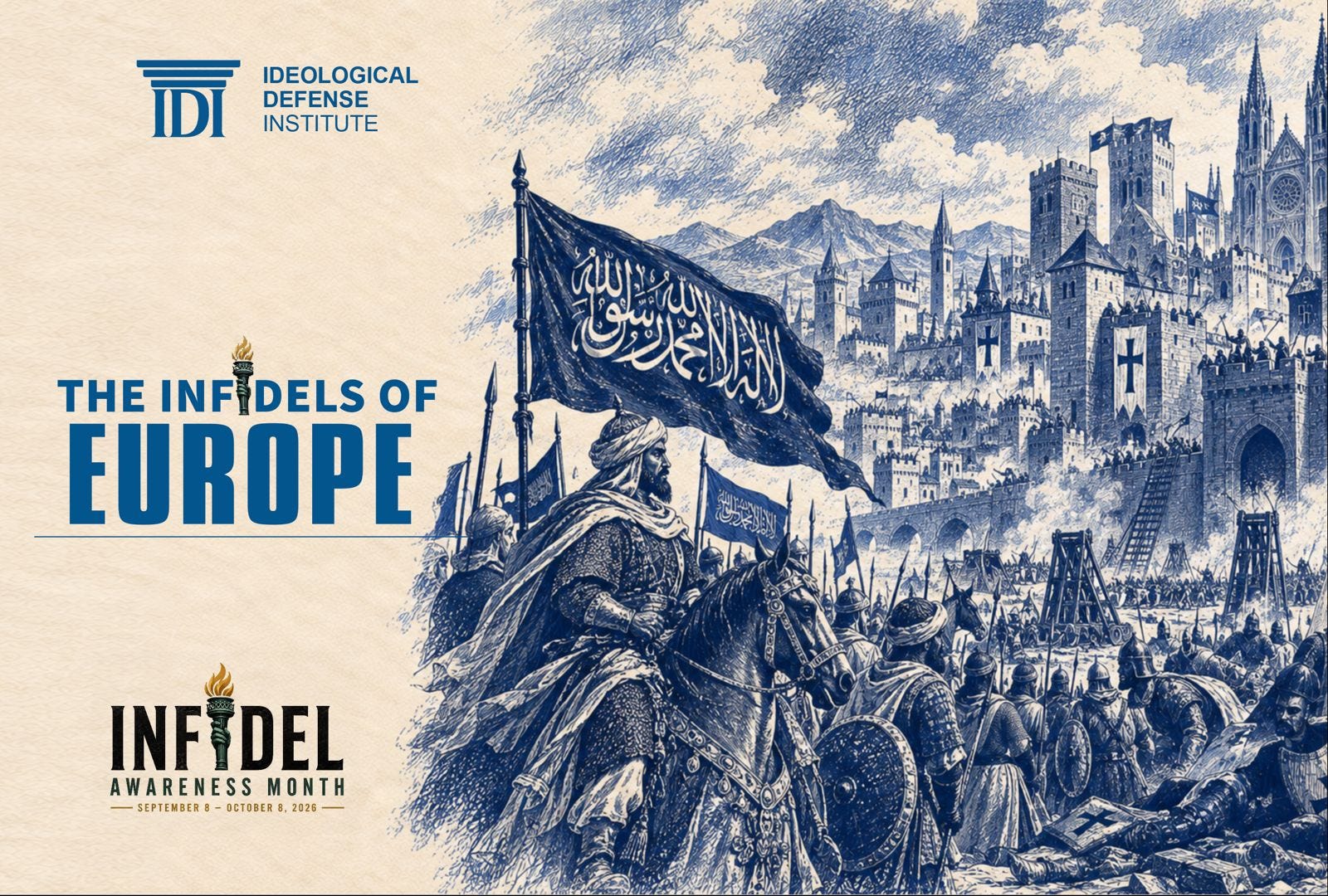
Once upon a time, in the land of la dolce vita, Catholic infidels resisted Muslim invaders by mocking their prophet Muhammad à la Charlie Hebdo. The Basilica of San Petronio in Bologna houses a king-sized fresco of Muhammad. Painted by Giovanni da Modena (ca. 1410), it portrays the prophet of Islam in hell. The painter positions Muhammad to the right of Lucifer, depicting him as an old man, naked and tortured by a demon while lying on a rock.
Modena got his inspiration from Dante’s Divine Comedy, which consigns Muhammad to the ninth circle of Hell. In Canto 28 of Dante’s Inferno, Muhammad’s body is split from end to end. His entrails dangle out amid excrement. Dante lets his pen rip when rhapsodizing on the Prophet:
Between his legs his guts spilled out, with the heart and other vital parts, and the dirty sack that turns to shit whatever the mouth gulps down.
Not afflicted by historical amnesia, the poet and painter evoked the memory of the man whose followers had ravaged the Italian peninsula from 652, just 20 years after Mohammad’s death, starting with a raid on Sicily. Muslims frequently “plundered” Sicily and Sardinia from 704. In 752-753, both islands paid jizya. Sicily’s capital, Palermo, fell in 831. Jihadis stepped up attacks on Naples, Calabria, Capua, Taranto, Bari, Benevento, and other Italian territories.
Dante and Modena would have heard tales of jihadi savagery and sacrilege. One chronicle describes Sawdan, the emir of Bari (857–71), killing over 500 Christians a day, using their piled-up bodies as a throne-cum-dining table and drinking from the sacred chalices. A Salernitan chronicler recounts a Muslim general raping Catholic girls on a church altar. The Muslim leader Benarvet ravaged churches, defiled sacred images, stole sacred vessels, and commanded his men to rape the nuns when he raided Calabria. Muslims turned key churches into mosques. In Salerno, a Muslim chief would rape a virgin nun each night on a church altar.
Islam’s early triumph was the jihad on Rome (Rūmiya) in 846. Benedict of St. Andreas chronicles the desecration of the Petrine basilica:
Rome was besieged, the city of Leo was taken, the church of St. Peter was captured and plundered, and their horses were in its monasteries and churches. The barbarians danced around the altar, waving their hands, and one of them hit the chest of the image of the Lord with a small lance, which was portrayed in the mosaic in the apse.
“There is no doubt about how the Muslims perceived the campaigns against the Christians in Italy. They were jihad, which, in those centuries, was considered a fight against the infidels in the dār al-harb (The House of War),” notes Luigi Berto. An epitaph hails the Muslim deceased as “fallen martyr, happy thou, on the field of jihad, surrounded by wretched barbarians.” Al-Muqaddasi, the 10th-century Muslim geographer, called Sicily a “place of continual holy war.”
Christians as the Quintessential Kuffar (Infidels)
The jihadis saw the Christians not just as barbarians but as infidels of the most conspicuous kind. Kafara (literally, “to cover”), the root of kufr, appears about 500 times in the Qur’an. The term “is at the center of the value system of the Qur’an” and “an essential element to all post-Qur’anic theological discussion,” Marilyn Waldman emphasizes. Toshihiko Izutsu notes that kufr forms “the very pivot round which revolve all the other negative qualities.”
In the early phase of Muhammad’s career, kufr is used to describe “ingratitude,” “unbelief,” and “those who are inimical to the Call.” It later becomes increasingly linked with shirk—the sin of associating partners with Allah (as in the doctrine of the Trinity). The third Meccan period associates the kufr with an obdurate refusal to accept the truth of Islam. In the Qur’an, it is the “greatest of all sins.” From early days, Caliph ‘Abd al-Mālik ibn Marwān (646-705) attacks shirk by stamping coins with the Qur’anic verse: “God has not begotten and is not begotten.”
Christians “cover” the truth by choosing shirk over absolute monotheism. “Hence, the term ‘kafir’ in the Qur’an is also used to refer to Ahlul Kitab [People of the Book], the Jews and Christians who do not accept Muhammad’s prophethood as the final prophet.” In a 2015 Friday sermon in Ninawa (Nineveh in modern Iraq), the Imam called Europe “the abode of original disbelief,” [kufr] distinguishing it from the “abode of incidental disbelief,” i.e., the Arab states who commit the “disbelief of apostasy after Islam.”
Islam’s response to kufara is jihad. A letter sent by the Fatimids to the Muslims in Sicily labels the Christians as Mushrikeen (people who commit shirk). It names shirk as the key driver for jihad:
…in virtue of your land’s proximity to that of the Christians (dār al-Mushrikeen), and for your struggle (jihad) against unbelief and oppressors, if God wills, I shall fill your island with cavalry and infantry of the faithful who will wage holy war for God and the duty of His jihad. Through them, God will empower the faith and the Muslims. Through them, He will overcome polytheism and the polytheists!
Christendom Saved: From Rome to Constantinople
Rome, for Muslims, was “the greatest city of Christian unbelief in Italy and the home of its imām (that is, pope).” Constantinople was the “second Rome” or “New Rome.” Medieval Constantinople had so many churches and monasteries that visitors “often resorted to hyperbolic description.” Sources document about 500 churches between the fourth and fifteenth centuries. “Since the days of [General] Mu‘āwiya’s campaigning under the caliph Uthman, the city had been the strategic goal of the caliphate.”
The 9th-century philosopher Abū Yūsuf Al-Kindī had foretold that the mahdi would conquer Constantinople after Rome: “[he] will conquer the Spanish peninsula and reach Rome and conquer it. … He will conquer Constantinople, and rule over the whole earth will be his.” A hadith in the collection of Imam Ahmad b. Hanbal, has Muhammad himself prophesying: “You will liberate Constantinople, blessed is the Amir who is its Amir, and blessed is the army, that army.” Byzantine iconodulia had further provoked Islamic ire.
Muslims first attacked Constantinople in 654, 22 years after Muhammad’s death. The Umayyads “personally directed the jihad against Constantinople.” The second Muslim siege of Constantinople lasted from 668 to 669; the third from 674 to 678. All failed. “The significance of the Byzantine victory of 678 cannot be overestimated,” writes Georgije Ostrogorsky. “In the defense of Europe against the Arab onslaught, this triumph of Constantine IV was a turning point of worldwide historical importance. The fact that it held saved not only the Byzantine Empire, but the whole of the European civilization.”
The final siege of Constantinople lasted for a year (717-718). A synaxarion (historical note read at a liturgical service) reveals how the Orthodox believed that the Muslims “intended to besiege and capture her to convert the faith of the Christians to their own error [i.e., Islam].”
If Rome had fallen in 846 and Constantinople had been conquered in 718, it would have spelled the end of Christian Europe, driving the papacy into an “uncertain exile, possibly shattering Catholic hegemony over religious dogma before it even began.” If Constantinople had also fallen, there would be “no one apostolic church, but rather multiple competing doctrines, further splintering the few remaining Christian communities of Europe,” observes Si Sheppard.
Christian dhimmis would have benefited from the golden age of Islamic achievement, Sheppard notes. But this enlightenment was itself a product of Jewish and Christian scholars. Sheppard corrects himself, noting that Christendom’s fall also meant “they would have been assimilated into the fundamentalist backlash of al-Ash‘arī, al-Ghazālī, and Nizam al-Mulk.” This would have aborted the Renaissance’s “artistic efflorescence,” without which there would have been no Enlightenment and Industrial Revolution; no separation of faith and state and hence no democracy; no abolition of slavery and no emancipation of women. “In the game of history, therefore, the siege of Constantinople was played for the highest stakes of all,” he concludes.
Christian Schism Seals the Islamic Conquest of Constantinople
When Constantinople fell in 1453, it was not because of Muslim weakness but because of Christian disunity. The Great Schism of 1054 between the Eastern Orthodox and Western Catholics bitterly divided Christendom. Seeking reconciliation, the Council of Florence (1438-1445) had papered over the cracks, granting Rome cosmetic control over the Eastern churches. In Constantinople, the Orthodox rioted among themselves, with the anti-Catholic lobby accusing their pro-Catholic co-religionists of capitulating to Rome.
The Florentine reconciliation was more pragmatic than dogmatic: the Greeks wanted the Latins to help them fight the Muslims. A pact was reached. Rome sent unwilling Venetian mercenaries to defend the Greeks, who would pay exorbitant fees.
Even worse, for many Orthodox Christians, “Muslim power looked like a happy alternative to Catholic hegemony,” writes Katherine Fleming. A 1170 letter from Patriarch Michael III of Anchialos to the Emperor Manuel Komnenos illustrates how many Orthodox preferred Meccan rather than Roman rule:
Allow the Muslim to be my ruler in external things rather than the Latin rule me in spiritual things. If I am under the Muslim, at least he will not oblige me to share his faith. But if I am under Frankish [that is, Roman] rule, and united with the Roman Church, perhaps I will have to separate myself from my God.
Many Orthodox even abandoned Hagia Sophia, lamenting its desecration by the celebration of heretical Roman eucharists. Doukas, a contemporary Greek writer, narrates how the Greeks regarded a reconciliatory Orthodox-Catholic eucharist held at the Hagia Sophia Basilica in December 1452 as “no better than an abominable heathen sacrifice.”
The very next year, Ottoman Sultan Mehmet II conquered Constantinople and converted Hagia Sophia—the world’s largest Byzantine basilica—into a mosque. Soldiers smashed the church, looted its valuables, and gouged the eyes of the icons. They placed its altar cloths on their dogs and horses and stomped on the Gospels and sacred books. Mehmet’s muezzin proclaimed the Islamic declaration of faith from the pulpit. The sultan climbed onto the stripped altar to lead Islamic prayers. The jihadis had earlier manifested their hatred for the infidels’ religion in the siege of 718, when General Maslama ibn Abd al-Malik rode into Hagia Sophia, snatched a gold cross, and rode out by fixing it upside down to the tip of his lance in an act of desecration.
Muslims plundered the city for three days, raping, slaughtering, or enslaving its residents. They killed even those who surrendered, also wanting “to terrorize the population into submission.” Women, nuns, boys, and girls were raped en masse and taken as sex slaves. Ottoman historian Tursun Beg interpreted the conquest as the sexual subjugation of a “bride” by her “groom.”
The fall of Constantinople failed to teach Christians the folly of division. On the contrary, many Orthodox viewed Islam’s conquest as “an instrument both of divine protection and divine punishment” through which God was punishing them for their “heretical” dealings with the Roman Church while saving them from papal autocracy. The Catholics viewed the defeat of Constantinople with schadenfreude—God had punished the Orthodox. For Muslims, the conquest of Constantinople vindicated Muhammad’s prophecy. It gave the Muslims enormous prestige and new momentum to conquer the world for Allah.
Europe’s Victories, Islam’s Defeats
Islam, meanwhile, was marching on Europe. The conquest of Iberia began in 711. From Gibraltar, General Tariq ibn Ziyad tantalized his jihadis with the lure of “ravishingly beautiful” Spanish women and assured them that “the word of Allah shall be exalted in his country, and that the true religion shall be established there.” Caliph Umar ibn Abd al-Aziz displayed his disdain for the Christian infidels, noting that “the non-Muslims are nothing but dirt” created by Allah “to be partisans of Satan” and upon whom “rests the curse of Allah, of the Angels and of man collectively.”
In 719, jihadis penetrated France until Charles Martel famously defeated them in the Battle of Tours (732). Ironically, Martel’s grandson Charlemagne would make the mistake of collaborating with Muslim governors in Spain in an Islamic civil war. The alliance collapsed during the failed siege of Zaragoza (778). It would take 770 years for the Spanish to drive out their Muslim conquerors (the Reconquista).
By the time of the historian al-Tabari’s death in 923, Islam had expanded from Portugal to India. The conquest of Constantinople emboldened Muslims as jihadi invasions subjugated Armenia, Bulgaria, Serbia, Bosnia, Herzegovina, Croatia, and Albania, in addition to parts of Poland and Hungary. Islam’s success further spurred her zeal for proselytizing the infidels. Sultan Mehmed IV (reigned 1648–87) warred against the Habsburgs, Romanovs, and Venetians, seeking to convert Christians to Islam and “transform the sacred geography of Europe into a sanctified Muslim landscape.”
Three major battles halted Europe from being totally conquered and Islamized: Charles Martel’s victory at the Battle of Tours (732), the sea battle at Lepanto (1571), and the Battle of Vienna (1683). If Vienna were conquered, “all the Christians would obey the Ottomans,” Sultan Mehmet IV’s grand vizier, Kara Mustafa, had told him. “Lepanto became a celebrated name throughout Europe and was clear proof that the Ottomans could, after all, be beaten,” writes Robert Spencer. The Battle of Vienna, won on September 12, marked the beginning of the end of the medieval Muslim presence in Europe.
Muslims Remember, Christians Forget
It is no coincidence Osama Bin Laden chose to attack the Twin Towers on September 11. It marked the day before Islam was defeated. The Muslim collective consciousness does not suffer from historical amnesia.
In 2017, analysts warned that Al Qaeda leaders, Osama Bin Laden and Ayman Al Zawahiri, were using Spain’s past as a key element in their jihadi propaganda. Both made multiple references to recapturing Ceuta and Melilla, two Spanish enclaves in northern Morocco. Western governments ignored the red flags. On July 30, 2026, over 75,000 military-age Moroccan Muslim men stormed Ceuta. While most returned to Morocco, over 5,000 remaining illegals destabilized Ceuta and marched through its streets shouting “Takbir” and “Allahu Akbar.” “It would be logical to conclude that the accumulation of references to a given country in terrorist discourse constitutes a solid indicator of the position occupied by the country in the terrorists’ world view and, by extension, of the level of threat it faces,” Manuel Ricardo Torres-Soriano warns.
In 2016, Islamic State launched its magazine Rūmiya (Rome). Analysts suggested that naming the publication after the “center of Christendom is a way to show what you aspire to, rather than what you have lost.” ISIS English-language publications have made 432 references to Italy, the Vatican, and Rome since June 2014. “We will not rest from our jihad until we are under the olive trees of Rome,” Abu Ayyub al-Maÿri, a leader in al-Qaeda in Iraq, declared. The jihadi literature cites texts from the hadith of Sahih Muslim wherein “Rome” also refers to Constantinople, indicating that the reference is also symbolic of the Christian West. The July 2016 issue of the ISIS magazine Dābiq is titled “Break the Cross.” The article replicates the conditions imposed on medieval European infidels who are conquered and pay the jizya: they are banned from building or repairing churches, displaying their faith in public, owning weapons, selling wine, having taller buildings than Muslims, and raising their voices in church.
The magazine also features an article titled “Why We Hate You and Why We Fight You.” “We hate you, first and foremost, because you are disbelievers; you reject the oneness of Allah—whether you realize it or not—by making partners for Him in worship; you blaspheme against Him, claiming that He has a son; you fabricate lies against His prophets and messengers, and you indulge in all manner of devilish practices,” the article states.
Muslims remember. Christians forget. Church leaders have responded to Islamic aggression by whitewashing history. In July 2020, when Turkey converted Hagia Sophia back into a mosque, Father Felix Körner, Consultor to the Vatican Commission for Religious Relations with Muslims, maintained the “re-classification” of the basilica as a mosque “should not be put down to current Islamic aggression.” Pope Francis responded with just six words in Italian: “I think of Hagia Sophia and I am very saddened.”
This was despite President Recep Erdoğan citing the “foundation charter” issued by Mehmet Khan, which turned Hagia Sophia from the world’s grandest basilica into a mosque in 1453. “May the eternal curse of Allah, the Prophet, the angels, all rulers, and all Muslims be upon him and those who change this foundation charter,” Erdoğan imprecated. “The conquest of Istanbul and the conversion of the Hagia Sophia into a Mosque are among the most glorious chapters in history, particularly Turkish history,” Erdoğan told Turks.
Pope Leo XIV has continued the trajectory of historical revisionism. While returning from Lebanon, Leo claimed that Western fears about Islam are “oftentimes generated by people who are against immigration.” He insisted that Muslims and Christians can “live together to be friends” and Westerners “should perhaps be a little less fearful” of Islam. Hasn’t Leo heard of the Lebanese Civil War fought between Maronites and Muslims, which killed 150,000 and led to 900,000 mostly Christians fleeing the country?
Doesn’t Leo know that the Vatican walls were built by his namesake, Leo IV, after the jihadi sack of St Peter’s Basilica in 846? How would Leo respond to Dante’s poem on Muhammad? Perhaps he would prefer to read the new Dutch translation of the Divine Comedy, which erased Muhammad’s name to prevent the epic poem from causing “unnecessary offense” to Muslims.
And Leo, I suspect, would respond to Modena’s painting by quoting Mike Hawthorne’s quip on silencing history: “Sometimes the truth behind a picture doesn’t have to be cut out. You just have to keep quiet about it.”
Father, this is the memory the gate was built to keep, and the memory the present See would rather file under immigration.
Modena did not invent the man in the fresco. He painted what Bologna already knew. Dante had already put Muhammad among the sowers of schism, split, because the wound he opened was a wound in the body. The raids had been on Sicily since the generation after the prophet’s death. Palermo fell in 831. In 846 the jihad reached Rome, took St. Peter’s, and danced around the altar. Leo IV did not answer with a dialogue commission. He built the walls that still carry his name. A pope who cannot hear that, standing inside those walls, has forgotten the reason the stone is there.
The same memory runs east. Constantinople held in 678 and held in 718, and those holds were the holds that kept Europe from being a dhimmi shore. It fell in 1453 because the Christian house was divided, and some in the city preferred the sultan’s rule to Rome’s. Hagia Sophia was stripped, the altar taken for the prayer, the icons gouged. Erdoğan cited Mehmet’s charter when he made it a mosque again and pronounced the curse on anyone who reverses it. The answer from Rome was sorrow in six words. Sorrow is not a garrison.
Three battles mark the line that was held: Tours, Lepanto, Vienna. Muslims remember the day before Vienna. Bin Laden chose September 11. The magazines still name Rome. The hadith still blesses the army that takes Constantinople. Ceuta and Melilla have been named for years as the unfinished gate. On July 30 that gate was used. Tens of thousands across Tarajal, the takbir in the streets, the cover called migration, the coordinators still inside. A horse is a horse. The wrapping does not change the animal.
My own people learned this before the Latin Church finished her argument. Mount Lebanon was not a misunderstanding. The sword and the famine were the policy. The Maronite war in our own lifetime killed on the order of 150,000 and drove the better part of a million, mostly Christians, out of the land. To be told that the fear is generated by men who oppose immigration is to be told that the ledger is a phobia. The kuffar are not a mood. They are the name the book gives to those who will not call the prophet final, and who will not surrender the Son.
Christians forget. The other side does not. Dante and Modena were not bigots ahead of their time. They were men who had heard the chronicle and refused to keep quiet about the picture. The infidel is not ashamed of the name. He knows who he is, and he knows which gate he is keeping.
Semper Fi Brother and have a Blessed day Sir 🙏
Oh what fun it will be under Sharia when the lovable muzzies have reached tipping point in our countries, let in by the useful idiots dripping with lovingkindness. That will not save them.