


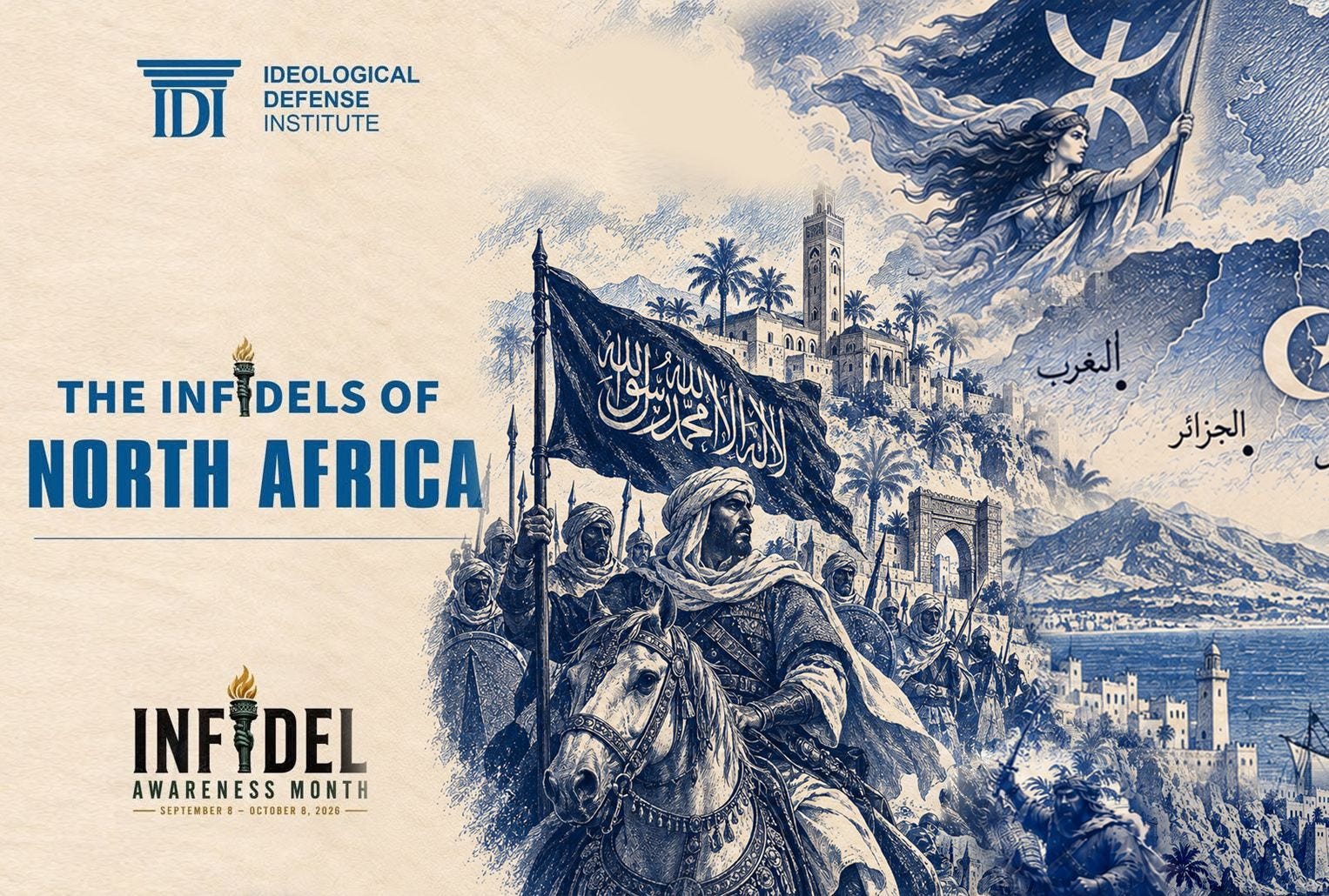
Roman North Africa stretched to the Atlantic, and its Amazigh population absorbed Christianity so thoroughly that by the third and fourth centuries the region hosted more than three hundred bishops, a religious infrastructure denser than most of Christian Europe at the time. Carthage, in what is now Tunisia, was one of the most influential Christian centers anywhere in the ancient world. Cyprian, bishop of Carthage, died a martyr under Roman persecution and became one of the faith’s most cited early voices. Augustine, the single most influential theologian in the history of Western Christianity, was born in what is now Algeria and wrote every major work of his career on North African soil. Tertullian, the man who coined “the blood of the martyrs is the seed of the Church,” was North African too, a line he wrote about Roman persecutors, never imagining it would apply just as precisely to the conquerors still centuries away.
Jewish communities were established across the region long before Islam existed as a religion at all. Cyrene, in present-day Libya, had a Jewish population old enough that the man who carried Christ’s cross, Simon of Cyrene, was a Diaspora Jew making pilgrimage from there to Jerusalem when Roman soldiers pulled him out of the crowd.
The Amazigh, the indigenous people of North Africa, a name meaning “free people,” not the slur “Berber” their conquerors hung on them, a word that means “savage” in its origin, were mostly Christian before a single Arab army crossed into their territory.
Islamic military campaigns against North Africa began in the late seventh century. Uqba ibn Nafi marched west declaring open jihad against the Amazigh, and left a trail of killing and destroyed towns behind him with every step. Earlier raids into Libya had already been extracting jizya from Christian communities, and when families ran out of money to pay it, the commander Amr ibn al-As ordered them to sell their own children into slavery to cover the tax bill.
Conquest of what is now Tunisia, Algeria, and Morocco took decades of continuous war, not a single triumphant campaign, because the Amazigh did not surrender. The medieval historian Ibn Khaldun, an Islamic source, recorded that the Amazigh apostatized from Islam twelve separate times: forced conversion after forced conversion, each one abandoned the moment the army that imposed it marched away, until Musa ibn Nusayr finally broke the cycle by force.
Al-Kahina, known to her own people as Dihya, an Amazigh Christian queen who led the fight against the Muslim invaders and personally killed Uqba ibn Nafi in battle, was leading the resistance. It took Musa ibn Nusayr, and atrocities on a scale even Islamic chroniclers struggled to describe without awe, to finally finish what Uqba had started. Ibn Khaldun’s history records that Musa enslaved roughly 120,000 Amazigh, girls and boys alongside the men, an entire generation of a free people shipped east in chains to the caliphate in Damascus as human tribute.
Ibn Kathir, another Islamic source wrote: “Islam had never heard of captives like the captives of Musa ibn Nusayr, emir of the Maghreb.”
Churches across the region were torn down. By the tenth century, Christianity had been erased from North Africa almost in its entirety, over roughly three centuries of continuous military and religious pressure.
Under Idris I, founder of Morocco’s first Islamic dynasty, Jews, Christians, and remaining pagans were eliminated on a large scale, a purge the medieval historian Ibn Idhari recorded. What followed for the next thousand years was a recurring cycle of humiliation, forced conversion, and mass killing that returned again and again whenever a new dynasty took over.
In ninth-century Tunisia, a Muslim judge ordered Jews to wear identifying patches sewn onto their shoulders, one stitched with the image of a monkey, the other a pig, and had the same animals marked onto the doors of Jewish homes, so that a Jewish household could be identified by any passerby at a glance. Under the Almohads, Jews were forced into black clothing specifically chosen to mark them out in public.
Under the caliph Abd al-Mu’min ibn Ali, Jews who refused conversion were executed in the public squares of Marrakesh, Fez, and Meknes, in front of crowds. Rabbi Yusuf ibn Amram was forced to convert under that pressure; a hundred and fifty other Jews who chose to stand beside him and refuse were put to death rather than accept Islam.
Rabbi Yehuda HaCohen ibn Susan was burned alive under the Almohads for refusing to convert to Islam. In 1595, more Jews were executed and burned, among them a man named Said Sawwad.
Mass killing on a civic scale struck twice at the same city within four centuries. In 1033, the Fez massacre killed more than 6,000 Jews in a single episode, a number large enough that it represented a substantial fraction of the entire Jewish population of the region at the time, wiped out in one coordinated act of violence. In 1465, a second massacre hit the same city on an even larger scale; by some estimates only a handful of the city’s Jews survived the killing, with thousands slaughtered in an event that essentially reset the Jewish population of Fez back to almost nothing.
This Is Not Ancient History
Minorities in North Africa found no durable safety until French colonial rule arrived centuries later and did, for the first time since the seventh century, build churches, however limited, and protect Jewish communities from the recurring mob violence and state-sanctioned killing that had defined their existence for a thousand years.
Today, Jews have all but vanished from North Africa. Their numbers sit close to zero in Tunisia, Algeria, and Libya. Morocco retains a few hundred, the last visible remnant of a community that once numbered in the hundreds of thousands before the mid-twentieth century, most of whom left for Israel in the years following its founding.
None of these countries permits Christianity to spread among its own citizens. Churches, where they exist, are built for foreigners, diplomats, expatriate workers, tourists, never for the native population, because native conversion is not accepted regardless of what the constitution says about religious freedom on paper. Citizens are Muslim by law in these states, and are barred, whether by explicit statute or by unwritten but absolute social and legal custom, from converting to Christianity.
In Algeria, tens of thousands of Christians exist today, likely more than official counts admit, concentrated especially among the Amazigh, descendants of the very people Musa ibn Nusayr enslaved by the hundred thousand, still practicing a faith their ancestors held before Islam ever arrived. The state persecutes them methodically: shutting down churches and religious gatherings under the pretext that they lack proper licensing, and prosecuting people accused of proselytizing under a 2006 law that criminalizes possessing Christian materials capable of being used for missionary purposes. More than forty local churches have been shut down under this regime. More than fifty Christians have stood trial for the crime of their own faith.
Tunisian Christians, overwhelmingly converts, practice in secret, because open practice invites similar persecution.
Morocco offers no better ground. Christians meet in secret gatherings inside private homes, practicing rites in hiding out of fear of both their own communities and the state itself. They cannot legally give their children Christian names. They cannot marry according to Christian rites with any legal standing. They cannot even be buried in a Christian cemetery when they die.
Libya and Mauritania have simply written the old punishment back into law rather than leaving it to mobs and custom: apostasy from Islam carries the death penalty in both countries. In Libya today, roughly nine people currently sit on death row for exactly that.
The infidels of North Africa share a grave with the infidels of Egypt, the infidels of the Levant, the infidels of Arabia, and the infidels of South Asia. Different names, the same sword.
The ones who survived did not simply survive. They were infected. The conquered took on the conqueror’s language, the conqueror’s god, the conqueror’s law, and the conqueror’s own contempt for whatever their ancestors had been before Islam arrived. Generations on, the grandchildren of the murdered were praying five times a day to the god their own great-grandfather died refusing, wearing the invader’s history as their own inheritance, calling the civilization that annihilated their bloodline home, and picking up the same sword to do to the next infidel down the line exactly what had been done to their own people first. That is the final and most complete victory any conquest can win: not just the land, not just the bodies, but the memory itself, rewritten from the inside, by descendants who no longer know, or no longer want to know, which side of the sword their own ancestors were standing on when it fell.
This history is crucial to the understanding of Islam's spread and its continuing threat to the peoples of the West and, indeed, the world. I'm grateful for this work. The days of darkness from Islam are far from over.