


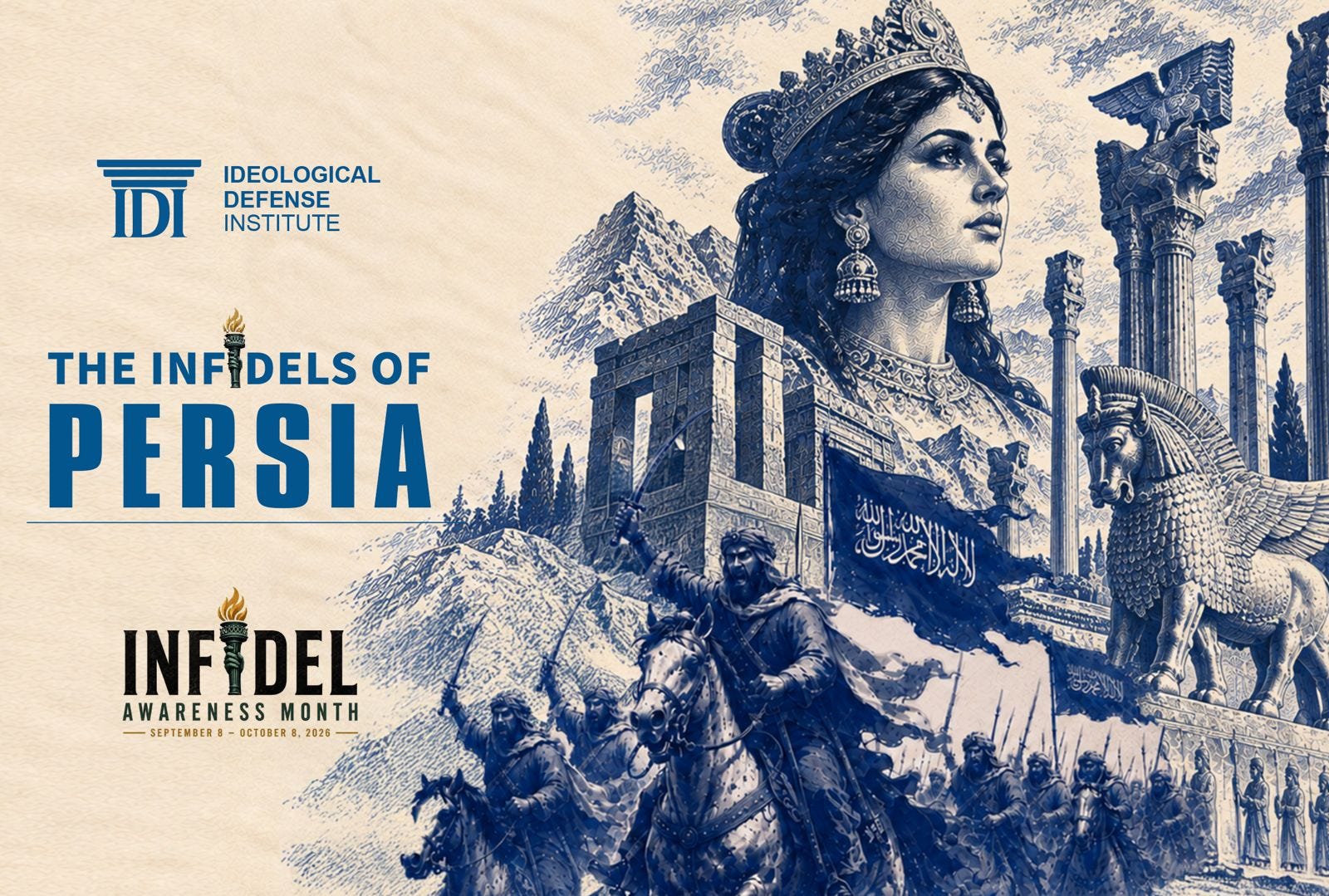
By the time Muhammad was born, Persia had been one of the great civilizations of the world for eleven hundred years. Cyrus the Great founded the Achaemenid Empire in the sixth century BC, and it became the largest state the world had yet seen, running from the Aegean and Egypt to the Indus. Its kings built Persepolis. They laid the Royal Road from western Anatolia to Susa, with relay stations for mounted messengers. They dug qanats, underground channels that carried mountain water across the desert to fields and cities, some of which still run. In 539 BC Cyrus took Babylon and let the Jewish exiles go home, and Jews have lived on the Iranian plateau ever since. Alexander burned Persepolis in 330 BC. The Parthians who followed held Persia against Rome for nearly five centuries.
In 224 AD Ardashir I overthrew the Parthians and founded the Sasanian dynasty, which lasted more than four hundred years. His son Shapur I killed one Roman emperor on the battlefield, forced another to surrender, and captured a third, Valerian, along with part of his army. The Roman prisoners were put to work on Persian bridges and dams. Rome and Persia fought over the Near East for four centuries, and Persia mostly held its own.
The state religion was Zoroastrianism, with fire temples across the plateau and a priesthood, the mobeds, that stood beside the throne. Below it lived Christians of the Church of the East, who built bishoprics and monasteries and sent missionaries toward India and China. Jewish academies in Sasanian Babylonia produced the Babylonian Talmud. The Sasanian priesthood was no friend to minorities. It persecuted Christians, and Mani, the prophet of Manichaeism, died in its custody. Nobody has to pretend old Persia was a paradise of tolerance. But it held Zoroastrians, Jews and Christians inside one state for four centuries.
Khosrow I, who ruled from 531 to 579, reformed the tax system and the army and took in Greek philosophers who had lost their patron when the emperor Justinian shut down the school of Athens. In 570 his forces drove the Ethiopians out of Yemen and made it a Persian vassal state, which is why a Persian governor was sitting in Sana’a when a letter from Arabia arrived.
His grandson Khosrow II, called Khosrow the Victorious, took the empire to its greatest extent. In 614 his armies took Jerusalem and carried the True Cross to Ctesiphon. Egypt fell a few years later. Persian troops stood across the Bosphorus from Constantinople. Then the emperor Heraclius counterattacked deep into Persia and destroyed the Persian army at Nineveh in 627. The nobles deposed Khosrow. His son Kavad II had him executed on 28 February 628.
Kavad killed his brothers and died within months. In the next four years the throne passed through more than ten rulers, including generals and two of Khosrow’s daughters. The twenty-six-year war with Byzantium had emptied both empires. In 632, the year Muhammad died, the crown went to a boy named Yazdegerd III.
Around 628 Muhammad, the head of a small city-state in the Hijaz, sent letters to the great rulers of his world: Heraclius of Byzantium, the ruler of Abyssinia, and Khosrow II, the King of Kings of Persia, whom the Arabs called Kisra. The messenger to Persia was Abdullah ibn Hudhafa al-Sahmi.
According to the Islamic sources, the letter told Kisra to submit to Islam and be safe, and warned that if he refused he would carry the sin of all the Magians, the Zoroastrians, on his own head. Sahih al-Bukhari records that the letter went through the Persian governor of Bahrain, who passed it up to the king. Khosrow read it and tore it into pieces.
In 633, before the empire had even recovered from its civil war. Khalid ibn al-Walid, fresh from crushing the tribes of Arabia, invaded Persian Iraq and beat the Sasanian frontier armies at the Chains and at Walaja. At Ullais in May 633, according to al-Tabari and Ibn Kathir, Khalid vowed that a river would run with Persian blood if God gave him the victory.
He took the captives and had them beheaded along a canal. When the blood did not fill the channel, he diverted water over the bodies so the river ran red. 70,000 Persian were killed.
The Persians beat the Muslims at the Battle of the Bridge in 634, then lost the big fights that followed. In 636 an Arab army destroyed the main Sasanian force at Qadisiyyah, killing its commander Rostam Farrokhzad. Ctesiphon, the imperial capital, fell in 637 after a three-month siege. The Arabs took the royal treasury. Among the loot was the Baharestan carpet, the royal garden carpet of the Sasanian court, too heavy for the Persians to carry away. Sa’d ibn Abi Waqqas sent it to Caliph Umar in Medina, where it was cut into pieces and divided among the Muslims.
In 642 at Nahavand the Arabs beat the last great army the empire could raise. Muslim historians named it the Victory of Victories. Yazdegerd III spent his last nine years running from province to province, looking for someone who would shelter him. He was killed at Merv in 651.
Zoroastrians are not People of the Book in the Quran. Muslims gave them dhimmi status anyway, for the same reason the Sindhi idol-worshippers got it: a dead infidel pays no tax. Fire-worshippers paid the jizya, lived under the ban on building and public worship, and stood below every Muslim in court.
Those who could not pay or would not convert had one more choice, which was to leave. The Parsis of India descend from Zoroastrians who fled Persia after the conquest, and they still count their years from the accession of Yazdegerd III, the last king they had.
Over the next two centuries the tax did most of the work. Fire temples closed for want of worshippers, priests lost their income, and by the ninth and tenth centuries most of the plateau had gone over to Islam.
In 816 a man named Babak Khorramdin raised the mountains of Azerbaijan against the Abbasid caliphate. His movement, the Khurramites, mixed the old Iranian religion with revolt against Arab landlords and tax collectors, and its aim was to get the foreign rulers out.
Babak beat one caliphal army after another. Al-Ma’mun died in 833 without defeating him. His successor al-Mu’tasim sent his best general, Afshin, who rebuilt the border fortresses, bought Babak’s spies, ran supplies to his army by relay, and took the rebel stronghold of Badd in August 837. Babak fled toward Armenia, where a Christian prince, Sahl ibn Sunbat, handed him over for a reward of two million dirhams. In March 838 he was executed at Samarra, and his hands and feet were cut off first.
Persian returned as a written language in the ninth and tenth centuries, and around the year 1000 Ferdowsi finished the Shahnameh, the book of Persian kings, which carried the memory of the pre-Islamic past. Persian scribes ran the caliphate’s administration and Persian scholars wrote its books. The Persians kept their language and their poetry, but they lost their religion.
Jews, under Muslim rule in Persia, were ranked as unclean. Historians of Iranian Jewry record rules that kept them indoors when it rained, in case the water ran off them onto a Muslim. They were confined to their own quarters and periodically forced to convert, in Shiraz, in Isfahan, in Barforush.
In March 1839 a rumor that the Jews of Mashhad had mocked a Muslim holy day brought a mob into their quarter. Between thirty and forty Jews were killed. The synagogue was burned, homes were looted, and about seven Jewish girls were carried off to become child brides. The surviving Jews, some 2,400 people in roughly 300 families, were then told to convert or die. They converted. The event is called the Allahdad, “God’s Justice,” a name the forced converts gave it themselves. For generations afterward they lived as Muslims in public and practiced Judaism in secret, a community of Jadid al-Islam, “new Muslims.”
The community on the eve of the 1979 revolution numbered about 80,000, and some estimates run above 100,000. The 2016 census counted 9,826.
In the twentieth century Persia tried to turn back toward itself. The Constitutional Revolution of 1905–1911 produced Iran’s first parliament and the idea of citizenship. Under the Pahlavi dynasty, from 1925, Iranian nationalism deliberately reached back to Cyrus, to the Achaemenids and to the pre-Islamic past, and the Shah staged a great celebration at Persepolis in 1971 to mark 2,500 years of Persian monarchy. The country presented itself as the heir of a civilization that predated Islam by more than a thousand years.
Then came 1979. The Islamic Republic made religion the government, put Islamic law into public and private life, forced women to cover their hair, and created the Revolutionary Guards. Khomeini put a universal Islamic identity above Iranian nationalism.
The revolution was not made by clerics alone. Marxists, leftist students and fundemental Muslims marched together against the Shah, joined by hatred of America and of Zionism. Khomeini crushed his leftist allies once he held power, and he kept their program.
Since 1979 the Republic has spent Persia’s oil, army and geography on a war against Israel and the United States. It built Hezbollah into an army on Israel’s northern border, armed Hamas and Palestinian Islamic Jihad, and organized militias across Iraq, Syria and Yemen. It calls America the Great Satan and treats Israel’s destruction as a founding goal.
The constitution of the Islamic Republic recognizes three religious minorities: Zoroastrians, Jews and Christians. Their members cannot be elected to representative bodies except in five reserved seats out of 290 in parliament: two for Armenians, one for Assyrians, one for Jews, one for Zoroastrians. They cannot serve in the judiciary or the security services. They cannot be school principals. They cannot be president, a post reserved for Shia Muslims. Public-sector job applicants are screened for their knowledge of Islam. Baha’is are not recognized at all.
Christians who were born Christian, mostly Armenians and Assyrians, are tolerated inside their own churches, where the state registers who attends and keeps Muslim converts out. Open Doors ranked Iran eighth in the world for danger to Christians on its 2023 list.
In his article The Infidels of Persia, Ali Siadatan narrates the history of Iran from the pre-Islamic era to the terrorist Islamic Republic regime, and along the way addresses the place of religions, Iranian identity, and its relationship with Islam; a narrative in which the Arab conquest of Iran and the process of Islamization of Iran, the subsequent changes in identity and religion, and ultimately the formation of the Islamic Republic regime as a government with an Islamic ideology are examined.
Siadatan emphasizes that the Pahlavi era is part of a deliberate effort to return Iran to its historical roots and pre-Islamic identity; Iranian nationalism becomes connected to Cyrus, the Achaemenids, and the pre-Islamic past, and Iran, through the efforts of Aryamehr, at the 2,500-year celebrations of the Persian Empire in Persepolis, is presented as the heir to a civilization that had existed for more than a thousand years before Islam. Ultimately, this nationalism and connection to Iranian historical identity is severed with the ominous 1979 Revolution; the Islamic Republic regime, by making religion the basis of government and placing Islamic identity above Iranian nationalism, embarks on a different path.
Yes, the purpose and will behind our revival of the Pahlavi monarchy is the Pahlavi legacy: the effort to restore the Iranian nation’s connection with its pre-Islamic past and redefine Iranian national identity, in opposition to the ideological and destructive identity of the Islamic Republic.