


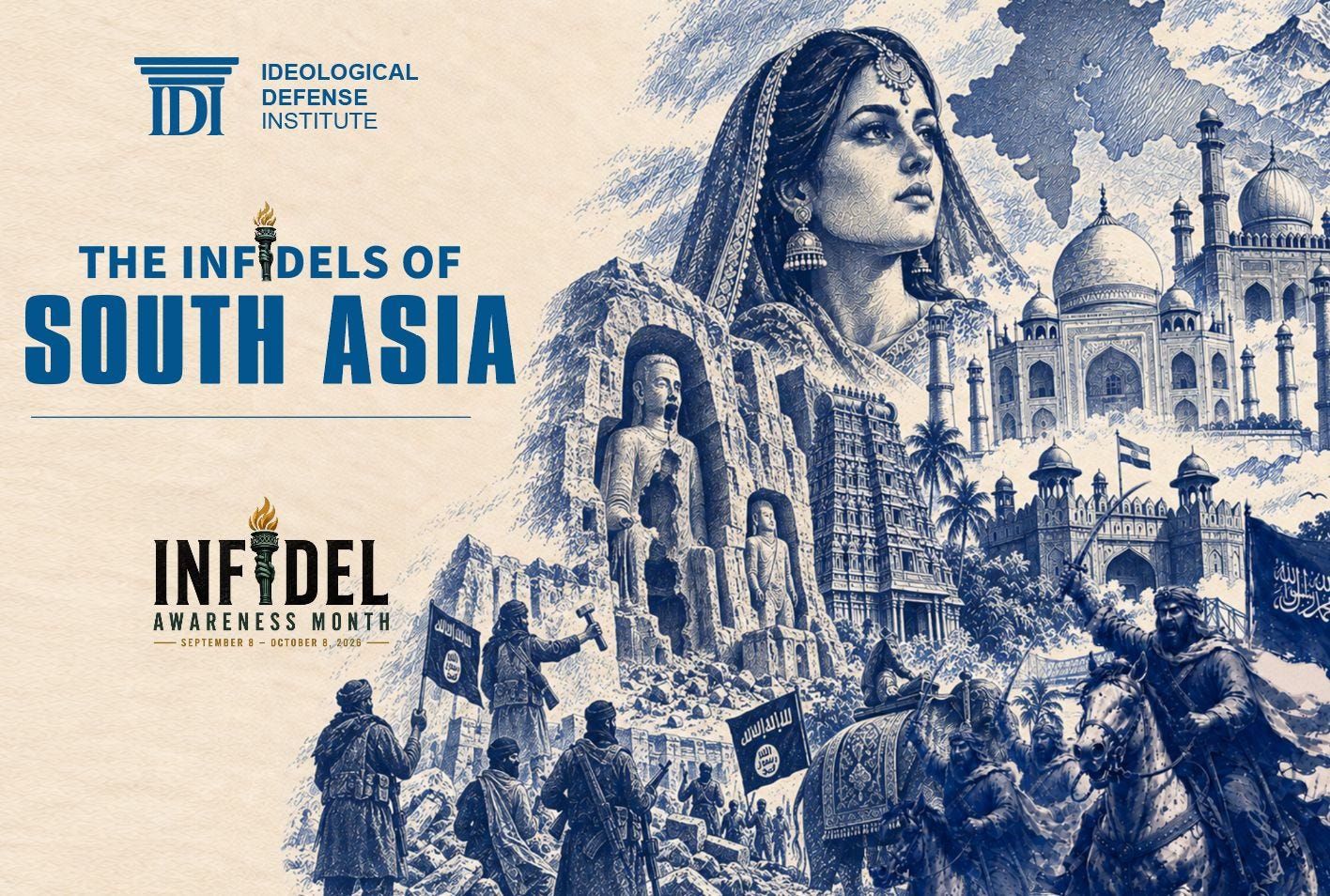
Forget everything your textbook told you about Islam’s “golden age of tolerance” in India. Forget the Sufi poetry, the spice-route romance, the multicultural Mughal miniature paintings hanging in museums funded to whitewash the brutal Islamic conquest. None of that built the second-largest Muslim population on Earth out of a subcontinent that was overwhelmingly Hindu, Buddhist, and animist for thousands of years before a single Arab horse crossed the Indus. The sword did, sieges did, mass executions did, burned and beheaded idols did, a poll tax engineered to starve the infidel into submission did.
Historians who launder Islamic barbarity into a story about traders and intermarriage are fraudsters.
Sindh: The First Blade, 711–712
Muhammad bin Qasim was only seventeen when he crossed into Sindh in 711 at the head of an Umayyad army, sent to break the last independent Hindu-Buddhist kingdom on the Arabs’ eastern frontier.
His first major target was Debal. The city’s defenders held behind massive walls that even Arab chroniclers described with admiration. Qasim’s army finally broke through after constructing a huge catapult they called “the Bride” and using it to bring down the temple flagstaff that the defenders believed protected the city.
What followed was three days of killing after the city fell. Fighting men and much of the male population were killed, the Brahmin priests of the great temple were slaughtered inside their sanctuary, and the surviving women and children were bound together and taken as war booty. Some were distributed among the soldiers; others were sent west to be sold. According to the Quranic rules, one-fifth of the captives and spoils belonged to the Caliph in Damascus. Sindhi women and children were therefore literally counted as part of the Caliph’s share of the war dividend.
Qasim then moved north along the Indus, repeating the pattern at Nerun, Sisam, and eventually Aror, the Sindhi capital. There, in 712, King Dahir rode out on his war elephant to meet the invading army and was killed in battle. His head was cut off, packed, and sent to Damascus as proof that the kingdom had fallen.
Dahir’s wife, Rani Bai, was trapped in the fortress of Raor with what remained of the royal court and the surviving defenders. Rather than be captured, she and the women around her chose death by fire. It was an early recorded example on Indian soil of a terrible choice that would recur again and again in later centuries when women faced an Islamic army at the gates: death rather than capture.
Sindh’s temples were looted or destroyed, its Brahmin ruling class killed or dispersed, and the surviving population was placed under jizya and reduced to dhimmi status. That created a theological problem. Hindus and Buddhists were idol-worshippers, not “People of the Book,” and by the Islamic law they did not qualify for the protections extended to Jews and Christians. But the conquerors found a practical solution. They granted them a form of dhimmi status anyway because Damascus needed their taxes.
Afghanistan
Unlike Sindh, Afghanistan did not fall quickly. It took Islamic armies more than two centuries of repeated conquest, rebellion, retreat, and reconquest before Muslim rule finally took hold.
When Arab armies first pushed east from Persia in the seventh century, Afghanistan was not Muslim. Kabul, Gandhara, and the mountain valleys around them were ruled by Hindu and Buddhist dynasties, most famously the Hindu Shahis, whose kings resisted the advancing Caliphate for generations. Kabul changed hands repeatedly. Muslim governors captured it, besieged it, forced tribute from its rulers, and stationed troops there, only for local forces to retake the city when the occupying garrison weakened. For nearly two hundred years, conquest never quite became permanent.
By the ninth and tenth centuries, the Saffarids and then the Ghaznavids finally began breaking that resistance. The Hindu Shahi kings were driven out of Kabul and pushed east into Gandhara, losing territory piece by piece until there was almost nowhere left to retreat.
The decisive humiliation came under Jayapala, one of the last Hindu Shahi kings. Sabuktigin, the father of Mahmud of Ghazni, defeated him badly enough that Jayapala was forced into humiliating terms. Later defeats destroyed what remained of his power. Rather than continue ruling as a defeated king and watch his kingdom disappear, Jayapala chose death. He built his own funeral pyre and burned himself alive.
Afghanistan became Muslim through conquest, king by king, battle by battle, rebellion by rebellion, after more than two centuries of resistance, and once Afghanistan finally fell, its role changed completely. It became the base from which further conquest could be launched. Ghazni, sitting inside territory that had belonged to the Hindu Shahis only a generation earlier, became the staging ground for repeated campaigns into India.
India
Between 1000 and 1027, Mahmud of Ghazni invaded the Indian subcontinent again and again. He did not come as a merchant, he came as a Muslim conqueror, and his campaigns were openly celebrated in Islamic sources as jihad against unbelievers and their temples. Gold, slaves, territory, and the destruction of idolatry all went together.
His most famous raid came at Somnath in 1025–1026. The temple on the Gujarat coast was one of the great Hindu pilgrimage centers of India. Mahmud crossed the desert to reach it, besieged it, broke through its defenses, killed large numbers of defenders, smashed the temple’s sacred image, and carried enormous quantities of treasure back to Ghazni. Contemporary Muslim sources celebrated the destruction of Somnath as a triumph of Islam over idolatry. The Abbasid caliph rewarded Mahmud with additional honorific titles after the campaign.
When the temple’s Brahmin priests reportedly offered Mahmud an enormous ransom in gold to spare the idol, he refused it. Then he personally took an iron mace to the great Shiva lingam himself, smashed it apart, and had the fragments built into the steps of the city’s central mosque, so that Muslims would grind the broken god of the infidel under their sandals on the way to prayer, five times a day, forever.
After Muhammad of Ghor defeated the Rajput forces at the Second Battle of Tarain in 1192, Muslim rule expanded across northern India and eventually produced the Delhi Sultanate. For centuries, Islamic armies pushed against Hindu kingdoms farther south and west. Cities changed hands, temples were destroyed or converted, captives were taken, Jizya imposed, and resistance answered with repeated campaigns.
Alauddin Khalji besieged Chittor in 1303 and eventually took the fortress. Later Rajput tradition describes the women inside choosing jauhar, mass self-immolation, rather than falling into the hands of the conquering Muslim army, while the men rode out in a final suicidal charge. In 1535, during the siege by Bahadur Shah of Gujarat, another jauhar took place. In 1568, when Akbar’s Mughal army besieged Chittor, it happened yet again. Three times, across generations, women inside the same Rajput fortress chose fire rather than the possibility of capture after defeat.
In 1398, Timur invaded northern India and destroyed Delhi. His campaign was explicitly framed in Islamic terms, with Hindus repeatedly described as infidels and the war presented as religiously meritorious. Before the final attack on Delhi, his forces killed an enormous number of Hindu captives they had already taken during the campaign. The figure traditionally given is roughly 100,000.
Delhi was plundered on a massive scale. Its inhabitants were killed and enslaved, neighborhoods were devastated, and Timur returned west carrying enormous quantities of wealth and captives.
These were not simply random kings who happened to be Muslim. Again and again, conquest was described by Muslim chroniclers themselves in the language of jihad, infidels, idol-breaking, religious merit, and the triumph of Islam. Political ambition and greed were certainly there too, but they existed alongside religion, not instead of it.
From the Mughals to Kafiristan
The Islamic conquest of South Asia did not end with Mahmud of Ghazni or the Delhi Sultanate. Under the Mughals, the same basic conflict between Islamic rule and the non-Muslim population continued, even if some rulers were more tolerant than others.
Akbar is usually remembered as the tolerant Mughal emperor, and there is truth to that. He abolished the jizya in 1564 and relaxed many of the restrictions that had defined earlier Islamic rule. But that did not become the permanent direction of the empire. His great-grandson Aurangzeb reversed much of it. In 1679, he restored the jizya and presented the decision not simply as a tax policy, but as a return to proper Islamic government after what he regarded as the religious laxity of his predecessors.
Aurangzeb also ordered the destruction of major Hindu temples, including the Kashi Vishwanath temple in Varanasi and the Keshava Deo temple in Mathura, two of the most sacred sites in Hinduism. Mosques were then built at those locations. Islamic conquest was not merely about taking political control. It also meant physically replacing the religious civilization that had existed before it.
In 1675, the ninth Sikh Guru, Tegh Bahadur, was executed in Delhi after resisting Mughal religious pressure and refusing conversion to Islam. A generation later, two young sons of Guru Gobind Singh, Fateh Singh and Zorawar Singh, were captured at Sirhind and offered their lives if they converted. They refused and were killed. The Khalsa, the Sikh warrior order, was born in precisely this world: a community concluding that if it remained unarmed, it would eventually be forced to choose between submission, conversion, and death.
In the mountains of eastern Afghanistan, a polytheistic people had somehow survived centuries of Islamic expansion. Muslims called their homeland Kafiristan, literally, “the land of the unbelievers.” These people still worshipped the gods of their ancestors long after nearly every surrounding population had been Islamized. They had survived Arab armies, Persian Muslim dynasties, and Afghan rulers. What twelve centuries of pressure had failed to erase was finally broken in 1895–1896.
Amir Abdur Rahman sent his army into Kafiristan, crushed the resistance, burned temples and sacred images, carried away war trophies, and imposed mass conversion to Islam. Men were taken prisoner, others fled across the mountains into British India, and entire villages were brought into Islam in mass ceremonies after their old religious world had been destroyed around them.
This Is Not Ancient History
Afghanistan was once home to Buddhist monasteries, Hindu kingdoms, trade routes, scholarship, and a civilization connected to Persia, India, and Central Asia. Today it is ruled by the Taliban. Women are shut out of universities, religious minorities have almost disappeared, dissent is dangerous, and the country has been reduced to one of the most repressive and impoverished societies on earth.
In Pakistan and Bangladesh, the infidel still lives there, but never on equal terms. Christians and Hindus can be ruined by a blasphemy accusation. Churches and temples can be burned by mobs. Girls can be kidnapped, converted to Islam, married to Muslim men, and then presented to a court with a conversion certificate. Entire communities know that one accusation, one rumor, or one angry crowd can change their lives overnight.
That is what fourteen centuries of Islamic conquest left behind. Societies that once produced enormous cultural and religious diversity, Buddhist Afghanistan, Hindu Sindh, animist Kafiristan, a Bengal with a Hindu population in the double digits, a Kashmir with a five-thousand-year-old civilization still living in it, have become narrower, poorer, more homogeneous, and more afraid, one conquest, one conversion, and one generation at a time. The Islamic sword did that.