


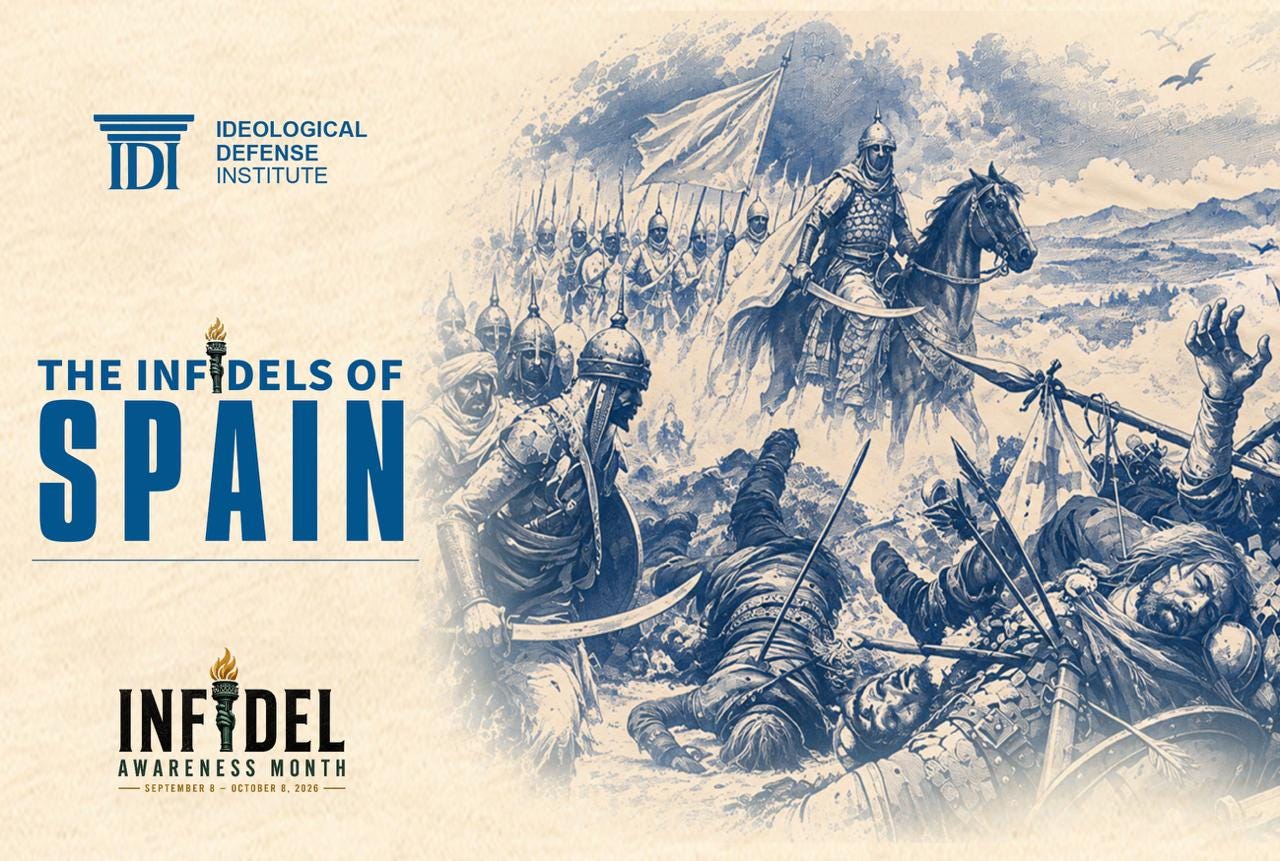
During an official visit to Spain in June 2026, Pope Leo XIV praised medieval Spain—which was occupied by Muslim conquerors for nearly 800 years—as an interfaith utopia that led to advancements in astronomy, mathematics, medicine, philosophy, and science. He urged modern Spaniards to embrace multicultural coexistence with Islam and stop “fanning the flames of polarization” over mass migration from the Muslim world. He claimed that Christians and Muslims can live together as friends as they did in centuries past.
The Pope’s remarks were greeted with significant pushback by historians, theologians, and lay Catholics. They accused him of misrepresenting Spain’s history by repeating the shibboleths of progressive historians that life on the Iberian Peninsula (modern-day Spain and Portugal) during its occupation by Muslims was a paragon of religious tolerance and harmony.
The purpose of this essay is to demonstrate that Islamic Spain was ruled by ruthless and tyrannical Muslim theocrats who marginalized and repressed Christians and Jews in all areas of life. Under Islamic law, non-Muslims under Muslim rule were branded as infidels (disbelievers) and relegated to a subordinate social class.
The case of Islamic Spain is a universally significant microcosm that serves as a warning of what awaits Christians, Jews, and other non-Muslims under Muslim rule. Islam and the West represent two diametrically opposed and fundamentally incompatible civilizations.
As millions upon millions of immigrants from the Islamic world pour into Western countries in our lifetimes, the sordid history of medieval Spain is repeating itself. The only difference now is that foot soldiers of the opposing civilization are being invited into non-Muslim lands with open arms by political leaders who are either ignorant of the history of al-Andalus or who despise the heritage of Western civilization.
Demographic trends favor the Muslim newcomers, who, by and large, refuse to assimilate to the Western way of life. They are not only establishing parallel societies in Western cities but are also taking the reins of political power. Islam is spreading across the West at a rapid pace, and if not stopped and reversed, it will eventually take over and impose its will on non-Muslims as in medieval Spain.
May Spain be a warning for the rest of Western world of what happens when Judeo-Christian values, history, and tradition—and especially the protection of individual liberties—are not adequately defended.
A Brief History of Islamic Spain
In AD 711, less than a century after the birth of Islam in the deserts of Arabia, a Muslim military force consisting of approximately 7,000 Arabs and Berbers from North Africa crossed the Strait of Gibraltar and invaded Visigothic Hispania (the Roman name for the Iberian Peninsula, modern day Spain and Portugal). The Visigoths, Germanic peoples who had taken full control of Hispania from the Romans by 507 and had converted the entire Iberian Peninsula to Nicene Christianity by 589, had become weak due to internal divisions and were utterly unprepared for the Muslim onslaught.
The Muslim invaders, led by Tariq ibn Ziyad, an Umayyad commander from what is now known as Algeria, faced little resistance. In July 711, at the Battle of Guadalete in southern Iberia, the Muslim forces decisively defeated the Visigoths and their leader, King Roderic, was killed in battle. The rout led to the total collapse of the Visigothic kingdom and opened the way for the capture of Toledo, the Visigoth capital, in 712. Visigoth Spain was forever lost. Christian Spain became Muslim Spain.
The Muslim warriors, known as Moors (a blanket term that refers to the medieval Muslim inhabitants of North Africa and the Iberian Peninsula), renamed the territory of Hispania and called it al-Andalus, a term of uncertain etymology but may derive its name from Vandalusia (“land of the Vandals”) and refer to the Vandals, a Germanic people who settled in Iberia and North Africa in the fifth century.
Within a period of just seven years, the Moors, motivated by religious fervor and hungry for plunder, succeeded in conquering most of the Iberian Peninsula and ruled it as an emirate of the Umayyad Caliphate in Damascus. In less than a decade, five million Christians suddenly were subjugated to the oppressive rule of Muslim autocrats.
The Moorish advance beyond Iberia was halted in October 732, when the Frankish leader Charles “the Hammer” Martel defeated the Umayyad army at the Battle of Tours (also called the Battle of Poitiers).
The defeat of Umayyads, who managed to cross over the Pyrenees mountains into France, not only curtailed the spread of Islam into northern Europe but also contributed to the birth a collective European identity. The first recorded use of the word “European” dates to 754, when a scribe, writing in Latin, referred to the victors of the Battle of Tours as Europenses, a term he used to describe the Christian peoples of the western part of the continent.
The Moors were unable to occupy parts of northern Iberia due to mountainous terrain that created a natural protective barrier. In 718, Pelagius (Pelayo), a Visigothic nobleman, founded the Kingdom of Asturias, from where he began to push back against the Moorish occupiers. In the summer of 722, Pelagius defeated an Umayyad army at the Battle of Covadonga, in what is regarded as the beginning of the Christian Reconquista (reconquest) of Iberia.
During subsequent centuries, power struggles and the fragmentation of Moorish al-Andalus allowed for the creation and expansion of Christian kingdoms in Aragon, Castile, León, Navarre, and Portugal. In 1085, Alfonso VI of León and Castile retook Toledo, the ancient Visigoth capital.
A key turning point of the Reconquista occurred in July 1212, when a coalition of Christian armies decisively defeated the Moorish Almohads at the Battle of Las Navas de Tolosa in southern Spain. The defeat significantly reduced the power of Moors in Iberia and gave new impetus to the Reconquista. In 1248, Ferdinand III of Castile retook Seville, further diminishing Islamic control over Spain.
Muslims occupied Spain for nearly eight centuries, until January 1492, when the Catholic Monarchs, Queen Isabella of Castile and King Ferdinand of Aragon, captured Granada, the last Muslim stronghold on the Iberian Peninsula. This ended formal Muslim political rule in Iberia.
An Islamic Golden Age?
Like Pope Leo XIV, modern liberal academics, authors, and religious leaders consistently promote medieval Islamic Spain as having ushered in a “Golden Age” of great learning and human advancement—a multicultural age that serves as an example for what could and should be replicated today. They claim that Islamic Spain was benevolent to, and tolerant of, its Christian and Jewish subjects. They present Islamic al-Andalus as the savior of medieval Europe and assert that Islamic Spain pulled Western Europe out of the Dark Ages by sparking the Renaissance.
Some examples include:
Historian David Levering Lewis, a two-time Pulitzer Prize winner, in his book, God’s Crucible: Islam and the Making of Europe, 570-1215, claimed that al-Andalus was a “beacon of cosmopolitanism, tolerance, and intellectual brilliance.” He praised Muslim leaders in medieval Spain for their “prodigious interfaith collaboration.”
Acclaimed author James Reston Jr., in his book, Dogs of God: Columbus, the Inquisition, and the Defeat of the Moors, wrote: “In arts and agriculture, learning and tolerance, al-Andalus was a beacon of enlightenment to the rest of Europe…. Among its finest achievements was its tolerance. Jews and Christians…were permitted to practice their faith and their rituals without interference. This tolerance was in keeping with the principles of the Koran.”
Professor Maria Rosa Menocal, author of the best-selling book, The Ornament of the World: How Muslims, Jews, and Christians Created a Culture of Tolerance in Medieval Spain, described al-Andalus as a “golden age of tolerance.” She wrote: “A thousand years ago on the Iberian Peninsula, an enlightened vision of Islam had created the most advanced culture in Europe…. al-Andalus was rooted in pluralism and shaped by religious tolerance.”
U.S. President Barack Obama, during a speech at Cairo University in June 2009, declared: “Islam has a proud tradition of tolerance. We see it in the history of Andalusia and Córdoba during the Inquisition [sic]…. Likewise, it is important for Western countries to avoid impeding Muslim citizens from practicing religion as they see fit—for instance, by dictating what clothes a Muslim woman should wear. We can’t disguise hostility towards any religion behind the pretense of liberalism.”
Many of the claims that are being peddled by liberal Westerners about Islamic tolerance in medieval Spain are demonstrably false and yet millions of people are being led to believe a lie about multicultural coexistence with Islam.
Infidels, Jihad, Dhimmitude
Before presenting evidence regarding the reality of life for non-Muslims in medieval Spain, a quick review of what Islamic doctrine says about Islam and non-Muslims (infidels) is in order.
Islam and its concepts, objectives, and terminology are derived from the Qur’an, the Hadith (quotes by Muhammad), Sunnah (actions by Muhammad), and Islamic law (sharia).
The term Islam means “submission” or “surrender” to the will of Allah. Islam does not mean “peace,” as many claim, although the Arabic words for Islam and peace (salam) do share the same three-letter root (s-l-m).
The Qur’an teaches that: Islam is preeminent over all other religions (9:33); Islam is the only true religion of Allah (3:19); Islam is universal and should reign over all of humanity (34:27); the Muslim community (umma) is perfect (3:110) and elected by Allah to rule over the world (35:37). This goal will be achieved by jihad (holy war), which is an obligation for all Muslims (2:216).
Islamic law divides the geopolitical world into two groups: Dar al-Islam (territory of Islam) and Dar al-Harb (territory of war). In other words, lands that are under Muslim rule and lands that are under non-Muslim rule.
Under Islamic jurisprudence, once a land becomes Islamic it is declared a waqf(religious endowment) and ownership transfers to Allah. As such, it cannot be permanently transferred back to non-Muslim ownership. For this reason, many jihadists believe they have a right to reconquer Spain for Islam.
Islam divides people into two groups: Muslims (umma) and unbelievers (kafir, roughly equivalent to the Latin term infidel). In medieval Spain, Christian and Jews, the so-called People of the Book (monotheists), were dhimmis(protected persons) and required to submit to Islam and pay an annual poll tax (jizya). In general, the jizya tax required Christians to pay an annual tribute of one gold coin per person, plus quotas of barley, honey, vinegar, and wheat.
Although legally protected, they were second-class citizens and required to accept religious and cultural repression in all aspects of life. Because they could never have equal status with Muslims, the jizya incentivized nominal Christians and Jews, including noblemen and elites, to convert to Islam.
Al-Andalus was governed by the Maliki school of Islamic jurisprudence, one of four major schools of Islamic law within Sunni Islam. The Maliki school was founded by Malik ibn Anas (c. 711–795), a jurist in Medina, to prioritize the influence of the Umayyads over the Abbasids. Alongside the Hanafi, Hanbali, and Shafi’i schools, the Maliki school provides a conservative methodology for interpreting the Qur’an, and deciding practical questions of worship, family life, criminal justice, and public order.
Myth of the Andalusian Paradise
In Islamic Spain, Christians faced systematic inequalities. They were heavily taxed, prohibited from proselytizing, and faced social restrictions aimed at humiliating non-Muslims.
In his landmark book, The Myth of the Andalusian Paradise, historian Darío Fernández-Morera documents the “brutality,” “brute force,” and “ruthless methods” with which the Muslims subjugated the Jewish and Catholic populations of Spain. He shows how Muslims systematically sacked Catholic cities and towns, demolished their churches, confiscated their property, enslaved them, and increased their taxes “to finance the embellishment of al-Andalus.” He further documents imprisonments, forced exiles, assassinations, and racial prejudice by Muslims against Jews and Christians. He explains:
“The existence of a Muslim kingdom in Medieval Spain where different races and religions lived harmoniously in multicultural tolerance is one of today’s most widespread myths. University professors teach it. Journalists repeat it. Tourists visiting the Alhambra accept it. It has reached the editorial pages of the Wall Street Journal, which sings the virtues of the “pan-confessional humanism” of Andalusian Spain (July 18, 2003). The Economist echoes the belief: “Muslim rulers of the past were far more tolerant of people of other faiths than were Catholic ones (November 15, 2001)…. The problem with this belief is that it is historically unfounded, a myth. The fascinating cultural achievements of Islamic Spain cannot obscure the fact that it was never an example of peaceful convivencia.””
Christian, Jewish, and Muslim sources document how the Muslim invaders burned churches and monasteries, destroyed castles, looted treasures, burned sacred Christian books, and took Christian women as sexual slaves.
The earliest known sources that document the Moorish conquest of Spain are the Byzantine-Arab Chronicle of 741 and the Mozarabic Chronicle of 754, both of which were written in Latin and provide details on the realities of Christian life under Muslim rule.
Following are some select examples documented by Fernández-Morera and other sources, including the Spanish Arabist Francisco Javier Simonet (1829–1897), whose magisterial work about the reality of the daily life of Christians in al-Andalus was not published, even back then, for more than 30 years after it was written due to fears of offending Muslim sensibilities. His book, Historia de los mozárabes en España, was finally published in 1897, briefly before Simonet died.
711. Shortly after they crossed into southern Spain, Muslims boiled, in large cauldrons, the cadavers of Christians killed in battle. Christian prisoners who witnessed the atrocities became convinced that the Muslims were cannibals and promptly submitted. The Muslim invaders were ruthless in their efforts to demoralize Christians.
711. After Muslims conquered Córdoba, surviving Christians gathered in a church. The Muslims torched the building and everyone inside was burned alive. Other Christians in Córdoba who surrendered were beheaded.
711–714. Musa ibn Nusayr (c. 640–716), a blood-thirsty Arab military commander who was a key figure in the Islamic conquest of Spain, spent three years waging jihad against infidels in Spain. Musa burned any city that resisted, “crucified” the nobility, and “cut to pieces” young men and infants so that the towns surrendered.
797. Al-Hakam I, Emir of Córdoba, and his local governor, Amrus ibn Yusuf, organized a grand banquet in Toledo, where he beheaded 700 Christian elites. The event is known as the Jornada del Foso de Toledo (Day of the Ditch) because their bodies were dumped into a massive pit.
850–859. A group of 48 Christians—including monks, nuns, and laypeople—were beheaded in Córdoba, the capital of Umayyad al-Andalus. Known as the Martyrs of Córdoba, they were prosecuted under the laws of the Emirate of Córdoba for a series of offenses, including refusing to renounce their Christian faith, publicly denouncing Islam, or insulting Muhammad. The Martyrs of Córdoba continue to be symbols of religious persecution in Islamic Spain.
852–886. Muhammad I (823–886), the fifth Umayyad ruler of al-Andalus, ordered Catholic nuns to be thrown into a cauldron of molten lead, monks to be lashed to death, and soldiers to be impaled.
891. The Umayyad governor of Seville unleashed a brutal campaign of repression and persecution against Christians as well as Christian converts to Islam who maintained ties of kinship with the Christian population.
919. A Christian woman in Córdoba was sentenced to death for publicly saying that Jesus was God and that Mohammed was a liar.
926. Abd al-Rahman III, Emir of Córdoba, ordered a thirteen-year-old Christian male named Pelayo to be beheaded after he refused a homosexual encounter.
928. Abd al-Rahman III ordered the mortal remains of Ibn Hafsun (c.850–917), a convert to Christianity who contested Umayyad rule in Spain, to be disinterred and crucified.
981. Muhammad Ibn Abu Amir al-Mansour (c. 932–1002), a prominent Moorish military commander known for burning Christian cities, razed the entire city of León, in what is now northwestern Spain, and left only a tower standing as a testament to his victory. In Córdoba, he ordered all heretical books to be burned. He regularly entered into peace treaties with local Christians only to betray them when he gained the upper hand. He carried out nearly sixty jihads against Christians.
985. Al-Mansour sacked and burned Barcelona.
997. Al-Mansour destroyed the Christian shrine of Santiago de Compostela in Galicia and ordered Christian slaves to carry the church bells over 800 kilometers to Córdoba, where the bronze was melted, turned into lamps, and hung in the Great Mosque.
1013. Jews were expelled from Córdoba and their wealth was confiscated.
1066. In a pogrom, Muslim rioters obliterated the Sephardic community in Granada.
1099. Muslim leaders destroyed the great church in Granada and plundered its sacred items.
1101. Christians fled the city of Valencia to avoid Muslim persecution.
1106. The Almoravids deported Christians from Málaga to Africa.
1126. Ali ibn Yusuf (1084–1143), Emir of the Almoravid dynasty in al-Andalus, ordered the mass deportation of Christians from Spain to North Africa, where they were forced into hard labor.
1135. Anti-Jewish riots broke out in Córdoba, where Muslim mobs stormed Jewish homes, plundered belongings, and killed Jewish residents.
1138–1170. Christians in Granada, Córdoba, and Seville were forcibly deported from al-Andalus and public Christian worship ended. Those who remained were dispossessed and martyred for their faith.
1148. Abd al-Mumin, the Almohad Caliph, ordered all Jews in Córdoba to either convert to Islam, leave al-Andalus, or be executed. Among those exiled was Moses Maimonides (1135–1204), a jurist, philosopher, and the foremost Jewish intellectual in medieval Europe. He was forced to leave al-Andalus in 1160. In 1164, Maimonides wrote a work titled “Epistle on Forced Conversion.” He died in Egypt in 1204. Maimonides was not a beneficiary of Andalusian tolerance.
1195. Averroes, an Andalusian jurist and philosopher, was banished from Spain for his attempts to integrate Islamic traditions with ancient Greek thought. Averroes, also known as Ibn Rushd, was born in Córdoba in 1126, and became universally known for his extensive commentaries on Aristotle. His work helped reintroduce Greek philosophy to Western Europe and influenced medieval Christian scholasticism. Averroes was an expert in the Maliki school of Islamic law and served as a chief judge (Qadi) in Córdoba. His books on metaphysics and philosophy were eventually condemned and publicly burned. He was exiled in 1195, the same year the Almohad Caliph Abu Yusuf won a decisive victory over the Christian forces of King Alfonso VIII at the historic Battle of Alarcos. Averroes died in Morrocco in 1198 and his body was later transferred to the family tomb in Córdoba.
1492. When King Boabdil of Granada capitulated to the Catholic monarchs, he included in the treatise of surrender a clause stipulating that “Your Highness will not allow Jews to have any authority over Muslims nor collect any kind of taxes from them.”
Other Examples of Moorish “Tolerance”
Fernández-Morera explained the why Muslims were required to dominate non-Muslims and why Islamic tolerance of infidels in al-Andalus was practically and theologically impossible:
“Muslims in medieval Spain considered Islam the final and most perfect form of divine revelation. They also believed that the “People of the Book”—Christians and Jews—had strayed from the teachings of their Bible in various ways that rendered them religiously inferior to Muslims, who had kept the true faith. Given this conviction of superiority, Islam in medieval Spain could hardly be said to be “tolerant” of other religions. To prevent other faiths from contesting the religious and therefore political, social, and cultural supremacy of Islam, rulers and clerics endeavored to keep every type of hegemony over the “People of the Book.””
Following are further examples of how non-Muslims in al-Andalus were discriminated against by their Muslim overlords:
Beheading. Large-scale beheadings of Christian prisoners was a widespread practice in al-Andalus. Spanish Arabist Maribel Fierro writes, “The rulers of al-Andalus, most especially the Umayyads, carried out indiscriminate beheading of prisoners of war, and took great pains to transport the severed heads to the capital, as symbols of the extension of their power and of the submission of their enemies.”
Blasphemy. According to the Maliki school of Islamic jurisprudence, which was dominant in al-Andalus, infidels who insult Muhammed must be killed. Blasphemy violated the promise of protection granted to dhimmis.
Cemeteries. In Córdoba, Christians were forbidden from walking across Muslim cemeteries because if they did they would supposedly contaminate the Muslim tombs. This resulted in the creation of separate cemeteries for Muslims, Christians, and Jews.
Destruction of Churches. Moorish invaders desecrated or destroyed churches, looted treasures, destroyed Christian art, crosses, or icons, which they considered to be blasphemous. They transformed churches into mosques to humiliate Christians and erase signs of pre-Islamic grandeur. After Islamic invaders took control of Córdoba, for example, all churches were destroyed. Churches could be converted into mosques, but mosques could never be used as churches. Muslims loudly announced the call to prayer, but Christians could not ring their church bells.
Diet. Muslims were not allowed to eat at the homes of Christians because Christian meals might contain forbidden foods, such as pork or garlic, or beer and wine. Muslims were required to use their own utensils for eating and drinking because anything touched by Christian infidels was considered impure.
Dress. Christians were compelled to wear badges, belts or other distinguishing clothing that identified them as non-Muslims.
Law. Islamic jurisprudence prescribed greater punishments for Christians than for Muslims who commit the same crimes. For instance, Muslims were not to be executed for killing a Christian, but Christians faced execution for killing a Muslim, even if the death was accidental. A Muslim was entitled to full compensation from a Christian as compensation for injury or death, but a Christian was entitled to only half.
Music. In al-Andalus, the Maliki school of Islamic law views musical instruments and singing as haram(prohibited).
Restrictions. Non-Muslims were prohibited from carrying weapons. They were not allowed to ride horses, only donkeys, which were to be mounted sideways so that non-Muslims could easily dismount and genuflect before Muslims. Muslims were not allowed to initiate the greeting when meeting a Christian.
Segregation. Islamic law forbade Muslims from having Christian neighbors. This led to the creation of distinct Muslim neighborhoods, like the Muslim parallel societies that exist across Europe today.
Sexual Relations. Muslim men were allowed to marry Christian women, but Christian men were prohibited from marrying Muslim women. The children of Muslim men with Christian women were required to be raised as Muslims. If Christian men fornicated with a Muslim woman, they were sentenced to death. Muslim men were allowed to have up to four wives. Polygamy exponentially increased the Muslim population in medieval Spain.
Slavery. Slavery was a widespread practice in al-Andalus, and many Christians—male and female—were bought and sold at slave markets. Male slaves were often required to perform heavy labor or military service, while female slaves frequently served as concubines in Islamic harems. Spanish Arabist Celia del Moral documented how the Umayyads especially valued blond or red-haired women from France and Galicia as sexual slaves. Christian slaves were also exported to North Africa and other parts of the Muslim world. The slave market in Córdoba was one of the largest and most prominent hubs for the slave trade in medieval Europe, and in the nearby city of Seville, slaves comprised an estimated 7.5 percent of the population.
Social Life. The Maliki school of Islamic jurisprudence forbade socializing between Muslims and Christians or Jews.
Worship. Christians were required to practice their religion indoors and under severe restrictions.
As has been shown, al-Andalus was not the multicultural paradise many progressive academics make it out to be. The Islamic overlords always considered Christians and Jews as inferior to Muslims. Non-Muslims were infidels and declared dhimmis, (protected people) if they paid a special tax called jizya. They were infidels (an English word used to translate the Arabic term kafir, which broadly refers to anyone who does not accept the Islamic faith).
Over time, most of the native inhabitants of al-Andalus either fled to northern Spain, converted to Islam, or became dhimmis. As a result, many Christian communities eventually ceased to exist as distinct religious entities.
The Re-Islamization of Spain
Modern Spain appears to have learned little from its former history as the only Islamic state in Western Europe. Today, Muslim immigrants are pouring into the country at breakneck speed, and nothing is being done to halt the demographic and cultural transformation of the country that the 800-year Reconquest of Spain worked so hard to stop.
In 1975, there were only 2,277 Moroccan residents in Spain, according to data from the Moroccan Consulate in Madrid. Fifty years later, that number has increased to 1.2 million, an increase of 53,000 percent.
Overall, there are now an estimated 2.5 million Muslims in Spain (of course, there is no way of knowing exactly how many illegal Muslim immigrants are currently present in Spain), roughly five percent of the total population, according to the March 2026 study, “Demograpy of Islam in Spain.” Of this group, approximately 1.8 million are first-generation immigrants, and 680,000 were born in Spain to at least one Muslim parent.
According to the Spanish National Statistics Institute (INE), eleven percent of babies born in Spain in 2024 had at least one Muslim parent.
The Muslim population is unevenly distributed across Spain. In absolute terms, the largest Muslim populations in Spain are concentrated in Catalonia, Andalusia, and the Valencian Community. In relative terms, Murcia, Catalonia, and La Rioja stand out. In these three regions, 19 percent of those born in 2024 had at least one Muslim parent. By province, this percentage rose to 28 percent in Almería, 27 percent in Girona, 25 percent in Lleida, 23 percent in Tarragona, and 22 in Álava.
Foreign-born Muslims now represent around eight percent of men aged 20 to 44 in Spain. This age group is demographically relevant because it accounts for a large proportion of births. In some provinces this this percentage is far higher: Almería (24 percent), Lleida (22 percent), Girona (percent), Tarragona (percent), Murcia (15 percent), and Huesca, Teruel, and Huelva (13 percent).
Approximately 85 percent of first-generation Muslim immigrants come from Africa, and nearly 65 percent were born in Morocco. After Morocco, the countries of origin with the largest Muslim populations are: Pakistan, Senegal, Algeria, Mali, Gambia, and Bangladesh.
The study highlighted that the fertility rate of Muslim women in Spain is far higher than that of Spanish women and non-Muslim immigrants. Statistics show that Muslims in Spain have far higher rates of unemployment, poverty, and crime, than non-Muslims.
Mass migration from the Muslim world continues to cast a spotlight on the problem of Islamic extremism in Catalonia (of which Barcelona is the capital), which has the largest Muslim population in Spain. The region is home to an estimated 700,000 Muslims, or roughly ten percent of the total Catalan population.
Catalonia, controlled for decades by radical separatists who seek independence from Spain, has deliberately imported hundreds of thousands of Muslim immigrants due to reasons of linguistics. Immigrants from Latin America speak Spanish, but in an effort to increase the number of speakers of Catalan, Muslim immigrants are preferred because they do not speak Spanish and are thus more likely to learn Catalan rather than Spanish.
The result of this linguistic policy has had devastating results. According to leaked diplomatic cables from the U.S. Embassy in Madrid, Catalonia has become a “prime base of operations” Islamic terrorists and a “international magnet for terrorist recruiters.” One cable warned that the influx of large numbers of North African immigrants “is changing the profile of Spain-based Islamic extremists, creating a large pool of young, alienated men available for recruitment.”
In his book Jihadism: The Radical Islamic Threat to Catalonia, the Catalan terrorism analyst Jofre Montoto estimated that at least ten precent of the Muslims in Catalonia are “radicals” who are hardcore believers in the “doctrine of jihadism.” He described Catalonia, which constitutes an important transit point and destination for migration flows, as the “Mediterranean corridor of jihadism.”
The July 2026 migrant invasion of Ceuta, a Spanish exclave in northern Africa, where more than 70,000 people illegally crossed the border into Spain, shows that Muslim migration into Spain continues at a relentless pace and is unstoppable unless Spanish authorities take effective measures to stop the onslaught. Strangely, no mainstream political party in Spain, left or right, seems ready to stop the permanent Islamization of Spain, one of the oldest countries in Europe.
Conclusion
Five centuries after Spanish monarchs succeeded in ousting the Islamic presence in Spain, one of the largest countries in Christendom, millions of immigrants from the Muslim world are now arriving unabated. Parallel societies are proliferating, Crime rates are skyrocketing and Spanish women and girls increasingly are the victims of sexual attacks. Muslims, rather than assimilating are demanding special privileges. Any yet, the general population overwhelmingly appears to believe the false narrative that Spain and the rest of Europe benefits from mass migration from the Muslim world—the uncontrolled influx of people who are culturally alien and non-integratable.
The historian Fernández-Morera concludes:
“By any objective standards…Islamic Spain was not a model of multicultural harmony. Andalusia was beset by religious, political, and racial conflicts controlled in the best of times only by the application of tyrannical force. Its achievements are inseparable from its turmoil….
“Extolling al-Andalus offers the double advantage of surreptitiously favoring multiculturalism and deprecating Christianity, which is one of the foundations of Western civilization. This mechanism is not unlike that in the mind of those who dislike Western culture intensely, but who with the fall of Communism find themselves without any clear alternative and so grab Islam as a castaway grabs anything that floats. So anyone who dislikes Western culture or Christianity—for any reason, be it religious, political, or cultural—goes on happily pointing out, regardless of the facts, how bad Catholic Spain was when compared to the Muslim paradise.”
Reading this article made me sick to my stomach