


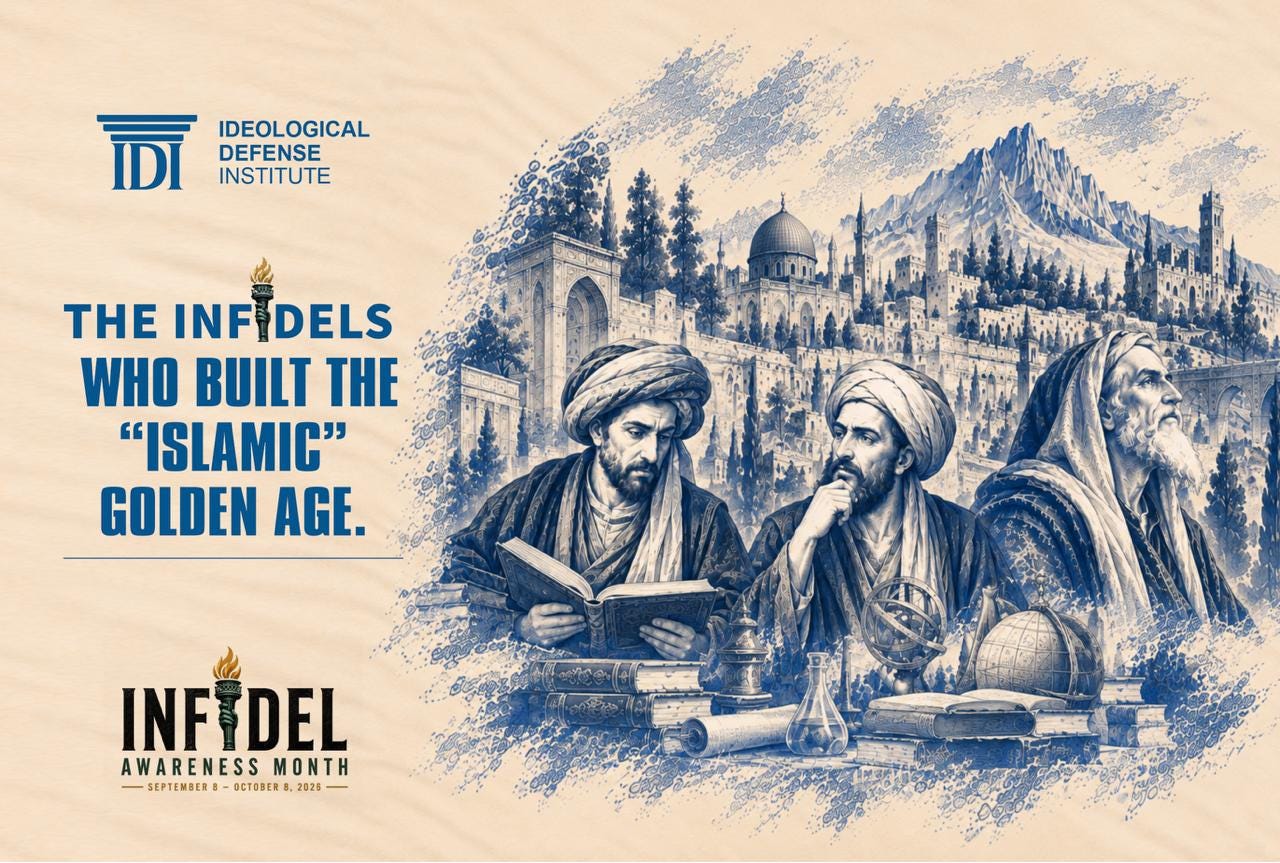
Mainstream history books often paint the medieval Arab world as a place of absolute, unbroken religious faith. Islamic writings from the past routinely reinforce this image, carefully burying or ignoring the voices of those who dared to question orthodox dogmas. Yet the historical reality is far more complex. Beneath the surface of the medieval Islamic world, especially between the second and fourth centuries of the Hijra, a vibrant, daring movement of freethought took root.
In the West, historical atheism is often defined by the rejection of God himself, an idea that runs from Enlightenment deism through to Friedrich Nietzsche’s famous phrase “God is dead,” and still animates titles like God: The Failed Hypothesis and The God Delusion today. Medieval Arabic freethought took a different path. Its primary target, in many cases, was not divinity but the concept of prophecy, since prophecy was viewed as the only bridge connecting humanity to God, and denying the prophets meant severing the path to revealed religion itself for those who did.
This intellectual rebellion was fueled by a fierce dedication to human reason, humanism, and intellectual freedom. Thinkers, scientists, and poets boldly prioritized logic over tradition. In response, orthodox religious scholars and nervous political rulers fought back with a weapon that remains powerful to this day: accusations of heresy (zandaqa), deviance (ilḥād), and infidelity. For many of the greatest minds of the Islamic Golden Age, choosing intellectual freedom meant risking exile, censorship, or a brutal death.
Virtually all of the most radical writings produced by these freethinkers were lost or deliberately destroyed. What survives of their arguments reaches us primarily through the quotations, summaries, and refutations composed by their orthodox opponents. While these hostile sources preserve invaluable fragments, they may exaggerate, distort, or selectively present the original ideas. Historians must therefore reconstruct these positions with caution, always mindful that the loudest surviving voices are those of the accusers. Where complete works or poetry remain, they offer a clearer window; where only hostile reports exist, we proceed carefully.
The Translation Movement and the Spark of Reason
To understand why freethought flourished between the second and fourth centuries AH, one must look at the Abbasid Translation Movement.
During this era, Islamic rulers, most notably the Caliph al-Maʾmūn, funded a massive project to translate Greek, Persian, and Indian scientific and philosophical texts into Arabic. Scholars working across Baghdad, often loosely associated with the palace library known as the House of Wisdom (Bayt al-Ḥikma) though the effort was never confined to a single institution, rendered the works of Aristotle, Plato, Euclid, and others into a language that had never carried them before.
This movement handed a generation of brilliant intellectuals an entire foreign philosophy, and with it the tools of formal Greek logic. Armed with these tools, thinkers began to ask difficult questions, and the study of Islam itself began to change shape in Arabic. Strict logic could now be applied not only to science but to the nature of God, the necessity of prophets, and the truth of holy texts, in ways earlier generations had no vocabulary for. What started as a state-sponsored science project quickly became the intellectual foundation for medieval freethought.
in the late eleventh century AD (The fifth century AH) Al-Ghazālī, a Muslim scholar, grew deeply alarmed by the influence of Greek philosophy over Islamic intellectuals. To check this trend he wrote his most famous book, The Incoherence of the Philosophers (Tahāfut al-Falāsifa). In it he systematically attacked the ideas of the rationalist thinkers. The Tahāfut is a serious, technically demanding work of philosophical argument in its own right, and its critique of causality in particular is still studied today on its own philosophical merits, independent of the political uses the book was later put to.
Al-Ghazali declared three specific philosophical beliefs to be acts of total apostasy (kufr):
Believing the universe is eternal and has no beginning. Believing that God knows only universal truths, not particular details about individuals. Believing that only human souls are resurrected after death, not physical bodies.
By labeling these ideas as infidelic, al-Ghazālī’s book supplied orthodox scholars and rulers with powerful theological justification for censoring, banning, and persecuting rationalist thinkers. Its long-term impact on speculative philosophy in the eastern Islamic world was profound, even if philosophy continued in other regions and later traditions.
Profiles of the Infidels of Islamic History
1. Ibn al-Muqaffaʿ
Rūzbih ibn Dādūyeh, a Persian translator and writer, lived through both the Umayyad and Abbasid caliphates. Upon converting to Islam he took the name ʿAbd Allāh and became known as Ibn al-Muqaffaʿ (”son of the shriveled-handed”) because his father had been punished by the governor al-Ḥajjāj, who beat his fingers until they became crooked.
His most famous work is Kalīla wa Dimna. Originally Indian (Sanskrit), it had been translated into Middle Persian; Ibn al-Muqaffaʿ rendered it into Arabic and added material of his own.
His end was tragic. He had a bitter dispute with Sufyān ibn Muʿāwiya, the governor of Basra under the Abbasid Caliph Abū Jaʿfar al-Manṣūr. Ibn al-Muqaffaʿ mocked Sufyān’s large nose, greeting him with “Peace be upon you both,” meaning the man and his nose. When Sufyān’s patience ran out he ordered an oven lit and had Ibn al-Muqaffaʿ cut to pieces limb by limb and thrown into the fire while still alive. As he died, Sufyān told him: “I have no qualms about mutilating you, for you are a heretic who has corrupted the people.”
The primary textual basis for his skepticism appears in the “Bāb Barzūyeh” (Chapter of Barzawayh) in Kalīla wa Dimna. There the narrator states:
“I found many religions and sects… but I found none among them who did not exaggerate in praising their own religion and condemning the religion of those who differed from it. And I found no justice or truth among them that a rational person could recognize and accept.”
Because of this passage, the later Caliph al-Mahdī, who actively persecuted heretics, remarked that he never saw a book of heresy whose roots did not refer back to Ibn al-Muqaffaʿ. By applying reason, Ibn al-Muqaffaʿ refused to submit to any dogmatic religion, holding that good conduct toward people was sufficient. He was killed at the age of thirty-six.
2. Ibn al-Rāwandī
Ibn al-Rāwandī was heavily influenced by his mentor and close friend, the skeptic Abū ʿĪsā al-Warrāq. Virtually all of their original writings were lost or deliberately destroyed. Their radical opinions survive because opponents quoted them in order to refute them. The most important surviving fragments of Ibn al-Rāwandī’s Kitāb al-Zumurrud (The Book of the Emerald) come from the Ismaili Majālis of al-Muʾayyad fī l-Dīn al-Shīrāzī and from al-Khayyāṭ’s Kitāb al-Intiṣār.
Originally mainstream theologians, both men eventually rejected the necessity of revealed religion. Al-Warrāq criticized the logic of religious dogmas and miracles. Ibn al-Rāwandī’s Emerald directly questioned prophecy. One of the best-attested fragments (the so-called “Brahmin dilemma”) runs:
“The Brahmans say: for us and for our adversaries it is certain that reason (ʿaql) is the greatest benefit from God for his creatures… Therefore, if the messenger has come to confirm good and evil, duty and prohibition already provided by reason, then we can omit to care about his authority… But if his message contradicts the judgement on good and evil according to reason, then we do not need to believe in his prophecy.”
Other fragments attack Islamic ritual, prayer, ritual washing, throwing stones, circumambulating a house that “does not hear or see,” as actions not required by reason, and mock the selective intervention of angels at the battle of Badr versus their absence at the battle of Uḥud. Scholars continue to debate the exact dialogue structure of the Emerald, yet the radical critique of prophecy is consistently attributed to him by both Muʿtazilī and Ismaili opponents.
3. Abū Bakr al-Rāzī
Al-Rāzī is considered one of the greatest scientists of the Golden Age; some describe him as the greatest physician of all time. His encyclopedic Al-Ḥāwī fī l-Ṭibb remained a primary medical reference in Europe for centuries.
His philosophical work, however, earned him accusations of atheism and heresy. His critical books On the Tricks of the Prophets (or On the Stratagems of Those Who Claim Prophecy) and related treatises were destroyed. What we know of them comes chiefly from the hostile report of the Ismaili Abū Ḥātim al-Rāzī, who recorded a public debate. According to that account, al-Rāzī argued that reason is given equally to all, that God would be unjust to single out only some for useful knowledge, that prophets contradict one another, and that miracles are the tricks of charlatans.
In his surviving Spiritual Medicine (Al-Ṭibb al-Rūḥānī) he praises the intellect in terms that make prophecy appear superfluous:
“The Creator… gave us reason and bestowed it upon us… it is the greatest of God’s blessings upon us… and through it we attained knowledge of the Almighty Creator. Reason is the thing without which our state would be the state of wild beasts, of children and lunatics.”
Modern scholars remain divided. Some accept the radical portrait drawn by Abū Ḥātim; others argue that al-Rāzī was a severe internal critic who still operated within a theistic framework. The tension between the surviving moderate works and the hostile reports of the lost ones is itself part of the historical record.
4. Abū al-ʿAlāʾ al-Maʿarrī
Al-Maʿarrī was a brilliant blind Syrian poet and philosopher. Blinded early by smallpox, he withdrew from society and called himself “the prisoner of the two prisons” (his blindness and his house). He was a strict vegetarian who spoke out against the suffering of animals.
Unlike most of the others, substantial portions of his own verse survive, especially in the Luzūmiyyāt. He did not deny a Creator, yet he systematically mocked the contradictions of theology and the claims of the prophetic religions. Among the best-known lines:
“The inhabitants of the earth are of two sorts: those with brains but no religion, and those with religion but no brains.”
And:
“Wake up, wake up, you misguided ones… for your religions are but a trick of the ancients.”
He asked pointedly whether the women of the Romans had been made lawful for the Arabs “except by the rulings of the prophecies,” and he requested a bitter verse for his gravestone:
“This is what my father did to me… and I did not do anything to anyone.”
His poetry remains one of the most extensive and direct surviving expressions of religious skepticism from the period.
5. Jābir ibn Ḥayyān
Jābir ibn Ḥayyān, remembered as the “father of chemistry” and credited with among the first systematic approaches to the science, may not have existed at all, at least not as a single person. Mainstream scholarship, following the philologist Paul Kraus, doubts that one historical Jābir ever lived, and generally attributes the large body of writing under his name to a school of alchemists writing roughly a century after his supposed death. Whoever stood behind the name, the corpus was influential enough that Islamic scholar Ibn Taymiyya later felt the need to attack it in his Majmūʿ al-Fatāwā, claiming that even if Jābir’s existence could be proven, one would only have proven “that he was a great magician in this religion, who worked with alchemy, chemistry, magic, and talismans.” The charge is late but it shows how mainstream Islam viewed scientific innovation as heretical.
6. Al-Fārābī / Alpharabius
Known as “the Second Teacher” (after Aristotle), al-Fārābī was a master of logic and philosophy. He argued that a prophet’s knowledge is imaginative and revealed, while a philosopher’s knowledge is received through the pure active intellect, making the philosopher’s knowledge superior in its intellectual character. Ibn Taymiyya declared him an infidel for claiming the philosopher more perfect than the prophet.
7. Ibn Sīnā / Avicenna
A legendary physician and polymath, Ibn Sīnā wrote The Canon of Medicine, and dictated an autobiography late in life to his student al-Jūzjānī describing a self-taught mastery of logic, physics, and medicine by his late teens. By his own account he read Aristotle’s Metaphysics forty times without grasping it, until he came across al-Fārābī’s commentary on the work, at which point it suddenly made sense. Because his philosophy leaned heavily on this philosophical inheritance, he maintained that the universe is eternal and that bodies do not physically rise on the Day of Resurrection. Al-Ghazālī officially declared him an apostate (kāfir) for these cosmological views; Ibn Qayyim al-Jawziyya later labeled him “the head of the atheists.”
8. Al-Kindī / Alkindus
The “founder of Arab-Islamic philosophy,” al-Kindī enjoyed royal patronage under open-minded caliphs but lost everything under al-Mutawakkil, who persecuted intellectuals. Rivals, the Banū Mūsā brothers, maneuvered him out of favor at court; al-Mutawakkil had him flogged and his personal library, known as al-Kindiyya, confiscated and handed to his rivals, only returning it near the end of his reign. Muslim scholars condemned him for asserting that human reason is the ultimate means of approaching God. He was declared an infidel and dismissed as a “misguided astrologer.”
9. Ibn Rushd / Averroes
Famous for his commentaries on Aristotle, Ibn Rushd argued in The Decisive Treatise (Faṣl al-Maqāl) that if the apparent sense of holy texts contradicts demonstrative reason, the texts must be interpreted metaphorically rather than the reasoning rejected. His Incoherence of the Incoherence (Tahāfut al-Tahāfut) is a direct, point-by-point reply to al-Ghazālī’s Incoherence of the Philosophers, answering the earlier attack chapter by chapter. Muslim scholars convinced the sultan that his books were dangerous. In 1195 he was driven from the mosque in Cordoba by an angry crowd, exiled to Lucena, and had his works publicly burned. Scholars such as al-Dhahabī and Ibn Taymiyya condemned him as a heretic who supported atheist philosophers and sought to corrupt the Sharīʿa with Greek philosophy.
10. Ibn al-Haytham
One of the greatest physicists in history and a pioneer of the scientific method, Ibn al-Haytham authored more than two hundred works. According to later biographers, the Fatimid caliph al-Hakim once invited him to Egypt to regulate the flooding of the Nile; after inspecting the river, Ibn al-Haytham concluded the project was impossible, and, fearing the caliph’s famously volatile temper, feigned madness rather than admit failure to his face. He spent roughly a decade confined to his house until al-Hakim’s death in 1021, after which he abandoned the pretense and settled near the Azhar mosque in Cairo, supporting himself by copying manuscripts and teaching until his own death. Some Muslim scholars nonetheless branded him an atheist outside of Islam, and later writers grouped him alongside Ibn Sīnā among philosophers who held to the eternity of the world.
The tragic reality is that many of the scholars, philosophers, and scientists who are praised today as the crowning achievements of the Islamic Golden Age were persecuted during their own lifetimes. Discouraging independent thought, punishing doubt, and attacking the free use of reason were tools actively wielded by medieval orthodox scholars and rulers.
Ask anyone who went through school in Egypt, or almost anywhere in the Arab world, and they will list Ibn Sīnā, al-Rāzī, and Ibn al-Haytham without hesitation as points of pride, and most will never have heard the other half of the story. Two recent issues of Al-Azhar’s own magazine make the point better than any outside critic could. One credits Islamic teachings themselves with guiding scholars like Ibn al-Haytham toward the correct experimental method, against what it calls the sterile rationalism of the Greeks, while listing Ibn Sīnā and al-Kindī alongside him as uncomplicated contributors to that legacy. Another describes Western accounts of these discoveries using the language of “intellectual fraud and scientific piracy,” and calls for restoring credit to their “true, legitimate” discoverers. Neither article mentions that in their lifetime, these men were ruled as infidels and heretics.
So who invented circuses and vaudeville and comic books?