


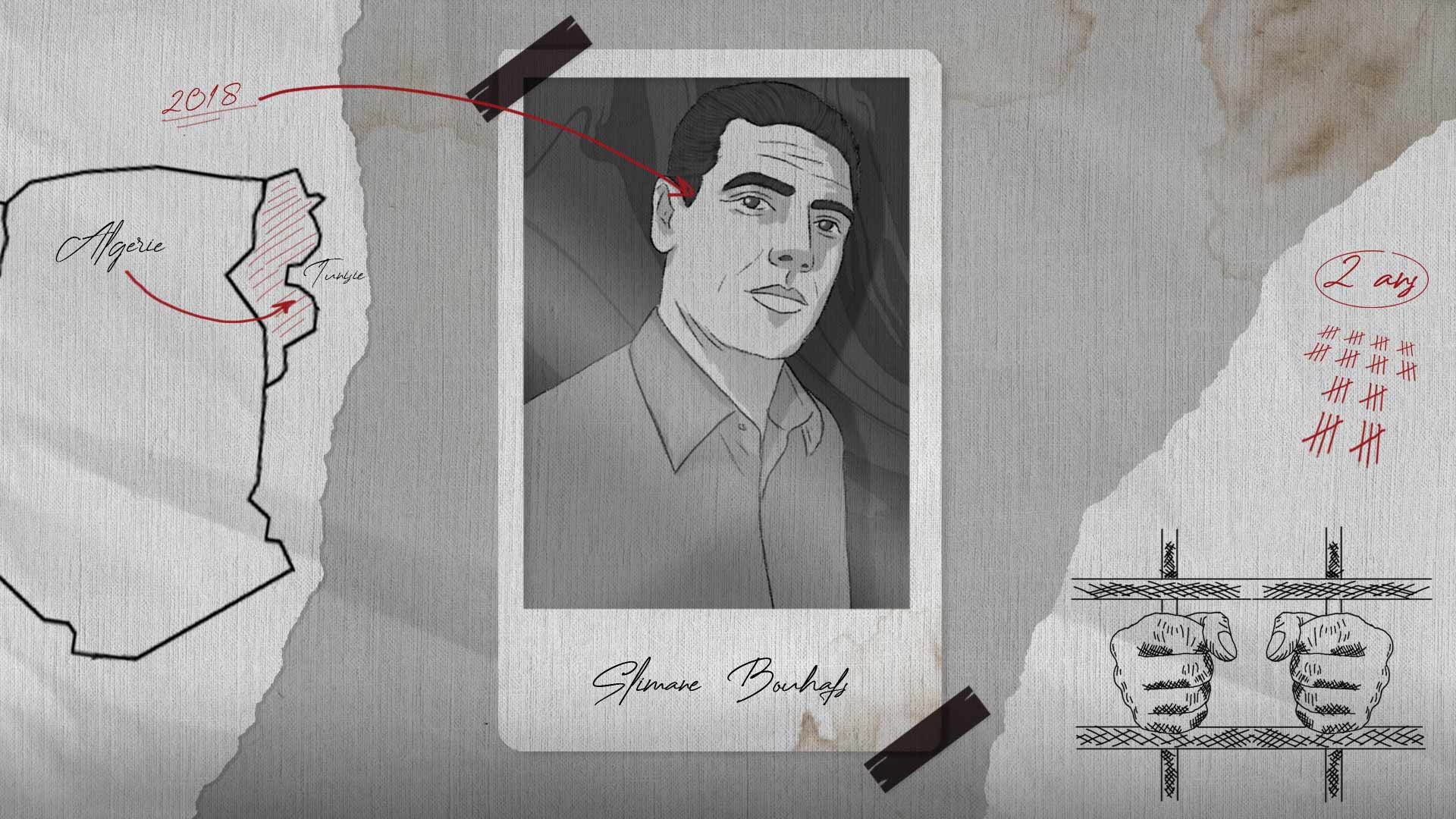
The Christian and Amazigh activist, Slimane Bouhafs, is a target of Algeria’s repressive system that uses blasphemy laws to silence Christians and critics of Islam. On 6 March 2026, Algerian authorities for the second time arbitrarily prevented Bouhafs from leaving the country. According to the news website Tamurt, Bouhafs wanted to travel to find some peace and “escape the pressure, daily harassment, and surveillance of the security forces.”
This was the latest rights violation that Bouhafs has experienced in his country for his Christian faith and political views.
A former Muslim who converted to Christianity in 1997, and the former Chairman of the St. Augustine Coordination of Christians in Algeria, Bouhafs has lost his civil rights due to his religious conversion and his defense of minority rights and freedom of religion.
In a 2026 report titled “the Oppression of Christians in Algeria,” the European Center for Law and Justice (ECLJ) details Bouhafs’ case:
“In 2016, Bouhafs was arrested for simple Facebook posts considered as an “attack on Islam and its Prophet.” Specifically, it was stated that he “shared four altered Quranic verses, offensive images of the Prophet, as well as articles denigrating the Islamic religion.”
Following proceedings (which were marred by irregularities), he was sentenced to three years imprisonment. His fragile health in detention and the conditions of his imprisonment prompted international mobilization, leading to his early release in July 2018 following a partial presidential pardon.
Fearing further prosecution, he left Algeria and took refuge in Tunisia, where he was granted refugee status in 2020 by the United Nations High Commissioner for Refugees. Despite this international protection, in August 2021 he was abducted in Tunis and returned to Algeria. He was then tortured and placed in pre-trial detention for “membership in a terrorist organization” and “undermining national territorial integrity.”
He was sentenced again to three years in prison. Since September 2024, having served his sentence and being officially a free citizen, his situation has remained very difficult.
In February 2025, he issued an appeal for help:
“I have become stateless, in my own country of Algeria. I have no identity documents. I am deprived of all my rights. The Algerian authorities refuse to issue me documents proving my identity. Even my retirement pension has been withdrawn. I am issuing a distress call to all international bodies and to all people of goodwill to come to my aid.”
Christians effectively have no freedom of expression in Algeria, notes ECLJ. Christians or ex-Muslims in the country face arrests for various offences such as the mere expression of Christian faith, the publication of a prayer, evangelization speech, or statements criticizing or mocking Islam or its prophet:
“Any expression of Christian faith may be regarded as an attempt to “undermine the faith of a Muslim” or as an offence against the precepts of Islam and may result in prosecution. Judicial repercussions and arrests mainly affect evangelicals, whose more visible practices are more likely to attract the authorities’ attention. Catholics, however, are not spared, despite their choice to practice their religion with great discretion.”
An Algerian convert to Catholicism told ECLJ:
“I was working with Mother Teresa’s sisters in Algiers, and one day I was summoned by the police and questioned for several hours because I was accused of proselytism. They had an entire file on me, with photos of me at church and with the children I was caring for.”
According to the 2026 report by Open Doors, more than 50 Algerian Christians have been prosecuted in recent years, with some receiving suspended prison sentences and fines for reasons related to Christian practice: “unauthorized worship,” “organizing a place of worship without a permit,” distribution of religious materials,” or “proselytism.”
According to the organization the Voice of the Martyrs, at least 64 Algerian Christians are awaiting trial for activities related to their faith.
Article 144 bis 2 of the Penal Code, introduced by a law promulgated on 26 June 2001, punishes “anyone who offends the Prophet and the messengers of God or denigrates the dogma or precepts of Islam.” This offence is punishable by 3 to 5 years’ imprisonment and a fine. It may be committed by any means: “in writing, drawing, statement, electronic means or any other medium.”
Meanwhile, all Protestant churches have been shut down by the Algerian government. The ECLJ notes that the 2006 Ordinance 06-03 and the 2012 Law on Associations impose a strict authorization regime for the exercise of non-Muslim worship. The result is that it is difficult to open places of worship or register religious associations.
Since 2006, 58 Protestant churches have been forced to cease their activities and have been closed by the authorities. Protestants are now deprived of freedom of worship in Algeria. They are compelled to gather in private homes, outdoors, or online.
But even then, they cannot freely worship. Pastors and members of evangelical churches risk prosecution when they gather. During a police raid in April 2025, following a religious service held on Good Friday, ten Christians were detained for nine hours. They were interrogated, photographed, and their phones were confiscated.
A high-profile case demonstrating the pressures faced by Algerian Christians is of Pastor Youssef Ourahmane, the Vice-President of the Protestant Church of Algeria. The pastor organized a spiritual retreat at a site containing a chapel that had been closed by the authorities. For this, he was accused of “holding an unauthorized religious service” in a “building not permitted for that purpose.” On 2 May 2024, the Tizi Ouzou Court of Appeal upheld his conviction, sentencing him to one year’s imprisonment, six months suspended, and a fine of 100,000 dinars.
Similarly, Pastor and bookseller Rachid Seighir, along with his assistant Nouh Hamimi, were sentenced on appeal on 6 June 2021 to one year’s suspended imprisonment and a fine of 200,000 dinars for distributing Christian books in their bookshop.
The ECLJ gives brief historical background information regarding the Christian roots of Algeria. From the second century onwards, North Africa became one of the major intellectual centers of Christianity and was predominantly Christian. In 680, Islamic armies invaded the territory of present-day Algeria under the leadership of Uqba, a companion of Muhammad. The subsequent Arab conquest of the Maghreb was followed by a process of Arabization, which took centuries to take hold. For a considerable period, significant Christian communities persisted throughout the Maghreb, particularly in Kabylia, which was resistant to Islamization. It was not until the 13th century, under the Almohads, who tightened Islamic religious norms, that Christianity almost completely disappeared.
Christianity returned to Algeria in 1830 with the arrival of French settlers and missionaries. A significant Christian minority from Europe subsequently formed in the cities, where churches, schools, and hospitals were built. The Catholic Church thus became an official and influential institution.
Algeria’s declaration of independence in 1962 and the exodus of the Pieds-Noirs (people of European descent born in Algeria during French rule of 1830–1962) as well as the vast majority of Algerians who had converted to Catholicism led to the near disappearance of this Christian presence, which still numbered close to one million Christians in 1950.
The Catholic Church was then reduced to a church tolerated by the Algerian State, with no missionary role. It was allowed to continue to exist, but its status became highly regulated. In 2022, Caritas, the charitable arm of the Catholic Church which served the entire population of Algeria, was closed by the authorities.
According to figures from Open Doors, the current population of Christians in Algeria is approximately 156,000. This is a huge decrease from the nearly one million Christians in 1950.
In Algeria, the choice for citizens is often described as “the mosque or the court.” And all this is happening in a formerly majority-Christian country.
The Western churches and governments should take this history as a lesson as to what might be awaiting them if the current tide of Islamization is not stopped in the West. They should also take concrete action to help Bouhafs, Ourahmane, and other Christians persecuted in Algeria.
Uzay Bulut is a fellow at the Ideological Defense Institute.
What Is IDI ?
The most trusted source of information on the Middle East, Islam, and the ideological threats facing the West.
Subject-matter experts, former Muslims, Arab Christians, and Western thought leaders, coming together to equip policymakers to prevent destructive foreign ideas from being translated into law, restore confidence in the biblical principles that built the West by empowering the Church to reengage the public square, and provide the public with solid analysis to combat the confusion that is making the West vulnerable.
I wish whoever writes this would suggest ways readers could help these prisoners in Algeria or anywhere else! Even political activism would be good - if not sending money - I guess I can pray - I'll do that... ???