


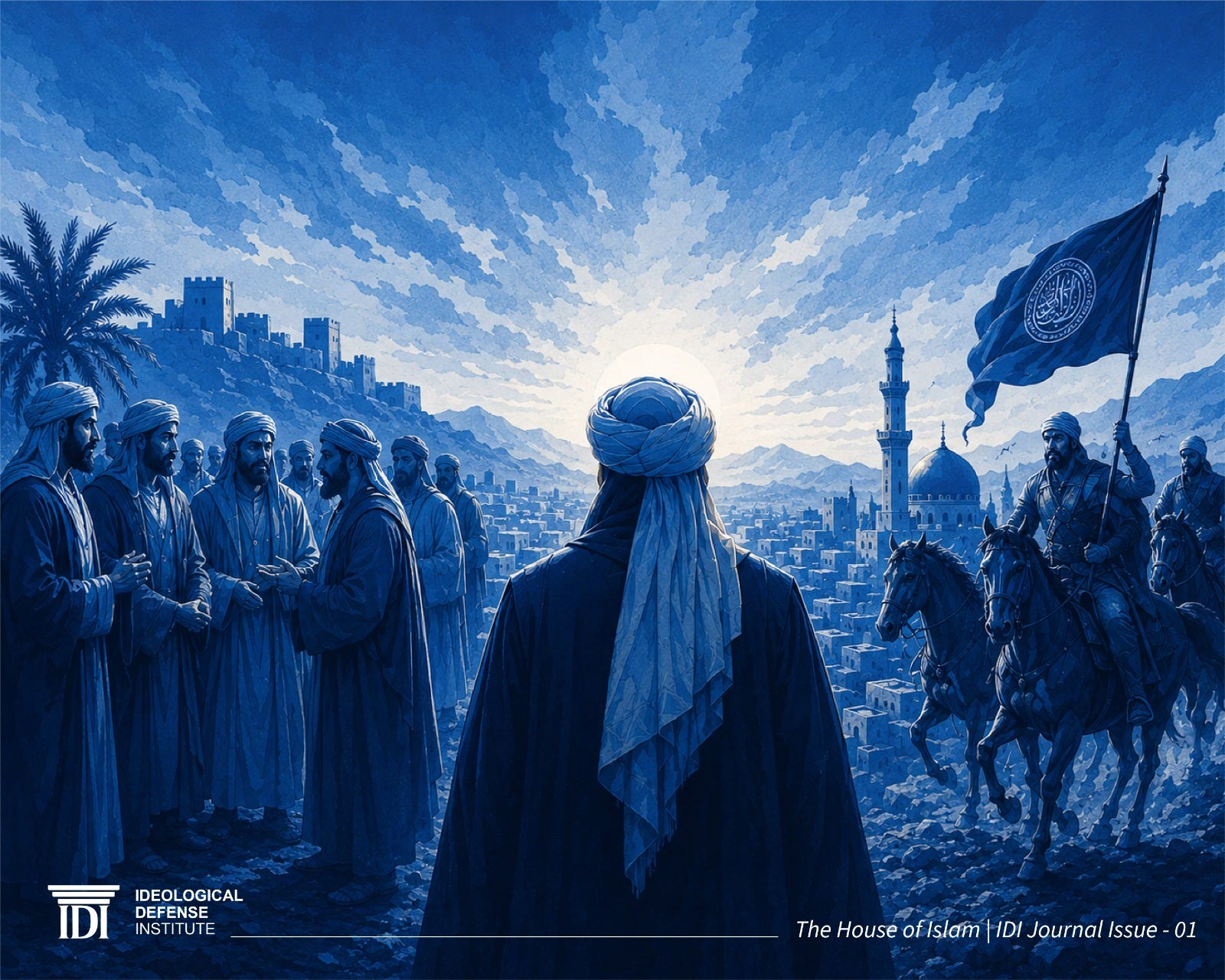
Muhammad’s migration from Mecca to Yathrib in 622 CE, the Hijra that marks the beginning of the Islamic calendar, was preceded by thirteen years of increasingly dangerous tension in Mecca. His followers had disparaged the Nabataean gods and goddesses, calling for the destruction of the idols housed in the Kaaba. The religious offense was inseparable from an economic one: Mecca, situated in an arid valley with no agricultural capacity, depended entirely on pilgrimage and caravan trade. Pilgrims brought offerings to the shrine; Meccan merchant caravans reached as far as Yemen and Syria. The destruction of the idols, as Muhammad demanded, threatened to end the pilgrim traffic and alienate Arab tribes throughout the region on whose goodwill the trade routes depended.¹
The town of Yathrib offered an escape from this impasse. At eleven camel-days distance from Mecca, Yathrib’s oasis had been settled by Jewish communities in two distinct migrations: the first following the Babylonian Exile in 586 BCE, the second after the Roman sack of Jerusalem in 70 CE.² Approximately two centuries before Muhammad’s arrival, a dam collapse in Yemen had driven a clan led by the matriarch Qayla northward to Yathrib with her two sons, Aws and Khazraj, and their extended families. By Muhammad’s time, their competition for dominance had deteriorated into sustained civil war. Yathrib’s Jewish clans, having taken sides with one Arab faction or the other, found themselves drawn into the same conflict, Arab fought Arab and Jew fought Jew at the Battle of Bu’ath, with only the Nabataean tradition of sacred months providing a fragile truce.³
It was against this backdrop of exhaustion that representatives of both Arab factions approached Muhammad at Mecca with a specific proposal. They needed a neutral arbitrator, a third party with no local loyalties who could settle disputes and bring peace. “Maybe God will unite us through you,” one representative told him. “We shall tell our people to accept your religion, and if God gathers them together around you, no man will be more powerful than you.”⁴
Upon reaching Yathrib, Muhammad established the Pact of Medina with the settlement’s five major communities: the Arab clans of Khazraj and Aws, and the three main Jewish clans, the Qaynuqa, the Nadir, and the Qurayza. The Pact, preserved most fully in Ibn Hisham’s recension of Ibn Ishaq’s Sira, consisted of two distinct sections.⁵ The first established the Muslim community, both the Emigrants from Mecca and the Medinan Arabs, as a single political entity with binding rules: no believer was to avenge an unbeliever against a believer; believers were friends to one another to the exclusion of outsiders; and, the provision whose structural significance would become apparent immediately, all disputes were to be referred to “Allah and His Messenger.” This clause placed Muhammad at the apex of Medina’s judicial system from the first day of his arrival.
The second section addressed the Jewish clans. The Jews were to have “the right to help and equality.” The Jew was “not to be wronged, nor his enemy aided.” The Jews would “have their religion and the Muslims theirs.” The city and its surrounding oasis would be “a sanctuary for all parties to the pact.” Disputes would be referred to “God and to Muhammad the Apostle of God.”⁶
Within a decade, Muhammad had exiled two of these three Jewish clans and massacred the third. The Pact’s provisions for the Jews were not a durable framework for coexistence, they were a transitional instrument that served his purposes until the power differential made them unnecessary.
THE JEWISH TRIBES OF MEDINA

