


Muslims insist that Islam is the purest, most uncompromising form of monotheism, the very standard by which they condemn Christians for worshipping the Trinity and Jews for allegedly elevating Uzayr (Ezra) to divine sonship, a charge that has no footing in Jewish texts or history. Muhammad, it seems, needed to invent that particular slander to make the accusation stick.
But the claim that Islam alone delivers untainted monotheism weakens first when we notice how completely Muhammad has, in practice, eclipsed Allah in the hearts and daily devotions of Muslims. It shatters again when we examine where Islamic rituals actually came from.
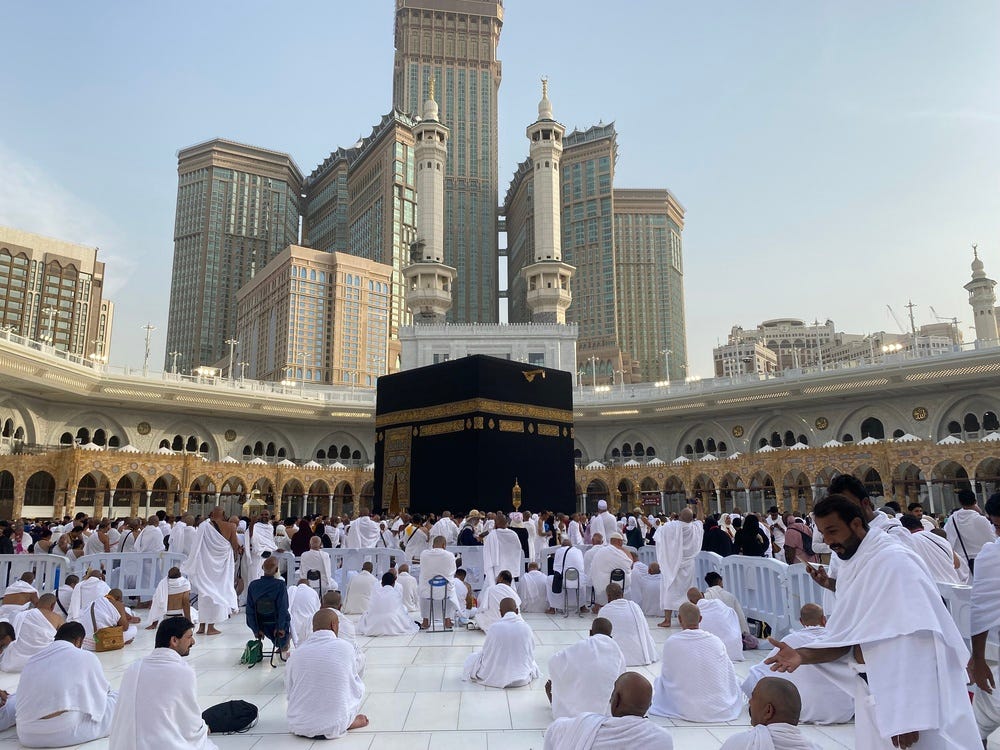
Yesterday the Islamic pilgrimage season ended, hundreds of thousands of men and women pressing in suffocating waves around the Kaaba, bodies climbing over bodies, hands clawing toward a single black stone set in silver, lips and foreheads desperate to touch it. What is the origin of that chaos?
Identity Theft
Allah was never the invisible, transcendent, jealous, one-and-only Creator who thundered from Sinai and sent prophets to Israel. That was never his face in pre-Islamic Arabia. He was already on the scene, centuries before Muhammad, as a fixture in the Meccan pantheon: a high god, sure, but a pagan high god, enthroned above a family of lesser deities, daughters, consorts, and intercessors who handled the day-to-day divine dirty work. Islam didn’t discover Allah. It hijacked him. It stripped the polytheistic fingerprints, slapped on borrowed Abrahamic rhetoric, and marketed him to the world as the same God who spoke to Moses, drowned Pharaoh, and fathered Jesus through the Holy Spirit. This was one of the most audacious theological identity thefts in human history.
In Jahili Mecca, Allah was never solitary. The Quran, trying to score points, accidentally confesses time after time that the Quraysh and their neighbors already confessed Allah as creator of the heavens and earth, sender of rain, reviver of the dead, controller of destiny (29:61; 31:25; 39:38). But they “associated” partners with him, daughters, helpers, intercessors, exactly the way every ancient Near Eastern polytheist had done for three thousand years: El in Canaan had Asherah and a divine council; Baal-Shamem in Syria had his consort and attendants; Zeus Hypsistos in the Hellenistic world had a whole heavenly bureaucracy. The Meccans were textbook henotheists: one boss god at the top, a loyal supporting cast underneath, and Allah was their undisputed kingpin.
Muhammad didn’t unearth some buried, forgotten monotheistic Allah who had been hiding under pagan rubble, waiting for the true revelation. He seized the existing pagan high god, the one the Quraysh already called creator, lord of the Kaaba, master of fate, and forcibly grafted Biblical clothing onto him. He kept the name Allah. He kept the Kaaba. He kept the Black Stone. He kept the sevenfold ṭawaf. He kept the sacred months. He kept the talbiya chant’s hypnotic rhythm. Then he wrapped the entire stolen package in Abrahamic camouflage: “This is the pure religion of Abraham the ḥanif.” Except Abraham never stepped foot in Mecca. Abraham never laid a single stone of the Kaaba. Abraham never kissed a meteorite fragment. Abraham never acknowledged a high god named Allah who came with three daughters named al-Lāt, al-Uzza, and Manat.
The Biblical God smashed golden calves, cursed high places, and declared, “I am the LORD, and there is no other; besides me there is no god” (Isaiah 45:5).
Mecca’s Monopoly on Pagan Pilgrimage
The Kaaba wasn’t unique in pre-Islamic Arabia. It was one Kaaba among many, dozens of cube-shaped shrines scattered across the peninsula, each serving as a local or regional cult center. Khalil Abd al-Karim, in his The Historical Roots of Islamic Sharia, counts at least twenty-one documented Kaabas before Islam. Other sources (al-Yaqubi, al-Maqrizi, Ibn al-Kalbi) name prominent ones: the Kaaba of Najran (dedicated to a palm-tree deity), the Kaaba of Dhu l-Khalṣa in Yemen (for the southern tribes), the Kaaba of al-Uzza in Nakhlah, the Kaaba of Manat near Medina, and several others tied to tribal gods like Wadd, Suwa, Yaghuth, Yauq, and Nasr (mentioned in Quran 71:23 as Noah’s idols, but still active in late Jahiliyya). Each had its own custodians (sadana), its own sacred precinct (ḥaram), its own pilgrimage season, its own sacrifices, and its own circumambulation rites. They were miniature versions of what Mecca became: sacred cubes housing stones, idols, or baetyls, drawing pilgrims who shaved heads, offered animals, and performed tawaf.
What made Mecca’s Kaaba special, and ultimately unbeatable, was not divine revelation. It was location and economics. Mecca sat at the crossroads of the most lucrative caravan routes in late antiquity: incense from South Arabia (Yemen, Hadramawt) heading north to Gaza and Damascus; spices, silk, and slaves moving south from the Levant and Mesopotamia; African gold and ivory funneled through the Red Sea ports. The Quraysh tribe turned the Kaaba into the peninsula’s premier franchise. They declared four sacred months (Rajab, Dhu l-Qada, Dhu l-Ḥijja, Muharram) during which all intertribal warfare was forbidden, creating the only safe corridor for commerce across a fractured landscape. Pilgrims came not just to worship but to trade. The annual fairs at Ukaz, Majanna, and Dhu l-Majas near Mecca were among the largest markets in Arabia. The Kaaba was the brand: a single, prestigious address where every tribe could deposit its god’s representative (an idol or stone), perform the same rites, and do business under truce. By the sixth century, it had become the monopoly hub. Other Kaabas were regional; Mecca’s was continental.
When Muhammad conquered Mecca in 630 CE, he didn’t destroy the Kaaba. He destroyed every other Kaaba he could reach. Ali ibn Abi Talib was sent to demolish Manat at al-Mushallal. Al-Mughira ibn Shuba razed al-Lat’s temple in al-Ṭaif (and, according to al-Kalbi, the site later became the left minaret of the mosque there). Khalid ibn al-Walid led the destruction of Dhu l-Khalsa (the “Yemeni Kaaba”) and al-Uzza’s shrine in Nakhlah. One by one, the rival cubes were smashed, their custodians killed or converted, their sacred stones broken or buried, their pilgrimages outlawed. Muhammad wanted only one Kaaba standing, only one pilgrimage worth making, only one sacred center worth the caravan trade. Muhammad kept the Kaaba of his own tribe, the Quraysh, and sacralized it as the sole legitimate house of God. All the others were declared idols and erased.
The claim that this Kaaba was built by Abraham and Ishmael has no historical or scriptural support outside Islamic tradition. Neither the Hebrew Bible nor the New Testament places Abraham or Ishmael anywhere near western Arabia. Genesis traces Abraham’s movements from Ur to Haran to Canaan to Egypt and back, never south of the Negev. Ishmael is expelled into the wilderness of Paran (near Sinai), fathers twelve princes, and disappears from the narrative. No Jewish, Christian, or pre-Islamic Arab source links either figure to Mecca, the Kaaba, or the Black Stone. The Quran’s assertion (2:125–127) that Abraham and Ishmael “raised the foundations of the House” is a seventh-century retrofit, an attempt to graft Biblical patriarchs onto an existing pagan shrine to give it legitimacy.
Paganism Preserved Step by Step
Islam markets the hajj as the purified pilgrimage of Abraham, monotheism in seven-day motion. But the entire sequence is lifted almost verbatim from pre-Islamic Arabian polytheism. Muhammad inherited these acts from his own tribe and the wider Ḥijazi cultic world, centralized them at Mecca, eliminated every competing shrine, and then insisted they had always been the property of the one true God. The physical movements, the sacred sites, the timing, the blood, the stones, all of it is pagan continuity dressed in monotheistic costume.
Here is the full hajj ritual cycle as practiced today, exposed side-by-side with its documented pre-Islamic roots.
Ihram (ritual consecration) Pilgrims stop at miqat boundary points, perform ghusl or wudu, put on two seamless white cloths (men), forbid perfume, hunting, sex, cutting hair or nails, and begin reciting the talbiya chant (“Labbayka Allahumma labbayk…”): These exact purity rules, sacred months, general truce (no bloodshed), no sexual relations, no hair/nail cutting, special garments, were already enforced by the Ḥums (Quraysh and allied tribes) for anyone approaching the Kaaba or other major shrines. The miqat stations (Dhu l-Ḥulayfa, Yalamlam, etc.) were pre-Islamic pilgrimage gateways. The talbiya chant itself is older than Islam: Ibn Hisham and al-Kalbi preserve pagan versions (“At Your service, O Allah… You have no partner except the partner You have…”), which the Quran criticizes for allowing “association” yet retains in edited form.
Tawaf al-qudum (arrival circumambulation of the Kaaba) Seven counterclockwise circuits around the Kaaba, ideally touching, rubbing, or kissing the Black Stone at the eastern corner: Sevenfold tawaf was the standard act of devotion at the Kaaba and at rival shrines. Pagans circled nude or in special garments; women sometimes wore only a single cloth over the genitals. The Black Stone was one among hundreds of baetyls/ansab, sacred standing stones, often meteorites, believed to embody divine presence or serve as the “hand” of a god. Pilgrims kissed and stroked them exactly as Muslims do now. Umar’s confession, “I know you are only a stone… if I hadn’t seen the Prophet kiss you, I wouldn’t kiss you”, is an unintentional admission that the rite had no inherent monotheistic logic.
Say between al-Safa and al-Marwa Seven trips (walking or jogging) between the two hills inside the Masjid al-Ḥaram, men jogging in the green-lit middle section: The two hills already hosted idols, Isaf on Ṣafa and Naila on Marwa (two lovers petrified by Allah for fornicating inside the Kaaba precinct, per Ibn al-Kalbi). Pagans ran or walked between them, touching or invoking the statues as part of the Kaaba pilgrimage. The Quran retains the exact path but removes the statues (2:158: “There is no sin for you in going between al-Safa and al-Marwa”), turning it into a Hagar story.
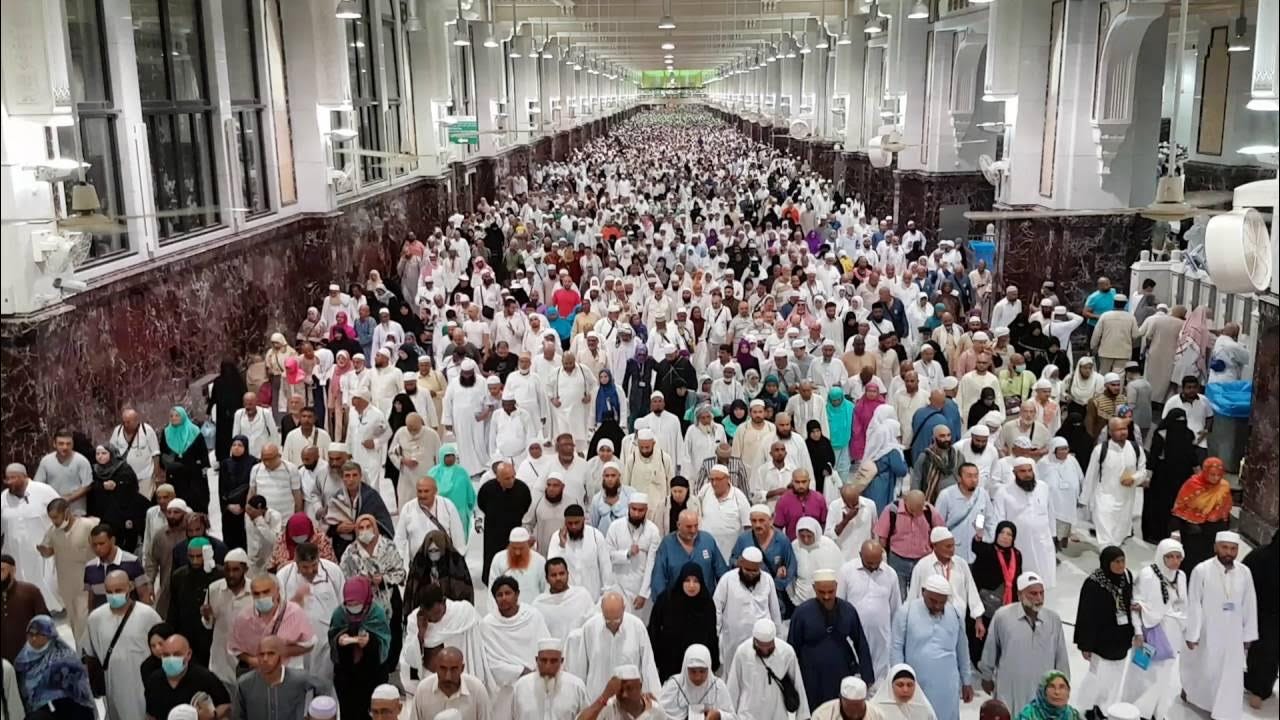
Wuquf (standing vigil) at Arafat Standing on the plain of Arafat from noon to sunset on the 9th of Dhu l-Ḥijja, praying and supplicating, the “peak” of hajj: Arafat was already the central assembly point for pre-Islamic pilgrims. Tribes gathered there during the sacred months, stood in vigil, listened to orators, traded goods, and performed collective rites at the high place. The name derives from “recognition” or “gathering”, pagans “recognized” their deities and renewed tribal alliances there. Ibn Hisham and al-Azraqi confirm it was integral to the Jahili hajj cycle.
Overnight at Muzdalifa Moving to Muzdalifa after sunset, praying maghrib and isha combined, collecting 49–70 pebbles for the next days: Muzdalifa was a pre-Islamic night halt where pilgrims gathered stones for the rami rite and spent the night in the open. Pebble collection was already part of apotropaic (evil-averting) customs across Arabia.
Rami al-jamarat (stoning the three pillars/walls) Throwing seven pebbles at each of three structures (Jamrat al-Aqaba on Eid day, then all three on the following days): Stone-throwing at cairns, pillars, or sacred boundaries was a widespread Arabian rite to drive away jinn, evil spirits, or rival deities. While the exact three-pillar sequence may be Islamic innovation, the act of pelting stones at ritual sites is pre-Islamic Bedouin apotropaic practice.
Nahr / ḥady (animal sacrifice) Slaughtering a sheep, goat, cow, or camel in Mina on the 10th (Eid al-Adha), with meat distributed to the poor: Animal sacrifice was the core of every Arabian cult, offered to Allah, al-Lat, al-Uzza, Hubal, and countless tribal gods at the Kaaba and other shrines. Mina was already a slaughter site during pilgrimage season. The Quran keeps the rite but insists it is directed to Allah alone (22:28–37; 108:2).
Ḥalq or taqṣir (head shaving or hair trimming) Shaving the head completely or cutting a lock of hair to exit ihram: Head-shaving or depilation was standard at the conclusion of pre-Islamic pilgrimage, especially at Manat’s shrine near Medina, where pilgrims shaved to complete their rites. The Quran retains it (2:196).
Other Pagan Footprints
The hajj is the loudest echo of pre-Islamic paganism in Islam, but it is far from the only one. Once you start looking, the traces appear everywhere, small, stubborn survivals that Muhammad either could not erase or chose not to. They were too useful, too familiar, too profitable, or too deeply wired into Arabian identity.
The Crescent Moon & the Lunar Calendar
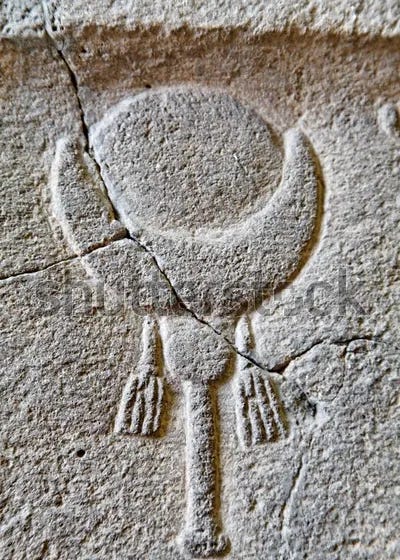
Every mosque in the world is crowned with a crescent moon. Muslims begin and end Ramadan by sighting the new moon. The Islamic calendar is purely lunar, months of 29 or 30 days, no intercalation to match the solar year. Pre-Islamic Arabia was saturated with moon-god veneration. South Arabian kingdoms worshipped the moon. The crescent was already a widespread symbol of divine power in Nabataean, South Arabian, and Mesopotamian iconography. Muhammad kept the lunar calendar, the moon-sighting rule (Bukhari 1909), and the crescent as a visual marker. Today Muslims still greet each other with “Eid Mubarak” under the same crescent their pagan ancestors saluted.
Friday as the Day of Assembly
Muslims gather for the obligatory congregational prayer on Friday (Yawm al-Jumua). Pre-Islamic Arabs, and many Near Eastern cultures, dedicated Friday to the planet Venus (al-Zuhara / Uzza) or, in some traditions, to the moon. Al-Maqrizi records that the seven-day week in ancient Arabia assigned each day to a planet: Saturday to Saturn, Sunday to the Sun, Monday to the Moon, and Friday to Venus. The Muslim Friday prayer replaced pagan planetary devotions with Allah’s name, but the day itself was already sacred.
The Kiswa (Black Covering of the Kaaba)
Every year the Kaaba is draped in a new black silk kiswa embroidered with gold Quranic verses. This is not an Islamic innovation. Pre-Islamic Arabs clothed their idols and sacred stones in cloth, especially black or red fabrics, to honor them.
The Zamzam Well & Sacred Springs
Muslims drink from the Zamzam well inside the Haram and carry its water home as a blessing. Pre-Islamic Arabs revered sacred springs and wells as gifts from their deities. Zamzam was already a pilgrimage focal point in Jahiliyya; pilgrims drank from it for health and blessing.
The Direction of Prayer (Qibla) & the Kaaba’s Centrality
Early Muslims prayed toward Jerusalem for about 16–18 months. Then Muhammad abruptly switched the qibla to the Kaaba (2:144). Why the sudden pivot? Jerusalem was the Biblical holy city; Mecca was the pagan one. The change was political and cultural: it yanked the new movement away from Jewish/Christian gravitational pull, after Jews and Christians rejected Muhammad, and anchored it firmly in Quraysh territory. The Kaaba became the sole direction of prayer for 1.9 billion people, not because Abraham built it, but because Muhammad’s tribe owned it.
The Old Gods Never Fully Left
Islam did not arrive on a blank slate. It arrived in a land thick with shrines, stones, seasons, chants, and blood rituals that had shaped Arabian identity for centuries. Muhammad destroyed the idols, banned the goddesses, outlawed rival Kaabas, and killed or converted their guardians. But he kept the Kaaba, the Black Stone, the tawaf, the say, the standing at Arafat, the stoning, the sacrifice, the shaving, the lunar calendar, the Friday assembly, the covering of the shrine, the sacred well, the crescent symbol, everything that could be repurposed without losing the economic engine or tribal loyalty.
The result is a religion that claims to be the final, uncorrupted monotheism while walking, step by step, through the exact choreography of the pagan pilgrimage it replaced. The hajj s the last pagan procession on earth, only now the worshippers chant one name instead of many. The old gods lost their statues, but they kept the shrine, the stone, the circuit, the blood. And every time a Muslim kisses the Black Stone or circles the Kaaba under the crescent moon, the Jahiliyya whispers: “We never really left.”
Danny Burmawi is the cheif executive of the Ideological Defense Institute.
What Is IDI ?
The most trusted source of information on the Middle East, Islam, and the ideological threats facing the West.
Subject-matter experts, former Muslims, Arab Christians, and Western thought leaders, coming together to equip policymakers to prevent destructive foreign ideas from being translated into law, restore confidence in the biblical principles that built the West by empowering the Church to reengage the public square, and provide the public with solid analysis to combat the confusion that is making the West vulnerable.
The article is broadly right in its main direction. Islam did not appear in Arabia as a pure, self-contained revelation untouched by its surroundings. The Kaaba, pilgrimage, circumambulation, sacrifice, sacred months, Safa and Marwa, Arafat and related practices clearly belong to an older Arabian religious world that Islam retained, purified, renamed and reinterpreted.
But we should be careful not to treat this as a problem unique to Islam. All so-called Abrahamic religions need to be placed back into history. Judaism developed over time as a legal, moral and social framework for a particular people, with monotheism emerging as an endpoint rather than as the obvious starting position. Christianity grew out of Jewish apocalyptic expectation, then built a theology around Jesus after that expectation failed to arrive in the form anticipated. Islam came later, absorbed Jewish and Christian narrative structures, retained Arabian ritual practice, and declared itself the final correction of both.
The Abraham issue is central. There is no independent historical evidence that Abraham existed as described. He appears as a later foundational figure used to create ancestry, covenant, continuity and authority. Islam’s claim that Abraham built or was connected to the Kaaba is therefore not historical recovery. It is a theological retrofit, taking an already mythic foundation figure and relocating him into Mecca to legitimise an Arabian shrine.
Of course, one can always say there may have been some distant memory behind the Abraham story. But that is not evidence; it is a permission slip for speculation. By that standard, Abraham may as well have been Abracadabra, a wandering Bronze Age magician whose camel had strong theological opinions.
So yes, the article gives a reasonable explanation of Islam’s pagan inheritance. But the wider point is larger: religions regularly turn later stories into sacred history. Islam did this with Mecca and Abraham, Christianity did it with Jesus, and Judaism did it with its ancestral narratives. The difference is not that one tradition is historical and the others are fiction. The difference is how each tradition constructed authority, identity and continuity from the materials available to it.
This is very interesting esp the bit about the black stone.