


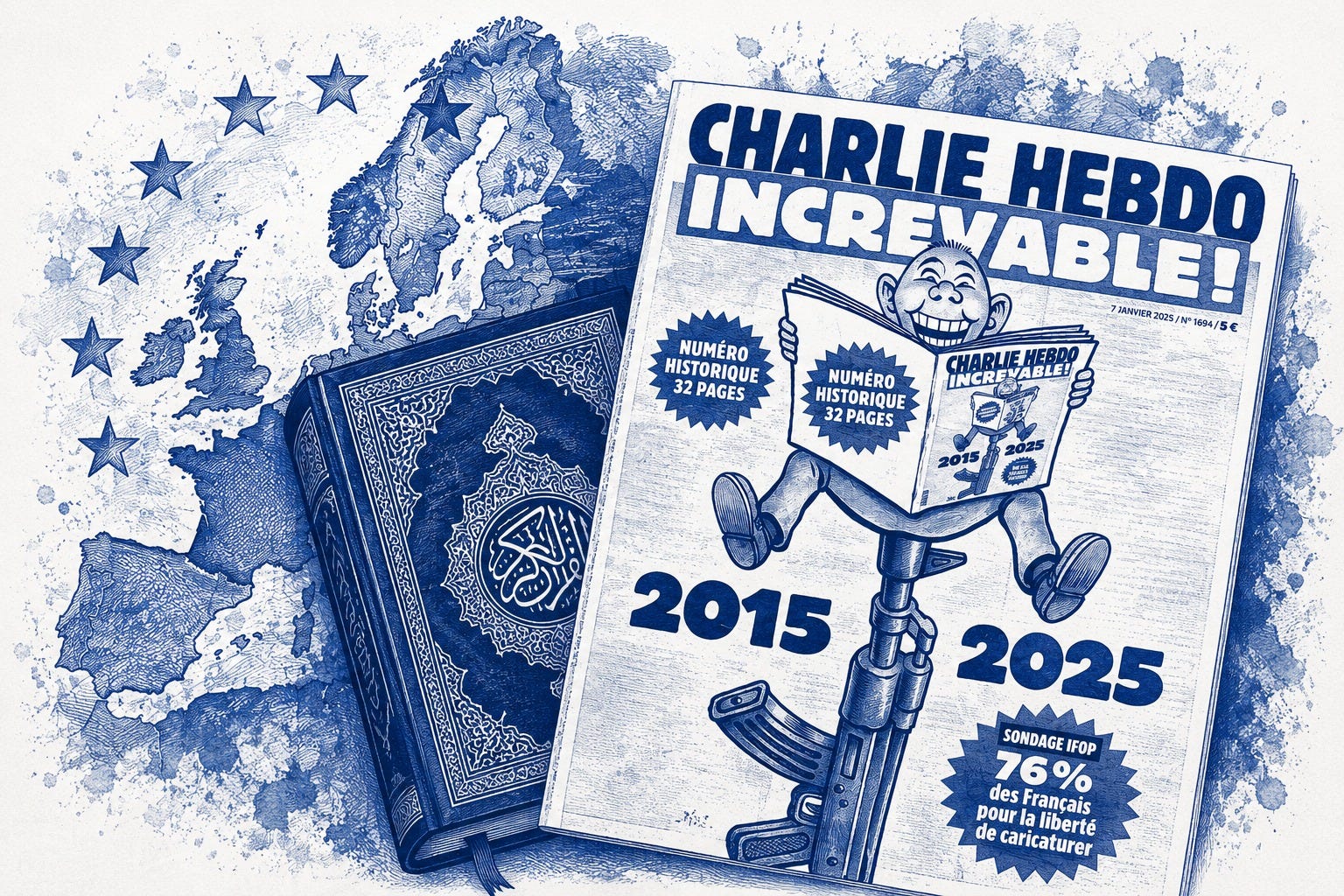
On the morning of January 7, 2015, two brothers walked into the offices of a satirical magazine in Paris and killed twelve people over a cartoon. Before they opened fire, one of them announced why they had come: the magazine had drawn the Prophet, and they were there to enforce the law. France guarantees the right to mock a prophet, but the law the brothers carried into that building punishes the act with death.
The reflex, every time, is to call this a problem of integration, or a few extremists who have misread their own religion. It is neither. It is two legal orders, each coherent on its own terms, returning opposite verdicts on the same act, and the gap between them is structural.
The Western doctrine is simple to articulate. The state holds no opinion about which ideas are true. It may not punish speech for its content, only for a narrow band of harms: incitement to imminent violence, fraud, defamation of a private person. The American text says, “Congress shall make no law… abridging the freedom of speech.” From Schenck in 1919 through Brandenburg in 1969 to Snyder v. Phelps in 2011, the Supreme Court has treated the protection of offensive, blasphemous, and hated speech as the entire point of liberty. Justice Brennan put it in one line in Texas v. Johnson: government may not ban an idea simply because society finds it offensive.
Europe holds the same core, for now. Article 10 of the European Convention protects the freedom to hold and impart ideas without interference by the state, and the Strasbourg court has ruled, case after case, that criticism of religious doctrine, however provocative, is protected expression.
Islamic law regulates speech about religion through two offenses: blasphemy, sabb Allah, sabb al-rasul, the insulting of God or His Messenger, and apostasy, ridda. Surah al-Ahzab warns that “those who abuse Allah and His Messenger, Allah has cursed them in this world and the Hereafter and prepared for them a humiliating punishment” (33:57). When the jurists turned the prohibition into law, it became a capital matter that deserves death.
A second verse, Surah al-Ma’idah 5:33, supplies the law of muharabah, waging war against God and His Messenger, and prescribes death, crucifixion, amputation, or banishment. The jurists did not confine this to men with swords. Words judged to destabilize the Islamic order were folded into the same frame. Al-Mawardi, Ibn Hazm, and Ibn Taymiyya, across schools and across centuries, worked out the legal treatment of the blasphemer and the apostate in detail. On apostasy the four Sunni schools converge: the public renunciation of Islam, the ultimate act of dissent by speech, carries death unless the speaker recants.
The most authoritative Sunni compilation, Sahih al-Bukhari, records the Prophet’s instruction in the words of Ibn Abbas: “Whoever changed his Islamic religion, then kill him” (Vol. 9, Book 84, Hadith 57). The narration is graded sahih, authentic, by the scholars of every school, and it is the primary proof-text for the apostasy penalty across the tradition, and the reason why many Islamic country still criminalize apostasy. On insulting the Prophet, the jurists built from prophetic precedent the rule that sabb al-nabi is a hadd offense, capital, and carrying no offer of repentance at all.
No US court has ever upheld a blasphemy conviction; the Supreme Court voided the last such statute in 1952. Washington cannot prosecute a cartoon, a novel, or a verse-by-verse attack on the Qur’an, and no campaign will change that by frontal assault, because the First Amendment was built to break the frontal assault. So, the assault changed shape. The blasphemy claim learned to travel under a Western passport, and the passport reads hate speech.
The jurist said criticism of the Prophet is forbidden because God forbade it. That argument cannot move an American court an inch, so the demand is retranslated: the same speech must be restricted not because it wounds God but because it wounds a vulnerable community, Islamophobia, dignity, safety, harm. The demand is identical. Only the vocabulary changed, and the new vocabulary is one a Western government already believes it may act on. Groups like the Council on American-Islamic Relations have largely set down the language of the sacred and picked up the language of harm, because harm is the lever that moves the Western machine.
This is why the European model, not the Saudi one, is the real danger to American liberty. No one will persuade the United States to adopt the death penalty for apostasy or write the Prophet’s name into the criminal code; that route is sealed. Europe offers a quieter one. After the Second World War, much of the continent wrote hate-speech exceptions into its free-expression guarantees, Article 10 protects expression, then permits restrictions to guard the “rights of others” and public order, and the prosecutions come through that opening. The Dutch state put Geert Wilders through years of criminal trial for, among other things, comparing the Qur’an to Mein Kampf. He was acquitted of the religious-criticism charges; Dutch judges ruled that attacking a religion as an ideology is not a crime. But the machinery existed to drag an elected member of parliament through a decade of jeopardy for criticizing a book. In America the cartoonist fears the assassin, and the state condemns the assassin. In Europe the cartoonist fears the prosecutor, and the state is the prosecutor.
That procedure is what is being pressed onto American institutions, through the side doors, because the front door is bolted. It comes as campus codes that recast religious criticism as harassment. It comes as corporate and platform policies that quietly file criticism of Islam under abuse, needing no constitutional authority because they impose no prison, only the lost job, the locked account, the quiet erasure from public life.
That is the danger, and it never has to repeal the First Amendment. It only has to build a second enforcement system beside it, one that speaks the warm dialect of safety and inclusion while delivering the verdict the jurists wanted all along. The brothers in Paris enforced the law with rifles. The quieter project enforces the same law with a vocabulary America already congratulates itself for using.
The system reaches its perfection at the moment it no longer has to act at all, when the cartoonist does not draw the cartoon, the editor kills the column, the professor drops the topic, not because a court forbade it but because each has quietly calculated the cost and decided it is not worth the ruin. A blasphemy law on the books punishes a hundred people. A blasphemy law in the mind disciplines millions. America is being asked to forget what its own freedom is for, one compassionate exception at a time, and a nation will guard itself against the rifle long after it has forgotten how to guard itself against the silence it has learned to call good manners.
Abd Al-Fadi is a fellow at the Ideological Defense Institute.
Islamic law opens discussion.
The Reality: In serious legal history, Islamic jurisprudence (fiqh) is famously pluralistic, dynamic, and decentralised. It spans four major Sunni schools of thought, various Shia traditions, and centuries of fierce internal debate over what constitutes blasphemy, context, and proper jurisdiction. By treating a complex religious legal tradition as a single, unchanging code that instantly compels violence, the author skips the actual research required to discuss Islamic legal history.
I'd give that essay a miss.