


THE SACRED ORDER BENEATH IT ALL
From the earliest moments of consciousness, human beings have looked to the heavens, to the rhythms of the seasons, to birth and death, suffering and joy, and asked: What is behind this? Who am I within it? Theology begins here, not as dogma but as orientation, the instinct to seek coherence, to interpret the invisible, and to make moral sense of existence.
But this raw impulse must be shaped. It requires language. It requires stories. It requires authority. And so theology crystallizes through narrative. It is encoded in origin myths, epics, hymns, rituals, sacred laws, and divine names. A society’s theology emerges not simply from individual contemplation but from what it collectively chooses to remember, repeat, and revere. What it fears. What it blesses. What it believes the gods, or God, require. Over time, these narratives form belief. They are taught to children, inscribed in temples, enforced by kings. And eventually they cease to be remembered as responses to mystery; they are declared as reality itself. This is how theology becomes civilization’s bedrock. Its truths are no longer argued; they are assumed. No longer explored; they are enforced.
Because of this, every civilization carries a theological foundation, even when it is not named as such. These ultimate convictions form the moral architecture of a society, determine its direction, and set its boundaries. Behind every renaissance, every revolution, and every collapse lies a vision of the world, and of the ultimate order that gives it meaning, whether named as God or conceived in secular terms.
In the earliest civilizations, theology and power were inseparable. In Mesopotamia, kings ruled by divine sanction;¹ in Egypt, the pharaoh was regarded as the god incarnate. Law, economy, and daily life were all downstream from cosmology. Justice was not an abstract concept but the maintenance of cosmic balance as decreed by the gods.² The rise of empires was read as divine favor, their downfall as divine judgment. For these ancient peoples, religion and politics were not two spheres that could be separated, they were a single fabric.³
The Greco-Roman world carried this fusion forward in new ways. What we now call “philosophy” did not emerge in opposition to religion but as its child. Socrates, Plato, and Aristotle did not begin their inquiries by rejecting the gods, but by asking what kind of cosmos the gods had made and what kind of human life would be worthy within it.⁴ Reason was not a rebellion against the sacred but a means of refining its understanding. Rome inherited and reshaped this synthesis: Greek philosophical categories were absorbed into Roman civic religion, sacralizing law, elevating citizenship, and presenting order itself as a divine mandate.⁵
Judaism was the first great rupture in ancient religious thought. It introduced a sovereign Creator, transcendent yet just, who established a moral order and declared that every human being, regardless of status or origin, was made in the image of God.⁶ This was an ontological revolution. Human dignity was no longer earned or granted by the state; it was inherent. Christianity built upon this foundation, universalized it, and carried it across cultures and continents, making explicit what Judaism had inaugurated: that human value is not tied to bloodline, tribe, or empire, but to creation itself.
This idea, that all people are equal before God, did not remain a doctrine. It erupted into history. Over centuries, it inspired the abolition of slavery, the sanctity of life, the defense of the poor, the elevation of women, and the moral architecture of human rights. It laid the foundation for modern democracies. But that transformation was not instant. For centuries, the Church itself became the new institution of power. Eventually the tension between power and principle erupted: the Reformation shattered the monopoly of sacred interpretation and unleashed the modern West. It was the religious revolution Luther led in Wittenberg that inspired a political one.⁷
The printing press was a philosophical earthquake. For the first time, ideas moved faster than armies. The Enlightenment did not discard religion; it unleashed its consequences. The conviction that man could reason morally apart from clerical control, that conscience could challenge kings, that nature itself was governed by law, all of this emerged from the fusion of Judeo-Christian theology and Greek philosophy. These ideas gave birth to the American Declaration of Independence and the French Declaration of the Rights of Man, and laid the groundwork for human rights, limited government, and constitutional democracy.⁸
But the same power that builds can also destroy. When theology goes unchallenged, or when false gods are enthroned, civilizations deform. Nazi Germany declared that ultimate reality was race; blood and soil, not human dignity, became the foundation of existence. This was a theological claim: it redefined what it meant to be human. Hitler did not need a god in heaven; he enthroned the Fatherland in its place. Marxist-Leninist communism sought to erase the divine altogether, but in doing so enthroned a new absolute: history itself. The Party was its high priest, interpreting the will of the future, purging heretics, promising utopia on the far side of obedience. Even postmodernism, which declares that there is no absolute truth, enthrones a god of its own: the individual becomes sovereign, lived experience becomes scripture, and those who question the anti-structure are not debated but excommunicated.
Whether we admit it or not, every system is theological at its root. Even the claim “there is no god” is a theological claim. The question is never whether theology shapes a civilization. The only question is which theology, declared or hidden, true or false, liberating or oppressive, is doing the shaping. Strip away the surface of any civilization and you will find a god. It may be the state. It may be the race. It may be the collective will, the historical dialectic, or the prophetic leader. But someone, somewhere, is speaking in absolutes. And absolutes always come with rituals, enforcers, doctrines, and consequences.
PRE-ISLAMIC ARABIA
The Arabian Peninsula before Islam was no godless wasteland. It was a spiritual ecosystem, a living theater of theological imagination. The gods were tribal guardians, war patrons, fertility figures, and protectors of commerce, as real as the sand underfoot and as territorial as the clans that invoked them. In Arabia, theology was geography. Every valley had its sentinel. Every tribe its chosen god. The sacred was not universal but fractured, not transcendent but local.⁹
The Kaaba in Mecca was the central node in this network, but not the only one. Shrines stood in Taif, Sana’a, Dumat al-Jandal, and elsewhere, each sheltering its own idols. Long before Islam, Mecca’s sanctuary housed hundreds of deities. During sacred months, tribal violence was suspended, and Mecca became a venue for commerce, legal settlements, poetry competitions, marriage alliances, and rituals of purification. Practices such as pilgrimage, circumambulation, fasting, sacrifice, and even ritualized raiding followed sacred calendars and were embedded in the region’s theology.
Among the most venerated deities was Hubal, chief god of the Quraysh. Equally revered were the three great goddesses, al-Lat, al-‘Uzza, and Manāt, invoked across tribal lines. These goddesses acted as intercessors with a distant high god often called Allah, not exclusive or personal, but vague, cosmological, absent from daily devotion.¹⁰ Divinity was layered: local gods near and active, higher gods remote and indifferent. Faith was not orthodoxy but loyalty. This theological imagination gave Arabia depth, tradition, and identity, but no unity. The very power of tribal religion made it incapable of transcending tribe. The richness of its religion became its ceiling: it preserved but did not evolve, affirmed but did not transcend, bonded but did not unite.
THE CONSOLIDATION OF THE SACRED
As the theological imagination of Arabia reached its limit, rich in ritual, embedded in kinship, but paralyzed by division, a new voice rose from the hills of Mecca. It spoke in the name of one God. But that voice did not emerge from a void. It grew out of the soil it claimed to transcend. Islam was not a break from Arabia’s religious past; it was its reassembly.
The longing for unity was real, politically and cosmologically. Tribes were weary of vengeance and fragmentation. Arabia’s sacred order was too crowded to carry a single vision forward, yet too revered to be discarded. What was needed was not invention but integration, something powerful enough to unify without appearing foreign. In that tension, Islam found its opening. It resolved Arabia’s civilizational deadlock by gathering scattered gods under a single banner, centralizing sacred authority in one man, and transforming tribal religion into a system of submission. Its brilliance lay not in creating from nothing, but in fusing what already existed: tribal theology, Arabian ritual, and the hunger for sovereignty.
But unification required legitimacy. Allah was already present in Arabia’s vocabulary, a distant high god, acknowledged but rarely worshiped.¹¹ Muhammad did not invent this deity; he elevated him, stripping the hierarchy of intermediaries and declaring Allah alone worthy of worship. Still, a high god without narrative was an empty throne. For a backstory, Muhammad turned to Judaism. Jewish communities had long been present in Medina, Khaybar, and Yemen, recognized, even by enemies, as a people of the Book.¹² Muhammad borrowed their framework wholesale: he retold the stories of Adam, Noah, Abraham, Moses, and Joseph; adopted their terms; echoed their dietary laws; and placed himself within their prophetic arc. Allah became not just the god of Arabia, but the God of Abraham. The Kaaba was rebranded as Abraham’s sanctuary.
Yet beneath the monotheistic shell, Arabia remained.¹³ The gods were gone, but their functions survived. Tribal loyalty became submission (Islam). Military allegiance became jihad. Tribal codes became Sharia. Oral poetry became Qur’an. Islam did not reject Arabia’s theological architecture; it institutionalized it.
Nowhere is this clearer than in the infamous incident of the Gharānīq, the “Satanic Verses.” Early sources like Ibn Ishaq, al-Tabari, and al-Waqidi recount that, under pressure from Quraysh, Muhammad once recited verses acknowledging the goddesses al-Lat, al-‘Uzza, and Manāt: “These are the exalted gharānīq, whose intercession is to be hoped for.”¹⁴ The pagans rejoiced. But Muhammad later retracted the verses, claiming Satan had inspired them. The impulse it reveals is unmistakable: Muhammad’s aim was unity, and for the sake of cohesion he was willing, at least briefly, to make space for the old gods. Islam was not simply a message; it was a merger, built from existing materials: the narratives of the Jews, the rituals of the pagans, the tribal ethos of Arabia, and the political calculus of survival.
THE MISSING ELEMENT
Long before Muhammad rose from Mecca with a message of divine unification, another figure emerged from the deserts of Arabia who attempted, in his own way, to reshape the fractured tribal world into a single political body. His name was Kulayb ibn Rabi‘ah,¹⁵ a powerful chief of the Banu Taghlib, whose ambition marked one of the earliest recorded attempts to transform Arabia from a tribal mosaic into a centralized monarchy.
Kulayb had traveled south into Yemen’s settled kingdoms and glimpsed what structured rule could look like. He consolidated authority across northern Arabia, asserting himself as a sovereign above the tribes rather than a negotiator among equals. He fortified his power with visible symbols of permanence: a stronghold, a settled seat of power, surrounded by walls. But even more radical was his decision to prohibit tribal raids, the lifeblood of the desert economy and a ritual of honor embedded in Arab theology. Raiding (ghazw) was not simply opportunistic theft; it redistributed wealth, affirmed valor, and provided cohesion. By outlawing raids, Kulayb was disrupting the sacred rhythm of life. He governed by decree but offered no theological framework to sanctify his authority. In a land where theology and kinship were inseparable, he tried to rule by power alone.
The collapse came, as it often does in Arabia, over a camel. When Kulayb killed a she-camel that had strayed into his territory, the act triggered the Basus War, a forty-year blood feud. Kulayb was assassinated by his own brother-in-law in a revenge killing that symbolized the tribal order reasserting itself against centralized power that had failed to speak in sacred terms. Kulayb failed because he offered Arabia a political structure without sacred legitimacy. Muhammad failed for the first ten years because he offered sacred claims without political power. The two men, separated by a century, fell at opposite ends of the same truth: in Arabia, neither power without the sacred nor the sacred without power could unite a people.
FROM WARNER TO RULER
Muhammad began his public mission in Mecca around 613 CE with a bold theological claim: that there was only one God, Allah, and that he was His final messenger. He challenged the authority of the tribal gods, condemned idol worship, and warned of a coming judgment. But his message arrived without tribal backing, military strength, or enforceable law. In a culture where power was visible and strength was existential, such a message was perceived as weakness, a surrender of agency.
He had no ground to rule, no army to enforce, no tribe to defend him. He had only verses. The tribes of Mecca tolerated him, then slowly began to isolate him. His early followers were mostly the poor, the enslaved, and the marginal. His own tribe, Banu Hashim, protected him out of kinship obligation,¹⁶ not conviction. But when his uncle Abu Talib died, even that fragile shield began to crack. His movement was weak, and the city’s elite simply waited for his voice to disappear. And it nearly did.
If Muhammad had remained in Mecca, he would have been remembered, if at all, as a failed preacher with grand claims and no ground. But then came the Hijra, the migration to Yathrib, later known as Medina. There he was no longer a mere prophet; he became a political leader. The Constitution of Medina established him not just as a spiritual voice, but as the head of a city-state.¹⁷ With that came the authority to govern, to punish, to legislate, and to protect. The Kaaba, once the center of idolatry, was reimagined as the original sanctuary of Abraham. The qibla, once directed toward Jerusalem, was turned back toward Mecca.¹⁸ And the structure of tribal raiding was revived under a new name: jihad.
Raids were launched on Quraysh caravans. Blood was now spilled in the name of Allah. The theological message had not changed, but its force had. The revelation had found a sword. Islam was no longer a message that threatened to tear down the Arab tribes; it became one that reinforced them. Their rituals were restored, their honor affirmed, their territorial logic embedded in a larger religious framework. Muhammad succeeded where Kulayb failed because he completed the equation. He didn’t just offer a god; he offered their world, sanctified. His vision of Allah did not float above Arabia. It descended into it. It looked like Arabia, spoke its language, followed its seasons, used its law, rewarded its warriors, preserved its structures, and simply replaced its names.
THE MESSENGER WHO BECAME THE MESSAGE
Muhammad’s migration to Medina in 622 CE marks more than a geographic or political turning point. It represents a seismic shift in the structure of Islamic authority itself. In Mecca, Muhammad claimed the role of a nadhir (warner). But in Medina, with military power, economic control, and legislative authority in his hands, he ceased to be merely the messenger of the message. He became its embodiment, its sole interpreter, and its center. From this moment forward, Islamic praxis developed what might be described as a functional binitarianism: Allah remained ultimate in theory, but Muhammad became the necessary mediator, interpreter, and access point through whom divine will was revealed and enforced. While Islam formally rejects the Christian Incarnation, in practice it elevated Muhammad to a status not entirely unlike that of Christ, not divine, but indispensable.
This centrality is most evident in how Muhammad’s biography (sira) and actions (sunnah) eclipse the Qur’an in shaping Islamic law and moral consciousness.¹⁹ The Qur’an alone is insufficient to establish rulings. It is the hadith corpus, records of his words, deeds, and tacit approvals, that forms the primary tool of jurisprudence. In practice, Islamic law is not Qur’an-centric but Prophet-centric. Even the Qur’an itself reflects this transformation. The early Meccan surahs are poetic, apocalyptic, and theocentric. The Medinan surahs shift toward legalism, community organization, warfare, and submission to the authority of the Prophet.²⁰ Surah 4:80 asserts, “Whoever obeys the Messenger has obeyed Allah,” effectively fusing prophetic authority with divine command.
In the biblical model, the prophet is a vessel, not the message itself. The Hebrew Bible recounts with ruthless honesty the failures of its prophets: Moses’ disobedience, David’s adultery, Jonah’s rebellion. Their imperfections do not disqualify them, because authority resides in the divine source, not in the man. The New Testament continues this pattern: Peter denies Christ, Thomas doubts, Paul rebukes Peter publicly. Even the later founders of Christian traditions are not beyond critique, Luther’s anti-Semitism is condemned by Lutherans,²¹ Calvin’s role in the death of Servetus is rejected by Presbyterians. In Judaism and Christianity, the man serves the text. In Islam, the text serves the man.
This reversal shapes the entire Islamic system. The Qur’an cannot be read in abstraction, subjected to historical-critical inquiry, or philosophically reconstructed. Its authoritative reading is already embedded in Muhammad’s life. His words and deeds are the interpretive grid, and that grid is fixed. If he made war, war is sanctified. If he ordered assassinations, those are jurisprudential precedents. If he expressed hostility toward Jews or Christians, that hostility becomes doctrine. The Sunnah records his campaigns, his treatment of captives, his punishments, not as anecdotes, but as templates.
This explains Islam’s distinctive sensitivities. Across the Muslim world, blasphemy laws exist not to protect Allah, but to guard Muhammad’s honor. Cartoons of God provoke little reaction; cartoons of Muhammad provoke riots. The earliest assassinations ordered by his followers were not against idolaters but against poets who mocked him personally: Ka‘b ibn al-Ashraf, Asma bint Marwan, Abu Afak. The offense was not rejection of God but insult to the Prophet.²² Islamic soteriology confirms this orientation: Jews and Christians, monotheists who affirm the God of Abraham, are nonetheless condemned in the Qur’an as kuffar, not because they deny God, but because they deny Muhammad. The Shahada makes this explicit: “There is no god but Allah, and Muhammad is His messenger.” Without Muhammad’s name, God’s name is inert.
This is why Islam cannot be apolitical if Muhammad was political. And he was. His community was not a church; it was a state. Every major domain, governance, warfare, taxation, punishment, treaty-making, finds precedent in his actions. In this sense, Islam is not simply the preservation of a message. It is the institutionalization of a life. Muslims are not called to obey abstract principles but to emulate a man whose every decision is sacred precedent. This fusion transforms Islam from a religion into an ideology. When the messenger becomes inseparable from the message, worship shifts from transcendent devotion to immanent enforcement, not a faith that liberates, but an ideology that governs, demanding allegiance, regulating society, and measuring salvation by submission to authority.
THE ANATOMY OF A POLITICAL IDEOLOGY
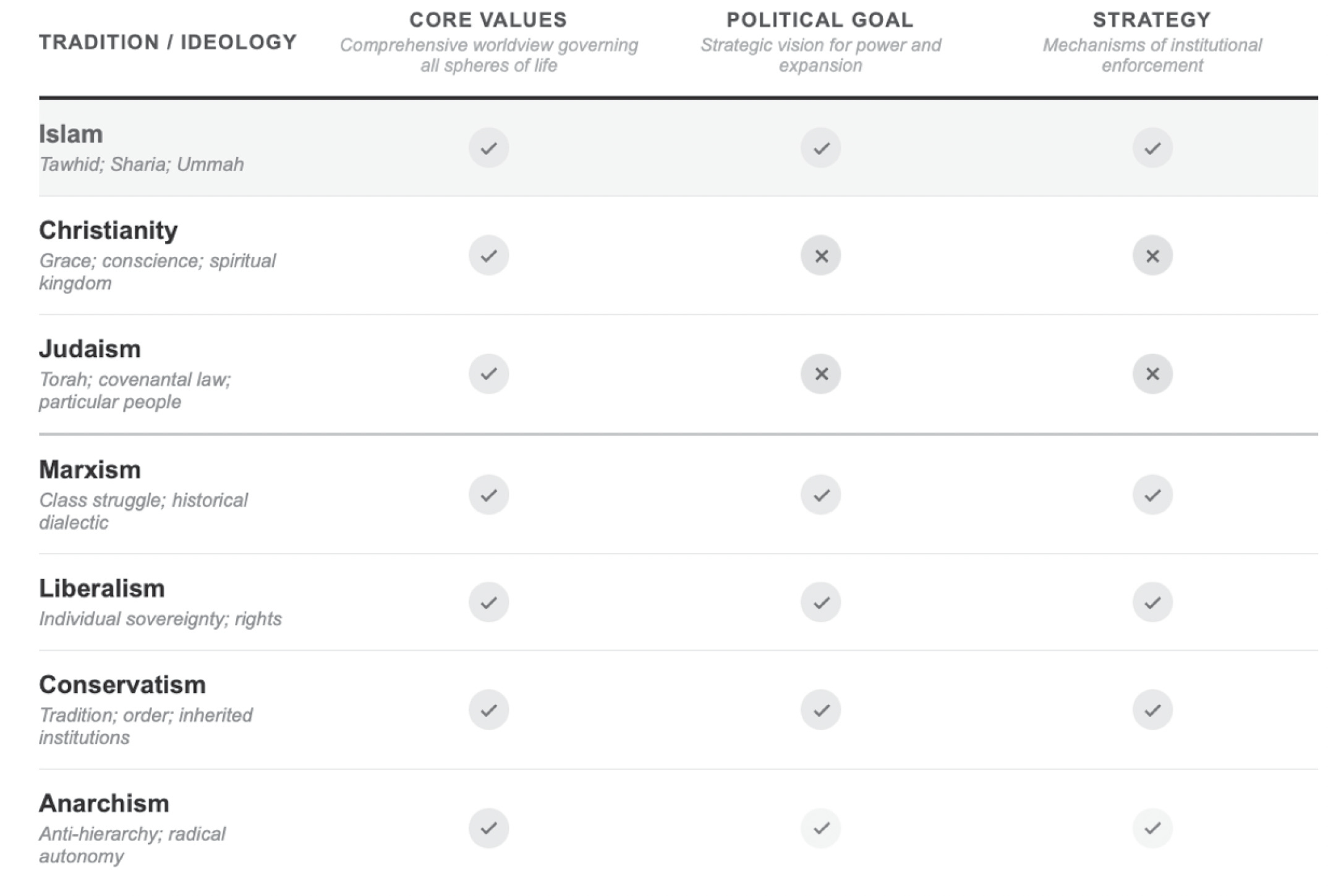
The concept of ideology has been one of the most contested in political theory. Since its coining by Destutt de Tracy in the late eighteenth century as a “science of ideas,”²³ it has carried shifting connotations. The Stanford Encyclopedia of Philosophy defines a political ideology as a set of beliefs and principles that form a comprehensive worldview on how society should be organized and governed, providing a blueprint for a preferred social and economic order by explaining how things are, how they ought to be, and what methods are best to achieve that ideal state.²⁴ This makes political ideology more than philosophy or belief. It carries a program for power. Its architecture can be recognized through three defining elements:²⁵
First, core values: a system of belief that governs all spheres of life. Second, political goals: a strategic vision for power and expansion. Third, strategies: mechanisms of institutional enforcement. Wherever all three converge, the line between religion and political ideology collapses, and it is here that Islam must be examined.
On core values: political ideologies begin with axioms. In Marxism, this is the struggle between classes; in liberalism, the sovereignty of the individual. Islam’s foundational axiom is the absolute sovereignty of Allah (tawhid), which is not confined to metaphysics. The Qur’an, Hadith, and subsequent legal tradition make clear that this sovereignty must manifest in governance, legislation, and judicial authority (Qur’an 12:40).
On political goals: the Qur’an repeatedly emphasizes the duty to establish Allah’s rule on earth, as in 9:33: “It is He who sent His Messenger with guidance and the religion of truth to manifest it over all religion.” This is not symbolic. The concept of Dar al-Islam (the abode of submission) versus Dar al-Harb (the abode of war)²⁶ illustrates that Islam is not content to remain a private faith; it defines itself in terms of jurisdiction and territorial reach.
On strategy: Islam established institutional mechanisms to enforce its vision. This is made explicit in Qur’an 9:29:
“Fight those who do not believe in Allah nor in the Last Day, who do not forbid what Allah and His Messenger have forbidden, and who do not embrace the religion of truth, from among the People of the Book, until they pay the jizya with willing submission and feel themselves subdued.”
And Qur’an 8:39:
“Fight them until there is no more fitnah, and religion is entirely for Allah.”
Here, non-compliance is not merely condemned, it is met with sanctioned coercion: conversion, political subjugation through the jizya tax, or war. Classical commentators such as al-Qurtubi emphasize that this command is absolute, not confined to any particular time, place, or people. It establishes a permanent principle of enforcement.²⁷
Unlike Christianity, whose sacred texts do not prescribe a political order and whose early church spread apart from state power, Islam’s institutional form was conceived from the outset within the apparatus of the state. The first four Caliphs (Rashidun), particularly Abu Bakr and Umar, fused military, judicial, and legislative authority into one office. Later, the Umayyad and Abbasid dynasties expanded this into bureaucratic empires. Islamic law was not simply applied by the state; it was the state. And unlike Judaism, whose Talmud orders life for a covenantal people within a particular land, Islam added what Judaism never claimed: universality. Islam fused what the others kept separate, comprehensive law, universal expansion, and institutional enforcement. This is the signature of a political ideology.
THE ENDURING SHADOW OF THE ISLAMIC STATE
If ideology is a belief system that not only explains the world but seeks to dominate it through organized authority, then history becomes its most powerful witness. From the death of Muhammad in 632 CE until the abolition of the Ottoman Caliphate in 1924, the ummah lived under a continuous political structure that asserted not merely a religious identity but legal authority, territorial governance, military expansion, and socio-political hierarchy. This unbroken lineage is the spine of Islamic history. The Islamic state was not an intermittent experiment; it was a continuous, institutionalized reality.
Initially centered in Medina, it expanded under the Rightly Guided Caliphs, assumed imperial form under the Umayyads, developed administrative sophistication under the Abbasids, defended its realm through the Seljuks and Mamluks, and extended global reach under the Ottomans. Dynastic names varied, but the essential aim never changed: to preserve and implement Allah’s law over society. This continuity explains one of the defining traits of Islamic history: crises were rarely defined by lapses in spiritual fervor, but by the loss of state power. For Islamic civilization, legitimacy was never derived primarily from moral perfection but from the state’s ability to uphold Sharia,²⁸ maintain order, and extend Islamic control.²⁹ This is why rulers with dubious personal conduct were still recognized as legitimate: they governed in the name of Islam. Ibn Khaldun articulated this reality in the fourteenth century: “The strength of religion is dependent upon the strength of the state.”³⁰
From the early caliphs to the Ottoman sultans, governance was the tangible manifestation of Islam’s claim over all domains of life. This governing legacy ended in 1924 when Mustafa Kemal Atatürk formally abolished the Ottoman Caliphate.³¹ It was not simply the termination of a political office but the rupture of a fourteen-century-old assumption that Islam must rule. Across the Islamic world, the event was seen as a theological catastrophe, the suspension of God’s presence in history, a void where divine authority no longer had a representative on earth. From that point forward, movements of every kind, pietistic, revivalist, and militant, emerged to fill the vacuum. Yet the consensus remained: without Islamic governance, Islam itself was incomplete.
NOTES
Nicole Brisch, “Religion and Power: Divine Kingship in the Ancient World and Beyond,” Institute for the Study of Ancient Cultures (University of Chicago, 2011), isac.uchicago.edu.
Pharaoh: Born of the Gods – E5,” National Gallery of Victoria, ngv.vic.gov.au.
Beau Branson et al., “The Intertwining of Philosophy and Religion in the Western Tradition,” in Introduction to Philosophy: Philosophy of Religion (Rebus Community, 2020).
Jan Garrett, “Homer’s Gods, Plato’s Gods,” Western Kentucky University, people.wku.edu.
Early Roman law was clearly intertwined with religious ritual. The ius civile (civil law) applying to Roman citizens was deeply bound to religion; its rituals and formalism (e.g., mancipatio, a formal property transfer) trace back to Etruscan, ritualistic origins.
“Judaism on the Worth of Every Person,” Jewish Virtual Library, jewishvirtuallibrary.org.
“Revolution in Wittenberg,” Britannica, britannica.com/biography/Martin-Luther.
“Did America Have a Christian Founding?,” The Heritage Foundation, June 7, 2011, heritage.org.
“Arabian Religion,” Britannica, britannica.com/topic/Arabian-religion.
“The Goddesses of Pre-Islamic Arabia (Al-Lāt, Al-‘Uzzā, Manāt),” Academia.edu.
“The Pagan Origin of the Word ‘Allah,’” bible.ca/islam.
“Judaism in Pre-Islamic Arabia,” Cambridge Core, cambridge.org.
“The History and Significance of the Meccan Hajj: From Pre-Islam to the Present,” Leiden University Scholarly Publications.
“Al-gharānīq al-‘ulā,” Sūrat al-Najm 53:19–20. Ibn Ishaq, Sīrat Rasūl Allāh; al-Tabari, Tārīkh al-Rusul wa’l-Mulūk (vol. VI, 107–112); cited via al-Waqidi. Related narrations on the mass prostration appear in Sahih Bukhari (Vol. 2, Book 19, Hadith 176–177; Vol. 6, Book 60, Hadith 385).
“Kulayb b. Rabīʿa,” Encyclopaedia of Islam Online.
“Abū Ṭālib,” Encyclopaedia of Islam Online.
“The Constitution of Medina,” Oxford Bibliographies, oxfordbibliographies.com.
“Qiblah, Islamic Direction, Prayer, Kaaba,” Britannica, britannica.com/topic/qiblah.
“Sunnah | Definition, Significance, & Examples,” Britannica, britannica.com/topic/Sunnah.
“The Difference Between the Meccan and Medinan Surahs in the Qur’an,” meforum.org.
“Luther and the Jews: A Record of Oppression and Hatred,” Lutheran Church–Missouri Synod, lcms.org.
Uri Rubin, “The Assassination of Kaʿb b. al-Ashraf,” Oriens 32 (1990): 65–71.
“Antoine-Louis-Claude, Comte Destutt de Tracy,” Britannica.
“The Definition of a Political Ideology,” Stanford Encyclopedia of Philosophy, plato.stanford.edu/entries/ideology/.
Andrew Heywood, Politics, 4th ed. (Basingstoke: Palgrave Macmillan, 2013), 28–29, “Concept: Ideology.” Defines ideology as “a more or less coherent set of ideas that provides a basis for organized political action,” specifying three features: diagnosis of the present order, a desired future, and a route to change.
“Dar al-Islam / Dar al-Harb,” Joukowsky Institute, Brown University.
In his commentary on Qur’an 9:29, al-Qurtubi (d. 1273 CE, a prominent Maliki scholar) emphasizes the broad, unqualified scope of the command to fight. altafsir.com.
Sharia: the body of Islamic law derived from the Qur’an, the hadith (traditions of Muhammad), and centuries of juristic interpretation. It covers both personal religious practice and social, political, and legal matters.
Sex, Wine, and Animals: The Caprices of the Caliphs,” raseef22.net.
“Religion and the State in Ibn Khaldun’s Muqaddimah,” Academia.edu.
“The Turkish Republic of Kemal Atatürk,” Britannica, britannica.com/biography/Kemal-Ataturk.
Danny Burmawi is the Chief Executive of the Ideological Defense Institute.
ADAPTED FROM ISLAM, ISRAEL AND THE WEST: A FORMER MUSLIM’S ANALYSIS
An excellent primer in how Islam is much more of an ideology ,rather than a religion.
That the west chose to seek.religious illiteracy , as Ataturk seemed to have finished Islamic claims to the world ; was the height of stupid complacency.
Indulging Al Qutb and Khomeini as the US did was as suicidal as it goes..Like the Frankfurt School, Marcuse, Said and Foucault....Omar and Mamdhani today? America turns out to be fatally naive in the face of real evil.
One of the most politically biased pieces on Islam I've ever read. Of course there is absolutely no account of where the Qur'an drew inspiration for its ethics from - which is directly from the Hebrew Bible. Clear Zionist propaganda which would never get published in a peer-reviewed journal.