


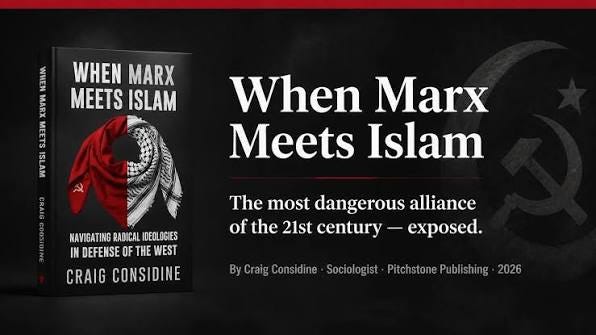
Disclaimer: As a matter of policy, IDI does not use the terms “Islamism” or “Islamist,” as explained in “The House of Islam: The Case Against the Islam/Islamism Divide,” the inaugural issue of The Ideological Defense Institute Journal. The review uses the author’s terms when necessary, adhering to the distinction the book makes between Islamism/Islam and Muslim/Islamist.
Karl Marx called “religion the opium of the people.” What would the atheist philosopher say if he walked into a Western university and saw Marxists and Muslims engaging in a libidinous lovefest to secure the liberation of the Palestinian proletariat? Would he find such ideological intercourse promiscuous beyond parody?
I confess I have been discombobulated by the dissonance of the hook-up between a religion that veils women and a godless philosophy that wants to smash the patriarchy. On many occasions, readers ask me why a seventh-century religion that conducts experiments to test if gays can defy gravity would hop into bed with a 19th-century ideology that champions same-sex marriage.
“What has Marx to do with Mohammed?” the early Christian writer Tertullian might have asked. “Marxism is Marxism and Islam is Islam, and never the twain shall meet,” the poet Kipling might have quipped. Dr Craig Considine’s landmark book, When Marx Meets Islam: Navigating Radical Ideologies in Defense of the West, is an audacious attempt at resolving this coalition of contradiction.
Considine’s stellar contribution to the conversation is to dig deep and scan wide, demonstrating that the Red-Green axis is rooted in the deconstructive theories of Karl Marx, Antonio Gramsci, and Frantz Fanon and is widely disseminated by a sprawling network of subversive actors, who use the tactics of language inversion described in George Orwell’s 1984 and Animal Farm.
Considine warns that the “soft war” between the Leftist-Islamist alliance and the West has intensified exponentially after Hamas’ massacre of Israeli civilians on October 7, 2023. This war is an existential threat to Western civilization. Losing the war would be catastrophic for democracy, liberty, religious freedom, free speech, equal rights, and the rule of law, he contends.
Considine crafts a metaphorical chessboard to choreograph how the Red-Green alliance is strategically mobilizing a totalitarian takeover. His book’s five chapters are based on the chess pieces that operate in concert, “much like chess pieces that move together for attack.”
The coalition’s “pawns” or foot soldiers are campus radicals—Islamist and Leftist students. “The absurdity of their convergence is striking,” Considine notes, “given that Leftists are typically pro-LGBTQ and secular, while Islamists are anti-LGBTQ and theocratic.” What unites them is a shared loathing of Israel and the US, and a desire to foist their ideologies on the West.
The “bishops” are faculty members who indoctrinate students using Critical Race Theory, social justice ideology, Herbert Marcuse’s cultural Marxism, Gramsci’s ideas of cultural hegemony and “war of position,” Fanon’s celebration of violence, and Edward Said’s theory of Orientalism.
The “knights” are leftist and Islamist organizations and networks. Using Sun Tzu’s principle
that “all warfare is based on deception”—the knights present themselves as civil rights or humanitarian organizations while engaging in methodical manipulation, controlling societal narratives, and advancing a coordinated campaign against the U.S.-Israel alliance and the West.
The “rooks” are politicians who influence policy and legislation. Considine names leading players like Rashida Tlaib, Ilhan Omar, Zohran Mamdani, and Alexandria Ocasio-Cortez. “Their power to vote and dictate law is paramount in realizing the Leftist-Islamist agenda,” he cautions. “They dictate the ideological battle from the highest echelons of power, transforming abstract Marxist theories into actual policy and divisive rhetoric that furthers the Leftist-Islamist cause.”
Most importantly, the “ultimate arbiters” of the “soft war” are state players—Qatar, Iran, and China—and their organizational and media proxies like Hamas, Al-Jazeera, the Popular Front for the Liberation of Palestine (PLFP), and TikTok. Considine warns that TikTok, the Chinese Communist Party-controlled app, “behaves like Orwell’s Ministry of Truth, with its agenda of controlling the narrative to shape not just the current ‘reality’ but also the future.”
A sociologist at Rice University and an internationally recognized scholar on Islam, Considine is a practising Catholic passionate about reconciliation and interfaith dialogue. He writes with the depth and dexterity of a seasoned intellectual, but while wearing the military fatigues of a veteran academic who has been through some of the bloodiest battles in the “woke” wars.
This book stands out due to several distinct hallmarks that boost its credibility and make it highly engaging for readers.
First, it persuasively links the ideologies of Marx & Co to the praxis of the Red-Green entente.
Second, it names and shames the seditious chess pieces, linking them to their partners on the ground and patrons in high places. In doing so, it offers a mini-encyclopedia of the renegade actors in the US and Europe. This isn’t a theory textbook—it is a combat manual.
Third, it demonstrates why Israel is a key ideological fault line in the “soft war.”
Fourth, when trying to make sense of the “soft war,” most of us see the reverse side of what seems like a tangled tapestry of unconnected threads. Considine flips the tapestry over and shows us the whole picture.
Most importantly, with refreshing candor, it semi-autobiographically tells the story of the author’s own Damascus Road conversion in slow motion. Considine is far from a right-wing firebrand. His goodwill for Islam is evident in his bestseller The Humanity of Muhammad: A Christian View. He has been eulogized at the highest level in the Muslim world.
However, the minute he showed support for the victims of October 7, his Muslim cheerleaders turned their megaphones against him. With deep sadness, Considine describes how even the Gülen (Hizmet) movement and the Ahmadiyya community—who advocate a “jihad of the pen” rather than a violent jihad spurned him and now label Israel as “genocidal.”
Considine has paid a price for his commitment to truth and reason, even at his own university, where he regularly hosted voices from across the spectrum. Considine had his own hermeneutical fracture. His mea culpa is inspiring: “I was once a ‘pawn,’ easily moved by the flattering treatment of the Leftist-Islamist alliance. This book is my declaration that I am no longer a pawn, the chess piece that moves forward in a predictable, straight line.”
The book would benefit from analyzing the Islamic counterparts of Marx, Gramsci, and Fanon. Considine examines how Muslim Brotherhood activists have Hassan al-Banna as their mentor. Would he consider including Abul A’la Mawdudi, Yusuf al-Qaradawi, Mohammad Baqir al-Sadr, and Ruhollah Khomeini? Or ideologues like Mirsaid Sultan-Galiev, Muhammad Baqir al-Sadr, and Sayyid Qutb, whose revolutionary methodology borrowed heavily from Marxist-Leninist organizational mechanics?
Further, one would ask if Muslims in the Red-Green axis go beyond the doctrine of their ideological mentors and derive their praxis from their interpretation of Qur’an and hadiths? If so, does Considine consider their methodology and interpretation valid in the overarching schema of Islamic exegesis and practice? Do the primary sources of Islam teach a separation of Mosque and State? If not, aren’t Muslim activists simply being faithful to the model and teaching of their Prophet?
Christians reading this book will ask if the mega-monster created by the mutation of Marx and Muhammad has to do with the gaping vacuum created by the collapse of Christianity in the West. Isn’t today’s West more like the parable of Nietzsche’s madman who, after being forced out of several churches, said: “What after all are these churches now if they are not the tombs and sepulchers of God?”
Considine’s analysis leads him to conclude that Leftism and Islamism work synergistically against these ideals by exploiting the very tolerance and openness that Western values demand. The solution is to act urgently on Karl Popper’s decisive dictum: to be “intolerant of intolerance” by establishing clear boundaries to protect our civic culture. John Rawls, the philosopher, expands on Popper and posits in A Theory of Justice that the principle of total tolerance is superseded by a society’s inherent right to “self-preservation,” Considine emphasizes.
Pope Leo XIV and his cohort of interfaith advocates, Archbishop of Canterbury Sarah Mullally, and Leftist politicians in the US and most European countries who have been afflicted by the “virus of wishful thinking,” to use a term from Oxford ethicist Nigel Biggar, might miraculously experience a shift in their own ideological tectonic plates if they were to read Considine’s book.