


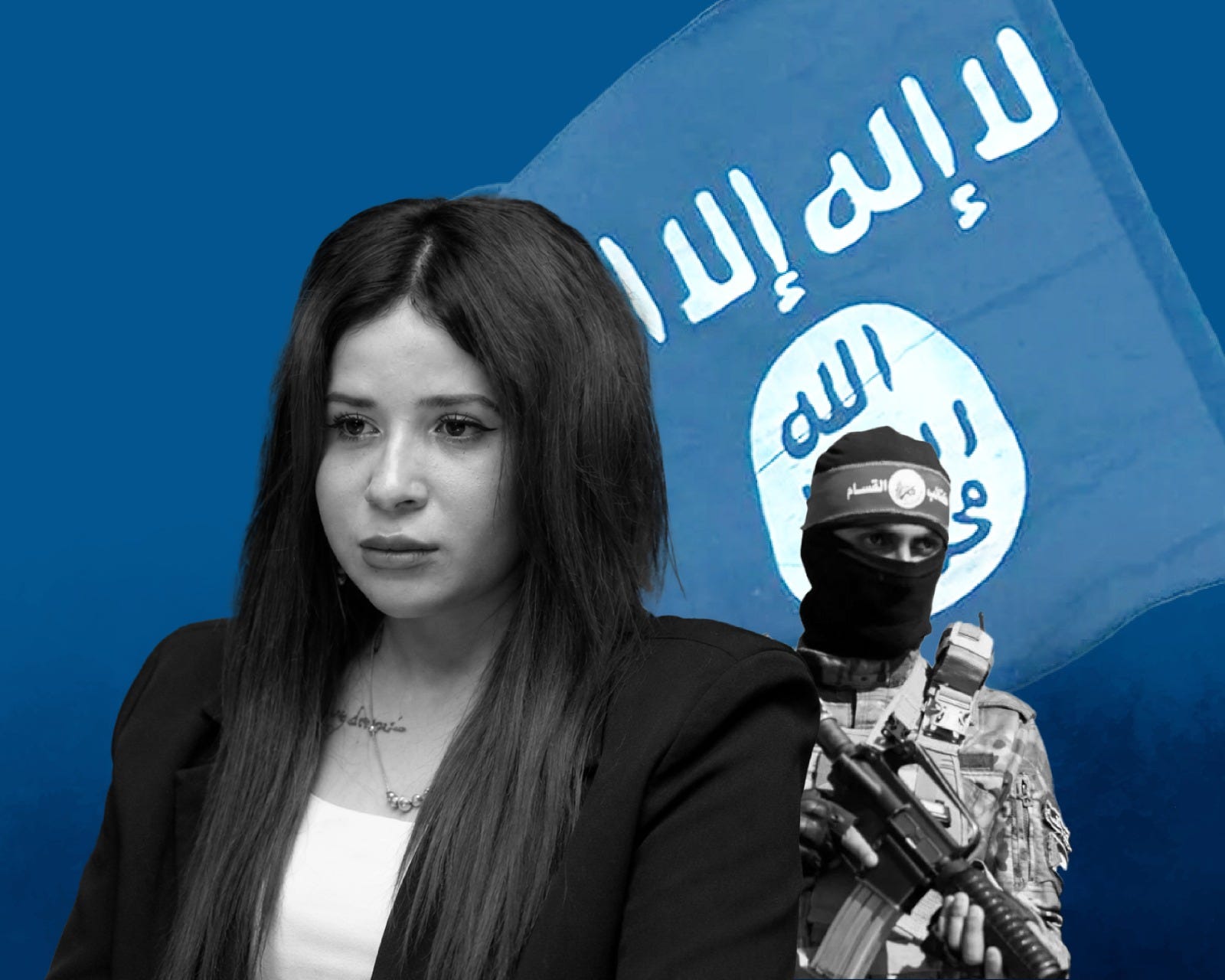
Fawzia Amin Sido is a Yazidi woman from Iraq who endured ten years of captivity and sexual slavery at the hands of Islamic terrorists. In August 2014, she was abducted by ISIS (the Islamic State) at the age of 10 during the Yazidi genocide in Sinjar. She was trafficked to Syria in early 2015 and later to the Gaza Strip. During this time, she was raped, tortured, and abused by several Muslim men who belonged to Islamic terror groups (including ISIS and Hamas). She was forced to bear two children.
Yazidis are a persecuted non-Muslim community indigenous to Iraq, Syria and Turkey. More than 6,000 Yazidis were abducted by ISIS in Iraq’s Sinjar region; many were sold into sexual slavery or trained as child soldiers. They were taken across borders, including into Turkey and Syria.
Sido and two of her brothers, aged 7 and 10 at the time, were among those thousands of Yazidis enslaved by ISIS because of their Yazidi identity.
Sido, while still 10 years old, was taken to a sex slave market. She said she was then sold five times, coerced to convert to Islam and “marry” a Palestinian-Arab jihadist. She recounted in an interview:
“The first and second day I was with him he didn’t approach me. On the third day he came to me and told me that he had received permission to approach me against my will. He was told to rape me even if I resisted. I was young and I couldn’t bear that, which is why he decided to give me a drug. I took the drug which numbed me and then he raped me.”
The captor became increasingly abusive, particularly after taking a second wife.
Over the following years, Sido was trafficked to different locations across several countries.
“We ended up in Al-Hol camp (in Syria) before we were smuggled to Idlib in 2019, and from there, we went to Turkey. In 2020, they arranged a passport for me in Turkey so I could fly from Istanbul to Hurghada, Egypt, and then to Gaza.”
She told CNN that she stayed in Rafah in the southern Gaza Strip for a year, describing her life as “unbearable:”
“Hamas constantly harassed me due to my Yazidi background and contacted my family, even going so far as to format my phone [erase its contents] during their investigations.”
In another interview, Sido affirmed that Hamas treated her as a slave. After the 7 October massacre, Hamas sent her to work in a hospital. She said that “All the hospitals in the Gaza Strip were used as Hamas bases. They all had weapons.”
For years, she lived in the Gaza Strip in captivity. She was sold and forced to marry a jihadist. There, she attempted suicide several times.
During the Israel-Hamas war, Sido reportedly escaped after her captor was killed in what was believed to have been an Israel Defense Forces (IDF) strike. This enabled her to flee to a “hideout” within the Gaza Strip.
In a complex operation coordinated between Israel, the United States, and other international actors, she was rescued in a secret mission in October 2024. Upon her entry into Israel, she continued to Jordan through the Allenby Bridge Crossing and from there, returned to her family in Iraq. In 2025, she relocated to Germany.
On 26 June 2026, Sido addressed UN Watch’s official side event at the 62nd session of the UN Human Rights Council, “Women’s Rights Under Extremism and Conflict.” She shared her story of enslavement and asked the German government to grant her sick mother and brother humanitarian entry so that she can finally be reunited with her family.
Sido appeared as a speaker at the event alongside Afghan, Iranian, Israeli and Somalilander women who gave their testimonies regarding Islamic gender-based crimes such as rapes, sexual slavery, gender apartheid and female genital mutilation.
During her speech, Sido introduced herself as “a human being who has endured what no one on this earth should ever have to endure.” She said:
“My name is Fawzia, one of the daughters of wounded Sinjar. I stand here to be the loud voice of thousands of Yazidi women and children whose lives were stolen, and to carry within my body and soul a bleeding wound born of ten years of captivity, slavery, and human degradation.
“At dawn on August 3, 2014, the sun did not rise over Sinjar — we breathed death. ISIS and the tribes that supported them attacked us in al-Ba’aj, al-Khatuniyah, and defiant Sinjar. In those terrible moments, the security forces withdrew, and we were left defenseless. Our families stood their ground with little more than light weapons and their own courage against an arsenal of heavy and sophisticated arms.
“Within just a few days, our families were devastated: more than 1,292 people were killed, and 6,417 women and children were abducted. The Alu Antar massacre claimed hundreds of victims, not to mention those who died of thirst and hunger while trapped on Mount Sinjar.
“On that cruel night, we slept on the roof of our house to escape the summer heat. My family ran downstairs in panic, and I — a little girl who understood nothing about war — remained alone on the roof for two hours amid a hail of bullets. When we later fled, I was holding the hand of my little brother, who was only five years old at the time. In my childish innocence, I believed that the grip of my small hand meant complete safety for him. But the beasts of ISIS came and violently tore me away from him. That final touch — the moment my brother’s hand was torn from mine against my will — is the knife that tears through my heart every second that passes in my life.
“I was only ten years old — a child whose childhood was stolen — sold from one man to another as if I were a piece of furniture, without feelings, without dreams, without dignity. They put me in chains. They beat me. They violated my innocence and subjected my fragile body to electric shocks.
“In 2020, I was taken as a captive to the Gaza Strip, where I was sold to a jihadist and, under threat of violence, forced to marry him and bear two children. I lived there for years in slavery. I was forced to do everything — even sleep. I was so exhausted and terrified that I was forced to sleep standing up.
“I was locked in a dark room without windows for three months and attempted to take my own life several times to escape that hell. But one thing kept me alive: my mother tongue, my identity, and the memory of my mother, which I refused to let fade from my mind.
“Finally, with the help of a courageous woman who secretly gave me a phone, I recorded a video in my mother tongue while wearing my niqab and posted it on TikTok, sending my final cry to the world. My story was believed, and a joint international effort involving the United States, Iraq, Jordan, and other countries was launched. They coordinated their efforts until I was rescued and brought to safety.
“Today, I am in Germany under humanitarian protection. After ten years of hell, freedom feels surreal. But alas, my happiness is not complete. Today, I am only a body without a soul.
“For ten years in captivity, the one dream that gave me strength was to return and throw myself into my father’s arms. But he died a few months ago before I could see him again, before he could embrace me with his warmth, because of travel barriers and legal complications.
“And now my mother is sick, alone, and battling for her life in Iraq alongside my brother, while I stand here helpless and unable to reach her.
“I ask you, in the name of the human values under whose banner you gather: after everything I have endured — rape, torture, slavery, and ten years of hell — do I not deserve to spend the rest of my life beside my sick mother? Does all this suffering not count in my favor? Does it not entitle me, at last, to see my mother again?
“That is why I am not standing here to beg for your pity. I have come to appeal to your conscience and to challenge rigid laws that lack compassion.
“I call upon the international community, the German government, and human rights organizations to immediately facilitate an exceptional humanitarian family reunification with my mother and brother in Germany.
“For me, family reunification is not merely a piece of paper or a bureaucratic procedure. It is the only cure and the final step in healing my broken soul. It means safety and dignity after years of loss, suffering, and displacement.
“Before I conclude, I would also like to express my sincere gratitude to Steve Maman and Dawood Jajju, whose tireless efforts contributed to my rescue and return to freedom.
‘I also beg and implore you: do not stop searching for the missing Yazidis. Behind every missing person stands an entire family that dies a thousand deaths every day from the agony of waiting. Save what remains of my family, and help me simply be a human being and a daughter who can live in peace and security.”
Sido’s story illustrates the links between Hamas, ISIS and other jihadist groups in the region. Her testimony mourns the crimes that those Islamic terrorist organizations have committed against civilians – particularly women and children - in Iraq, Syria, and Gaza, among others.
Pari Ibrahim, the Executive Director of the Free Yezidi Foundation (FYF), told IDI Center,
“Yezidis still have more than 2,500 missing, almost 12 years since the Yezidi Genocide perpetrated by ISIS. This is the issue that brings the most pain and suffering to our community. Yezidis do not have a large, global support network. We are a small community. While we have been very grateful for those who have stood with us during our time of suffering, it feels like the world has moved on. But to the hundreds of our women and girls still missing, held in captivity somewhere, life has not moved on. Behind each number, there is a name, a face, an identity, a story. We still would like to see a formal international mechanism to help identify and rescue our missing.”
With at least 2,500 Yazidi children and women still missing, jihadists terrorizing African nations, the al-Qaeda-ISIS takeover of Syria in 2024, and Hamas still not completely destroyed in Gaza, the inhumane ideology of those terrorist groups remain alive, and the fight against them remains as important as ever.
Uzay Bulut is a fellow at the Ideological Defense Institute
Her cries will fall on deaf islamic ears.
She is a kuffar and the UN is a 57-members of a caliphate.
As far as they care, her human rights were not denied because under sharia she's entitled to none.
Poor girl, Heartbreaking. 💔