


Muhammad’s Farewell Sermon is quoted as his last address to mankind, the summing-up of everything he came to teach, and it is produced on cue whenever Islam is accused of a poor record on race or on women. Fourteen centuries ago, the story goes, this man stood before a crowd and declared that no Arab outranks a non-Arab, no white man a black man, and that women are partners deserving of kindness. Case closed. The West got there in 1948; Muhammad got there in 632.
Few Islamic texts are cited more frequently to whitewash Islam in the West. Yet a comparison of the most popular version of the Farewell Sermon with earlier Islamic historical sources reveals substantial differences.
Passages concerning women have been softened or omitted, universal humanitarian language has been introduced, and several statements commonly quoted today simply do not appear in some of the earliest surviving accounts. These differences raise an important historical question: which version of the Farewell Sermon most accurately reflects the earliest Islamic sources?
This article does not seek to reconstruct Muhammad’s exact words during his final pilgrimage. Like much of early Islamic history, the Farewell Sermon survives through multiple narrations that differ in wording and detail. Instead, it is a case study in how modern Islamic apologetics present historical sources selectively, promoting the later, composite versions abroad while burying the earlier accounts that a Western audience would find harder to stomach. The result is the West is fed the sanitized sermon and comes to believe that is what Islam teaches, while the Islamic world goes on transmitting the original to its own.
The modern English version most widely reproduced online, can be found on websites such as IslamicFinder and IslamReligion, can be traced to Sermons of the Prophet, translated by S. H. Faizi in 2001. Faizi himself acknowledged that the authenticity of these collected sermons remained disputed among Muslim scholars. Rather than presenting a single historically verified sermon, the collection appears to compile material from different narrations attributed to Muhammad. It reads:
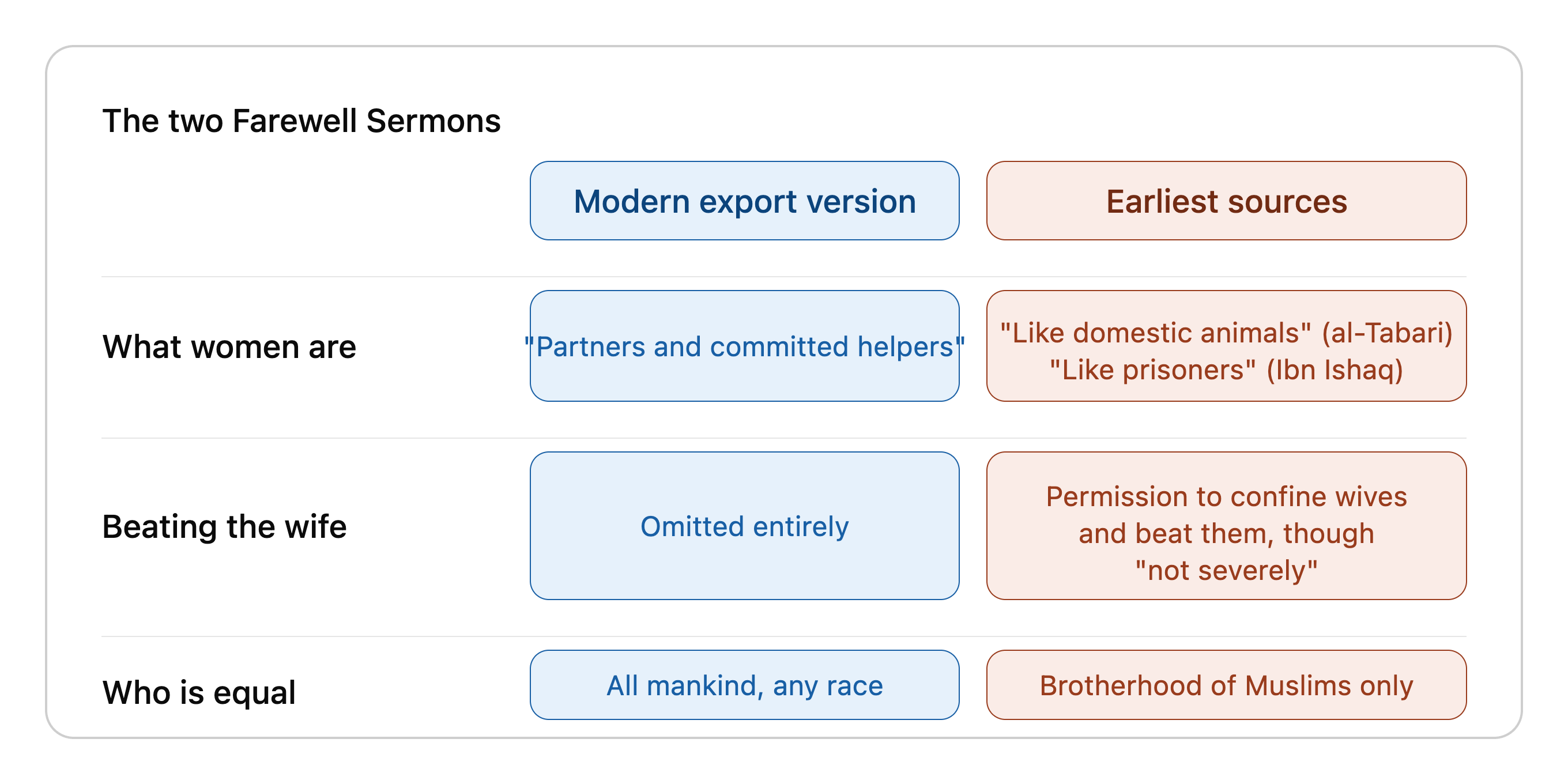
“O People, it is true that you have certain rights with regard to your women, but they also have rights over you. Remember that you have taken them as your wives only under God’s trust and with His permission. If they abide by your right then to them belongs the right to be fed and clothed in kindness. Do treat your women well and be kind to them for they are your partners and committed helpers. And it is your right that they do not make friends with any one of whom you do not approve, as well as never to be unchaste.
“O People, listen to me in earnest, worship God, say your five daily prayers (Salah), fast during the month of Ramadan, and give your wealth in Zakat. Perform Hajj if you can afford to.
“All mankind is from Adam and Eve, an Arab has no superiority over a non-Arab nor a non-Arab has any superiority over an Arab; also a white has no superiority over black nor a black has any superiority over white except by piety and good action. Learn that every Muslim is a brother to every Muslim and that the Muslims constitute one brotherhood. Nothing shall be legitimate to a Muslim which belongs to a fellow Muslim unless it was given freely and willingly. Do not, therefore, do injustice to yourselves.
“Remember, one day you will appear before God and answer your deeds. So beware, do not stray from the path of righteousness after I am gone.
“O People, no prophet or apostle will come after me and no new faith will be born. Reason well, therefore, O People, and understand words which I convey to you. I leave behind me two things, the Qur’an and my Sunnah and if you follow these you will never go astray.
“All those who listen to me shall pass on my words to others and those to others again; and may the last ones understand my words better than those who listen to me directly. Be my witness, O God, that I have conveyed your message to your people.”
The oldest surviving lives of Muhammad, al-Tabari’s History and Ibn Ishaq’s Life, are the most authentic and most widely accepted accounts Islam has, the sources Muslim and non-Muslim historians alike still begin with. Both are foundational to Islam, and when these texts are set beside the popular version promoted in the West, a very different picture emerges.
Al-Tabari’s version reads:
“Now then, O people, you have a right over your wives and they have a right over you. You have [the right] that they should not cause anyone of whom you dislike to tread on your beds; and that they should not commit any open indecency. If they do, then Allah permits you to shut them in separate rooms and to beat them, but not severely. If they abstain from [evil], they have the right to their food and clothing in accordance with the custom. Treat women well, for they are [like] domestic animals with you and do not possess anything for themselves. You have taken them only as a trust from Allah, and you have made the enjoyment of their persons lawful by the word of Allah, so understand and listen to my words, O people. I have conveyed the Message, and have left you with something which, if you hold fast to it, you will never go astray; that is, the Book of Allah and the sunnah of his Prophet. Listen to my words, O people, for I have conveyed the Message and understand [it]. Know for certain that every Muslim is a brother of another Muslim, and that all Muslims are brethren. It is not lawful for a person [to take] from his brother except that which he has given him willingly, so do not wrong yourselves. O Allah, have I not conveyed the message?”
Ibn Ishaq’s The Life of Muhammad renders the same passage slightly differently, describing women as being “like prisoners with you.”
These passages concerning women found in al-Tabari and Ibn Ishaq are not isolated reports. Qur’an 4:34 also contains instructions that earlier Islamic jurists have understood as permitting a husband to strike a “disobedient” wife under specified circumstances. Similar wording also appears in canonical hadith collections recognized within Sunni Islam which compare women to dogs and donkeys in the context of nullifying prayer, and that women will make up the majority of the Hellfire.
Nuriyah Khan is a fellow at IDI
Sources
Al-Tabari. The History of al-Tabari, Volume IX: The Last Years of the Prophet. Translated by Ismail K. Poonawala. Albany: State University of New York Press, 1990, p. 112.
The Qur’an. Surah An-Nisa (4:34).
Faizi, S. H. (trans.). Sermons of the Prophet. New Delhi: Adam Publishers & Distributors, 2001.
Ibn Ishaq. The Life of Muhammad. Translated by Alfred Guillaume. Oxford: Oxford University Press, 1955, p. 651.
IslamicFinder. “The Farewell Sermon by Holy Prophet (SAW).” Available at: https://www.islamicfinder.org/knowledge/islam-and-sunnah/the-farewell-sermon-by-holy-prophet-saw/.
IslamReligion. “Prophet Muhammad’s Last Sermon.” Available at: https://www.islamreligion.com/articles/523/prophet-muhammad-last-sermon
Jami’ al-Tirmidhi. Book of Marriage. (Hadith numbering varies between editions and online databases.)
Sunan Ibn Majah. Book of Marriage, Hadith 1851.
Thank you for providing the comparable texts between modernity and antiquity. Like all translations, including the Bible, certain elements can be altered for modern acceptance. It's also crucial to understand the various interpretations of a word from different languages. I recognize that the Arabic language, for example, offers many interpretations, which can lead to the perception that the Quran is being whitewashed for a global audience. The argument often arises that a literal interpretation may not capture the intended meaning, as there could be multiple meanings for a single word, and what Muhammad intended may be different from how it is interpreted today.
I watched a debate yesterday on YouTube at the Oxford Union on whether the West has the right to be suspicious of Islam. It was fascinating to listen and consider whether the opposition had been influenced to believe a particular viewpoint which is a whitewashed translation and at the same time they were attempting to convince the proposition that certain words are not meant to be understood the way many in Britain perceive them.
i wondered id they were doing their own form of self-whitewashing, where individuals acknowledge the Quran's true meaning but present a different interpretation to others because the true interpretation doesn't fit the debate argument. The opposition's argument included brief examples of kindness exhibited by both historical and contemporary figures. Indeed, kindness can be found even in the hardest of hearts, but the core issue remains: what are the historical teachings, and how are they being applied today?
Here is the debate: [https://youtu.be/yRJBZrlT2kw?is=GVjot2y1-Kkm7J8K](https://youtu.be/yRJBZrlT2kw?is=GVjot2y1-Kkm7J8K)
Thank you again for the thought-provoking article.
This so called sermon is sourced from various HADITHS and is not a singular oratory given by Mohammed and knowing the history of the Hadiths it puts it in the largely rejected category of supporting evidence of origins. 600,000 Hadiths were reported to Bukhari and then later to Sahi Muslim. Of the 600,000 reported only 7200 were accepted as authentic. And even then seeing the 7200 today, you can tell that most of them are also suspect as to their authenticity and originality. The farewell sermon of Mohammed is not a real sermon. The sermon of Mohammed is cobbled together from the varying Hadiths by modern day believers of Islam. Furthermore Mohammed was allegedly poisoned to death and had very little time if any to give a farewell sermon.