


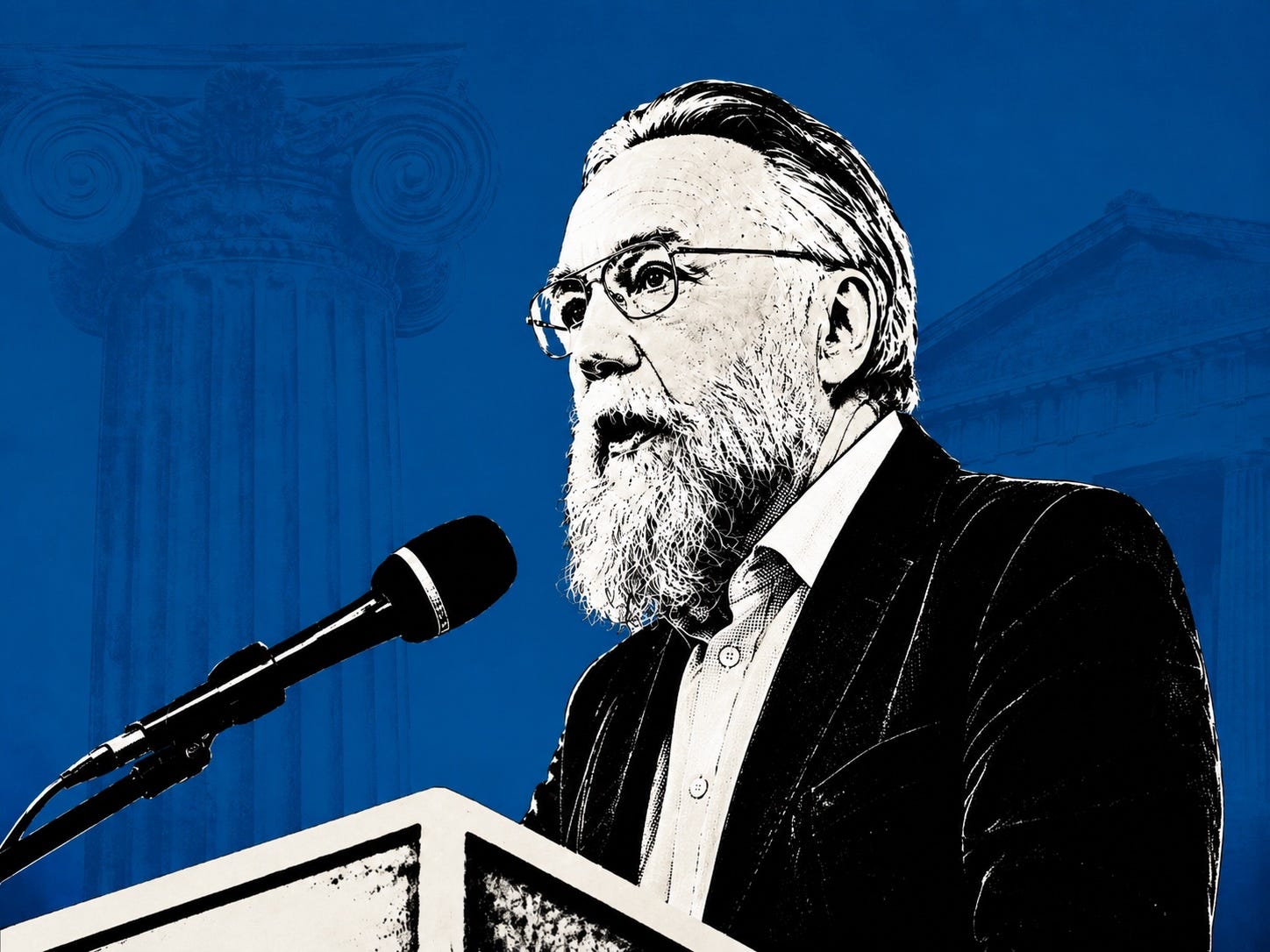
The West, Aleksandr Dugin says, has mistaken its own historical experience for a universal model. Individual rights, liberal democracy, freedom of conscience, these are not truths applicable to all of humanity. They are the products of one particular civilization that has arrogantly imposed itself on the rest of the world. His multipolarity is presented as the cure: let Russia be Russia, let Iran be Iran, let China be China. The West has no right to demand that you become like it.
It sounds, on the surface, like a defense of diversity. It is not. It is a philosophical project to abolish the only principles that have ever given ordinary people, inside Russia, inside Iran, inside China, the standing to resist the power of those who rule them. What Dugin calls the cage of Western universalism is, for the dissident in a Moscow prison, the only key that exists.
Western civilization produced a specific set of ideas about the relationship between the individual and power. Every human being possesses an inherent dignity that no ruler, state or collective can erase, not earned through service to the state, not granted by government in exchange for loyalty, but existing before the state and placing limits on what it may do. Law stands above rulers. The king is not the source of law. He is subject to it. Conscience precedes political authority. What a person believes, how he worships, what he says, these are not gifts from the government, revocable at its pleasure. They belong to the person before any government exists. Rights are not granted by states. They are recognized by states. If rights come from the state, the state can take them back. If they exist before the state, its only function is to protect them.
These ideas were encoded in the Magna Carta, the English Bill of Rights, the Declaration of Independence. Dugin’s argument depends on a claim that these principles are Western, historically contingent products of one civilization’s experience, with no more universal validity than any other civilization’s arrangements. The claim is false.
There is a reason more than 175 nations adhere to civil and political rights treaties manufactured in the West. The non-Muslim in an Islamic country and the Shudra in India are protected, theoretically, at least, by those laws, not by their religious or caste standing. Because if they were left to the traditions of any other civilization, they would have no protection at all: their own traditions are precisely the thing the treaties protect them from.
Western civilization globalized its Judeo-Christian principles. The intrinsic value of the human being, the premise adopted by all those signing nations, comes from Genesis: if man bears the image of God, then his worth comes from God, not from his religious affiliation or social rank. No caliph grants it; no caste assigns it; it arrives at birth, from above every throne.
The limitation of power comes from the same source. If God stands above every ruler, then the ruler answers to a law he did not make. In Deuteronomy the king is commanded to write out the law with his own hand and read it all the days of his life, “that his heart be not lifted up above his brothers,” the king as the law’s copyist, not its author. The ruler is not the source of law. He is its subject.
And freedom of conscience comes from there too: if conscience is the place where the individual stands alone before God, then no political authority can legitimately occupy that space.
These ideas did not originate in London or Philadelphia, they originated in Jerusalem. The West translated them, through centuries of legal development, through the Reformation’s insistence that Scripture stands above rulers, through the Enlightenment’s rendering of theological claims into political language. John Locke wrote that the reason no one may harm another is that human beings are “the workmanship of one omnipotent Maker.” The verse on the Liberty Bell, “proclaim liberty throughout the land”, is from Leviticus. The Declaration of Independence grounds rights not in the wisdom of the founding generation but in a Creator.
Dugin is therefore not attacking Western preferences. He is attacking the political consequences of a theological claim about the nature of the human person, a claim that preceded the West and will outlast it.
Dugin presents multipolarity as liberation. Each civilization, freed from Western universalism, organizes as it likes. Russia can be Eurasian, Iran can be Islamic, China can be Confucian, or Marxist-Leninist, or whatever civilizational identity the Party finds convenient that decade.
What does that mean for the human beings actually living under each civilization? In Russia, journalists are imprisoned for reporting on the war in Ukraine under laws that criminalize the word “war” itself. Alexei Navalny died in February 2024 in an Arctic penal colony above the polar circle, because his fate was decided by the principles of a non-Western civilization.
In Iran, women who remove their headscarves face arrest, torture and death. Mahsa Amini died in the custody of the morality police in September 2022, and the young women who took to the streets afterward, who cut their hair and burned their hijabs, did not appeal to Shia jurisprudence. They appealed to the right to determine what happens to their own bodies, to freedom of conscience, to the proposition that no government owns the person. These are Western impositions.
In Afghanistan, the Taliban erased women from schools, universities, parks, and finally from windows, a 2024 edict ordered that new buildings deny women even a view of the street. The girls studying in secret basements are not appealing to Islam. They are appealing to an idea that the West globalized.
There is a reason the peoples of the world aspire to the Western model: it is universal. It is the destination, for justice, liberty, equality before the law, rather than one culture among many. If the totalitarian governments of the world achieve Dugin’s dream, each “civilization” decides what is good and what is evil, which means the men holding power decide. They will decide whose life outweighs whose: the believer’s over the infidel’s, the Party member’s over the peasant’s, the ruler’s clan over everyone else.
Multipolarity delivers every human being to whoever rules the ground he stands on. This is not the liberation of civilizations. It is the liberation of governments from their people.
Dugin calls Western universalism a cage, but in reality for the people inside the civilizations he celebrates, the cage is the multipolarity he is building. No one smuggles himself toward Tehran, no one crosses an ocean on a raft bound for Pyongyang. The migration of the modern world runs overwhelmingly in one direction, toward the societies built on the very ideas Dugin describes as parochial.
Ali Siadatan is a fellow at the Ideological Defense Institute
This is absolutely true. The “west” exists because it = its Judeo Christian foundation. We have forgotten the very basis - that the rights of each individual and every thing good are bestowed upon us by gd and the development that government exists to PROTECT those rights bestowed by gd. We have forgotten this because enlightenment thinking has obscured the source of all rights, all beauty, all good, that is, gd, and has led us to forget about that source and to instead put our trust in man and the material world only. And why has atheism become so prevalent? Big problem. It’s frightening because so many many of us will face a reckoning - maybe soon. We’ve had an easy ride for the last maybe 100 years and it’s coming to a fork in the road.
It sounds like one could summarize Dugin’s idea as form of relativism where there is no universal truth that everyone & every government should operate by. Instead, he argues that each country should operate on its own “truth”.