


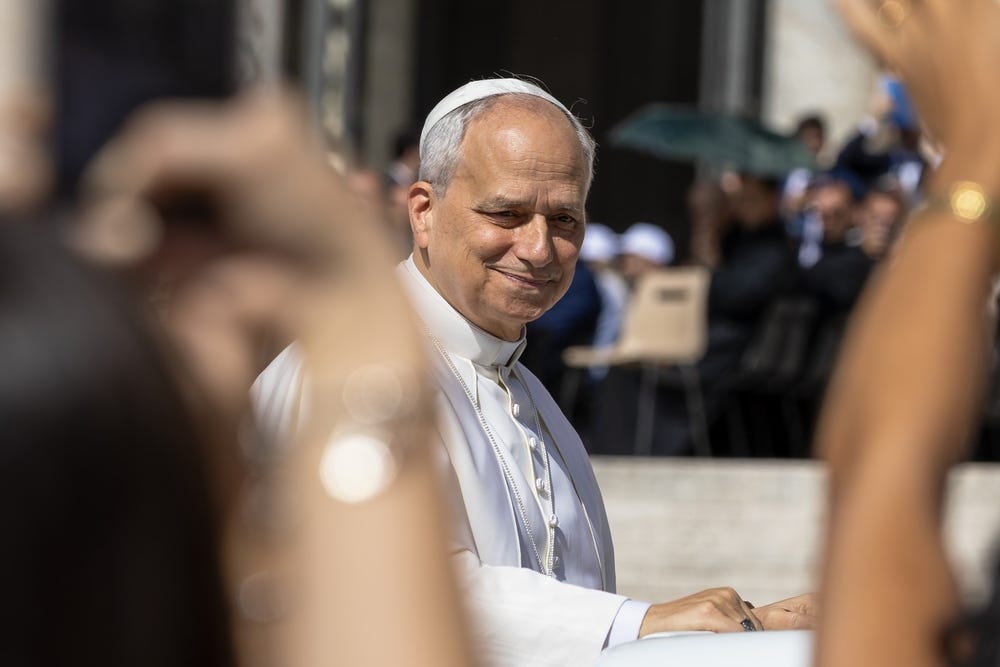
Pope Leo XIV is getting lynched on social media. The Chicagoan pontiff renewed his broadside against the death penalty after US Defense Secretary Pete Hegseth said he would livestream the execution of Nidal Hasan, who shot dead 13 unarmed US soldiers at the Fort Hood military base in 2009. “I, an American jihadi, killed for Islam,” Hasan declared at his court-martial.
Leo rushed to rescue the jihadi from the firing squad. “The death penalty is inadmissible because it is an attack on the inviolability and dignity of the person,” he pontificated on X. Leo stated his logic for countermanding capital punishment. We have created “effective systems of detention” that keep us safe while not depriving the guilty of “the possibility of redemption,” he argued.
Leo’s tweet garnered over 10 million views. Plebs and highbrows united in an unprecedented barrage of insults against the putative successor of St. Peter. “Sit this out. Let the Christians handle it,” one X-user quipped. Several posted images of the robe and axe used by Giovanni Bugatti, the Papal States’ longest-serving executioner, who carried out 514 executions over 68 years. Scores of Twitterati, including Gad Saad, author of Suicidal Empathy: Dying to be Kind, asked Leo to read his Bible. Others asked why Leo was tight-lipped on the thousands of executions in the Muslim world. A 2002 report highlights a 600 percent rise in capital punishment in Bahrain.
“We’ve reached the stage of Catholicism where the Pope has accused God of being a sinner,” one X user quipped, referring to God legislating capital punishment in the book of Genesis. “Whoever sheds the blood of man, by man shall his blood be shed, for God made man in his own image,” God commands Noah. In fact, capital punishment for premeditated murder is the only law repeated in all five books of the Torah.
I’m not going to argue that abrogating the death penalty is a contradiction of Scripture and pre-Vatican II magisterial teaching. Catholic philosopher Edward Feser argues this persuasively in his book By Man Shall His Blood Be Shed: A Catholic Defense of Capital Punishment, writing: “If capital punishment is wrong in principle, then the Church has for two millennia consistently taught grave moral error and badly misinterpreted Scripture.”
“The reversal of a doctrine as well established as the legitimacy of capital punishment would raise serious problems regarding the credibility of the magisterium,” Cardinal Avery Dulles wrote in 2001. “If the tradition on capital punishment had been reversed, serious questions would be raised regarding other doctrines.”
Pope Francis confirmed the magisterial status of the new teaching on the death penalty by promulgating it in his declaration Dignitas Infinita and his encyclical Fratelli Tutti. Leo’s tweet is simply reiterating what has now become official Roman Catholic doctrine.
Did Jails Exist When the Bible Ordered Capital Punishment?
Leo’s main argument against the death penalty in his latest tweet is the development of “effective systems of detention.” He is citing Francis’ exact words in his revision of the Catechism of the Catholic Church on capital punishment. Two popes claim that there weren’t prisons fit for purpose when the death penalty was practiced in biblical times.
Leo’s main argument against the death penalty in his latest tweet is the development of “effective systems of detention.” In doing so, he is quoting Francis’ exact wording from the revised Catechism of the Catholic Church on capital punishment. Both popes contend that prisons fit for purpose did not exist in biblical times, when the death penalty was practiced.
Have the popes even read the Bible? Five chapters in Jeremiah deal with his imprisonment (20:1-3, 32:1-5, 37:11-15, 16-21, 38: 1-13, 39:11-14). From overnight detention in stocks by the priest Pashur, to his imprisonment in the “court of the guardhouse” on the orders of King Zedekiah, to his arrest by a royal officer who “imprisoned him in the house of Jonathan the Scribe, which they had converted into a prison,” we are made aware of “effective systems of detention” that imprison the prophet. Jeremiah is also put into a vaulted pit beneath the house, where “he remained for a long time.” At one point, the soldiers detain him in a cistern. They return him to the “court of the guardhouse,” acting on a friend’s petition.
Pharaoh throws Joseph into prison (Genesis 39:20) for 12 years (Seder Olam Rabbah §2 and Shemos Rabbah 7:1). Samson is jailed (Judges 16:21). Assyria’s king Shalmaneser imprisons Israel’s king Hoshea (2Kings 17:4). Jehoiachin, king of Judah, spends time in a Babylonian prison (2Kings 25:27). The psalms speak of God’s concern for prisoners (68:6, 69:33, 79:11, 102:20, 107:10). Herod puts John the Baptist in prison (Matthew 14:3). Jesus tells his disciples to visit prisoners, because by doing so they are visiting him (Matthew 25:44).
Before encountering the Messiah, Saul is on a mission to imprison Jesus’ followers (Acts 8:3). The high priest has the apostles put in the “public prison” (Acts 5:17), and Luke records multiple accounts of their imprisonment. Paul writes four letters from prison. The biblical accounts establish that the detention facilities cited are “effective.” Peter escapes from jail only by angelic intervention (Acts 12:7), and an earthquake enables the jailbreak of Paul and Silas (Acts 16:25-34).
Notably, the magisterial texts do not talk about “humane” detention systems. If they did, one might point to Paul’s two-year house arrest—during which the Romans permit him to receive visitors and preach the gospel (Acts 28:16–31)—as an example. If Leo reads The Oxford History of the Prison, he will discover that effective detention systems weren’t developed after Vatican II. They existed in the ancient world.
Michel Foucault’s Ideological Capture of the Catholic Church
For two millennia, the Catholic Church so firmly upheld biblical teaching on the death penalty that Martin Luther’s nemesis, Pope Leo X, in his bull Exsurge Domine, even declared that it was the will of the Holy Spirit to burn heretics. What accounts for the shift from Leo X to Leo XIV? A strong clue to the revolution lies in how Pope Francis advanced the debate from capital punishment to life imprisonment.
Addressing the International Association of Penal Law in October 2014, Francis condemned all forms of life imprisonment as an affront to human dignity. “Recently the life sentence was taken out of the Vatican’s Criminal Code. A life sentence is just a death penalty in disguise,” Francis stated. Leo similarly rejected chemical castration for a pedophile who savagely raped a 3-year-old girl when he was bishop in Peru, even though Peru faces an epidemic of child rape and several countries, including seven states in the US, prescribe chemical castration for pedophilia.
Francis’ condemnation of life imprisonment as a “hidden death penalty” is straight out of the playbook of Michel Foucault—the “emblematic figure” of French postmodernism. Foucault treated capital punishment as a problem of power—specifically the “right of the sword,” the prerogative of the ruler to take life (articulated by St Paul in Romans 13:4).
Like Leo, Foucault claimed he was taking a “pro-life” position. “How could power exercise its highest prerogatives by putting people to death, when its main role was to ensure, sustain and multiply life, to put this life in order?” he asked in The History of Sexuality (Volume 1). In May 2025, Leo said: “Someone who says ‘I’m against abortion but says I am in favor of the death penalty’ is not really pro-life.”
Foucault condemned the death penalty as a retributive response to crime that pathologized the criminal as a “monster”—someone deemed incorrigible or a threat to the safety of the population (emphasis mine). Francis and Leo’s reasoning closely parallels Foucault’s: the guilty can be redeemed, and modern prisons pose no threat to communal safety. Foucault’s theories have had a huge impact on criminal justice practice in the West. It’s no surprise that the Vatican has capitulated to the zeitgeist.
What is tragic is that Rome has bought into the ideology of a philosopher who simultaneously upheld the dismantling of Christian sexual ethics in his life and works. Foucault sexually abused boys in Tunisia. James Miller’s authoritative biography of the philosopher, The Passion of Michel Foucault, records his interest in sadomasochism. “Besides, to die for the love of boys: What could be more beautiful?” Foucault’s biography records him saying. Foucault was one of the first openly homosexual public figures in the 20th century, dying of AIDS at the age of 57. Known as the “prophet of pederasty,” he signed a petition to the French Parliament calling for the decriminalization of sexual relations between adults and minors under the age of 15.
Popes Silent on Capital Punishment in the Muslim World
On September 17, 2026, Saudi Arabia pronounced the death sentence on Anojan Sivarasa, a 24-year-old Sri Lankan migrant worker, as a hadd punishment under Sharia for posting a Facebook comment deemed insulting to the Prophet Muhammad. Sivarasa later deleted it and issued an apology. Leo said nothing.
In Sunni Islamic jurisprudence, all four major schools (Hanafi, Maliki, Shafi’i, and Hanbali) classify apostasy (abandoning Islam) as a capital offense. Muslims who convert to Christianity face the death penalty. Leo says nothing.
Iran and Saudi Arabia account for the majority of recent death penalty cases in the Muslim world (as of mid-October 2026), with Iran especially active on protest-related cases. Leo remains silent.
The Trump administration announces the execution of an Islamic terrorist. Leo roars like a lion.
If he could travel back in a time machine, Leo would plead for Adolf Eichmann and Rudolf Höss to be spared the death penalty. Francis would go one step further. Had Hitler survived the war, Francis would ask for him to be spared life imprisonment.
Canon Gomes puts the question where it belongs. When a man who has already taken thirteen American lives is the subject of a papal plea for clemency, the ordinary teaching of the Church is not optional background. It is the standard by which the plea is measured.
Saint Pius V ordered and promulgated the Roman Catechism. On the Fifth Commandment it states that “another kind of lawful slaying belongs to the civil authorities, to whom is entrusted power of life and death, by the legal and judicious exercise of which they punish the guilty and protect the innocent. The just use of this power, far from involving the crime of murder, is an act of paramount obedience to this Commandment which prohibits murder.” The end of the commandment is the preservation and security of human life. The punishments inflicted by the civil authority tend to that end by repressing outrage and violence.
Pius V did not treat the just execution of the guilty as an attack on human dignity. He treated it as the magistrate fulfilling the commandment. The later assertion that capital punishment is inadmissible in every case because it violates the inviolability of the person is a different claim. It does not amend the Catechism Pius V published. It simply sets it aside.
The thirteen dead are not an abstraction. They are the reason the civil authority exists in the first place. When the plea for mercy is extended to the man who took their lives, and the ordinary teaching of the Church on the magistrate’s duty is left unmentioned, the flock is left with a different order than the one Pius V handed down. Canon Gomes has named the difference. That is the service the post performs.
Semper Fi Brother and have a Blessed day Sir 🙏
Please, please, please let it be an all female firing squad